Apr/110
10 years of Adventure Sports Journal
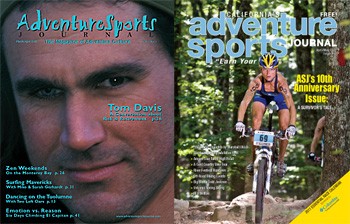
Ten years ago Adventure Sports Journal was inspired by a Sierra climbing trip gone bad. Matt Niswonger and Cathy Claesson were a husband and wife team off route, lost, cold and hungry. But they pulled together, solved one problem at a time, and made it back to Highway 120, albeit miles from where they parked.
By the time they got back to the car the frustration turned to sheer joy. As they drove home the climbing experience crystallized into an epiphany about the magic of such “deep play” in the Sierra. One could do worse than to devote one’s life to such matters. Why not this quirky husband and wife team? Teachers by trade, how could they live closer to the richness of such adventures?
On the car ride home, Matt convinced Cathy that they should start a magazine that would offer a unique forum for other adventure enthusiasts in California to share their own stories of adventure, hellish or not. Traditional media at the time rarely covered nature-based outdoor sports with the possible exception of skiing. This new magazine intended to fill that void.
They settled on a name, put a mock issue together, and thought they were in business. Little did they know there is a lot more to publishing then a masthead and boundless enthusiasm. Media kits, demographic studies, CPM’s, printer contracts, distribution routes — the mysteries were many and they needed help. They took on an editor, Christa Fraser, as a partner and got some tentative advertising contracts with local businesses.
Nearly eight months later, 7,000 copies of the inaugural issue of Adventure Sports Journal were spread around Northern California from the back of a couple of barely running station wagons. It was truly a grassroots effort.
Since then, ASJ has become a favorite resource for a diverse and dispersed yet thriving outdoor sports and adventure community in California and Nevada. With a mission to provide the inspiration and beta for our readers to get out and enjoy all that our regional landscape has to offer, ASJ has strived to highlight the year-round adventure opportunities that make California and the West one of the richest regions in the world to live and play. After all, where else can you be skiing in the morning and surfing at sunset?
To commemorate our 10-year anniversary, we’ve compiled some of the highlights from our past issues stretching back to 2001. We hope that those of you who have been reading ASJ for years will remember some of the articles we’ve selected. And for those of you who are turning the pages for the first time, we hope that the excerpts that follow inspire you to get out on you own adventures — and to pick up future issues of what has grown into the top adventure sports magazine in California.
—The Editors
| 2001 |

Photo: Brian Kohl
March/April, #1
“I frantically jumped up and down, knowing that because of where I was stuck, no one could easily help me. The rocks below, with water rooster tailing and surging off of them, made for a painful swim. I looked at the rest of the rapid; it was just as challenging and dangerous as the falls. I couldn’t possibly make it through that even if I was able to get the boat unstuck.”
—Christa Fraser on rowing a fully loaded oar boat through Clavey Falls on the lower Tuolumne River
“Growing up I was really into superheroes. When I discovered climbing I was like, ‘Cool, this is a superhero sport.’”
—from the article “Risk and Retirement: A Conversation with Tom Davis.” Davis is an avid Yosemite rock hound and owner of the Pacific Edge Climbing Gym in Santa Cruz
May/June, #2
“My eyes shifted suddenly to the right and I saw a huge fin breaking the water through the second swell and the outline of a massive, grey animal coming straight toward me. Somehow, for reasons I can’t really explain, my mind refused to acknowledge what I had just seen. It just didn’t register that it was a shark.”
—Casey Stewman on his encounter with a great white
“Don’t get me wrong. I love powder. I have been skiing for a lot of years. But when the powder is a three-inch thick layer of ultra fine dirt that offers no purchase for a cross-country mountain bike, anyone might feel challenged.”
—Sarah Stout on her first lift-served biking experience at Northstar in Tahoe
July/August, #3
“The steep rocky slope of the drop off disappeared into the depths. Untold mysteries lurked below. A nearby lake was known to be 600 feet deep. Thus, relative to its size, Tulainyo could have been twice that depth. We were overwhelmed by the sense of endless space.”
—Peter Hemming on diving Lake Tulainyo in the Eastern Sierra. At 12,818 feet, it’s the highest lake in the continental U.S.
September/October, #4

Photo: David Miln Smith's Collection
“I remember climbers coming up to me in Yosemite and saying something like, ‘We’re not into commercialized competition, man.’ Once people got wind of the $15,000 purse for first prize, though, all the philosophical reservations just kind of evaporated.”
—David Miln Smith on getting athletes for NBC’s “Survival of The Fittest” TV series
November/December, #5
“The discovery of Mavericks in the backyard of hard-core Northern California surf territory was somewhat like finding the Loch Ness monster in San Francisco Bay – somehow undiscovered all these years, yet always right beneath our nose.”
—Krista Hammond on the once unheard of Mavericks surf break
“Tragically, Dano was killed in November 1998 while breaking his own record for roped free-falling. The news was shocking. Of course, nobody questioned that the stuff he did was dangerous, he just seemed to be surrounded by a special light that kept him safe from harm.”
—Matt Niswonger on rock climber Dan Osman who died at age 35 while performing a “controlled free fall” from Yosemite’s Bridalveil Falls
| 2002 |
January/February, #6
“I sold my belongings and moved to Alaska to learn the wilderness skills I would need to take a dog mushing journey to Antarctica. Call it escapism, call it denial, call it crazy—but I was determined to try.”
—Pam Flowers on her decision to quit her “normal” life and solo the Arctic by dogsled
March/April, #7
“Yet risk will always be at the frontier in climbing. As people like Chris define what’s possible from a strictly physical standpoint, in the future climbers will take Sharma-like sequences to the big faces of the world.”
—Matt Niswonger on Chirs Sharma and his influence on the sport of climbing.
May/June, #8
“Advocating strength and redemption from the humiliation of World War I, the newly elected Nazi party threw unprecedented sums of money at Willy Merkl’s proposed 1934 assault on the world’s tenth highest peak. For Merkl, a mediocre climber and a railway engineer, the funding was a dream come true, but at a price: the pressure to succeed was intense and came from high up, probably from Hitler himself.”
—Matt Niswonger on the 1934 Nazi attempt on Nanga Parbat
July/August, #9
“For his second expedition down the Grand Canyon, one-armed John Wesley Powell strapped an armchair atop a wooden dory, which he named the Emma Dean, and read Sir Walter Scott’s Lady of the Lake out loud to his men.”
—Christa Fraser on John Wesley Powell’s first descents down the Grand Canyon in 1869 and 1871
September/October, #10
“To give you an idea of just how civilized McMurdo is, I had just arrived in town, an F.N.G (f-ing new guy). I was walking down the main hallway and then I stopped. Jaw dropping, I turned and recognized a Wells Fargo ATM. Yes, an ATM.”
—Matt Rutishauer on living at McMurdo Station while ice diving in the Antarctic for marine research
“As the wind howls, the Taugwalders and Whymper stare at the severed rope in despair. Whympher gathers himself first. He tells the Taugwalders that they will die, too, if they don’t pull themselves together.”
—Looking back at Edward Whympher and his tragic quest to summit

Photo: Schneider & Vandergrift Inc./Terri Schneider
the Matterhorn in 1864
November/December, #11
“Many people in our society want to be somewhere else rather than where they are in their lives. They remain in the “can nots” and the “should nots” and the “what ifs” of everyday life until one day they wake up and realize that they’ve lived in that “did not” world for over 40 years.”
—Terri Schneider on adventure racing
“Immediately, we’re in trouble. First up are 12 miles of roller blading—our weakest event. Karen already has a wound the size of a small pizza on her leg from a spill she took during a last-minute training session and Chris just isn’t comfortable with wheels strapped to his feet. Our goal at this point is modest: stay out of last place.”
—Jordan Reiss’ experience in an urban adventure race
| 2003 |
January/February, #12
“I expected the trip to be long and hard, and I wasn’t disappointed. There were some moments when I felt certain that the ride was by far the most stupid-ass idea that I had ever attempted in my life, and I had no idea how I was going to make it out the other side.”
—Sarah Beaver on her 2,987-mile southern transcontinental bike ride from California to South Carolina
“We start to rope up. Nima goes off belay to clip Evan in and – vanishes. Magid, who saw it, says he fell on his back and was flying head first down the lip toward the face. What I saw was the fastest self-arrest in history and one of the biggest smiles – he stopped about ten feet from me.”
—YOSAR team member Michael Freeman off-duty on Khumbu in Nepal
March/April, #13
“As we scraped across every rock on that ‘non-paved’ road at 15 miles an hour, my anger growing with each dent in the oil pan, I made a solemn promise to myself: The next time I drove into Baja it would be in a big, bad-ass, 4-wheel drive truck.”
—Krista Hammond deep in the Baja desert searching for surf
“Time took on a more circular meaning on the river. At put-in I hid my watch for the duration of the trip.”
—Daniel Spero on rafting the Colorado River through the Grand Canyon
May/June, #14
“Twenty days is a long time to be alone aboard a boat whose cabin is smaller than a VW bus, and standing headroom is not an option.”
—Skip Allan describes his living quarters while sailing 2000 miles from San Francisco to Oahu in the 2002 West Marine Pacific Cup Race

Photo: Dave Stewart
“Dealing with fear has been a big part of my return to climbing. My biggest struggle has been conditioning my mind to believe that I can climb hard again.”
—Peter Carrick on getting back into climbing after being struck by lightning on a climb in Utah
July/August, #15
“It was fun – a bunch of chicks in the woods riding all day, trying out our new chops, then cooking and eating massive amounts of pasta, talking non-stop story and a little smack.”
— Jacquie Phelan talks about the early days of professional mountain biking with writer Ramona d’Viola
“I couldn’t deploy my parachute, since deployment kills all forward speed and immediately uses up about 100 vertical feet.”
—Wingsuit daredevil Rob Kelly has a close call while flying past a granite stone cap
September/October, #16
“The birthplace of surfing is Hawaii, but it took a Californian to bring the sport into the modern age.”
—Krista Hammond on the evolution of surfing
“OK, let’s really make it interesting. Let’s run as tight a schedule as possible and plan the road trip down to the minute with absolutely NO room for errors.”
—Paul Romero of Team Epi-SOLE planning his trip to the starting line of Cal Eco’s 24-hour adventure race in Yosemite
November/December, #17

Photo: Chris Falkenstein
“Eric also stumbled off of our bivy ledge while attempting to turn over the tape in the player while I was making dinner. I wasn’t tied in due to the comfortable size of the ledge, so I assumed he wasn’t either. All I saw when I leaned over the ledge was a headlamp falling to the ground. I thought Eric was attached to it. A dreadful feeling came over me for a moment. I thought to myself, ‘I finally get a great partner and he falls off the route while drunk. Great.’”
—Eric Rasmussen reflects on some of his wild adventures in Yosemite Valley
“At one point I was slightly maddened by having my clothes on, so I ripped them off in a village and tossed them in the garbage.”
—Overdressed in Borneo, Terri Schneider takes it off while racing in the Eco Challenge
| 2004 |
January/February, #18
“Brad and Bob were nearly mad with hunger. Somewhere along this stretch of the journey they were able to catch and kill a small squirrel.”
—Brad Washburn’s near fatal experience while climbing Mt. Lucania in the Yukon
“There is a reason that early Homo Erectus didn’t dive – he wanted to survive. Fortunately, the first part of learning to dive appeals to our modern brain. Otherwise, my inner Neanderthal would have hightailed it out of there pretty quickly.”

Photo: Nikki Brooks
—Editor Christa Fraser learns how to dive
March/April, #19
“These are all things we train for: big surf, winter conditions, low light, victims near rocks. But in 12 years of lifeguarding never have I worked under all of these conditions at once.”
—Lifeguard Haven Livingston, pushed to the limit when unprecedented surf required rescuers to save multiple victims up and down the Santa Cruz coast
May/June, #20
“After his accelerated climb up Half Dome, Florine ran down the cables on the backside to the valley floor and bought an ice cream bar. On his hike to the base of El Cap, Florine ran into his friend Steve Schneider, who told him that just 24 hours earlier well-known speed climber Dean Potter had come to Yosemite to do the “Big Linkup” before him.”
—Speed climbers Hans Florine and Dean Potter race to be the first to complete the “Big Linkup,” a solo ascent of both the face of Half Dome and El Capitan’s Nose in one day
“Back at camp, we beam with satisfaction and physical relief, and celebrate with a backcountry potluck dinner (cook whatever you have, pass the pot around with a couple of spoons in it, return, cook, pass…), ibuprofen, great stories, and laughter about hairy situations and shared discomforts.”
—Editor Pete Gauvin after a treacherous day of climbing and skiing Shasta’s Hotlum-Wintun route
July/August, #21
“Like many epic ideas that take hold of our imagination, the Death Ride was born out of the same illogical desire that possess people to climb big mountains – because they can, maybe.”
—Pete Gauvin on the birth of one of California’s most difficult single-day events, The Death Ride: Tour of the California Alps, 129 miles, five passes and 16,000 feet of climbing
September/October, #22
“But the ‘Ray Way’ is much more than cutting the handle off your tooth brush. And it is certainly not about rushing out to buy the latest in ultralight gear. On a deeper lever, it is more about overcoming the commercially promulgated view of nature as an adversary that one must continually prepare to do battle against and adopting a more rhythmic, harmonious approach to backcountry travel.”
—Pete Gauvin on Ray Jardine and the revolution of lightweight wilderness travel
“We did absolutely nothing. A fascinated curiosity dampened our protective impulses. It was as if we were watching Mutual of Omaha’s Wild Kingdom live: ‘Now let’s return to the field, where Bill is about to get nuzzled by a 400-pound bear’.”
—Bob Walton’s friend has a close encounter with a Yosemite bear
November/December, #23
“What Lynn proposed to do was a gymnastic challenge that was almost shockingly ambitious: to use her fingers and toes to physically climb every inch of the route, using her ropes and gear as a safety net only.”
—Matt Niswonger on Lynn Hill’s 1993 free climb of the Nose Route on El Capitan in a day
“Completing what amounted to six weeks of the most intense physical activity of their lives, the team found the excesses of civilized society to be just as harrowing as the journey itself. Rowell noted that somewhere along the way they had lost not only their capacity to enjoy civilization, but even the simple emotions of love and beauty that come with all the experiences.”
—Seth Lightcap looks back on Galen Rowell and the 1980 American Karakoram traverse expedition
| 2005 |
January/February, #24
“There is a fine line between passion and addiction. Passion connotes a ravenous love, often at the edge of control. Addiction suggests a habitual fixation, usually beyond control.”
—Seth Lightcap explores his love for backcountry snowboarding
“Rather than dismissing the Sierra pioneers as eccentric loners as many in previous generations had, the extreme bohemians like Robinson cast them in a different light: they celebrated them as some of the first people to come under the spell of a truly wild and magical place.”
—Matt Niswonger explores how the “extreme bohemians” of the Sierra, including Doug Robinson, Yvon Chouinard, and Royal Robbins, sparked an outdoor movement in the early ‘70s that continues to this day
March/April, #25
“So why this late inclination to surf? Three reasons: It’ll save me from golf, which has claimed the minds and bodies of some of my best friends. It’ll give me another reason to go into the water now that my usual body boarding buddies are chained to land by work and families. Mostly I want to learn because, after 20 years of lying prone in the ocean, I want to evolve. I want to stand up on my feet and see how it feels.”
—Jerry Kay explains his urge to learn to surf at 58 years of age
May/June, #26
“The magic of a good surf film is that it can turn a landlocked youth into a surf dreamer without ever having ridden a wave.”
—Krista Hammond on the evolution of surf films
“The best way to survive an adventure race, particularly an event that takes longer than 24 hours, is to bring your mom along and let her take care of you and bring you cookies and your carefully packed gear to every checkpoint along the way.”
—Karen Lundgren and Paul Romero of Team Epi/SOLE explain the importance of support crews on expedition length adventure races

Photo: Jono Stevens
July/August, #27
“They always say, ‘Hurry the bus is leaving now!’ So you rush to get on the bus, hoping your luggage makes it to the top of the same rig, and wait for the driver to start the engine. It’s hot and you are crammed in tighter than a Tokyo subway. You wait and wait until you realize that time is metered entirely different here. Nothing is ‘on time,’ things just happen when they happen.”
—Melissa Stevens getting used to El Salvadoran time on her Central American surf odyssey with husband Jono Stevens
“The National Park Service is missing an opportunity. Because the Half Dome trail is the first wilderness experience for many hikers, it is an ideal place to teach backcountry etiquette – if we can summon the will and resources to do so.”
—John Yewell on the importance of proper trail etiquette for the growing crowds hiking Half Dome’s cable route
September/October, #28
“It’s just after midnight and I’m sandwiched between two Irish gals. It’s hot and there’s a lot of heavy breathing, squirming and giggling going on. But hedonistic our arrangement isn’t. We’re all fully dressed.”

Photo: John Mallory
—Liam Gallagher travels to the Sierra on the legendary Green Tortoise bus
“In a country that tries to avoid walking whenever logistically possible, he lives to walk.” —Pete Gauvin on through-hiker Scott Williamson, who has hiked the Pacific Crest Trail seven times and was the first to yo-yo it in one season
November/December, #29
“Where is the no-pain-no-gain, survival-of-the-fittest-fastest-richest-and-most-popular-culture of team tryouts from my high school days? The formative experiences that inflated some egos and prematurely punctured others, sometimes turning kids off athletics altogether?”
—Kimberly Bird explores the surging popularity of high school mountain biking leagues in Northern California
| 2006 |
January/February, #30
“While eating my glistening fresh fruit, bragging how good it was, the old Aztec woman took a ladle of brackish water out of a soiled 5-gallon paint bucket under the table and proceeded to pour it over the fruit cups to keep them looking glossy.”
—Ian Elman learns that you can never be too careful with the food when you are traveling in Mexico
“Trekking up the Dur Chu, I learned one of my first trekking lessons: When hiking up a river valley, as beautiful as its waterfalls may be, you will soon be ascending. And the more spectacular the falls, the steeper the ascent will be.”
—First-time trekker Drew Miller gets trail wise in Bhutan
March/April, #31
“Leaving the security of solid rock for the thin air of the chasm makes even hardened climbers cringe.”
— Matt Johanson on Lost Arrow Spire’s famous Tyrolean traverse in Yosemite
May/June, #32
“Rather than tempt your maker with carefree disrespect, better to just suck it up and join the faithful throngs observing Cathedral’s congregation hours. Even with the crowds, you’ll still find plenty of granite enlightenment. Unlike surfers, climbers frown on dirty looks when racking up at the bottom.”
—Bruce Willey on the importance of getting an alpine start before climbing Tuolumne’s Cathedral Peak. The author was almost caught in a thunderstorm after getting a late start on the climb.
July/August, #33
“I remember when I first began adventuring solo many years ago. My father asked (more than once): “Aren’t you going to

Photo: All-Outdoors, www.AORafting.com
carry a gun with you?” As any self-respecting daughter would do, I flexed my biceps and replied, “These guns!”
—Petit Pinson shares her passion for experiencing the wild solo, and encourages other women (and men) to do the same.
“You find yourself popping open a beer at the takeout and it tastes just a little better than normal. The sky seems a little bluer, the air crisper. You stand a little taller. And on Monday, back in the office, when your coworker asks about your weekend, you reply with a simple, “Good. Really good.” They wouldn’t understand anyway.”
—Geoff Jennings on California’s Class V classic, Cherry Creek
September/October, #34
“The echoed voice from the past of a cantankerous Shasta Mountain Guide telling me, ‘Step, kick, kick, plant your axe – rest!’ resonates as I come closer to the grail of 29,035 feet.”
—Robert Chang recall’s his Northern California roots on an ascent Everest
“Above all, going to surf camp as an adult is really, really fun. How many mornings are you stoked to get up early because you know you get to do something enjoyable all day? How often are your big responsibilities for the day re-applying sunscreen and rinsing out your wetsuit?”
—Maria Vitulli on the growing popularity of surf camps
| 2007 |
January/February, #35
“Some of the world’s best long-distance runners, the Tarahumara have been known to routinely run several hundred miles in five days during competitions or even just while getting around to perform everyday tasks – farther than I think I’ve ever biked in that time.”
— Karen Kefauver shares her mountain biking trip to Mexico’s rugged Copper Canyon, home to the indigenous Tarahmara people
“Witness a skier gracefully skating up a Sierra valley in half the time it would take a tele skier with climbing skins, and the discipline immediately entices.”
—Seth Lightcap reflect on how new backcountry skis restyle ancient Nordic discipline
March/April, #36
“With care and appropriate skill, there is nothing like the feeling in your gut as you approach the horizon line on a 20-foot waterfall.”
— Geoff Jennings shares the thrills of creek boating
“Turn by turn, section by section, dropping down the great white expanse, our efforts were rewarded.”
— Andrew Sawyer on spring skiing on Mt. Lassen
May/June, #37
“Pulled forward like a disobedient dog on a leash, my feet lost contact with my board and I was pitched headlong over the falls as the wave broke with a booming crash of whitewater.”
—Thomas S. Garlinghouse shares his surfing adventure in El Salvador’s “Wild East”
“On my knees, I take a final stroke and cut my hand on a rock just beneath the surface. It seems appropriate that I’ve given the ocean a piece of myself at the start and finish of my crossing. A toll, perhaps, for my successful passage?”
—Ryan Pingree’s reflections on the 32-mile QuicksilverEdition Molokai to Oahu Paddleboard Race.
July/August, #38
“The squirrely and somewhat unpredictable movement of the line is what makes slacklining the ultimate balance challenge.”
—Seth Lightcap on the history and current popularity of slacklining
September/October, #39
“If flatwater paddling is the equivalent of road biking, and whitewater paddling is more akin to mountain biking, upriver paddling might be the waterborne counterpart of cyclocross.”
—Pete Gauvin behaves like a salmon while paddling a sea kayak upstream on the Sacramento River
“His refusal to rate his climbs and emphasize “chasing numbers” has inspired others to look for deeper meaning in the act of climbing.”
—Matt Niswonger on Chris Sharma’s deepwater soloing project in Mallorca, Spain.
November/December, #40
“Perhaps the most important thing to bring on a winter mountaineering trip is the right mindset. Don’t push for a peak in winter with an “at-all-costs” approach, which can backfire … The mountains will still be there whether you tag the top this time or next.”
—SP Parker gives tips on winter mountaineering and getting out in the “off” season.
“The climbing began with moderate climbing up fractured slabs, then quickly switched to exposed jamming and smearing. Many holds, cracks, and ledges were filled with snow. Several hundred feet above the talus slopes it became apparent that my only escape from the arete was up. The climber’s game had proven dangerously intoxicating once again.”
—Andrew Sawyer makes an impromptu free solo of the classic Sierra climb, the Swiss Arete.
| 2008 |
January/February, #41
“In addition to big fir planks and whisky-fed courage, there was one other key ingredient the miners needed for speed on the hill: Good dope.”
—Pete Gauvin on the history of “longboard” ski racing in the mining camps of the Northern Sierra and the concoction of racing wax applied to their 14-16 foot skis
“Climbing was an extension of backpacking. People came as backpackers that couldn’t get to the top of the peak. Nowadays they come from the climbing gym. So they don’t really have that deep-rooted feeling of love for the mountains already in place.”
—Bela Vadasz of Alpine Skills International shares how things have changed over his 30 years as a mountain guide
March/April, #42
“By the time many California rafters and kayakers get into river mode, streams up and down the state are drying up and coming off the menu.”
—Pete Gauvin shares top spring river trips and reminds us to not let the runoff pass us by
“There were other pros in big trucks with their names painted on them and lots of logos. In contrast, I had brought my mom, my uncle, and a bike mechanic friend from home.”
—Rebecca Rusch makes the transition from professional adventure racer to 24-hour mountain biking
May/June, #43
“Part of the attraction to surfing is the fulfillment that comes from being part of a wild, untamed environment.”
—Ian Fein on the fear of sharks while surfing in the “Red Triangle”
“Indeed, stand-up has become the latest surf-inspired offshoot to grab a following, and it appears poised to last, as the reasons for its recent growth spurt go well beyond bare-chested celebrities. The practical, physical and sporting advantages of stand-up paddleboarding are numerous and compelling.”
—Ramona d’Viola explores the surging popularity of stand-up paddleboarding
July/August, #44
“There is something to be said for following your passion and donating your time to things you think will make a difference.”
— American Whitewater Stewardship Director Dave Steindorf of Chico shares his passion for protecting California’s rivers and providing public access
“If hang gliding and paragliding were a major sport you would have already heard of Kari Castle. Which is odd considering the sport’s extreme element. I mean strapping on a snowboard and launching ten feet in the air is one thing. Strapping yourself under some poles and fabric and flying off a hill only to catch some thermals and go up to an altitude that would scare the shit out of most birds is entirely another matter.”
—Bruce Willey introduces ASJ readers to record-setting, high-flying Kari Castle of Bishop
September/October, #45
“It is fine to race in California’s dust and sunshine, but I want to play in the mud, so we go for the rainy season.”
—David Gill, a cyclocross race organizer in Santa Cruz County
“Competition and cooperation. They are another of those big dualities we get to chew on. Like pride and humility. Like fear and desire. Climbing set them a stage, and alpine air encourages the rumination. How you play them out affects everything, from getting laid to the future of humanity.”
—Doug Robinson ponders the nature of alpinism in the High, and mild, Sierra
November/December, #46
“The sport wasn’t big enough to exclude anyone. The whole point was to persuade people to experience the satisfaction that comes from earning turns, not from the style of the turn.”
—Die-hard telemark skier Craig Dostie shares his decision to have his California-based publication, “Couloir,” be inclusive of all downhill disciplines, opening up the backcountry to a much wider audience
“We’re not telling anyone how to live their life. We’re just trying to show people a way to put adventure and fun back into snowboarding while respecting the environment.”
—Chris Edmunds of Leeward Cinema talks about his film “My Own Two Feet,” in which they turned their back on mechanized travel and hiked into the backcountry to get footage
| 2009 |

Photo: Mark Nadell
January/February, #47
“I was soon convinced that if I were to try the crossing, she certainly would be my choice of a companion. She changed my opinion that a woman’s place was definitely only in the home.”
—Dennis Jones first-hand account of his remarkable first ski crossing of Tioga Pass with “Miss” Milana Jank, a German alpinist and ski ambassador, in 1932
“However you ski The Great Ski Race, whether as a super-fast competitor or as a casual tourer, it is one of those community bonding events that you will enjoy year after year.”
—Mark Nadell shares the experience of the West’s largest cross-country ski race, The Great Ski Race from Tahoe City to Truckee
March/April, #48
“It wasn’t rocket science. You get an old bike and try to make it a little more useful in the dirt.”
— Mountain biking pioneer Charlie Kelly reflects on the evolution of off-road bikes
May/June, #49
“The reason people surf for 40 years or longer is because you don’t spend much time as a surfer on your feet riding waves. You almost never feel faded.”
— San Francisco surfer and author Matt Warshaw talks to ASJ about the surfing lifestyle
July/August, #50
“As I stood in the meadow watching my dog run through the tall grass, I thought to myself, I don’t know how much closer a person can get to heaven on earth than this.”
— Dave McNeill on hiking the Eastern Sierra high country above Bishop
September/October, #51
“On the one hand, there is this incredible danger. If you fall you are dead after you are 50 feet off the ground. But on the other hand you are completely safe if climbing within your limits. And there is the feeling that you are doing something you shouldn’t be doing—free soloing has that sort of intrigue.”
—John Bachar reflects on his sport just two weeks before falling to his death while free soloing the Dike Wall near Mammoth
“Originally, it began as an ambitious 2,500-mile off-road route from Montana to Mexico along the Continental Divide. But as the twirling globe slowed to a stop, our fingers ran all the way down the longest continguous mountain range in the world.”
—Jacob Thompson shares his epic pedal from Alaska to Patagonia down the backbone of the Americas
November/December, #52
“Few downhillers know what an adrenaline rush it can be flying down a narrow, winding trail on a couple lightning-fast skinny sticks.”
—Tim Hauserman from the article “Nordic Relief for Alpine Skiers,” on the misconceptions gravity-fed skiers have about cross-country skiing
| 2010 |
January/Februay, #53
“This is what we do for fun. We bundle ourselves up and head out into the elements enjoying its carefree pleasures and enduring its heaping shares of whoop-ass. And what better metaphorical experience – joy and laughter, discomfort and fear, struggles and uncertainty – could a newlywed couple embarking on a lifetime together have in one trip?”
—Wendy Lautner writes about her backcountry ski honeymoon in Patagonia
March/April, #54
“After a year of battling Stage Four cancer and enough infused chemo to light Las Vegas, I was in search of more strength. The leapin’ lizards, cherry gnarr-gnarr type that makes even the worst situations open into starbursts.”
—Robert Frohlich about his search for mojo at Glacier Point during his battle with cancer
“The challenge of steadying your shooting hand while gasping from race-pace Nordic skiing is like a doctor trying to operate after running up flights of stairs.”
—Seth Lightcap on the sport of biathlon and the new training center at Northstar

Photo: Tommy Bensko
May/June, #55
“Being a practical middle-aged fellow I care no longer for foolish risks nor needless expense. I paddle the waters of Lake Tahoe every summer to celebrate my love affair with mountain life.”
—Robert Frohlich on kayaking Lake Tahoe, simple and care free
“Steamer Lane is like a surf auditorium built for show-offs. It breeds the worst in localism and the best in surfing acrobatics. Not surprisingly, the two often go together.”
—Jamal Yogis in an excerpt from his book, “Saltwater Buddha: A Surfer’s Quest to find Zen on the Sea”
July/August, #56
“Windsurfing is like dancing with a partner on a surfboard … Kiteboarding feels like you’re dancing solo on the board, hooked at the waist with a wind-powered umbilical cord.”
—Experienced windsurfer Craig Dostie in “It’s Not Sailing, It’s Flying,” about taking his first lessons in kiteboarding at the Delta
“The Oakland A’s gave him a tryout in 1973. Fortunately, his fastball wasn’t big-league material and he realized his fortunes were more likely to be determined by his ability to deliver a deft sentence than a strike on the outside corner.”
— Pete Gauvin on prolific San Francisco newspaper columnist and guidebook author Tom Stienstra
September/October, #57
“John was killed on a Highway 395 after hitting a deer on his motorcycle on his way to climb Excelsior Mountain … Too often it’s not the mountains that take good mountaineers but just getting to them.”
—A remembrance of John Fischer (1946-2010), noted climber and owner of the Palisade School of Mountaineering, by Bruce Willey
November/January, #58
“So if not full circle, at least I’ve come a long ways. And that’s why they call it practicing rather than doing yoga. It’s the process that counts. The results are just a by-product.”
—After years of denial and protestation, climber Bruce Willey finally comes to terms with yoga in his piece, “The Reluctant Yogi”
“The Brissendens persevered and not only rebuilt Sorensen’s, but also helped rescue Hope Valley from future development. … In 1985, along with other local activists, they helped create the Friends of Hope Valley. The nonprofit helped to preserve 25,000 acres of open space in Hope Valley and eastern Alpine County through the Trust for Public Land.”
—The late Robert Frohlich recounts the history of a favorite Sierra getaway, Sorensen’s Resort. “Fro” passed away in October from cancer.
“It doesn’t take very long for dedicated Tahoe ski bums to hear the stories from the many skiers and riders who use Squaw as training ground for the bigger, wilder terrain in Alaska. I knew I had to go, but how was I going to afford the trip?”
—Brennan Lagasse on the seeds of his mission to leave ski tracks on each of the world’s seven continents
| 2011 |
February/March, #59
“Dozens of wild haired, loose souls began settling in South Lake Tahoe. Once they got there, they did whatever the hell they wanted. They twirled on skis and practiced precision mogul turns. They built jumps, did back flips, puffed on joints and did more back flips.”
—Jeremy Evans on the golden age of ski bumming at Heavenly
“Give me the long steady hills and even the flats, but my chicken feathers flutter on the downhills. When I see a sign that says 12% grade, I put on the brakes and feel the breeze of dozens of riders roaring past.”
—Tim Hauserman enjoys the Chico Wildflower Century as a rookie over the age of 50
Oct/090
One Wheel Will Do, Thanks

Nor Cal Mountain Unicyclists Find Few Places They Can’t Tread
By Christa Fraser
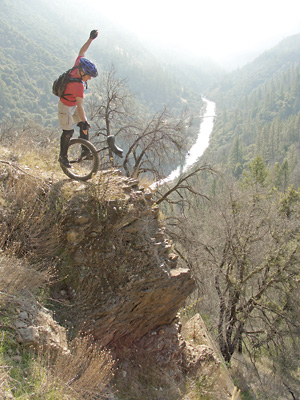
Corbin Dunn doing a “seat drop.” Photo by John Foss.
“First off, people can’t be posers,” Corbin Dunn says.
Riding a 36” fat-wheeled Coker unicycle, Dunn powers up a steep road in Los Gatos on a weeknight ride with a motley contingent of mountain unicyclists. The lone wheel is enormous. He powers up hill faster than a typical mountain biker. On the descents, his legs spin madly, trying to keep his feet on the pedals. He has broken his “handlebar,” a small carbon-fiber nub under his seat. Regardless, he aims for a berm on the side of the road. He bails at the last second, falling nearly four feet off his perch. He remounts in one fluid succession of movements.
“People can’t simply pick up a unicycle and stand on it,” he says. “They have to dedicate at least 10 hours to learning how to simply ride the thing.”
A YouTube Favorite
People seem equally parts in awe of and confused by unicyclists, especially on singletrack. Passing cyclists shout out predictable comments and questions:
“Where’s your other wheel?”
“Hey, I think you lost something.”
To which unicyclists often respond: “I just got rid of my training wheel.”
Mountain Unicycling, or MUni for short, hasn’t exactly reached mainstream status. But thanks to YouTube and the Banff Mountain Film Festivals, MUni has recently gained some wider exposure. “MUni has probably attracted more press than any other form of unicycling,” says John Foss, founder of California MUni Weekends, a festival held every year since 1996.
YouTube star and Vancouver native Kris Holm has brought MUni much of its notoriety. “If unicycling has a Tony Hawk, it’s him,” says Foss. With a mix of trials, freeriding and downhill techniques, Holm has shown that unicycles can go anywhere a bicycle can go—and many places bikes can’t. Vertigo-inducing videos of Holm riding sheer granite ledges and bumping urban trials moves around his town have received millions of hits on YouTube.
Nathan Hoover, a Los Gatos engineer, has ridden in Bhutan and Mexico with Holm. The films of their adventures, Into the Thunder Dragon, about their trip to Bhutan, and Unizaba, which recorded their descent of the third highest mountain in North America, Mexico’s El Pico Del Orizaba, demonstrate that mountain unicycles can hold their own in any terrain.
“We can stop on a dime, go backwards, spin on one spot, hop up stairs and curbs,” Foss enthuses.
Essentially a unicycle operates in a 360-degree groove.
One-Wheel Mini Revolution
No one is certain exactly how unicycling got its start. But an early prototype unicycle may have been created when cyclists began to remove the micro rear wheel from their penny-farthing bikes in the late 1800s. They found the enormous front wheel was sufficient, while the rear wheel was merely a hazardous nuisance. However, many riders give credit to Alaskan George Peck for really getting mountain unicycling rolling in the late 1980s.
In the mid-‘80s, Peck, considered the “grandfather of MUni,” started riding his unicycle on some of the local dirt roads and offroad unicycling was born.
A decade later in California, Foss discovered great MUni riding on the trails around Sacramento and Auburn. He got the idea to hold an “all-dirt convention” and the MUni Weekends were born. The movement picked up momentum when Bruce Bundy, an engineer from Santa Cruz, met Peck in 1997 and watched Peck’s video, Rough Terrain Unicycling. Interest grew and there is now a tight-knit group of riders in Nor Cal.
Unicycles used for mountain riding at the time were typically made with either a 24” or 26” wheel, which were versatile on technical singletrack but inefficient over long distances. Then, in the late ‘90s, Coker Cycling Company released a 36” unicycle, which greatly improved their suitability for long distance trail riding (and helped to make up for the fact that unicycles don’t have gears). The enormous wheel allows riders to cruise long cross-country distances and still roll over reasonably rough terrain.
With their new cross-country rigs, Hoover and Bundy joined the small but growing trend of unicycle touring. Recent trips include pedaling the Great Wall of China, the Swiss Alps, Laos and the Mediterranean. Locally, many of the riders have pedaled the circumference of Lake Tahoe.
But unicycle touring isn’t what’s garnered the most attention for the sport. “People realized they could use the unicycle to hop over things and trials emerged,” Dunn says. “Next, people decided to combine trials and freestyle riding to (become) street riding.”
Physics and equipment limits unicyclist from performing some of the tricks we’re used to seeing bicyclists perform. “People won’t be riding uni’s on huge skateboard half pipes and getting five to 10 feet of air,” Dunn says. “The unicycle doesn’t have a freewheel and so we can’t physically get enough speed to do enormous amounts of mad air.”
But then unicycling has never been about copying others. It’s about individuality and mastering its unique challenges. As Dunn says, “To really appreciate some of the things that are done on a unicycle, one must first be a unicyclist.”
Oct/090
Destination: Santa Cruz
By Christa Fraser
While municipal bigwigs argue whether Santa Cruz or Huntington Beach can claim the title of being the original Surf City, Santa Cruzians continue to live the California beach lifestyle. With an envious blend of coastline and public open space, local garages are commonly packed with bikes, surfboards and kayaks rather than cars.
The county comprises a variety of distinct terrain—redwood and oak groves, marine terraces, expansive meadows, long, sandy beaches, and coastal mountains.
November and December can be one of the best times to visit. Average temperatures range from the mid-60s to the 80s. Winter’s big waves are just picking up, the hiking and biking trails are not too muddy and the beaches are nearly deserted.
Autumn visitors can find an inexhaustible list of outdoor activities within a short drive of the Bay Area.

Old Cabin trail in Wilder Ranch State Park.
Photo by Mark Woodhead
Biking
Rocky hillsides, root-filled redwood forests and miles of terraced cliffs give this bike-loving community a reason to hit the trails on a regular basis. From a simple people-watching cruise along West Cliff to a zone-inducing singletrack, Santa Cruz County offers all kinds of two-wheeled recreation.
Cruising
- West Cliff – From the famous Santa Cruz Beach Boardwalk to Natural Bridges State Beach, lazy pedalers can take a slow spin along picturesque ocean cliffs and watch surfers and sealife. Round trip is around seven miles.
- Ohlone Bluff Trail – This trail, just north of town, offers miles of flat riding with access to several secluded beaches. Park in the Wilder Ranch parking lot and head towards the ocean on the fire road.
Cross Country
Wilder Ranch – This area is a favorite gym for many area cyclists who go there to pump up their legs and lungs. This state park encompasses 6000 acres and offers virtually every type of riding. For a classic introductory ride, park in the Wilder Ranch lot and take the Englesman fire road to Old Cabin, Old Cabin to the top of the Eucalyptus Trail. From there riders can opt to head back down into Wilder or Grey Whale Ranch.
- Nisene Marks – This steep, redwood forest nearly became off limits to bikers recently. Fortunately, the fire road is still legal to ride. For a classic uphill, the 17-mile Aptos Creek Fire Road loop from the entrance in Aptos to the Sand Point Overlook and back shouldn’t be missed. Riders will pass the epicenter of the 1989 earthquake that leveled parts of the county.
- Soquel Demonstration State Forest or ‘Demo’ – Miles of challenging singletrack and fire roads are legal and waiting to be ridden in this area above Nisene Marks. Open to the public, but administered by the California Department of Forestry, this area boasts no facilities. Park at the entrance on Highland Way.
Bike rentals – are available from Family Cycling Center on 41st Avenue: Cruisers, tandem cruisers and Santa Cruz mountain bikes. www.familycyclingcenter.com (831) 475-3883

Kelp bed exploring
Photo by Mark Woodhead
Kayaking
The protected Santa Cruz coastline sits inside of the Monterey Bay National Marine Sanctuary. Underwater forests of giant kelp, pods of southern sea otters and other marine mammals, and miles of scenic coastline invite even the most novice paddlers to explore.
The easiest tours leave from either the Santa Cruz Municipal Pier or the harbor. Local companies offer a variety of guided natural history, wildlife viewing, kayak fishing and full-moon tours, weather permitting. Most companies also rent boats for self-guided tours.
Elkhorn Slough, situated along the Pacific Flyway bird migration route, is a ‘don’t miss’ location for paddlers. The Slough is the second largest coastal wetland remaining in California, and offers superlative bird and marine mammal viewing. (Parking costs $2.00 at the boat launch in Moss Landing.)
Call these companies for further details and to make reservations:
- Kayak Connectionwww.kayakconnection.com
(831) 724-5692 in Moss Landing and (831) 479-1121 in Santa Cruz
- Adventure Sports Unlimitedwww.asudoit.com
(831) 458-3648 by reservation only.
- Monterey Bay Kayakswww.montereybaykayaks.com
(800) 649-5357 in Moss Landing
- Venture Quest Kayakswww.kayaksantacruz.com
(831) 427-2267 Santa Cruz Wharf
- Blue Water Ventureswww.bluewaterventures.org
(831) 459-8548 by reservation only.
Hiking/Trail running
Big Basin, California’s first state park, features some of the state’s largest redwood trees. Over 80 miles of trails and a variety of distinct ecosystems wind through this century-old park. Hike to Berry Creek Falls from Waddell Creek (11 miles roundtrip). Trailhead is at the Waddell Creek turnout on Hwy 1. Or plan a day long hike-a-thon and do the Skyline to the Sea trail (12.5 miles one way). Trailhead is located across from park headquarters in Boulder Creek. Shuttle recommended. Contact park headquarters at (831) 338-8860 for more info.
For runners, Henry Cowell Redwoods State Park’s Fall Creek Trail is a nearly 7-mile loop through classic, creekside redwood stands with moderate elevation gains.
The park is about five miles out of Santa Cruz on Highway 9, near Felton. 831-438-2396

Photo of Micaela Eastman by Nikki Brooks
Surfing
The classic waves that make this area a breeding ground for phenomenal surfers are a finite resource. The best way to get in the water without hassle is to do it as unobtrusively as possible. A one or two-person private lesson with one of the following surf schools should provide a proper lesson in etiquette and safety:
- Richard Schmidt School of Surfingwww.richardschmidt.com (831) 423-0928
- Club Edwww.club-ed.com 1-800-287-SURF
- Cowell’s Surf Shop and Surf Schoolwww.cowellssurfshop.com (831) 427-2355
- Adventure Outwww.adventureout.com (650) 208-8113
- Santa Cruz Surf Schoolwww.santacruzsurfschool.com (831) 426-7072
Disc Golf
De Laveaga Municipal Park, known to most locals as “DayLa,” features a popular disc golf course. Head up there to play a round or just hike to the top for the view of Santa Cruz proper from Top of the World, otherwise known as Hole 27.
(831) 462-5293 www.delaveagadiscgolf.com
Sailing
Every December, sailors decorate their boats with lights for a maritime Christmas parade in the harbor (Saturday, Dec. 3, 5:30 p.m.) If you don’t know someone with a boat you can take a sightseeing cruise on the bay with one of these two companies:
- The Chardonnaywww.chardonnay.com (831) 423-1213
- Pacific Yachting and Sailingwww.pacificsail.com (800) 374-2626
Brews and Bottles
- Seabright Brewerywww.seabrightbrewery.com (831) 426-2739
- Santa Cruz Mountain Brewingwww.santacruzmountainbrewing.com (831)425-4900
- Coastline Brewerywww.coastlinebrewery.com (831) 476-2378
- Beauregard Vineyardswww.beauregardvineyards.com (831) 425-7777
- Bonny Doon Vineyardswww.bonnydoonvineyard.com (831) 425-3625
- Storrs Winerywww.storrswine.com (831) 458.5030
- Soquel Vineyardswww.soquelvineyards.com (831)462-9045
Only in Santa Cruz
- Mystery Spotwww.mysteryspot.com (831) 423-8897
- Bigfoot Discovery MuseumLocated next to Henry Cowell Redwoods State Park
www.bigfootdiscoveryproject.com (831) 335-4478
- Santa Cruz Surfing Museumwww.santacruzsurfingmuseum.org (831) 420-6289
- Seymour Marine Discovery Centerwww.seymourcenter.com (831) 459-3800
- Natural Bridges State Beach Monarchs831-423-4609
For more information on Santa Cruz, visit www.scccvc.org/index.html or
Places to Stay
Spendy (but worth it):
- Costanoa Resort — 25 miles out of town. www.costanoa.com (650) 879-1100
- Sand Rock Farm — legendary cuisine. www.sandrockfarm.com (831) 688-8005
- Pleasure Point Inn — on the point in Capitola. www.pleasurepointinn.com (831) 475-4657
Cheap:
- Pigeon Point Lighthouse Hostel — 27 miles out of town.www.parks.ca.gov (650) 879-0633
- Santa Cruz Hostel -— blocks from the beach.www.hi-santacruz.org (831) 423-8304
Cheaper: Camping
- Big Basin Redwoods State Park(831) 338-8860
- New Brighton State Beach (831) 464-6330
- Manresa State Beach (831) 761-1795
Oct/091
FLASHBACK: Red Lining on the Anguish Index: The Velodramatic History of the Race Across America
By Christa Fraser

Mike Shermer in full flight. Photo: Lon Haldeman/Insight Race Across America
In 1982, a McDonald’s in the sun-scorched desert town of Blythe was the fueling station for the lead racer in the inaugural version of a solo cycling race across the entire continental United States. That racer was Lon Haldeman. He rode on junk food, little water and even less sleep for the next nine days and 20 hours to win the first-ever Race Across America (RAAM) out of a field of four.
“It was like running a triathlon in flip flops,”Haldeman recalls.
The inaugural Race Across America was actually christened “The Great American Bike Race.”It was a challenge drawn up by an elite pack of four long-distance solo cyclists to see who could pedal the fastest across the country, from the shores of California to the Empire State Building in New York City. It would prove to be one of the only years in which every racer completed the challenge.
In sports, superlatives are tossed around like empty race cups. The best of, the greatest ever, the toughest this, the biggest that ®X Yet, 23 years after its inaugural transcontinental sufferfest, the 3000-mile Race Across America remains worthy of a few superlatives.
Outside magazine ranked the Race Across America as “The World’s Toughest Event”in 1993. Using yardsticks such as cost, distance, likelihood of participants dropping out, and an “Anguish Index,”the magazine ranked events for their capacity for pushing racers to the limits of endurance. Measured against infamous races like the Raid Gauloises, the Iditarod and the Vendee Globe Solo Around-the-World sailing race, among others, RAAM out-punished them all.
To put it in perspective, more people have successfully summitted Mt. Everest than have completed a RAAM. To complete RAAM, riders must climb a total of nearly 110,000 feet, the equivalent of summiting Everest more than three and a half times from sea level.
The original RAAM was not the first time that a solo rider successfully traversed America on bike. The concept of a bicycle race across America can be traced back to newspaperman George Nellis. In 1887, Nellis crossed the country on a 45-pound high-wheel bicycle with no gears and with pedals attached directly to the front wheel. He followed railroad routes and made the crossing in just under 80 days.
Other riders attempted to cross the country and break that record in subsequent years. In the late 1970s, one rider in particular was ready to commit toe to clip in a quest for the fastest possible time — John Marino.

Recreational riders follow the competitors in a parade section through Balboa Park, San Diego on the way to the start line, 13 miles from the downtown.
Photo: Hawkins & Garrigues, © 2004
“On a day in September ’76, I was feeling quite ambitious and began paging through the Guinness Book of World Records for a sport that I could do. I wanted to be in this book someday. I chose cycling and specifically the U.S. coast-to-coast record — Santa Monica City Hall to New York City Hall. I became a cycling fanatic for two years and in 1978 broke the Guinness Book record,”Marino recollects on the UltraCycling Hall of Fame website (www.ultracycling.com).
But Marino found that making the Guinness Book by racing across America in just over 13 days wasn’t ultimately satisfying. “After setting the record, I realized that the endeavor was more than a race. It was an expedition,”he says.
Around the same time Marino was rethinking the significance of his feat, four other American cyclists were struggling to break similar records. “I had been following his career,”Haldeman explains. “No one had done anything like that…”
Inspired, Haldeman started several of his own attempts. Meanwhile, in 1980, Marino traversed the country in 12 days and three hours setting another record. In 1981, Haldeman decided to try a back-to-back traverse of the country (a double transcontinental) to push the newest record Haldeman finished his east-to-west run in just over 12 days, which wasn’t a record. His west-to-east run, however, was — just over ten days.
Meanwhile, ace-cyclist-turned-triathlete John Howard, who had been anointed as Competitive Cycling magazine’s “Cyclist of the Decade”for the 1970s, was now pushing his endurance portfolio in Ironman races.
Marino and Howard talked of racing each other, setting into motion the idea of a cross-country race as a head-to-head test rather than a solo time trial. Haldeman’s double transcontinental record, however, forced them to add a third contestant to the challenge. For good measure, Marino also invited his friend Michael Shermer, who had just set a record for a Seattle to Los Angeles trek.
“Marino probably knew best what he was getting into,”Haldeman recalls.
Marino was the favored racer going into the race, but it was Haldeman who won. His merciless technique of sleeping only a couple hours at a time and riding through most of the night forever changed the face of endurance cycling races. By the time the other three racers realized that Haldeman wasn’t sleeping much, he was too far ahead to catch.
He adopted his sleep-deprived racing strategy from Susan Notorangelo, a cycling record-setter herself who would later become his wife. Haldeman had crewed for Notorangelo in 1982 when she nearly broke his 10-day traverse record by riding through the night. Previously, racers like Haldeman and Marino rode through the day until about midnight and then slept for six hours or so. In Notorangelo’s strategy, Haldeman saw a way to catch Marino, Howard and Shermer off guard.
Haldeman completed that inaugural challenge in less than 10 days. The race was filmed by ABC’s Wide World of Sports, but the producers sat on the film for nearly a year, unsure it would generate much viewer interest. When the race was finally broadcast, it wound up winning an Emmy and drawing millions of viewers.
The public interest showed that the race had potential to become a big force in American cycling. As a result, the Great American Bike Race was held again the next year with several more racers and rechristened as the Race Across America. It has been held every year since, consistently drawing new racers and adding new race divisions, such as tandem, recumbent, team-relay and female-solo categories.

Lon Haldeman wheels into the finish in downtown New York, 1982.
Photo: Lon Haldeman/Insight Race Across America
One rider who has experienced firsthand the evolution of RAAM is Rob Kish. Practically unknown outside of endurance cycling circles, Kish is a legend among his fellow racers. This year he will race in his 20th RAAM. He has finished every year, including his first year when he took a nasty spill at the start of the race that resulted in severe road rash.
While Kish may be slowing down a bit now that he is in his 50s, he is still a solid racer. “It’s a hard habit to kick,”he jokes.
Today, RAAM is usually won in five to six days. This year’s 3,051.7-mile race, which rolled from San Diego on June 19th, was expected to be a face off between Jure Robic, 40, a professional soldier from Slovenia, and Mike Trevino, 30, a software engineer from San Diego, out of a field of 25 solo male competitors ranging in age from 18 to 53.
To show you how far ultra-endurance cycling has come, this year’s cut-off time for all riders to finish was noon on July 1st — a scant 12 and a half days, or about the same time as Haldeman’s record-setting attempt in 1980.
Yet all those who finish will be drafting off the innovation and exploits of the original four. While none of them could have foreseen riders finishing a transcontinental race in less than six days, in the tradition of the Great American Bike Race, records continue to be broken.
For complete results for this year’s Race Across America, visit www.raceacrossamerica.org
Oct/091
Flashback: High Peaks and Deep Canyons by Kayak
Photos by Reg Lake • Story by
Christa Fraser

Reg Lake, Royal Robbins and Doug
Tompkins take the Triple Crown
The late 1970s and the early ‘80s were a time of fierce and friendly competition to claim first kayak and raft descents down hundreds of miles of unexplored California rivers. In order to make a successful first descent more likely, most boaters explored Sierra rivers in teams. Two teams stood out for the number and difficulty of first runs they made — the team of Reg Lake, Doug Tompkins, and Royal Robbins, which came to be known as the “Billy Goat Crew;” and the team of Lars Holbeck, Chuck Stanley and Richard Montgomery, known as “The Hipsters on the Move.”
“We had an interesting competition going with the Triple Crown crew,” recalls Montgomery. “In our superior, egotistic 20-year-old way, we viewed Reg Lake as the only real paddler of the bunch.” Arguably, the group of Holbeck, Stanley and Montgomery as a group were all-around better boaters and ultimately notched the bulk of California first descents as a result. Even so, the so-called Triple Crown, which consisted of the headwaters of the Kern, The Middle Fork of the Kings and the Middle Fork of the San Joaquin, was snared by the Billy Goat crew.
There were many reasons for their success at claiming these three highly desired first descents. To begin with, Robbins and Tompkins came armed with a long list of successes in a different realm, having already tackled
many first ascents in the world of climbing. Robbins had famously put up many routes in Yosemite, and Tompkins had completed an ascent of Mount Fitzroy, among others. “Both of them had been through the evolution in climbing and well recognized where these rivers would fit into the history of kayaking,” Lake explains.
Robbins, however, claims that “we were interested in adventure more than we were interested in kayaking. The goal was not to kayak a river, but to make a first descent, however it had to be done.” Their pursuit of the Triple Crown would require logistical ingenuity, solid river-reading skills, major gear schlepping and the ability to keep a secret. It would be hard to say which of these qualities was most important to their success.
The first jewel in the crown, the Middle Fork of the San Joaquin, otherwise known as the Devil’s Postpile Run, was attempted in September 1980. This 32-mile Class V run, which drops as much as 400 feet per mile, was unforgiving enough that Royal and Doug considered climbing escape plans if Reg was unable to find a run through a particularly harrowing stretch known as Granite Crucible. “We agreed that if necessary, we would abandon the boats and climb out of the canyonassuming we could finds a way up the 3000’ walls,” Reg recalled in the book California Whitewater: A Guide to the Rivers, by Jim Cassady and Fryar Calhoun.
Holbeck, in his and Stanley’s essential whitewater guidebook, The Best Whitewater in California, wrote of the San Joaquin, “This is the most demanding run I’ve ever seen. In many places it is like Yosemite Valley, but the walls are only a river’s width apart. The scenery is awesome as are the portages… The portage through the crucible area near Balloon Dome requires delicate friction climbing, lots of precarious rope work with people and boats, and flawless teamwork.”
What better team than the Billy Goats to handle a run that required those sorts of skills, innate to climbing. “New kayaking and rock climbing routes have in common the intoxicating quality of discovery, of doing and finding something new,” Robbins says. And finding something new was one of Robbins’ specialties.
After plunging and portaging through the San Joaquin’s granite canyon for six daystwo more than they had planned, requiring them to ration their food down to only about four ounces each per daythey finally were able to sit down for a midnight feast at Royal’s house in Modesto. After dinner, as Lake recalls, “Royal pulled a stack of topo maps out of the drawer and asked if I could keep a secret. I said no and he placed them back in the drawer.” But Robbins’ excitement wasn’t contained for long and the maps were pulled out.
They were looking at the Kern drainage area. Their eyes followed the river’s line to its headwaters, which drains the highest peaks in the Sierra, including the western slopes of Mount Whitney (14,495’). From there the river headed south off Triple Divide Peak at a gradient that seems almost leisurely when compared to the Middle Fork of the San Joaquin a mere 80 foot average per mile.
The put-in at Junction Meadow, however, involved climbing from Whitney Portal on the east side over the shoulder of Mt. Whitney laden with gear. As Reg recalls, “the real zinger was that we had to carry our kayaks and camping gear over the pass at 13,777 feet. We considered helicopters and aerial drops, but being in a national park, this was illegal. So the crux of the Kern is carrying over Mt. Whitney.” This trip demanded the logistics of a mountaineering expedition.
But they made it to the put in within a couple of days in 1981. However, they nearly lost their lead kayaker when Reg, carrying his then state-of-the-art 13’ plastic kayak, took an 800-foot tumble down a snow-covered slope below Whitney Pass. Tompkins went down to help him. “It’s a good thing he was dazed, otherwise I might not have been able to talk him into coming back up,” Robbins recalls Tompkins saying later. Even with an unintentional first descent with kayak down the snowy flank of Whitney, the Billy Goat Boaters were in their element and succeeded in claiming the Class V Headwaters of the Kern run.
Steep descents, after all, were what the three were seeking and it was only natural that the next stretch of Class V they would claim would be an unexplored stretch of whitewater that emerges from the deep granite walls of Kings Canyon. According to Cassady and Calhoun, the Middle Fork of the Kings is one of the two most difficult and most remote rivers in California, that “even hikers and fishermen can’t reach it.” Both the Hipsters and the Billy Goaters were keen to be the first to see what whitewater ran in this giant cataract, whose innards were hidden by the immensity and sheerness of its walls. With gradients ranging from 100- to 510-feet per mile, the Middle Fork of the Kings was quite possibly the most challenging and frightening of the three runs that made up the Crown.
Holbeck writes in his book, “I mentioned my interest to Royal. He replied that he thought the river was much too steep at that instant I just knew he was going to run it.” Even though Robbins, Tompkins and Lake, along with Newsome Holmes, did successfully run the forbidding Class V-VI stretch in 1982, it presented them with drops and holes that Robbins recalls gave it the feel of “a scary, deadly place.”
Though the Billy Goat Boaters had completed the Triple Crown, as Tompkin’s coined it, the two teams remained competitive for another year. With most of the main Sierra runs having been completed by 1983, however, the rivalry was coming to an end. That year, Robbins, Montgomery, Lake, Stanley and Holbeck joined forces and ran the Grand Canyon of the Tuolumne in Yosemite National Park. It was, as Holbeck writes, “perhaps the last ‘obvious’ High Sierra run to be done.”
Ultimately, the members of the Billy Goat Boaters and the Hipsters on the Move all became legendary members of California’s whitewater community. But the Billy Goaters won their prize because, as Robbins
says, “we were willing to carry [the boats] all the way if necessary. It turned out, happily, that we didn’t have to do that. But we were willing.”
Oct/090
Gear: Backcountry Stoves
By Christa Fraser
John Muir was able to survive for days in the backcountry on not much more than a loaf or two of bread. Many of today’s backcountry pilgrims, on the other hand, can barely hike a few miles before they break out the beef stroganoff and chocolate cheesecake.
The improvement of stoves and hydrate-and-serve backpacking cuisine has fostered a culinary appreciation even amongst light-and-fast aficionados. But before they can argue the finer points of rehydrating their backcountry delicacies, they have to pick a stove, which can be a very tough choice, indeed. Here is a breakdown of the different stove types and what sets each one apart:
Liquid multi-fuel
These are ideal for travel to other countries or for long-term expeditions. Multi-fuel indicates that the stove can be operated with several fuel types since certain fuels are more readily available in some countries than others. These are among the costliest stoves. The MSR XGK Expedition ($110) and the Brunton Optimus Nova Multi-Fuel, are good examples. They run on everything from diesel to kerosene to jet fuel. Stoves like the XGK also feature self-cleaning jets to remove built up soot and debris. On the downside, multi-fuel stoves often need to be primed just right and can be prone to leak fuel when uncoupling the canister from the stove. But they are the most versatile stove and can be relied upon when white gas is not readily available.
Single fuel
On the simpler side, single fuel stoves burn just one type of fuel, usually white gas, which is inexpensive and easy to find throughout North America. A few stoves like the Trangia Mini ($30) burn denatured alcohol, which is odorless and clean burning. White gas stoves are good for campers who plan to use them only in developed countries where white gas is readily available. They burn hot and work well at high elevations. They also are good for longer treks because it’s easier to carry more fuel as opposed to having to carry multiple fuel cartridges for a canister stove. The alcohol stoves, in particular, are easy to use and burn very quietly (although they can take longer to boil liquids). These types of stoves typically run between $25 and $75.
Canister
These are the ultimate in convenience and are fairly light for shorter trips. With the lightest canister stoves hovering in the hummingbird category of about 3 ounces (without fuel canister), there is little reason to not carry a stove for an overnighter. These models require no priming or pressurizing at all and burn hot immediately. And many come with an integral igniter for match-free lighting. Canister stoves are good for backcountry gourmets because most have easier flame control than liquid-fuel stoves and simmer better. However, they do not work well in extremely cold conditions. These stoves run from around $30 up to $130 for the Primus Alpine Titanium Stove (3 ounces), with most models in the $50 to $70 range. The downside to canister stoves is that the fuel canisters, in addition to being more expensive than white gas, are not reusable and end up in the landfill when their useful life is over.

Solid Fuel Stove
Solid fuel stoves such as the Esbit Pocket Stove ($10) are ideal for emergency use. This lightweight kit is really just an ingenious version of the buffalo chip method of cooking. It consists of a few flammable fuel tabs and a metal pill box that opens into a microburner. But it will take a full fuel tablet to boil one quart of water. Save this stove for the emergency kit, not the manicotti.
To avoid messy fuels altogether, try the Mountain House Mountain Oven. It is a heating pouch that will heat up your freeze-dried meals in under 20 minutes. But it is a very limited option. If you want that campfire cup of
cocoa, you will still have to bring in another stove.
Nov/080
Fido in the Snow
Comfort and safety considerations for four-legged winter companions
By Christa Fraser and Pete Gauvin • Photos courtesy of Ruff Wear
If your dog looks like an Alaskan malamute or a Swiss mountain dog, chances are your pooch takes to snow like a five-year-old Norwegian kid. Certain dog breeds, such as Huskies and St. Bernard’s, have been bred for cold weather pursuits for centuries.
However, if your dog is not one of those thick-coat snow-adapted canines and spends most of his days running around in milder climates and suburban backyards, you may need to prep your pooch before heading for the high country, perhaps even buy him a new outfit or at least some winter accessories.
Winterize Your Pooch
Dogs are a lot like taking a car to the mountains. Properly trained and conditioned, even the canine-equivalent of a low-slung sedan can participate in a variety of cold-weather outdoor pursuits, including snowshoeing, cross country and backcountry skiing – snow and weather conditions permitting.
Yet even if you consider your dog an SUV-type breed, like the ever popular Labrador Retriever, don’t be over-confident in their snow-covered driving abilities. You may find your find your four-legged friend stuck in a snow bank like a teenager behind the wheel of the family Ford Explorer.
“The first time I brought Milo, my 8-year-old newly adopted black lab, up from San Francisco to the Sierra, I noticed the snow turning red where he had stepped and realized that his paws were bleeding from snow abrasions,” says Anna Siebelink, a Truckee resident and owner of three dogs. “I was so used to having my other two dogs out in the snow, backcountry skiing and hiking, that I neglected to properly condition Milo for even a short hike in the snow.”
Whether for a day trip or a pack-in/pack-out overnighter, dog conditioning and weather conditions are as important as good tires, an effective defroster, a full tank of gas, and conservative driving habits.
“What is the temperature? How long will you be out? Is it sunny and bright? Is it icy, or deep powder? Is your dog used to being in the cold air? These are some things to consider before taking your dog out in the snow to exercise,” says Truckee veterinarian Dr. Heather Simon.
“Dogs can split their pads from running on sharp ice. They can get ice wedged between their toes that can result in frostbite, pain and lameness. They can post hole in the powder potentially leading to serious tendon or ligament injury. They can get sunburn on their noses or eyes, pneumonia from panting in the frigid air, and they can get sore and dehydrated.”
Remember, Dr. Simon points out, a dog dashing about can easily cover twice the distance you do in the same amount of time.
Friends and Partners
Snowshoeing is an easy way to cover terrain at a comfortable pace for you and your dog. It’s also great training to prepare for cross country or backcountry ski trips together. Teach your dog to follow your tracks if he doesn’t relish breaking fresh tracks himself.
If you’re at all uncertain of the toughness of your dog’s paws on snow and ice, use or bring dog booties or gauze bandages and tape. The gauze can also come in handy if your dog sustains a laceration from a ski edge – a relatively frequent injury, often inadvertently owner inflicted, among dogs galivanting around people on skis.
If you’re going to be out more than an hour or two, endurance might be a concern too – particularly in deep snow. Bring extra treats in case your dog begins to bonk, as well as water. Be sure to offer water periodically. Don’t assume your dog will stay hydrated eating snow.
When you’re confident that your dog can handle the snow comfortably, try cross-country skiing. With a little training (and a good helmet), the two of you can advance to skijoring.
Norwegian for “dog-driving,” skijoring is a bit like mushing without the sled. Using a towline and harness, your dog pulls you while you follow on skis. Just make sure you’re a competent skier because, as we mentioned, your ski edges can seriously injure your pooch in a collision. For details on skijoring and regional trail suggestions for the Tahoe area, visit champion skijorer Mike Callahan’s site, www.skijor.com.
You can also take your dog into the backcountry and into the steeps if your dog has the stamina. Remember a skier can cover far more ground with greater ease than your four-legged friend, so you may need to periodically stop and rest. To keep owner and dog safe, you should have avalanche training so you can recognize potential hazard areas before they slide. Dogs can trigger avalanches by running up, down, and across slopes. And they can become an avy victim by slides set-off by their skiing owners.
There is some controversy about the best avalanche safety measures for dogs. Some people advocate fitting your dog’s collar with an avalanche beacon or a BIP transmitter. Critics say this decreases the chances that people would be rescued first in the event of avalanche burial because transceivers can’t tell the difference between a dog’s or a person’s beacon.
Other backcountry dog lovers say that using a long line connecting you to your dog when traversing an uncertain slope is the best idea. Either way, in the case of an avalanche you may be your dog’s only way out.
Gear Hounds
No matter which cold weather activity you partake in, your dog must be comfortable in the elements. Just like you, he may benefit from some well-made, technical equipment:
- Jacket — Lean, short-haired dogs may require a snow jacket. Look for one that offers wind-resistance and protects the majority of the dog’s underbelly. The fit should be snug without chafing under constant motion. For a windproof softshell, try the CloudChaser by Ruff Wear ($75, www.ruffwear.com).
- Booties — Many dogs, even some sled dogs, need to use booties. Snow can ball up and turn into ice between a dog’s pads, causing debilitating pain. Look for booties that offer a no-slip tread. Your dog should be able to spread his paws out and still have good mobility but the booties should not be big enough to cause a clumsy or exaggerated gait. Try Ruffwear’s Bark ‘n Boots Grip Trex ($59.95 for a set of four) and liners ($9.95/pair), or GraniteGear Musher Boots made with the same climbing-skin fabric used for skis ($18.00/pair, www.granitegear.com). If you don’t use booties, regularly check your dog’s pads for injuries and frostbite.
- Goggles — No joke. Cartoonish as they look, dog goggles can protect your dog’s eyes against cataracts from bright high-altitude snow-reflected sun and from flying snow in nasty conditions. For shatterproof, anti-fog UV protection, try Doggles ILS ($21.99/pair, www.doggles.com)
- Leash — Leashes are mandatory in many backcountry areas. Regardless, you may want to keep your dog on leash anyway since dogs can easily lose your scent in the snow and get lost. Buy a shock-proof leash like the Granite Gear Absorber Leash ($13) so you won’t be jolted if Nanook bolts after a snow bunny.
- Pet First-Aid Kit — Bring a first-aid kit for your pooch or pack extra pooch-specific supplies into your kit. Ruff Wear offers a 13 oz. K-9 first-aid kit that includes a pet first-aid manual ($45.95)
Extended Trips and Overnighters
If you’ll just be out for just a few hours, carry all the supplies for you and your dog in your backpack. If you plan on snowcamping, your dog can shoulder some of his own load. However, try to keep the load weight under 10% of your dog’s weight if he isn’t in good shape. Fit dogs can carry as much as 25% of their own weight, if necessary.
- Packs — When selecting a K-9 backpack, look for one that fits snugly without chafing or sliding around. Choose a size appropriate for the amount of supplies your dog will be carrying. There are several high quality products available, including the Palisades Pack II from Ruff Wear ($74.95 – $94.95), the Kelty Chuckwagon ($45 – $60, www.kelty.com) and the Mountainsmith Dog Trippin’ Kit ($69.95 – $89.95, www.mountainsmith.com), which includes food and water bowls, a shock-absorbing leash and a sleeping blanket.
- Pup Tents — If you need a little privacy and your dog smells like, well, a wet dog, then a pup tent may be in order. Keep in mind, though, that your dog may refuse to sleep solo. Try the REI Adventure Dog Tent ($40, www.rei.com) or Uhlr Gear’s Pup Tent ($29.99 to $39.99, www.uhlrgear.com).
- Sleeping Pad — To stay insulated at night, a sleeping pad for your pooch is a necessity. The Mt. Bachelor Pad from Ruffwear packs up tight ($49.95).
- Sleeping Bag or Blanket — Bring a sleeping bag for your dog if he tends to run cold. Uhlr Gear offers the integrated Sleeping System for cold-sensitive hounds ($35.99 to $47.99).
- And don’t forget the cardinal backcountry rule — pack it out! Bring a roll of biodegradable waste bags.
Nutrition and Hydration
It’s up to you to keep your dog hydrated and well-fed when trekking through winter conditions. Carry your dog’s water or melt snow for them. Again, don’t presume that they’ll stay hydrated by eating snow.
Dogs can usually carry their own food, however. Bring high-calorie, high-fat food to compensate for the extra calories used to stay warm. Zukes sells PowerBones, endurance treats designed to keep active dogs from bonking ($5.59/bag, www.zukes.com).
Deciding to bring your four-legged bud into the winter backcountry is a serious consideration. While it creates special safety concerns, the rewards are well worth it. Plan ahead and you might become best buds in the backcountry, too.
May/070
Heliocentric: Love the Sun without Getting Burned

Peruvian Cross Country Champion Ruso Covarubias is used to vertiginous Andean singletrack.
Photo: Steve Ripley
by Christa Fraser
Most people know the basics of protecting themselves from the sun’s ill effects—wear sunscreen, avoid the sun between 10 AM and 3 PM, and avoid using baby oil while lying on a reflective mat. But there are a lot of sun protection myths out there. Since the rate of skin cancer in the US is now about 1 person in 35, it’s important to know the truth about sun safety.
Dr. James Beckett, a Santa Cruz dermatologist specializing in sun protection for outdoor athletes, helps us dispel these myths so we can play ‘til the sun goes down without weathering and leathering before our time.
Myth #1: I don’t need sunscreen if it’s cloudy out.
Ultraviolet radiation comes in three forms: UVC, which thankfully is absorbed by the atmosphere or else life as we know it wouldn’t exist (life forms can’t survive its deadly rays); UVB, which penetrates the atmosphere on bright, sunny days—just the kind of day that makes people reach for the sunscreen; and UVA, which is constantly present, even on the cloudiest days.
UVB is the form of radiation that causes sunburn, so sunscreen might seem unnecessary for a quick bike ride or trail run on an overcast day. But while there may be less UVB penetrating the atmosphere, UVA rays can still sneak in and age you prematurely.
Myth #2: A base tan is a good idea at the beginning of summer.
According to Dr. Beckett, “Any type of sunburn represents massive damage to cells.” Sunlight actually hits the human body right where it hurts most—in the nucleus of cells, with a sucker punch to the cell’s DNA. Over the long haul, the DNA in skin cells starts to make mutations and these mutations add up over the years—those new freckles on your shoulders may actually be the result of that thru-hike of the John Muir trail you did ten years ago.
In fact, as Dr. Beckett explains it, up to 80% of a person’s sun damage has already been incurred by the age of 20. Add to that another decade or four of whitewater boating, mountain biking and al fresco beers and the potential for skin cancer and premature ageing seems obvious.
Myth #3: UV rays can’t go through glass/my hat/my sunglasses, etc.
You can run but you can’t hide—UV rays will find you. UVA rays penetrate glass quite easily, even through car windows. Most people are aware that wearing glasses can protect against cataracts, but few realize that melanomas from sun exposure can appear on the eyes, as well as the skin. For this reason, only buy sunglasses that list their UV protection on the label.
Even clothes can’t filter out UV rays completely. Fortunately, tightly woven clothes can offer up to SPF 50. Some brands actually list their SPF on the label. Wear at least an SPF 30 long sleeved shirt, long shorts and a broad-brimmed, tightly woven hat while outside and you can deflect the worst of UV rays.
Myth #4: Sunscreen is sunscreen. It’s all the same.
Sunscreens can be evaluated three different ways: by the amount of Sun Protection Factor (SPF) they offer, whether they protect against UVA, UVB or both types of rays, and by their ingredients.
SPF is the measure of how much radiation is blocked by the lotion. A common misconception is that anything over SPF 15 is redundant and that SPF 15 offers sufficient protection on an overcast day. However, as Dr. Beckett explains, “SPF 30 sunscreens have been shown to result in significantly reduced levels of microscopic injury to epidermal cells than SPF 15 sunscreens given comparable ultraviolet radiation exposure.” These microscopic injuries to the skin set off an immune system red alert deep in the body. SPF 30 blocks some of the cellular damage that SPF 15 can’t stop.
In Addition to listing SPF, a sunscreen label should say either broad spectrum, UVA/UVB or full spectrum. Otherwise, it probably only protects against UVB rays.
In the old days, a solid stripe of white zinc oxide coating the nose, lips and undereye areas was the ultimate in sunscreen. Not much has changed. “The most effective forms are still zinc oxide and titanium dioxide,” explains Dr. Beckett. Fortunately, the newest forms of these ingredients are micronized and slather on to an invisible sheen. White zinc stripes today are just for retro beach cool.
Myth #5: If it says waterproof and sweatproof, it will last all day.
For athletes, a sunscreen that advertises water and sweat resistance is a good investment. However, every time you swipe the sweat from your forehead, towel off from that last wave or scratch the poison oak patch on your calf, you’re stripping the sunscreen from your skin. And sunscreen does get diluted from sweat and water. A good rule of thumb is to always reapply your sunscreen every two to three hours, especially if you’re working up a good sweat.
Should Iavoid the sun at all costs?
Global warming has now moved from the realm of conspiracy-theory and urban legend into declared fact. We are cooking the planet and ourselves like never before. The ozone hole is swirling above the poles and growing bigger—so big in fact, that Australia has developed a skin cancer ratio of one person in 15. Like Californians, Australians love sun, surf and sky. To combat the effects of the sun, they have developed a campaign to keep people safe outside. “Slip, slap, slop”—slip on a shirt, slap on a hat and slop on the sunscreen. Follow their example and enjoy the sun safely.
Mar/070
A Wimp’s Guide to Adventure Travel

Peruvian Cross Country Champion Ruso Covarubias is used to vertiginous Andean singletrack.
By Christa Fraser
Photo: Steve Ripley
Peak-bagging Kilimanjaro. Rafting the Futaleufu. Mountain biking Whistler. Heli-skiing Alaska …
I have my dream list of adventure travel trips although each intimidates me for one reason or another. For one, I am built like a Corgi, lots of torso and not much in the way of leg length—a fact which usually guarantees me a place at the back of the pack. Two, I am perpetually broke and these are not cheap endeavors. Three, I am perpetually broke. And finally, I’m a wimp.
To be clear, I have been called every variation of the word wimp at some point or another. I’m not proud of this but I have made peace with this and other shortcomings and learned to live with them. Learning to travel with them is another matter entirely.
Recently, I took a last-minute mountain biking trip to Peru. It wasn’t on my official to-do list yet but this trip had some qualities that would make it a perfect place to hone my future as an adventure traveler. First off, it has really high mountains—the second loftiest in the world after the Himalaya. Clearly, I would have plenty of chances to confront my desperate fear of heights and technical descents. Secondly, I would be going with perfect strangers. Finally, everyone else would be way better at biking (and geography, but we’ll get to that later) than me. This would give me a chance to perfect my bringing-up-the-rear/holding-back-the-entire-group skills.
In short, this trip would allow me to hone my adventure travel philosophy so I could start marking off my adrenaline-fueled, scare-the-crap-out-of-myself tick list. Here are a few of my hard-earned lessons:
Lesson #1: Never Panic.
And if you do, make sure there are no witnesses.
After a 14-hour flight to a foreign destination, it’s nice to find the people you’re supposed to meet, be driven to your hotel and sleep away the exhaustion. It’s not so nice to be stranded in an airport 6,000 miles from home, unable to find your host.
I was to meet up with Mike “Enrico Suave” Brcic, the owner of Fernie Fat Tire Mountain Biking Adventures in British Columbia, and Eduardo “Wayo” Stein, who owns Inka Adventures Mountain Biking Tours in Lima, Peru. When my flight arrived shortly before midnight, I couldn’t find either of them. Granted, I had zero idea what they looked like and no way to contact them.
A knot of fear formed in my throat. I was a female foreigner alone in the Lima International Airport with an enormous plastic bike case, two heavy bags and a pitiful traveling budget. It was approaching three in the morning. Taxi drivers and shady characters were offering to take me anywhere I wanted, or so they said. I was exhausted, overwhelmed and intimidated by the dense circle of men yelling and waving signs at me. I was hopeful that Mike and Wayo would arrive any minute.
They didn’t.
After a while, dark thoughts percolated into my reasoning: I am stuck by myself in Peru and my return flight isn’t for 10 days. I am going to travel alone. I am going to get mugged/robbed/sick. I will never make it home again.
I called my fiancé, in tears and utterly panicked.
“Did you get there ok? How was your flight?”
“I am stuck in the airport—by myself.”
“What? Have you talked to them?
“No.”
“You can’t reach their cell phones?”
“No. I don’t have their numbers.”
“You left the country … to meet two guys you’ve never seen before … in an airport in the middle of the night … and you didn’t bring their cell numbers?”
At 3:30 a.m., Mike finally arrived and I figured out why we hadn’t been able to meet up. Wayo had arrived on time to pick me up but I had waited in customs for Mike to arrive; only Mike’s flight was delayed several hours. Wayo couldn’t go through customs to find me, so he left when I never came out of the gate.
“Were you OK waiting alone?” Mike asked.
“Oh yeah, I was fine. I knew it would all work out.”
Lesson #2: Take care of your basic needs
In other words, sleep/eat/heed the call wherever and whenever you can.
Most adventure travel trips are pretty cush and this one was no different. Other than sleeping in the airport that first night, we were well taken care of. Wayo selected picturesque yet cheap hotels and excellent restaurants for us. A support van with helpful drivers followed us when possible or met up with us at key spots. Peruvian energy bars and fresh drinking water were offered to us throughout the day, as well as the opportunity to wimp out and hitch a ride or nap for the rest of the day’s miles.
Nonetheless, we were riding our mountain bikes on vertiginous livestock trails and vestigial Inca trails in the high Andes through remote Quechua-speaking villages. There were no port-a-potties and in many cases there weren’t any bushes. I have a bladder better suited to a squirrel and I was the only woman riding.
I’ll admit it—I answered my bladder’s call wherever necessary, including just off the pathways to a few Inca ruins, which could be one of the reasons I came home with a bad case of Atahualpa’s Revenge.
Or it could be because I welcomed cultural opportunities that forced me to forego the essential rules of eating while traveling abroad. Every guidebook says to try the local specialties (even if roasted guinea pig or alpaca isn’t your ideal protein source), making sure to avoid unbottled water and ice, to peel any fruit or potatoes yourself, and to be certain that any animal flesh is well cooked.
But what do you do if the locals offer you homegrown potatoes right from their field, fresh cheese and a swig of rotgut (popular Peruvian varieties are made from fermented corn or spit and known as Chicha or fermented sugar cane known as cañaso)? In the spirit of cultural sharing, I felt compelled to at least take a bite and a sip even though I was certain that drinking fermented spit was going beyond courteous behavior. (That’s what all those pre-trip shots were for, weren’t they?) I knew I would never again stand in that same field in Peru with that farmer and his family. I didn’t want to turn down an opportunity for a cross-cultural bond. But when my stomach turned on me the next day, I remembered that I didn’t peel those potatoes.
Lesson #3: Check your ego at the airport
After all, you’re not there to whine or win.
In a video clip from our trip, there is a scene that makes me laugh. A camera mounted on the steer tube of journalist Steve Ripley’s bike captures an epic ride along the steep banks of the Urubamba River. Eventually, Steve stops to rest with most of the group. The camera turns back to the trail and for an interminable time nothing happens. They were waiting for me for so long that the tape ran out before I arrived. The narrow singletrack with a certain-death cliff face on one side had me pedaling at glacial speed. Yet, when I finally wheeled up, they assured me they had only waited a couple of minutes.
Living with a group for several days or weeks requires diplomacy. I did my part by never complaining even though the riding was somewhat beyond my skill, fitness and fear thresholds. They did theirs by never pointing out the obvious to me and by noting that the extra time was useful for taking photographs.
Instead of feeling ashamed, I quickly learned that there are certain advantages to being the slowest of any trip. For starters, you usually have no witnesses to moments of lameness such as random exclamations of abject fear or pain. No one has to see you anxiously walk your bike past a bull after you’ve bragged to them about growing up on a farm and how tough it made you. No one will witness you walk the corners you can’t pull (in my defense, not making them could have meant falling off the edge of the world!), nor will they see you eat trail repeatedly.
And instead of feeling like you have to prove something by making excuses for why you aren’t as fast or as skilled, let your co-travelers help you when appropriate. I had to be pushed up a hill to the village of Rosaspata at 12,000 feet while in the grip of altitude sickness. Ruso “Turbo Ruso” Covarubias, the four-time national cross-country champion of Peru who grew up in that area, did the honors easily. And you know what, I welcomed the help. Let’s face it, sometimes your choice is between eating a fat slice of humble pie or holding up the entire group while you try to prove something. I’ll take the pie and the high fives at the top, thank you.
Lesson # 4: Don’t forget that you are representing your native country
But if you do forget, everyone else will remind you.
Estonia is somewhere near Finland, Poland is somewhere near Russia and Yugoslavia. Canada is north of the US and Peru is south. Overall, I feel pretty good about my geography skills—when I’m in the United States. Time and again, I was shown up as the epitome of the ignorant American, particularly in regards to geography and world politics.
The two Canadians, Mike and Steve, embarrassingly knew more about US policy and geography than I did. At some point, it became a funny albeit painful joke to ask me about geography or politics. The less I knew, the funnier it became. When Canadians can name the leader of each province and know details about the political history of each but I can only name Gov. Arnold Schwarzenegger, there is clearly a problem. But I countered my ignorance with a lot of curiosity.
Acting like you know everything when you clearly don’t is a certain recipe for adding “ugly” and “overbearing” to the stereotypes that Americans are often pegged with abroad. So if you’re headed down that road, stop and take out a guide to good traveling behavior. You may be the only American some people meet. In several villages, it was apparent that my citizenship, if not my skin and hair color, was a novelty. Leave them with something good to say. But don’t worry—someone will still make fun of you.
Lesson 5: Leave something good behind
And not just your Soles.
It’s easy to be separated from your money while traveling. You have to be vigilant that you are getting back proper change in an interaction, that you are being charged fairly and that the money you receive is real. In Peru, I lost count of the times that I got a fake five Soles piece as change (Peru’s national currency is the “Nuevo Sol”). Yet I couldn’t use the fake Soles anywhere because Peruvians are alert to this scam, so I’d be out about $1.50 U.S. each time.
Peru is a cash-poor country by US standards, with a per capita income at less than $6,000 per year. This means that the average full-suspension mountain bike is worth a good chunk of a year’s income. Throw in a pair of nice Italian cycling shoes, a Camelbak, a helmet, etc., and you’re riding half a year’s worth of Peruvian income. Still want to haggle over that alpaca scarf?
Admittedly, travelers bring in a lot of money to local economies. In turn, locals add authenticity to a traveler’s vacation. But we wanted to benefit the villages we passed through in a more direct way.
Mike passed out notebooks and pencils to the children in several small villages. Maybe it wasn’t a good idea because in the future all foreigners may be expected to bring gifts, but interacting with dozens of excited kids at a time was the best part of the trip. It felt good to give them something practical. And I am sure that teaching them how to high-five and say, “Trick-or-treat, smell my feet,” will have a lasting impact on the community, for better or for worse.
Adventure travel is pricey (although a good lesson in the relativity of being broke) and it can be scary to push your physical limits so far from home. But I can think of no better way to get to know the rest of the world and our place in it. At the least, it helps with geography. In my case, I learned that diplomacy counts more than pride or physical prowess, money isn’t the only currency and you stop being a wimp the minute you try something that makes you nervous.
Kilimanjaro, here I come—anyone care to give me a push?