Feb/111
Spinning to Paradise and Back
Chico’s 30-year-old Wildflower still one of the best centuries to test your riding legs, even for a rookie over 50
By Tim Hauserman
When you get to a certain age — say when the women you are riding with says, “Oh, yeah, my Dad’s about your age” — you begin to think about ways to test your physical capabilities that are challenging but don’t require jumping off rocks or screaming down mountains.
A century ride fits the bill. A hundred miles on a bicycle is certainly a physically challenging day. And just about every weekend in the spring, summer or fall you can find a unique century somewhere in California.
Last year, I decided to embark on one of the most popular, the Chico Wildflower.
For most of the last 30 years, bike riding for me has meant mountain biking on the awesome trails around Tahoe. But a few years ago, I found myself spending a lot of time riding on pavement: grunting up Barker Pass Road or hitting the bike trail between Tahoe City and Squaw.
So two years ago for my 50th birthday, I gave myself my first real road bike (that ten-speed in college doesn’t really count) and discovered the world of road riding. I began spinning on the flats, trudging over Donner Summit to Cisco Grove, or venturing to Sacramento for the 60 miles of pavement that is the American River Parkway.
The next step, once you begin to love road biking, is to take a dip into the world of century rides, metric first.
A great place to start for me was last June’s Tour de Manure in Sierraville. It’s a very civilized century: 200 feet of climbing and a nice metric distance of 100 kilometers (62 miles) through the expansive Sierra Valley set at 5,000 feet. It was all about spinning and holding on to a group that is going your speed.
Then in November it was off to Solvang for the Solvang Prelude Metric Century — a beautiful rolling journey through vineyards, farmland and fancy estates on the Central Coast.
Now I was ready for the next challenge — a full-blooded 100-mile century.
The Chico Wildflower, which celebrates it’s 30th anniversary ride on May 1, has been in the back of my mind for years. Primarily because it’s in Chico, where I went to school on the five-year plan. What’s the hurry when you are living in Chico and the tuition is $100 a semester?
Ah, Chico in the springtime. Bidwell Park. Frisbee. Jumping in the creek at One Mile. What a great place for a century … and the town is flat so how difficult can it be? To put the icing on the cake, the ride was on my birthday, so I had to do it.
Lots of Tahoe riders I’d met were effusive in their praise for the event, although they all seemed to have their own special shortcuts that would drop eight to 20 miles off the total.
What’s up with that? If you are going to do a century do the whole damn thing, right?
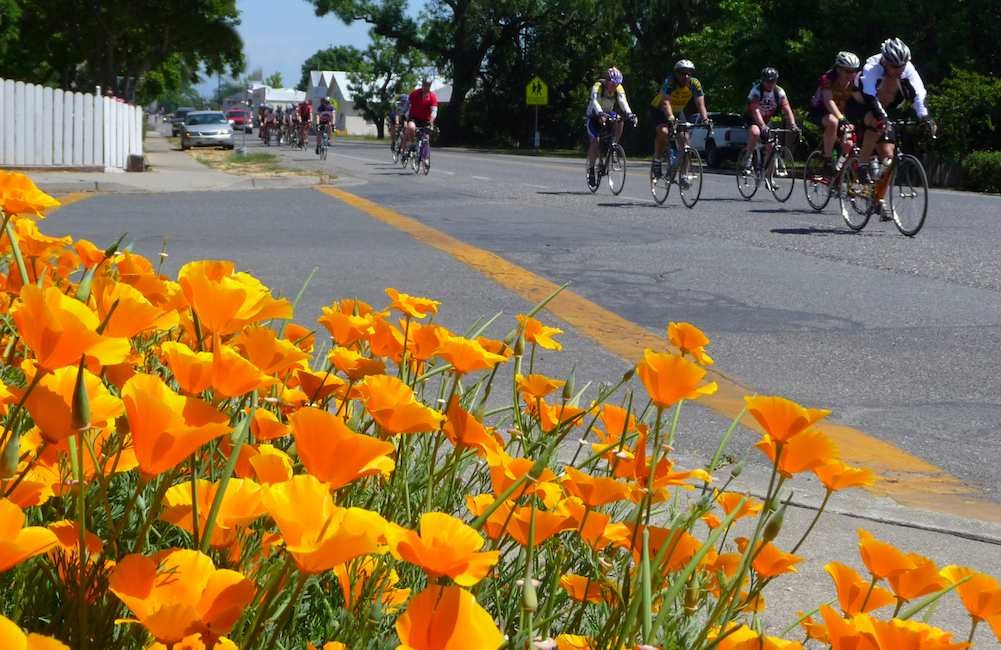
And do the whole thing I did. It was an incredible ride. You wind through Chico in the chill morning air and then warm up with a four-mile climb up Humboldt Road, a narrow rough pathway dishing out the quick realization that this isn’t going to be just a flat cruise through the orchards.
After a swift downhill on Highway 32 showcasing a nice view of Chico, you hit Honey Run Road and begin winding along Butte Creek, which in the spring is more of a small river coursing through a progressively deeper walled canyon of red-hued igneous rock. The route heads past delightful countryside with expansive estates hidden in the trees to the first rest stop at the Honey Run Covered Bridge, a Chico-area landmark.
Now comes the big climb, up narrow, switchbacking Honey Run Road to Paradise. Like all substantial climbs, it seems to go on forever, but it’s a great ride in the shade and the numerous chalk signs on the old pavement offer encouragement to help pull you up the hill.
When it eventually tops out at the next rest break you’ve reached Paradise — literally, not just cause the climb is over — and you begin to appreciate what an organizational undertaking this ride is. Hundreds of riders mill about or wait in line to drink and eat and use the loo. It seems like it is all running smoothly.
With lots of miles to go, however, the milling must end and I am off to Pentz Road and a big-ring downhill toward Oroville. Give me the long steady hills and even the flats, but my chicken feathers flutter on the downhills. When I see a sign that says 12% grade, I put on the brakes and feel the breeze of dozens of riders roaring past. Near the bottom of the hill is a sign, “Speed limit 55, so pedal harder.” I put on the breaks and more people pass me. The number of fearless flyers amazes me.
The downhill is followed by lovely views of the coast range capped with snow, impossibly green fields marching on for miles and wildflowers galore bringing you to the shores of Lake Oroville’s Thermalito Forebay and another well-organized rest stop. Only 15 miles and the dreaded Table Mountain between me and lunch.
Table Mountain is a steady mostly unshaded climb. The heat gets the attention of us Tahoe guys. 80-plus degrees in April? That’s not what we’re acclimatized to. I pass a sign that says four miles to the top and about three days later I reach the three-mile mark.
Eventually Table is topped. After a break for flower peeping on the mesa, it’s easy rolling terrain, with a couple of sucker uphills before a winding, steep downhill on a lumpy road brings you to Highway 70 and the lunch stop. I relax with the crowds of people lying like dogs under patches of shade.
Sixty miles completed, only 40 to go with no major climbs. Piece of cake, right? Well not exactly. It starts out easy enough. More magnificent riding across the grassy, wildflower dotted terrain. How did I miss this springtime glory when I was at Chico State? Too much time tubing down the Sacramento, or was it those countless hours in the library?
Crossing Highway 99 we ride through miles and miles of orchard country to Durham and Dayton. It’s flat. I’m tired. I understand that at this point the trick is to jump on a group riding by and stick on the back rider like my life depends on it. The problem with this theory is that you’ve got to have enough oomph to latch on as they pass you. After several attempts, I realize my turbo will not kick in. I manage to hold on to one group for a few minutes — until Mr. Hammer takes the front and begins pounding nails in my hurt locker.
Just before Dayton I come upon a moment of decision that many century riders must face: One rider is telling two tired ladies that if they just take this little old road instead of the main route it will cut 10 miles off the remaining 25. He is like the little devil of conscience sitting on my shoulder and egging me on … But I stubbornly refuse to listen and press on. And on. And on.
The last 20 miles of a century can be an uncomfortable tug-of-war between your will to finish and your body’s aching desire to get off the bike. Time and distance seem to creep along in slow motion. But I keep the pedals turning on fumes and centrifugal force and the green power of pride.
Suddenly I am on the tree-lined streets on the outskirts of Chico, and my spirits rise with a tide of energy born of relief and accomplishment, knowing that the end is near.
It’s a great day because I realize that even though another year had accrued to my personal tally, I can still ride one hundred miles … One hundred beautiful miles with nearly 4000 other cycle-happy folks sharing the road and the common bond of a rewarding achievement.
Tim Hauserman is the author of Cross-Country Skiing in thee Sierra Nevada and Monsters in the Woods: Backpacking with Children.
If You Go:
This year’s 30th Wildflower Century is on May 1. The registration deadline is April 15. The ride is limited to 4,000 riders. The entry fee is $65 and includes a 30th Anniversary Chico Wildflower Century t-shirt. Contact the Chico Velo Cycling Club for more information: www.chicovelo.org
You can camp at the Silver Dollar Fairgrounds where the ride begins. There are restrooms, nice grassy areas to set up your tent and it’s fun hanging out with a bunch of other riders the night before. Just camp as far away as possible from the go-cart track. It’s very loud and they ride late into the night.
Upcoming California Centuries
FEBRUARY 2011
February 26 — Spring Death Valley Century
Death Valley, www.adventurecorps.com
MARCH 2011
March 12 — Solvang Century & Half Century
Solvang, www.bikescor.com
March 26 — Hell’s Gate Hundred
Death Valley, www.adventurecorps.com
APRIL 2011
April 3 — New Moon Century Ride
Santa Monica, www.newmooncentury.com
April 16 — Mount Laguna Bicycle Classic
San Diego County, www.adventurecorps.com
April 16 — Tierra Bella Bicycle Tour
Gilroy, www.actc.org
April 17 — Diablo Century
Walnut Creek, www.ccjcc.org
MAY 2011
May 1— Chico Wildflower Century
Butte County, www.chicovelo.org
May 1 — Grizzly Peak Century
Moraga, www.grizz.org
May 1— Delta Century
Lodi, www.stocktonbikeclub.org
May 7 — Wine Country Century
Sonoma County, www.srcc.com
May 7 — Tour of the Unknown Coast
Humboldt County, www.tuccycle.org
May 14— Hungry Buzzard Century
Visalia, www.sscbike.org
May 15 — Strawberry Fields Forever
Aptos, www.strawberryfields.org
May 28 — Heartbreak Hundred
Frazier Park, www.planetultra.com
JUNE 2011
June 4 — 2008 Auburn Century
Gold Country, www.auburncentury.com
June 11— Fiesta Metric Century
San Diego, www.shadowtour.com
June 11 —Sierra Century
Rocklin, Placer County, www.sierracentury.org
June 25 — Summer Solstice Century
Quincy, www.SummerSolsticeCentury.org
June 26 — Climb To Kaiser
Clovis, www.FresnoCycling.com
AUGUST 2011
August 7 — Mt. Shasta Summit Century
Shasta, www.ShastaSummitCentury.com
August 13 — Tahoe-Sierra 100
Soda Springs, www.globalbiorhythmevents.com
TBA — 2007 Marin Century
www.MarinCyclists.com
SEPTEMBER 2011
September 24 — Tahoe Sierra Century
Squaw Valley, www.TahoeSierraCentury.com
OCTOBER 2011
October 29 — Fall Death Valley Century
Death Valley, www.adventurecorps.com
Feb/112
Mammoth Extends Reach

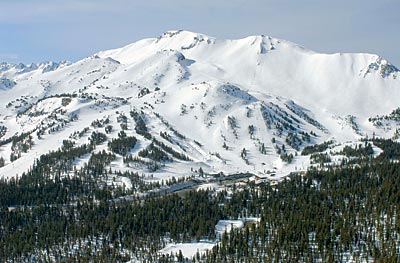
Mammoth Mountain is a massive sleeping volcano that last erupted some 50,000 years ago when it was even bigger, perhaps as high as 18,000 feet. The Main Lodge is bottom right.
With daily flight service from the Bay, Mammoth lures Nor Cal skiers to the High Sierra
By Pete Gauvin • Photos by MMSA/Peatross
It is only by virtue of geographic inconvenience that Mammoth Lakes is considered more a playground for Southern California than Northern California. If it were not for a wall of snow-caked mountains in the way — chiefly Yosemite National Park and the Ansel Adams Wilderness — Mammoth would likely be Nor Cal’s winter alternative to Tahoe.
Look at a map: Mammoth is directly east of the Bay Area, at virtually the same latitude as Hayward and San Mateo. By way of the bird, the Bay Area is closer to Mammoth than Los Angeles. If you had wings, you might care.
Without them, the drive to Mammoth in winter is more than most Nor Cal skiers want to undertake; some 6-8 hours from the Bay Area on clear roads. Plus you have to drive right by the temptations of Tahoe — and we hear there are some decent mountains to ski there, too.
Indeed, for Bay Area and other Nor Cal skiers, “Mammoth” … well, that might as well describe the drive. And so, heretofore, Mammoth has largely been left to Southern Californians, who have no significant mountain passes to cross, nothing approaching Tahoe in their path, just a few hundred miles of sagebrush-lined asphalt to channel them up the backside of the Sierra.
That’s not going to change. But with the advent of direct flights from San Francisco and San Jose this season, Bay Area skiers and boarders can now jump the topographical fence in little more than an hour and find themselves at one of the most unique, dramatic and naturally well-endowed ski mountains in North America.
Winging It
Through April 25, there is one flight daily out of SFO on United (departing 3:50 pm), and one flight out of San Jose on Horizon (12:30 pm weekdays; 3:10 weekends). (There are two daily flights from LA.)
And the cost of flying is on par with driving. Flights range from as low as $29 one way from San Jose, $59 one way from SFO. If you’re flexible, there are some tremendous weekday deals. Through February, Mammoth is offering a four-day/four-night midweek fly, ski and stay package for $99 a day from San Jose, $109 from SFO. (Check mammothmountain.com/flyskistay for details.) For comparison, a one-day adult lift ticket runs $92.
Once on the ground, it’s easy to get around without a car. It’s only an eight-mile shuttle ride from the airport to the closest lift. In town, the free Mammoth Trolley runs every 20 minutes until 2:30 in the morning.
You can grab a coffee in town at the Looney Bean and head for the mountain, enjoy a pint of Real McCoy Amber Ale from the Mammoth Brewing Company at the popular Whiskey Creek restaurant and bar, or head to the actual brewery tasting room (open daily 10-6) two blocks away for a full sampling. There’s the also the Euro-style pedestrian village at the base of the mountain with a selection of shops, bars and eateries.
Blessed by Geography
There’s the Sierra and then there’s the High Sierra. Though often used interchangeably, they are not one in the same. The true High Sierra, as noted author/guide John Moynier has pointed out, begins near the northern boundary of Yosemite and Matterhorn Peak, the northern most 12,000-foot peak in the Sierra, and extends southward 175 miles through the Whitney Zone.
Mammoth and sister resort June Mountain are the only developed ski areas in the true High Sierra, where the relief from sageland to summit is most dramatic.
Due to its geographic position and altitude, Mammoth often gets more snowfall than Tahoe resorts, an average of 32 feet annually. This season it nearly equaled that by January with an astounding 370 inches.
Sitting on the eastern flank of the range, one would guess the mountain might suffer from the rainshadow effect. But the San Joaquin River canyon funnels Pacific haymakers up to a low section in the Sierra Crest allowing moisture-laden air to cross to the east side, where it’s wrung out by the broad volcanic peak topping 11,000 feet.
The mountain, which has been snoozing since its last eruption some 50,000 years ago, is the remains of a humungous volcano that may have been as tall as 18,000 feet. Imagine, for a second, the vert we’d be talking about had it not blown its top!
Still, Mammoth more than justifies its name. The resort’s base of nearly 8,000 feet is as high as some Tahoe resorts, yet it still offers more than 3100 feet of vertical. It’s all sprawled over 3500 acres served by 28 lifts (including three gondolas) and three base areas: Canyon Lodge, Eagle Lodge and Main Lodge.
All this in a stunning Alps-like setting framed by the steepled summits of the High Sierra and long views of the Great Basin out east.
On the Mountain
Mammoth’s upper mountain is entirely above treeline and offers some of the steepest skiing in the West, including the famous Cornice Bowl. Beginner and intermediate skiing can be found all over the mountain.
The backside, close to a thousand acres and served by only two lifts, Chairs 13 and 14, is a good place to find both sunshine and powder. It features big bowls up top and well-spaced tree skiing below. Hemlock Ridge just beyond Santiago Bowl is a great place to hike for turns. After about a 400-foot vertical hike, a steep descent leads down to Chair 14.
Though not well publicized, Mammoth has an open-gate policy. The most popular expression of this is skiing off the top of the Mammoth Crest, a big palisades running right behind Mammoth Mountain toward the south, with multiple runs that all drain back to the Tamarack/Twin Lakes area, where the Tamarack Lodge and cross-country center are located. The most popular and unique out-of-bounds run is “Hole in the Wall,” a steep chute through a lava tube that forms a natural tunnel.
From Tamarack, you can catch a free shuttle bus that runs every hour on the hour back to the village and town.
If you work up an appetite but don’t want to leave the slopes, keep an eye out for Mammoth’s latest culinary creation, the Roving Mammoth, a snowcat that roams the mountain like an all-terrain taco truck, selling burritos for $5.50.
If you like your burritos with lots of corn, wait till spring. That’s when Mammoth’s ‘Great Corn Factory’ produces that buttery hero snow ripe for carving and serves it typically longer than any resort in the country. Last year, Mammoth was open until Independence Day.
June Mountain
For a change of pace, Mammoth tickets are also good at June Mountain, a hidden gem of a resort about 10 miles north on Hwy 395. There’s a shuttle roughly every hour, opening the possibility for a double day.
Overlooking the June Lake Loop, with jagged mountain peaks right behind it and views of austere Mono Lake out east, June is more of a purist’s mountain. No roaming burrito snowcats here.
Although it gets less snow than Mammoth, about 250 inches a year, June is known for its powder because it’s so uncrowded for its size. While a weekend at Mammoth can draw 20,000 people, a big day at June is 2000 people. And its acreage is still substantial, about two-thirds the size of Mammoth. It has seven lifts and 2,500 feet of vertical with a variety of terrain, including some great tree skiing.
Tamarack Cross-Country
Another great way to mix up a week of skiing at Mammoth is to stretch out the legs and lungs on the 19 miles of groomed trails at Tamarack Cross-Country in the scenic Lakes Basin. Adult day passes are $27. The ski school run by two-time Olympian Nancy Fiddler can help iron out your skating or diagonal stride imperfections. Snowshoe trails are also offered.
However you choose to wrap up a trip to Mammoth, with the new flight service there’ll be no worries about fatiguing yourself because you’re facing a long drive home. Enjoy your wings.
Feb/110
Scenic Sliding at Spooner Lake XC

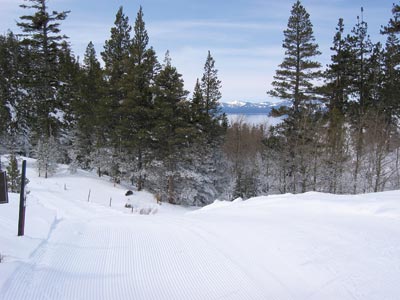
Uncrowded groomed tracks, like the Saint’s Rest Trail (above, photo by Tim Hauserman), and stunning lake views await skiers at Nevada’s lone cross-country resort, run by husband-and-wife Max Jones, skate skiing (right), and Patti McMullan, at the Wildcat Cabin (below right), one of two wilderness log cabins available for rent. Photos courtesy of Spooner Lake XC
A mountain bike mecca in summer, Tahoe’s east shore is just as spectacular in winter but much less crowded
By Tim Hauserman
Many adventurers in the summer and fall head to Spooner Summit on the east side of Lake Tahoe for epic riding or hiking on the Flume Trail. Some are not aware that this area is equally fine during the winter, when it becomes Spooner Lake Cross Country Ski Area, Nevada’s only groomed cross-country ski resort.
Since 1985, Max Jones and his wife Patti McMullan, have operated Spooner Lake Cross Country. For Max and Patti, running a Nordic center has meant a ton of work and a lot of finger crossing: Will the weekend and holiday crowds somehow pay the bill of keeping 80 kms of trail groomed during the week? Will it snow enough?
It certainly doesn’t help that average annual snowfall on the east shore of Lake Tahoe is about half as much as the west shore, but it works because Max and Patti are expert groomers and are dedicated to providing top-notch XC skiing, and the Spooner Lake area is one of the most beautiful places in the world to put some glide under your feet.
Spend a few hours huffing and puffing your way around Spooner and you will really appreciate the glorious terrain including views of Spooner Lake, Snow Valley Peak, Marlette Lake and, of course, Lake Tahoe.
While these trails may be packed with mountain bikers in the summer, in the winter if you start out early you may have the place to yourself. “We think Spooner has the best wilderness feel of any of the ski areas at Tahoe,” Max says.
Your Route:
While there are a few easy trails close to the lodge, when you go to Spooner make a day of it and challenge yourself to the best that Spooner has to offer.
Start out on the North Canyon Trail, which will be familiar to mountain bikers as the road providing access to the Flume Trail. After the first stiff climb you intersect the Lower Aspen Trail, climb to Upper Aspen and meander through vast aspen groves before reaching the Waterfall, a short steep section that is appropriately named. Soon enough you meet up once again with the North Canyon Trail. If you are tired already, brace yourself Bridget, because from here it gets pretty darn steep as you climb up to the Marlette Saddle.
Once you reach the saddle you may embrace the concept of turning around and heading back to the lodge — but not so fast buckaroo, now is when it really gets good. The Saint’s Rest Trail beckons. A bit more climbing is rewarded when you cross over to the lake side of the ridge, and Flume Trail-like views and fun sweeping ups and downs await you.
Eventually you end up below the Marlette Lake Dam, where a short climb brings you to the edge of the lake and a few miles of level skating (perhaps the only level skiing you are blessed with all day). After enjoying the frozen expanse of Marlette Lake you climb up to the Marlette Saddle, where your big climbs of the day are over and five wonderful miles of downhill lie ahead.
Start the joy with the Super G trail, which gives you a series of Super G-type turns from the top of Snow Valley. If the trail was a little firm on your way up, now it should be softened up to Goldilocks’ conditions, giving you some of the best downhill skate skiing you can find anywhere.
At the bottom of Snow Valley, Super G meets North Canyon Trail and it’s time for a long glide the rest of the way home. If you haven’t had enough (and most of you will), then you can check out some of the lovely trails that lie in the meadow or circle Spooner Lake.
Stay in a Cozy Cabin:
The Spooner Lake folks have created two hand-hewn rustic log cabins available for daily rental just off the trail system. Constructed in 1997 and 1998, the cabins are equipped with beds, water, compost toilets and a true feeling of remoteness — yet you can ski to them easily.
Go for the ski described above, then finish your day at your own cabin right on the trail, and get up the next morning and go for another ski on the quiet Spooner trails. Does it get any better? This should be enough to rejuvenate the most harried city dweller. It is also your contribution to keeping afloat a business that depends on the cabins year round to pay for great grooming in the winter.
The Wild Cat Cabin is located about 3.5 kms from the lodge and has a view of Emerald Bay. The Spooner Cabin is just one km from the trailhead and is situated close to the shores of Spooner Lake. Ski season rates start at $160 per night, which includes the cabin plus trail pass, equipment rental and a lesson if desired.
What’s New:
Last winter Spooner introduced the five-mile long Tahoe View snowshoe trail, which provides snowshoe only access to an awesome lake view as well as the Wild Cat and Spooner Cabins.
The Details:
Spooner Lake Cross-Country is on Nevada Highway 28, just a half mile north of the junction with Highway 50 on Spooner Summit. From Incline Village, drive 11 miles on Highway 28 to the parking lot on your left. From Carson City take the 10-mile drive to the junction of Highway 50 and Highway 28. For more information, or for cabin reservations, go to www.spoonerlake.com, 775-749-5349. 1-888-858-8844.
Tim Hauserman wrote “Cross-Country Skiing in the Sierra Nevada.” He teaches at Tahoe Cross-Country Ski Area in Tahoe City.
Feb/114
Skate Skiers Unbound

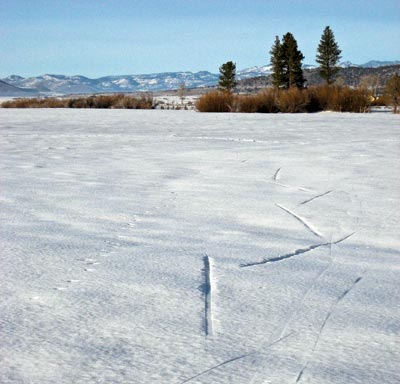
Temperature inversions during clear sunny stretches in Sierra Valley can produce a skiable crust on meadows.
Backcountry skate skiing captivates, doles out lessons to Tahoe writer
Story and photos by Laura Read
In the early spring, when warm days melt snow crystals into a fine paste and frigid nights freeze them to a crust, Mother Nature extends an invite to skate skiers to stray from the confines of machine-packed trails onto an open canvas of boundless gliding and backcountry exploration — no groomed tracks, no trail passes, no limitations.
Indeed, when the freeze-thaw cycle persists and the snowpack settles into a dense and supportive surface resembling frozen cheesecake, skate skiing provides the swiftest means of traversing a snowy landscape under one’s own power, allowing for speedy forays deep into Sierra canyons and across open meadows and frozen high-country lakes.
Though best suited to flat and rolling terrain, the gliding efficiency of a capable skier on lightweight skate gear can make a backcountry skier shuffling along on skins look like a gear-laden tortoise next to Apolo Ohno. Most backcountry skate skiers don’t seek out high-angle terrain, but when conditions are just right — a firm base with a sun-warmed top of buttery corn — moderately steep slopes are not beyond limits of fearless skinny-ski descenders.
Some adventurous skate skiers have been known to knock out multi-day backcountry tours of 30, 40, even 50 miles in a day; trans-Sierra tours like Mammoth to Yosemite and crest traverses such as Donner Summit to Echo Summit.
Neophytes, of course, are urged to start with something a little less ambitious and closer to civilization — for as I found out, there are lessons to learn.
The first time I tried skate skiing on a glossy crust of frozen snow, my husband, Doug, and I were in the Martis Valley next to Truckee. Before dawn he’d nudged me awake saying, “Let’s go skate on a meadow. Conditions are perfect.”
Perfect? The outdoor thermometer read 25 degrees F.; sunrise was an hour away. Nevertheless, into the car we went, wrapped in thick hats, gloves and extra sweaters.
At Martis Meadows, located between the Truckee airport and Northstar-at-Tahoe, the snow was a pre-dawn shade of cool blue, and beneath the plastic grooves of my cross-country boots it crunched slightly.
Quite different from classic cross-country skiing, which employs a scissors-like kick-and-glide movement, skate skiing has a side-to-side momentum that mimics ice skating or in-line skating. The ultra-light skating skis are treated with glide wax from tip to tail, which makes them ultra fast. My first push off onto the smooth snow sent me into a whizzing glide that felt incredibly light and free.
However, my enjoyment was diminished by the icy chill of the air, because even though I had lots of warm clothes with me, I didn’t have exactly the right clothes.
Lesson #1: A wind jacket isn’t enough for these early morning jaunts. Wind pants are key so your legs don’t go numb.
Despite the frigid dawns, I became a meadow skiing junkie. One spring when we heard Lake Almanor was having warm days and freezing nights, Doug booked a motel room in Chester. Chester! I exclaimed. Couldn’t we go somewhere more dramatic — down the Sierra’s Eastside, for instance? But Doug had an inkling that Chester would be good, and so we went.
As we got started the next morning a cloak of fog snuffed out all the scenic features — the fluffy green trees, the big lake, the mountains — so we stayed close to the lakeshore. Slowly, the fog shriveled into curly threads that hugged the streams. We cruised up one creek into a nearby meadow. Sunshine lit up the sky, revealing a landscape awash in snow crystals. But the best reward was the long vista once everything cleared: In the distance, snow-domed Mt. Lassen boomed up from the forest like a kingdom from the Lord of the Rings.
Lesson #2: Don’t let the fog deter you.
One night a friend called to say she’d heard Anton Meadows above Tahoe City had a frozen crust. To reach Anton the next morning, we used the groomed trails of Tahoe Cross Country ski area, where we had season passes. Most cross-country centers contain a couple of flat open places that freeze and thaw in the springtime: Tahoe Donner has the Euer Valley, Kirkwood has Kirkwood Meadow, and the Tamarack Cross-Country Ski Center in Mammoth has snow-covered lakes.
On this particular morning, the slender shards of hoar frost sparkled across the surface as if someone had sprinkled a million diamonds there. Once we left the trails, we could ski wherever we wanted to go. I swooped between willows, scampered up hillsides, circled creek holes, and inspected rabbit tracks.
Lesson #3: Check out the meadows next to groomed ski center trails.
Doug and I bought a small camper, and now we travel often on Highway 395 to where the glacier-scooped valleys of the Eastern Sierra provide endless meadows for long days of skate skiing. On one early excursion into a canyon below Mt. Emma near Sonora Pass, Doug asked if I wanted to take a peanut butter and jelly sandwich in my fanny pack. I said no. I had plenty of Gu’s, those 100-calorie packets of gooey carbs laced with caffeine.
It was a spectacular tour. We skated up the canyon, following an open creek, dodging willow bushes and peering at transparent ice lips growing out of the snow banks above the rushing creek. We climbed a glacial moraine and scooted through an aspen grove. A couple of hours passed and I swallowed one Gu after another. We crested a knoll to see another irresistible glistening valley ahead of us. We flew into it, hooting with excitement and feeling free as eagles. Then, bonk. My energy drained away as if someone had pulled a plug. I had eaten all my Gu’s. I found Doug ahead sitting on a stump, nibbling his sandwich. He kindly shared it. Refueled, I zoomed back to the camper, where I took a nap.
Lesson #4: Always take the PB&J.
Backcountry skate skiing can test all of your limits. Sun comes from all sides, so wear a good sunscreen, big hat and a long-sleeve lightweight wind-shirt. Carry extra water and don’t wear dark-colored, heat-absorbing clothes.
And then there are the survival issues: Travel with a friend, know your terrain, and leave a note on your car describing your route and when you’ll be back.
Lesson #5: Be prepared for anything.
The sweetest aspect of spring skate skiing is that it can be done anywhere. The snowpack simply needs to be gathering lots of sunshiny warmth during the day, and freezing hard at night. My favorite finds include a couple of meadows on Highway 89 between Truckee and Sierra Valley, any snow-covered alkali flat in Nevada, anyplace at all in magical Hope Valley off Carson Pass, and meadows around Tioga Pass and Crowley Lake, near Mammoth.
Lesson #6: Skate skiing is a great way to get deep into the backcountry quickly and with ease.
Feb/110
Three Classic Eastside Couloirs
For some skiers, nothing beats “getting walled”
Story and photos by Brennan Lagasse
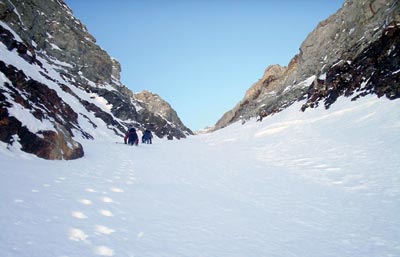
Although California’s ‘Range of Light’ is known for many things, to backcountry skiers it’s famous for some of the best couloirs found anywhere on the planet. Striking corridors of snow easily identified by the rock walls that make up their borders are plentiful in the Sierra, nowhere more so than off that black ribbon of mountaineering dreams, Highway 395.
Peak bagging, chasing powder, dropping a steep cliff face — these are all easily understood and revered for their worth in the ski world. However, those of us who look for the most aesthetic line on any given peak know couloirs offer some of the most unique and satisfying ski descents any snow slider can find.
Some choose to look past the adventure that’s found when couloirs become primary ski objectives while others don’t, or rather can’t.
When you climb your line, you gain intimate acquired knowledge about the snow you’re planning to ski. It takes a lot longer to ski this type of terrain, and depending on one’s chosen objective, you might have to plan for long days in the field. But once you’ve ascended your line, taken in the view from wherever you’re planning to drop in, and arc your way down a sliver of snow lined by beautiful natural walls of rock, you’re hooked.
As much as I love powder and new mountains to climb and ski, I’ll choose a couloir descent over a snowfield, ramp, bowl, or ridge any day.
There’s a plethora of choices for “getting walled” in the Eastern Sierra. There are so many notable descents the tick list is literally never ending. I’ve found once you tick one off there are easily five more to replace it. It took me a while to think of just three specific couloirs to highlight. What to choose? The Matterhorn has its East and West Couloir. North Peak’s North Couloir and just about every line that drops off the Dana Plateau is pure bliss. What about the Scheelite and Mt. Emerson and its North and Zebra Couloirs? How about the Mountaineers Couloir off the highest peak in the lower 48? We could go on for days here, but I was finally able to choose a few that I think are about as worthy as any line you can find anywhere.
Here’s a breakdown of three absolute classics listed by increasing level of difficulty and reverence.
Pinner Couloir, Laurel Mountain
- Top of descent elevation: 11,800’
- Descent in Vertical Feet: 3400’
- Slope: 35-38 degrees
- Aspect: East
- Distance from trailhead: 3.25 miles
- GPS: 37.578/-118.890
- USGS Map: Convict Lake
Notes: In a range packed to the brim with aesthetic couloirs, the Pinner holds its own as one of the most beautiful lines in California. There are two options for access. One is to first summit Mt. Laurel via the northeast ridge and then traverse to a large east facing bowl, which is the entrance to the couloir. But booting up the couloir is the best way to know what you’re getting into and what snow conditions will be like. Contour around the northeast face of Laurel up into Convict Canyon for this route. The couloir entrance will come into view on your right as you gain some elevation. Conditions in the Pinner can change quickly, and since it faces east, snow quality is always a question. The Pinner is a frequent flusher as well, meaning it sheds new snow often during and after storm cycles. The large rock walls shade the couloir for most of the year. The adventure with the Pinner is you can never see too far in front of your current turns. Extreme caution should be taken since this line does harbor rock fall and avalanches frequently and once you’re in it there are very few safe spots. As far as aesthetic couloirs go, this is a fairly accessible, gorgeous line; not too far from the trailhead or exceptionally steep.
Bloody Couloir, Bloody Mountain
- Top of descent elevation: 12, 522’
- Descent in Vertical Feet: 5342’ (about 2600’ for the couloir proper)
- Slope: 40-45 degrees (depending on time of year/snowfall)
- Aspect: North
- Distance from trailhead: 6.5 miles
- GPS: 37.561/-118.909
- USGS Map: Bloody Mountain
Notes: The Bloody Couloir is one of the most classic lines on California’s Eastside. Recently named as one of the 50 Classic Ski Descents of North America it’s hard to find a more prominent line off the 395 corridor. You can actually see the Bloody Couloir many miles away dropping down Conway Summit to Mono Lake, and as you get closer and closer to Mammoth Lakes it just looks better and better to ski. This line is a step up from the Pinner in terms of steepness and overall rowdy factor and your experience will greatly depend on the time of year you choose to ski it. It’s seen tracks as early as October and as late as July. The approach can be considerably shorter if the high-clearance four-wheel drive road leading to the base of the couloir is passable. Otherwise it’s just a long slog to the base and boot up. Generally, the Bloody is considered to be about 42-43 degrees, but less snow in November or ample snow in May causes the pitch to either grow or back off.
North Couloir, Red Slate Mountain
- Top of descent elevation: 13,163’
- Descent in Vertical Feet: 5583’ (about 2000’ on the peak proper)
- Slope: 45-50 degrees
- Aspect: North
- Distance from trailhead: 8 miles
- GPS: 37.509/-118.869
- USGS Map: Convict Lake
Notes: In my opinion, this is the one. Building in difficulty and grandeur from Pinner and Bloody, the North Couloir of Red Slate Mountain is one of the most beautiful ski lines in the lower 48, let alone California. The North Couloir splits off the top of Red Slate and once a backcountry ski mountaineer views this gem for the first time, it’s just about impossible to think about anything else until they ski it. It’s a perfectly silhouetted peak on the Sierra Crest, with a perfect couloir right down the middle. The danger factor and exposure is much higher on Red Slate, and a lot of that will depend on which way you access the North Couloir. Either take the west ridge to the top, or climb the North Couloir if that’s what you plan to ski. Once at the top of the couloir either head left across an extremely exposed face where a fall is not an option or head right, if possible, through what’s known as the alternate entrance. This is a much less exposed and safer way to get into the North Couloir. The couloir proper is much bigger than it looks from afar, about 100 feet wide. It’s a straight down fall line, 2000 feet of sustained steep skiing, and easily one of the most memorable runs found on the Eastside.