1
Mar/08
0

Sizing up Two Epic Tours: The Sierra High Route and Alps Haute Route

High Traversing

By Anna Siebelink

Heading Off Across the Sierra

I go to lift it, but it doesn’t move. I try again and the behemoth barely budges. Impossible, I think, as I look across the parking lot at my three partners. Amused smiles fire back, along with an, “I’ll help you.”

Help me? This is only day one in the parking lot at 6300 feet. What about the next eight days? Hoisting the pack is only the beginning. How can I possibly lug this load over 12,000-foot passes?

Traverse
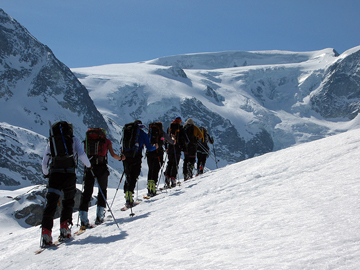
Route up to Col de la Serpentine from Dix hut, Haute Route. Mark Houston
We’re at the Symmes Creek trailhead, in the high desert sage out Onion Valley Road west of Independence, about to embark on the Sierra High Route. Pioneered by Dave Beck in 1975, this ski tour became an instant classic. Beck envisioned this line across the southern Sierra as California’s answer to the famous Haute Route of the Alps. Traversing 50 spectacular miles from the Owens Valley near Mt. Whitney to the grand conifers of Sequoia National Park on the west, the route crosses the highest portion of the Sierra, including six major passes that top 12,000 to 13,000 feet.

Considering my overloaded backpack, some 70 pounds with skis and boots attached for the initial hike in – more than half my body weight – the idea of reaching the west slope’s giant sequoias begins to slip from the realm of conceivability. Am I insane? Do I really need these crampons? This rope? This tent? This food?

I think of my friend Doug Robinson, the respected climber and mountaineer and my former partner in the guiding business Moving Over Stone. In 1985, he did the High Route three times. The second time, returning to the east side after guiding a group west, he went extra light and bombed the route solo in just over 22 hours. (See Robinson’s sidebar, “Rapid Transit on the Sierra High Route,” p. 12.)

My gawd! What would he think of my ridiculous pack?

I get a boost hoisting the shoulder-strapped pantry/gear closet on my back. I teeter a bit, widen my stance and gain my balance. The beast is on! Hope for a successful journey trickles again.

I don my MP3 headphones. Yes, despite flack from my partners, I am bringing music and a couple extra ounces. I’ll need something to take my mind off the burden on my back as I huff 6000 feet up to Shepherd Pass. Due to sparse snow cover, much of it will be hiking.

I face west, look up at the mountains, smile and take the first step.

Commencing the Haute Route

Two years later, I stand awaiting the opening of the first tram going up the Grand Montets, in Chamonix, France, the starting point for the Haute Route of the Alps.

This famed 6-8 day ski tour begins in Chamonix, nestled at the foot of Mont Blanc (4,808 meters/15,774 feet), the highest mountain in the Alps, and traverses some 60 miles through the heart of this awe-inspiring range. From France, the route crosses into Switzerland on the first day and ends at the base of the Matterhorn in Zermatt. It generally stays above 3000 meters (9800 feet), descending into dramatic valleys from time to time, traverses over 10 passes (Verbier version), the highest ones cresting 3300 meters (nearly 11,000 feet).

There are two variations of the Haute Route, one via Verbier and a harder version that traverses the Plateau du Couloir. The Haute Route via Verbier is by far the most popular version and what we are setting off to do.

I am travelling with five others from the States. We are led by IFMGA-certified (International Federation of Mountain Guides Associations) guides Kathy Cosley and Mark Houston. They recently moved their home base from the cowboy/climbing community of Bishop to the café/alpinism world capital of Chamonix. With more than 25 years of guiding experience, they have guided variations of the route 15 times. (Kathy has also guided the Sierra High Route a few times.)

The pack cradled against my back is barely detectable, even after stuffing a few extra pounds of chocolate in it. I step onto the packed tram with about 100 others with ski mountaineering gear. Most are either starting the Haute Route themselves or heading off on other mountain tours.

The Intrigue of Skiing High

AnnaHaute

Photo courtesy of Anna Seibelink.

Exploring on skis is a bug I caught early and never lost. Growing up in Sweden, I would often “tour” to school on my red wooden skis and leather boots. Gliding deep into snowy mountains, self-propelled, seeing spectacular landscapes rarely seen by others, challenging your stamina and your skills, is the sort of adventure that never fails to capture my imagination. At some point, skiing the highest route across ranges such as the Sierra and the Alps becomes an intriguing goal.

In the Alps, I found many people, young and old, who share and live that dream. Each year thousands of skiers set off to ski the Haute Route or portions of it. It’s hard to estimate the exact numbers, says Cosley. “A lot of people do bits and pieces at a time. During April, the Vignettes Hut (on the most popular section of the route) may host around 80 people per night,” or more than 2000 people over the course of one month.

That vastly exceeds the number of skiers traversing the Sierra High Route. In fact, although it’s difficult to document, it’s likely that more people do the Haute Route in one season than have ever done the High Route.

“I have only once encountered another party on the trip,” says Todd Vogel of the Sierra Mountain Center, a Bishop-based guide company, who has guided the route eight times.

High and Highly Unique

High Route-HauteRoute Beta

Sierra High Route

Permits:

Your direction of travel determines which agency youobtain permits from.

If you go from east to west:

Inyo National Forest

Office in Bishop

351 PacuLane

Phone: 760.873.2400

www.fs.fed.us/r5/inyo/

If go from west to east:

Sequoia and Kings Canyon national parks

Phone: 559.565.3766

www.nps.gov/seki/

MoreInformation:

Siebelink’s 2004 crossing was profiled in a series ofarticles in the Reno Gazette-Journal by Martha Bellisle, “Over the Top: A Weekin the Heart of the High Sierra.” You can find the articles online at www.rgj.com.

Books:

  • Steve Roper: The Sierra High Route: Traversing Timberline Country
  • R.J. Secor: The High Sierra: Peaks, Passes, and Trails
  • John Moynier: Backcountry Skiing California’s High Sierra
  • Out of print, but still considered one of the best resources if you can find a copy, is David Beck’s Ski Touring in California.

Guides:

Alpine Skills International

11400 Donner Pass Road

Truckee, CA 96161

Phone: 530.582.9170

www.alpineskills.com

Sierra Mountain Center

174 West Line Street

Bishop, CA 93514

Phone: 760.873.8526

www.sierramountaincenter.com

Sierra Mountain Guides

148 Willow St.

Bishop, CA 93514

Phone: 877.423.2546

www.sierramtnguides.com

Beyond following a lofty line across mountains on skis, the similarities between the High Route and the Haute Route soon end.

The High Route is much more of a wilderness experience.

The beauty of this tour is the quiet, solitude and vastness of the terrain. “There is more a feeling of being out on one’s own, away from civilization,” Cosley says.

The challenges are to carry all that is necessary, rugged living conditions and hard work, both to make and break camp and to cook meals. Slipping out of a warm sleeping bag into a frosty morning to make breakfast takes toughness. But once up, there’s deep pleasure in sipping from a warm mug and soaking in the incredible views.

“Because of bigger, heavier packs, the skiing is more a mode of transportation than a pleasure in itself,” Cosley says. “The pleasure is in the journey, the wildness, and the achievement.”

The Haute Route, in contrast, is more of a skiing experience.

The complex system of huts in the Alps facilitates going light and allowing one to enjoy the downhill turns. “There are few places in the world where skiers can travel unencumbered, in the heart of the mountains, over high cols, hidden valleys, and immense glaciers,” Cosley says.

Then, at the end of the day, you get to relax in a warm hut, enjoy a hearty meal cooked by someone else and wash it down with cold beer or a bottle of wine. Later, you can settle into a game or cards or chat with fellow ski mountaineers from all over the world, before turning in to a shared bunk room with pillows and blankets provided (most skiers carry lightweight silk sleeping sacks).

The huts also provide a comfy refuge during storms when continuing on may be hazardous. This is key because, unlike the Sierra High Route, the Haute Route traverses glaciated crevasse fields and steep cols that require expert route finding and decent visibility. The possibility of falling into a crevasse and high avalanche danger can make travel unsafe. Holing up in a hut or even skiing out to a village are options when storms descend on the Alps.

The Sierra High Route is much more committing. Once you get in the heart of the tour, there are no easy outs if storms roll in. It may be best to just hunker down in the tent with a book. In California, a blue-sky day is usually not far behind.

The price of the Haute Route’s popularity is that you may share the terrain, at times, with a small parade of ski mountaineers. This typically happens when setting off in the morning and when crossing some of the passes. Worse is when others track up your powder field, heaven forbid.

On the High Route, this is not a concern. You’ll likely be carving corn slopes for only you and your mates to see.

Out in the Open, Out in the Outhouse

Perhaps no experience exemplifies the differences between the High Route and the Haute Route more than going pee in the middle of the night.

On the High Route, you slither out of your bag, crawl out of the tent, and waddle into the cold night to find a spot in the snow. When you look up, the deep black sky is salted with stars. It’s magical!

On the Haute Route, the experience is, for the most part, more mundane, and warmer. The Vignettes Hut, though, deserves special mention. Here, one has to walk a narrow path along the side of a cliff to an outhouse perched right at the edge. The hole drops off into air. It’s quite a long drop.

Tent

Anna Siebelink. Photo: Scott Sady

The Common Thread

The differences between the High Route and the Haute Route, though numerous, are in the end mostly superficial. At their core, these two tours of a lifetime share a bedrock commonality.

“Both have the feeling of the epic journey, the satisfaction of covering a significant distance with important difficulties, essentially under your own power,” Cosley says.

So whether you enjoy quiet solitude in deep wilderness or hearing multiple languages spoken over a glass of wine, bunking in huts or carrying it all on your back, the High Route and the Haute Route reward you in a similar fashion.

They are both a singular experience of journeying on skis through stunning mountains that you’ll remember for the rest of your life.

Anna Siebelink is a physical therapist and ergonomics consultant. Formerly a ski and climbing guide with Moving Over Stone, she splits her time between Truckee and the Bay Area. She did manage to carry that overloaded pack across the Sierra.

1
Mar/08
0

Working the 24-Hour Shift

Mountain Bike Style

By Rebecca Rusch

RebRuschRacing

Photo by Charlotte Sport Photos.

My 24 hour mountain bike racing career started in 2006. A long-term adventure racing team sponsor bowed out and I was left with the task of redefining myself as an athlete or getting a real job. Fortunately, my sponsors Red Bull and Specialized were supportive in my quest to avoid a nine-to-five existence. For lack of a better idea, I decided to take my endurance experience into mountain bike racing. I knew I could race for days on end from my adventure racing career, but had no idea if I was fast enough or good enough on a bike. I had never actually entered an official mountain bike race or ridden against any women. I won the first 24 hour race I participated in that year in Spokane, WA. It was my test run and I beat everyone in the race, including the men. I took it as a sign. Nine to five would have to wait.

The 24 Hour Solo Nationals in Wisconsin was my second 24 hour race. I went in as a complete unknown and with a lot of trepidation. This was a huge step. The reigning female champion from the previous year was there with a gigantic motorhome parked right on the course and a host of professional-looking assistants and more bikes than I could count. There were other pros in big trucks with their names painted on them and lots of logos. In contrast, I had brought my mom, my uncle, and a bike-mechanic friend from home. The intimidation factor was huge. What was I thinking? How could I possibly make a proud showing against all these pro badasses? I cried during my practice ride and figured I’d made a huge mistake in coming to nationals this soon. The course felt very technical. My self-doubt multiplied.

We staked out camp, bagged the idea of sleeping outside, got a hotel and clicked on the Weather Channel. There were severe thunderstorm warnings for the weekend.  The radar showed a big red blob right over Wausau, Wisconsin. We knew we’d get rained on, it was just a question of when and how much.

The next thing I remember was the starting gun. For the first couple of laps, I was ecstatic to realize that I was not very far off the lead rider. I figured it would take a while, but I’d try to reel her in over the next 24 hours. When you have all day, you might as well use it, right?

My confidence increasing, I was shocked to see the back of her uniform on a small climb during the third lap. I felt a surge, passed her while trying to act as if I wasn’t working hard, and promptly fell off my bike right in front of her. A wave of embarrassment and another surge of adrenalin got me back up. I rode away frantically and never looked back. From that point on, I rode like a hunted animal.

I crashed hard shortly after dusk. Trying not to scrub speed through a tight section of trees, my handlebar nicked one and the bike started to wobble. Like a slab of meat I collided with a large oak to the left of the trail and was thrown to the ground. I didn’t have time to brake, so the smackdown was hard and fast. Trying to get back up, I knew my shoulder was in trouble. But desperate to stay in the lead, I raced off into the night.

About 4 am, the wind started howling, the air turned cool, and it was clear that we were about to get absolutely hammered with rain. Sure enough, the downpour came fast and furious. With visibility drastically reduced, the pace slowed immediately. I squinted and focused on staying upright, trying to ride by feel. Soon after, race officials waved me down and forced me to stop at an aid station about half way around my lap. About 30 riders were there and officials were handing out trash bags for us to wear. As we all crammed under one tent, lightning cracked and boomed around us at regular intervals. Curled up in a fetal position inside my trash bag and shivering, I tried to relax my cramping, seizing legs. I huddled with total strangers and wondered how much of my lead I was losing. I kept scanning the tent for another female rider to arrive. My biggest fear was that they’d restart the race from here and I’d have a head-to-head battle for the last six hours. I could barely stand, let alone race a bike.

We were held there for about 45 minutes before a chaotic re-start was attempted from various stop points around the course. I finished my lap wearing the trash bag, turning the pedals like molasses.

At 9 am, with just one hour to go in the scheduled race time, I pulled up to my transition area, ready to swap bikes and head out on my final lap. The balls of my feet were numb, my wrists felt like they’d been jackhammered, and my eyes were crusty with mud. However, I was machine-like in my determination. As far as I was concerned, I still had one hour to ride and one more lap to complete to seal the deal.

Approaching the pits, my crew was lounging around and my second bike was not ready to ride. I was a bit delirious and confused. Turns out the officials had stopped the race again due to the rainstorm and had given everyone an official finishing time from the first stop. It meant I’d ridden an extra two hours that I did not get credit for. But I didn’t care. It also meant I was officially the new National Champion!

I didn’t have long to enjoy my victory when the pain set in. I could not lift my arm. My legs were beginning to swell and I felt my body and mind shutting down. I needed help changing my clothes and had to be directed where to go and what to do.  I was too tired to take a shower at the venue and fell asleep in a chair before the awards ceremony.

RaceEnd

The nap must have done me well because I bolted awake when they announced my name. I went up and was presented a new stars-and-stripes jersey. I needed help putting it on over my injured shoulder, but it was like a healing salve once it was on. As I stood on the top step of the podium at my first National Championship, all the pain, the doubts, and the fatigue melted away as I raised my good arm high above my head.

Yes, nine to five would have to wait.

Rebecca Rusch has been a professional ultra endurance athlete for over 10 years. She has raced at the elite international level in adventure racing, outrigger canoeing and most recently mountain bikingShe has finished 1st or 2nd in every 24 hour mountain bike race she has entered. In two short years as a 24 hour racer, she has earned the titles of 2006 National Champion, 2007 USA Cycling Ultra Endurance Series Champion and 2007 24 hour solo World Champion. When she’s not racing, Rebecca is a part time firefighter/EMT and cross country ski coach in Ketchum, Idaho.