May/080
The Yuba River

Three Forks of Liquid Gold for Whitewater Prospectors
By Geoff Jennings
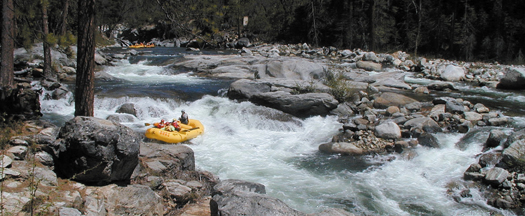
Photo courtesy of Beyond Limits Adventures, Inc./www.rivertrips.com
As a refugee of Texas and Southern California, the amount, variety and quality of whitewater rivers in Northern California continues to boggle my mind. Take a map and draw a three-hour driving circle around my Sacramento home and within that circle lies some of the world’s best and most abundant whitewater. Among this abundance, there are many gems, such as the canyons of the Yuba River.
Located just northeast of Sacramento and only a few hours from the Bay Area, the three veins of the Yuba – the north, south and middle forks – tumble down like whitewater gold through a large swatch of the Sierra’s west slope, from Interstate 80 north to Downieville and Highway 49/Yuba Pass, before meeting up and spilling into the Feather River.
Despite their proximity and relatively easy access, the forks of the Yuba get little publicity outside the dedicated paddling community. This is primarily because they drain the milder elevations of the north-central Sierra near Yuba and Donner passes, which makes for a shorter spring/early summer runoff window. And also because most sections of the Yuba cater to advanced paddlers, with the majority of its runs rated class IV or V.
But if you’re not an ace in the hole, or elsewhere in a kayak for that matter, don’t let that stop you from enjoying the Yuba’s Gold Country riches. There are a few stretches suitable for less experienced paddlers, or you can go with a commercial rafting outfitter on the rollicking North Fork – an excellent step up for those looking for an alternative to the popular South Fork American.
In addition to the whitewater action, Yuba River country is home to world-renowned mountain biking, as well as swimming holes and other outdoor diversions, as well as the tranquilo atmosphere of great towns like Nevada City and Downieville that mix an earthy, organic vibe with Western pioneer spirit. Stay a few days and soak it up between runs.
South Fork Yuba
The south fork of the Yuba starts near Donner Summit and closely parallels I-80 for the first few miles. The “Summit Run” doesn’t get paddled as much as the stuff downstream. But it is a raucous granite slide-and-drop filled class IV+ to V+ run, depending on portages. It closely follows the highway, so it’s not remote, but it’s still a scenic high-elevation run with some fun and challenging rapids. Recommended for experienced kayakers only, this is an early-season run controlled by snowmelt.
Downstream, the South Fork is commonly broken into four sections. Below a dam, these sections have unpredictable flows, with the best odds being during the spring runoff. Unfortunately, due to the lack of predictable flows, no commercial outfitters raft this section.
Washington to Edwards is a 14-mile class IV run with one portage. This run doesn’t get paddled a lot, but more boaters should put it on their to-do list. If it weren’t for the unpredictable flows coming out of Spaulding Reservoir, this might be one of the most popular runs in California. It offers quality rapids similar to the Tuolumne and is very scenic. From the put-in at the quaint old mining town of Washighton, six miles off Highway 20, the first 10 miles are pretty straightforward class III-IV. When you reach a rocky gorge, watch for the portage around a rocky 12-foot falls. The rapid below the drop is tough and should be portaged by all but the strongest paddlers. More entertaining rapids follow before you take out at Edwards Crossing.
Edwards to Purdens is a popular early-season run for local kayakers. The first time I did it, we were slipping on ice at the put-in. Not a good day for a swim, but I flipped in the first rapid, lost my paddle, and swam. Lucky for me, it got much better after that! This run is only 4 miles, making it perfect for short winter days, or running laps. It packs a lot of high quality rapids into its short length, with challenging rapids and some sticky holes at higher flows. It is similar in difficulty to the Chamberlain Falls section of the North Fork American. A few of the rapids have consequences,so paddlers should be comfortable on class IV whitewater. It’s gorgeous down there, so take your time and look around. There is a trail alongside the entire section, making it popular with hikers and nudists. Don’t be surprised if you drop into an eddy and see some bum!
Purdens to 49 starts where the last run leaves off. It’s difficult, with some solid class V rapids, but lacks the quality fun of the 49 to Bridgeport section downstream. It’s not nearly as popular and for a visiting paddler I’d probably recommend hitting the other sections first. That said, if you have paddled the rest and are looking for a challenge, it is worth consideration.
49 to Bridgeport is, in this writer’s opinion, the absolute gem of all the sections of the Yuba, and one of the best runs anywhere in California. But with a significant amount of difficult class V paddling, it’s certainly not for everyone. Choked with Sierra granite, the scenery is gorgeous. For the first mile or so, the paddling is fairly easy. Then the river steepens to gradients of 120 feet per mile. Sticky holes, tough moves and dramatic waterfalls combine in rapid sequence to make for a stout overall run. The first time I paddled it I was lucky to follow some solid locals who knew the run like a frequently traveled backroad. It was a fast moving day, and the rapids blurred together in a frenzy of tough moves, hair-raising horizon lines, and barely-made-it-upright escapes. Exciting, scary and fun all rolled into one. Although only 13 miles, expect a full day if you don’t have a guide, as many of the rapids are difficult to boat scout and will require you to pick your line from shore. It’s a must-do for strong paddlers in my book, and that of others apparently. On a nice spring day with good flows you can expect to see some of Nor Cal’s top boaters and visiting hot-shots at the put-in.
Middle Fork Yuba
The Middle Fork Yuba is very rarely run, but has two sections worth noting. Unfortunately, the middle fork is choked with dams, and diversions dewater most of the river to un-boatable levels much of the year. Many years, even during spring runoff, there is little water available. A shame, as these runs would both be valued additions to Nor Cal boaters with reliable or predictable water.
That said, catch them when you can, and your vigilance may be rewarded. The first run, Plumbago Crossing to Our House Dam, I’ve not paddled, but Bill Tuthill, on his excellent website California Creeks (www.cacreeks.com), says that except for a tough portage he would consider this an absolute classic, with an abundance of excellent Class IV. Given Bill’s resume of rivers run, I’ve added this run to my “hit list” for this spring’s runoff.
The section from Our House Dam to Highway 49 runs even less often, with an additional 600 cfs diverted from the flow. But in a big water year, you might be able to catch this run when the dam is spilling. Although an interesting run, it wouldn’t be high on my list, and is mostly something I’d recommend to locals looking for something different.
North Fork Yuba
With runs starting near Sierra City and passing through Downieville, the North Fork Yuba begins to take on much more of a Northern California feel. While the South and Middle forks feature a climate and scenery much like the American, Stanislaus and Tuolumne river drainages, the North Fork looks more like the far north runs in California, with abundant greenery, cold water, and dense vegetation.
Speaking from personal experience, you don’t want to swim on the North Fork. The bushwhacking here is tough, with poison oak, spiny blackberry vines and other prickly snags ensuring a slow and painful walk. Stay in the boat if at all possible.
Downieville is a scenic little town with a decent pizza place, River View Pizza, and a good breakfast spot for pre-run nourishment, C&J’s Downieville Diner. If camping, bring all your food, as the grocery store in town is spendy. Downieville is also a famous hotbed for mountain biking, so bring your bike to balance your wet/dry adventures.
The North Fork is the only stem of the Yuba that gets rafted commercially. There are three permitted outfitters offering 1-4 day trips on over 35 miles of class III to class V water: Beyond Limits Adventures (rivertrip.com, 800-234-RAFT), Tributary Whitewater Tours (whitewatertours.com, 800-672-3846) and Whitewater Voyages (whitewatervoyages.com, 800-400-7238).
Sierra City is the run upstream of Downieville. I’ve only done this run once, at almost double the recommended level, and I mostly remember a white-knuckle terror fest. At that flow there were few eddies to catch and the rapids were huge. Even at the normal levels of 1200 cfs and below, all accounts call this a solid class IV-V. It’s pretty continuous. Shortly before town, the flow will nearly double with the addition of the Downie River, which is itself a product of two classic creek runs, Lavezolla and Pauley creeks.
From Downieville to the Highway 49 bridge is a 13-mile stretch of water, mostly paralleled by the highway. Depending on where you put in, and what you choose to paddle versus portage, this section can be class III-Class V.
If you put in below the bridge in town, you’ll be running the Rossasco Ravine section, with brilliant Class IV rapids, and the best scenery on the North Fork. Most people will do at least one portage in here, though everything can be run.
However, putting in at Goodyears Bar is the most popular choice, and leaves nine miles of whitewater. This is the section run by commercial outfitters. Portage three times, and the run is a fun class III. Two rapids clock in at a solid class IV, and the remaining rapid, the aptly named Maytag, is a solid V. I paddled this rapid once in my playboat and it’s probably the longest I’ve ever travelled downstream completely submerged. A big green tongue leads into a huge hole. I thought I could skirt around the hole, but got pushed straight into it. Instead of getting stuck, I was pushed deep, and didn’t surface until much further downstream. Not really recommended! I’ve run it again in my creek boat with less drama, but shoulder my playboat here ever since.
The Yuba River drainages are gorgeous and offer fun, challenging whitewater that make for a great destination and an awesome resource for California paddlers. Each section has its own charms and challenges. But if you’re interested in experiencing the Yuba, don’t delay. By summer, the liquid gold in its canyons will be running thin and you’ll have to wait until next year to experience its whitewater riches.
May/080
Behind the Swell of Stand-Up Paddling

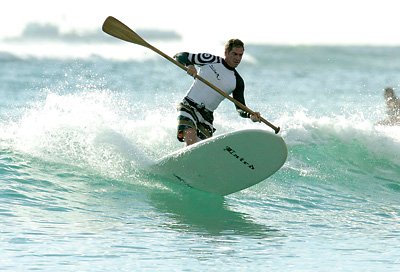
Lance Hookano surfing his SUP.
Photo by Sander Nauenberg.
Imported from Hawaii, hybrid sport growing from Santa Cruz to Lake Tahoe
By Ramona d’Viola
In the blush of first light, on the island of Moloka’i, a conch shell bellows from the shores of Kaluako’i Beach. The kahuna has blessed the gathering of paddleboarders and their crews, bidding them good luck and a safe passage. The sound of his shell horn breathes life into the still morning. On cue, dozens of men, and a handful of women, charge into the surf for the annual Moloka’i to Oah’u Paddleboard Race. Their goal: To reach the southeast shore of Oah’u in as little time as possible.
The line-up features an impressive cast of international paddleboarders: the formidable Australians, the competitive Californians, and a smattering of super-fit European and Japanese watermen. Punctuating the string of prone paddlers are several hulking Hawai’ians — standing upright with paddles in hand — powering away toward the choppy channel, looking very much like the glyphs of their ancestors.
For the Honolulu beach boys who taught surfing at Waikiki’s waterfront, grabbing a paddle from a nearby outrigger made for easy trips to and from shore, especially with a sunburned tourist in tow. Now the accidental practice of stand-up paddleboarding (SUP), once rooted in convenience, has been improved upon by innovation, perfected in competition, and in the last few years blossomed into a bona-fide sport of its own.
Gaining Exposure
Witness the likes of über-surfer Laird Hamilton slaloming mountainous waves, carving perfect arcs with paddle in hand. And rock-star Sting, struggling along in calm Caribbean seas, proving it ain’t that easy. A stand-up paddleboard recently showed up in People magazine, of all places, on the shoulders of big-screen hunk Matthew McConaughey (BTW: I only look at the pictures – I don’t actually read the magazine).
Well, the media exposure was another spoonful of confirmation that this sport, once thought of as a fringe pursuit practiced mostly by aging surfers with troublesome backs, had crossed the foam line and was now riding a swell of pop-culture legitimacy – a development which more than likely would curl the toes of a few veterans, although it’s unlikely they would even notice.
Indeed, “stand-up” has become the latest surf-inspired offshoot to grab a following, and it appears poised to stay, as the reasons for its recent growth spurt go well beyond bare-chested celebrities. The practical, physical and sporting advantages of stand-up paddleboarding are numerous and compelling.
Broad Appeal
Dan Gavere was an early SUP adopter. A former pro whitewater kayaker, Gavere is a sales rep for Werner Paddles, a leading kayak and canoe paddle manufacturer that recently brought its expertise to the SUP market. The Hood River, Oregon-based road warrior credits the sports’ popularity to its increased visibility — on the water and in the press.
“With the continued cross-pollination between paddle sports and surfing, there’s more opportunities for people to access the ocean in a variety of mediums, whether there’s waves or not,” he says. “Stand-up paddling is another niche for the ever-evolving water sports market.”
As sales rep for the Southwest U.S. and Hawaii, Gavere is a frequent visitor to oceans sports epicenters like Santa Cruz, where he has seen a jump in his SUP sales at outlets like Kayak Connection, which sells the boards and offers rentals and classes.
Not everyone coming to stand-up paddleboarding is a surfer, nor do they want to be. According to Gavere, stand-up paddle surfing takes many of the negative aspects of traditional surfing out of the equation.
“You’re standing upright, you can see the waves from further out, you have the extra power a paddle provides, and you don’t have to jump to your feet … That prone to upright snap gets harder as you get older,” laughs Gavere.
There is great interest among a broad range of outdoor enthusiasts, says Kayak Connection owner Margeret Collins, including surfers, wind surfers, kayakers, and others that want to stay fit and in the outdoors.
“It is a great workout that keeps us outside and out of the gym,” says Collins, who enjoys getting out on the water in the morning. “It’s very meditative and very close to nature.”
Surf-bred, Not Surf Dependent
Saltwater isn’t the only province for SUPs. There are growing numbers on lakes and rivers, too. Laird Hamilton even paddled one down the Grand Canyon. On Lake Tahoe, SUPs are becoming a common sight and are sold in shops such as Tahoe Paddle & Oar in Kings Beach. There’s even a race on the lake each summer; the second-annual Ta-Hoe Nalu Stand-up Paddle Classic, a 7.4-mile race, takes place on Aug. 16 this year, www.ta-hoenalu.com.
“A great thing about the sport is that you don’t need the ocean,” says Duke Brouwer, marketing director for Surftech, the Santa Cruz-based board manufacturer. “Wherever there’s a body of water there’s an opportunity to stand on your board and go for a paddle. I’ve seen guys fishing off their SUPs on rivers … and recently heard of some guys planning a four-day stand-up paddle tour of Lake Powell with packs and sleeping bags.”
That’s why shops like Aquan Sports in San Carlos and California Canoe & Kayak in Oakland are finding SUPs to be a great new market – because they cross over from the surf to flatwater paddling on the bay and local lakes. Now surfers and paddlers in the Bay Area and elsewhere who can’t make it to the coast that often can get a great surf-style workout closer to home.
For kayak paddlers, stand-up paddling provides a fresh, heightened perspective when out on the water.
In San Diego, SUPs have become a popular cross-training tool for triathletes in its protected bays and along the coast. It makes for a phenomenal low-impact workout, Brouwer says. “It works not only your core muscles but engages all of your major muscle groups (to paddle and balance on the board).”
Another factor behind SUP’s surging popularity, Brouwer notes, is that the sport is very easy to learn – at least on flat water. “The boards are very stable and you can have the paddle wired after about a half an hour on the water.”
In the Sacramento area, SUP classes are offered through the summer at the Sacramento State Aquatic Center on Lake Natoma (916-278-2842; www.sacstateaquaticcenter.com). The introductory classes ($30 for the public) are three hours long; all equipment is provided. Check the website for dates and times.
Expert Swell Catchers
In surf and on the open ocean, SUPs can demand a considerably larger skill set than on flatwater. With their length and speed, stand-up paddleboards are ideal for catching ocean swells that don’t crest. Called “runners,” learning to ride these moving mounds of water is like hitching rides on a conveyor belt of hills.
The runners in the channel between Moloka’i and Oahu are legendary. The refraction waves generated by water slamming into land mass gives an experienced stand-up paddler a huge, albeit potentially dangerous, advantage. Several years ago, I watched Buzzy Kerbox rocketing along Oahu’s China Wall on his stand-up board, paddling into giant waves, and surfing them all the way into the bay. It was the first time I’d seen a stand-up paddler, and I was intrigued — if not awe struck.
“With the extra paddle power, you can get, and stay, in the pocket,” says Gavere. “Your paddle becomes a tiller, or gets hoisted overhead for surfing the hell out of a seemingly endless wave.”
SUP Full Disclosure
There can be some downsides to the sport, admits Gavere. “The extra gear, the cost of equipment, and unfortunately, localism. Not all surfers have embraced us.”
Provincial knuckleheads aside, enthusiasts are growing in number as paddleboarding, kayaking, and outrigger clubs see their ranks embracing a new sport. With categories showing up with increasing regularity at paddling competitions of all ilks, stand-up paddling might be the missing link among all camps.
“It’s one of the hardest workouts I’ve ever had,” says surfer, prone and stand-up, Tom Duryea. “It requires equal parts balance, power, agility, and endurance. But once you’re moving, it’s fast, really fast.”
Duryea, a familiar name in the winner’s circle at traditional belly-on-the-board paddleboarding competitions, has recently applied his impressive fitness to the stand-up variety of the sport. “I like to try any kind of watercraft, and stand-up paddling requires a whole new set of skills,” says Duryea, two-time winner of the Santa Cruz Paddleboard Union’s annual Jay Moriarity Memorial Paddleboard Race, and three-time Catalina Classic champion.
“You’re much more exposed to the wind and wake when you’re stand-up paddling, so balance is crucial. But, it allows for training with a more social aspect, in all types of conditions,” adds Duryea. “From flat and calm in the bay, to big and bumpy in ocean.”
Although stand-up paddleboards are versatile watercraft, if you’re interested in trying one, common sense and courtesy should hold sway – e.g. don’t paddle out into a crowded break, and don’t paddle into conditions beyond your ability. Remember, you’ve got a paddle and a whole lot more board to handle.
Aside from a few agro surfers, Gavere rates Santa Cruz as one of his favorite places to put in. “I caught a wave at Indicators and connected the dots all the way into Cowell’s,” says the lifelong waterman. “Santa Cruz is the perfect place for stand-up, whether you want to surf or just explore.”
One thing’s for sure: The rebirth of this ancient sport and its adoption in places so far in distance and climate from the islands would impress any kahuna.
May/080
Reasonable Fear

Surfing in the Red Triangle: The Odds Are in Your Favor, But So What?
By Ian Fein
You’re sitting on your board, waiting for the next set to roll in through the grey morning fog. The waves are inconsistent. Few others are out. Out of the corner of your eye, you see something dark break the inky green surface.
A figment of fear – however unlikely, however irrational, despite the countless times you’ve heard how the real-world statistics are completely out of whack with the media hype – leaps forward and seizes your attention.
What was that? Could it be? … Shark!
Your senses tingle, your hands grip your board and your heart jumps. As you pull your dangling legs up to paddle toward shore, the creature strikes the surface again … It’s a seal. … a seal!
You feel a wash of relief tinged with foolishness for succumbing, as you have before, to that gullible combination of fear and imagination. … But if reason were one dimensional, no one would play the lottery either. And, now and again, there’s that one story told a thousand times over that reignites that pilot light of latent fear … It can happen, it does happen, however rarely, after all …
Indeed, despite all the surfer bravado, when you slip into a wetsuit and paddle out along our greater Bay Area coastline, it is near guaranteed that thoughts of sharks will creep into your mind at some point. Understandably so.
As any local knows, the stretch of Pacific from Monterey to Bodega Bay and out to the Farallon Islands off San Francisco, is known as the Red Triangle. By some counts, it is home to more than half of the world’s reported great white shark attacks.
That being said, the chance of ever crossing paths with a great white is extremely low – although, if you’re an avid surfer who ventures out from the most crowded breaks, probably not as low as winning the lottery. Still, most surfers face a much greater threat from driving to the break — or getting sliced by the fin on their board — than they do from a shark attack.
But there is something so instinctively menacing about great whites, Carcharodon carcharias – the ocean’s top predator and a vestige that’s prowled the seas since the Dinosaur era — that those rare tales of encounters leave a lasting impression. The thought of being caught in the jaws of a 15-foot beast is enough to blur anyone’s rational risk assessment and logic.
A good deal of effort has gone into calculating the chance of dying in a shark attack, and by any measure the risk is incredibly small.
In roughly the last half-century, 28 people have died in California from lightning strikes, compared to five fatalities from shark attacks. Bees, snakes and unruly farm animals are each responsible for more human deaths every year.
According to data compiled by the International Shark Attack File, a Florida-based organization that tracks shark attacks worldwide, you have a one in 84 chance of dying in a car accident during your lifetime, compared to a one in 3.75 million chance of dying in a shark attack.
Granted, terrestrial comparisons are unfair because only a fraction of the population spends any significant amount of time on or in salt water. And no matter how small the risk is to begin with, no one would deny that if you paddle out on a surfboard in the Red Triangle your chances of an encounter are greatly magnified.
Furthermore, experts agree that shark attacks on humans have steadily increased over the last few decades. There were only about 100 authenticated attacks on the Pacific Coast during the entire 20th century, according to the California-based Shark Research Committee. But in the last seven years alone there have been nearly 40.
The nine Pacific Coast shark attacks, none fatal, which occurred between June and October last year tied the previous annual record set in 2004. That was when the last Northern California fatality occurred, when an abalone diver was killed near Fort Bragg in Mendocino County.
The cause for the upswing in frequency is unproven, but most researchers believe it’s simply because more people are getting in the water. And the growing popularity of surfing is likely playing a role. According to the research committee, surfers accounted for 30 of the 37 Pacific Coast shark attacks since 2000.
Jonathan Kathrein was learning the sport about 10 years ago when, just a few days before the start of the school year, he headed out to Stinson Beach in Marin County to catch a few waves. Sixteen years old at the time, he was paddling on his boogie board, about 50 yards from shore, when he brushed against something smooth and hard with his right hand.
Moments later, he was struck in the side by a brute force, and a great white shark, its jaws sunk deep in his right thigh, dragged him underwater.
”It was like getting hit by a car,” Kathrein recalled. “But with teeth.”
Kathrein fought off the shark by grabbing its gills, and swam to shore with the use of only his left leg. He was then flown by helicopter to John Muir Medical Center in Walnut Creek. Surgeons who worked on Kathrein’s wounds said they stopped counting after a few hundred stitches.
Kathrein made a full recovery and hasn’t let the incident keep him out of the water.
“It’s usually in the back of my mind, but it’s not overwhelming,” Kathrein said. “I try to keep things in perspective.”
He surfs regularly, and said in an interview this April that he’d been out on his board three days that week. He’s more careful about where he goes — frequenting Ocean Beach in San Francisco or Rodeo Beach in Marin — and avoids areas teaming with marine mammals — like Stinson or the surf spot dubbed the Shark Pit near Dillon Beach at the mouth of Tomales Bay.
Kathrein said the only time he really gets nervous is if he’s out after work, around dusk, and there’s no one else in the water.
“If there’s more than two people in the water, the chances are really so low,” he said. “Most surfers will live their entire life and never even see a shark.”
The experience also gave Kathrein a new philosophy on life. After graduating from the UC Berkeley in 2004, he founded a nonprofit, Future Leaders for Peace, that teaches children about conflict resolution.
In 2006, he authored a children’s book, “Don’t Fear the Shark,” which uses his surfing encounter as an allegory for lessons about respect. Kathrein teaches children that he does not blame the shark that attacked him, and they in turn should try to forgive someone who may lash out at them.
“It’s not the shark’s fault,” Kathrein said.
The book also has an environmental subtext, and notes that humans are rapidly degrading the ocean. It raises a sad irony that, despite the trend of increasing shark attacks, marine scientists believe that shark numbers are actually dwindling. While sharks may kill about five people worldwide each year, humans kill millions of sharks annually, including many just for their fins, which are considered a delicacy in parts of Asia.
Sharks are particularly vulnerable to over-fishing because they take so long to mature and reproduce so infrequently. And as a keystone species, their departure could have a dramatic effect on the ocean’s ecosystems.
Not to mention, many surfers in Northern California admit that they would grieve the loss of their greatest fear.
Part of the attraction to surfing is the fulfillment that comes from being part of a wild, untamed environment. And one of the things that’s special about sharks is the sense of humility they command. They remind us of our place on the food chain — that there are still creatures more powerful than us.
In Northern California, the mere possibility of a great white’s presence adds to the thrill, and perhaps to allure as well. The course of adrenaline felt while racing down the face of a wave might only be exceeded by the rush from seeing a dorsal fin in the water.
Even if that fin ends up being just a porpoise.
May/082
Stick a Paddle In It!

Local paddle pros pick their favorite spots in the Bay Area & beyond
There’s a reason they call it the “Bay Area,” ya know. Because it ain’t Phoenix, it ain’t LA, it ain’t Dallas, and it sure as hell ain’t Des Moines – not that there’s anything wrong with those places!
(Ed. Note: That last clause, exclamation point included, will, we hope, cool the ire of folks who may have some allegiance to these places or, through no fault of their own, may even live in one.)
And it’s not called the Bay Area because of its high concentration of fresh-cuisine restaurants, or a silicon-infused economy, or a even liberal-greenie-yuppie-techie reputation. It’s called the Bay Area because, yep, there’s a big wet thing in the center.
Often, though, it seems it’s just a big wet secret. For all the millions who swarm around San Francisco Bay daily, perhaps only a fraction of a percentage point of these folks actually ever explore, or enjoy, the region’s defining geographical feature. Indeed, it’s likely that their most intimate contact with the bay comes when they have to pay a $4 toll to cross it. Little do they know that the waters below them are a world-class spot to mess about in a kayak, as Mark Twain might have put it.
To entice a few who find this a sad fact of crazy metro farsightedness, we’ve called upon a group of Nor Cal paddling experts and asked them to pick their favorite Bay Area paddling spots. They range from the obvious jewel of Angel Island, to the subtle winding charms of the Peninsula’s Corkscrew Slough, to the wind-whipped spray-in-your-face paddling to be had at the intersection of bay and delta near Benicia.
And since the Bay Area also includes the coast, we’ve liberally included suggestions for nearby paddle hot spots such as Half Moon Bay and Tomales Bay. And like any good Nor Cal kayak infomercial, we’ve even thrown in, as a bonus, a couple sodium-free paddling alternatives just for reading: a fine, easy-access Sierra lake ringed by granite and scented with pine that’s just a couple hours drive from the bay, and a jungle-like paddling experience in the Central Valley.
If you’re going to take such geographic richness for granted, you may want to consider moving to Dallas or Des Moines … The real estate’s cheaper and you’ll save on bridge tolls. And the rest of us will have an easier time getting our kayaks to the water. –Pete Gauvin
Marin Headlands, Golden Gate area
- Chosen by: Kenny Howell
- Residence: Montara
- Occupation: Program Director, California Canoe & Kayak
- Years Paddling: 30
Essential gear and knowledge to paddle this area: A trust-worthy ocean kayak, marine radio (or other signaling devices), knowledge of tidal currents, rough water and surf zone skills, and good judgment. File a float plan before launching with the Coast Guard station at East Fort Baker, which makes a good launch site for this trip.
Hazards: Strong tidal currents, fog, shipping, winds, ocean swell, and rock gardens.
Rewards: World-class scenery as pretty as a postcard, exhilarating kayaking along sea cliffs, arches, caves and tunnels, wildlife sightings, remote beaches, and fascinating geology unique to the San Francicso coast – the “Franciscan Formation.” This is one of the greatest places to kayak on the west coast of North America, one that every experienced sea kayaker should do at least once. I never get tired of kayaking here – it’s always exciting and beautiful.
Best time to go: Indian summer (September to early November)
Insider secrets and tips, like where to enjoy a bite or get a cold beer: Paddlers need to choose their days carefully before heading out to the Marin Headlands. Check the marine forecast. Go when the tidal currents aren’t too extreme. You can ride the ebb tide out the Golden Gate (launching from East Fort Baker), take a lunch stop at Kirby Cove or the Bonita Cove area, then ride the flood tide back into San Francisco Bay after lunch! The Presidio Yacht Club at the Horseshoe Cove marina is open to the public, but has irregular hours and service. When it’s open, typically on weekend afternoons, you can grab an Anchor Steam beer and sometimes a hamburger while watching the sunset over the most spectacular bay in the world.
Bair Island and Corckscrew Slough
- Chosen by: J.J. Ganjei
- Residence: San Jose
- Occupation: Owner and guide for Outback Adventures, San Jose and Larkspur
- Years Paddling: 15
Essential gear and knowledge to paddle this area: Bay Area residents may not realize that there’s an island within a stone’s throw of Redwood City’s shoreline. In fact, Bair Island consists of three islands – inner, middle, and outer – which are all managed by the Don Edwards San Francisco Bay National Wildlife Refuge. Outer Bair Island is only accessible by small crafts and is an excellent destination for kayakers due to its protected waters, wildlife, and exploration possibilities.
Put In: Launch your kayak at the Port of Redwood City located just north of the Hwy. 101 Woodside Road/Seaport Blvd. exit.
Hazards: During large tidal changes moderate currents may exist in some channels. Likewise, since many channels are shallow, an outgoing tide can leave you stuck in the muck if you’re not paying attention. It is highly recommended that you go with an experienced guide for your first adventure.
Rewards: Packed with shorebirds and winding channels, Bair Island offers kayakers miles of wildlife-rich exploration. Highlights include intimately exploring a saltwater tidal marsh in solitude, ample birding opportunities, paddling out to the bay from within the island, and spotting the occasional harbor seal.
Best time to go: Outer Bair Island literally has a maze of narrow channels to explore allowing you access the many reaches of the island. Most of these narrow channels are only accessible by kayak during tides above three feet and many lead to dead ends. Be sure to plan accordingly or risk becoming lost or stuck in the pungent bay mud and having to wait many hours for a rising tide.
Insider Tip: Keep in mind that due to the fragility of the marshlands, getting out of your kayak is strictly prohibited. Be sure to exercise a “do not disturb” ethic when viewing wildlife and be careful not to bump your kayak into the marsh banks.
West 9th Street Beach, Benicia
- Chosen by: Vince Darwood
- Residence: Benicia
- Occupation: Owner of Futura Surfskis
- Years Paddling: 43 years
Best place to go: West 9th Street Beach or boat launch in Benicia
Essential gear and knowledge to paddle this area: Sunscreen, sunglasses a hat and a paddle.
Hazards: Few hazards beyond the tugs, Kia movers and oil barges from Valdez. The river is close to a mile wide here and provides a very moderate paddling venue with just enough current and bump to make it interesting.
Benicia is the second oldest city in California (2nd to Monterrey) with loads of historic significance and architecture. There is a story on every corner. Benicia is the last bridge crossing of the 447-mile Sacramento River before it empties into San Pablo Bay.
Rewards: The confidence of knowing you can paddle in the same waters as Jack London, the same place where the Pony Express crossed on it’s way to Oakland and the general store where the secret was leaked of gold being discovered at Sutter’s Mill. Also see the old California State Capitol Building used in 1854.
Best time to go: Mid to late summer when the sun and water is always warm and the wind is graceful.
Inside secrets, or any other local knowledge, like where to enjoy a bite or a cold beer: Always fun to paddle near the First Street Pier around the islands where the currents swirl without threatening your safety. You may see surfskis and outrigger canoes around because Benicia hosts two clubs and a concentration of performance paddlers.
A wide variety of dining options settle onto first street but visiting The Chill, at 362 1st Street is always fun and tasteful. The Chill is a paddler-owned wine bar where you might meet other paddlers. Also visit Kinder’s B-B-Q and deli where they mix their own miraculous sauces. Both are a popular stop.
Angel Island
- Chosen by: Mark Pastick and Margaret Collins
- Residence: Santa Cruz
- Occupation: Owners of Kayak Connection, Santa Cruz and Moss Landing
- Years Paddling: 40-plus
Essential gear and knowledge to paddle this area: Paddlers must know the best tide times to cross Raccoon Strait. Mornings are usually the best time to paddle. A truly sea-worthy sea kayak is needed to handle the wind and chop. Also recommended: VHF radio, GPS, flares, snacks, water, and cell phone to order pizza when you return.
Hazards: More often than not the wind blows strong in the afternoon. Tides, particularly during the full moon and new moon, can be treacherous, with currents rushing through the strait at up to 4-6 knots. If you don’t know how to read a tide chart, check with local kayak stores for the best times to paddle, or better yet, to join a guided trip.
Rewards: Stunning views of San Francisco and the Marin Headlands, and the entire bay for those good for a hike to the top of Mount Livermore (788 feet). Paddlers can land for lunch at Ayala Cove, which also makes a good stop if you’re interested in paddling to Alcatraz and back.
Best time to go: Any time of year can be good. Spring and summer are beautiful. Winds are calmest in the fall.
Insider tips: One can land at Ayala Cove, have lunch (and a latte in the summer time) and go for a hike on some of the many trails around Angel Island. The views of the San Francisco skyline are stunning from the top of Angel Island. There is a lot of history on Angel Island. It was the Ellis Island of the West Coast and also was the seat of missiles pointed at Russia during the Cold War.
Foster City Lagoon
- Chosen by: Vince Pao
- Residence: San Carlos
- Occupation: Owner of Aquan Sports
- Years Paddling: 12
For beginners looking for a safe practice location or experts looking to improve their fitness, the Foster City lagoon offers an excellent nine-mile round trip paddle. The FC lagoon is entirely enclosed so there are no significant tidal issues or risk of being pulled out to sea. Morning paddles are quiet and beautiful, and while afternoon winds can be significant, the water typically remains fairly calm year round.
Essential gear and knowledge to paddle this area: Put in at Catamaran Park (corner of Shell Blvd and Catamaran St), which is located near the center of the lagoon loop. To the east are several restaurants, which include docs for a mid-paddle snack (be sure to bring proper lines to tie up your kayak). Enjoy watching the elite water kayak polo games often held to the west of the park.
Rewards: Numerous watercraft share the area, but no gas power boats are allowed, leaving the lagoon quiet and clean for the enjoyment of kayakers, outriggers, wind surfers and electric boats. Evening paddling is a delight in FC, but bring adequate light for yourself and your boat.
Inside secrets and other tips, like where to enjoy a bite or get a old beer: After paddling, enjoy the patio at Chalet Ticino (1058-C Shell Blvd., Charter Square Center; 650-571-0507) to try one of the Swiss specialties or jump out of your kayak at the Chevy’s dock and head over to Plaza Gourmet Deli (929 Edgewater Blvd., 650-638-0213) for an oversized cheese steak (work it off on the paddle home).
Hog Island, Tomales Bay
- Chosen by: John Granatir
- Residence: Inverness
- Occupation: Owner of Blue Waters Kayaking
- Years Paddling: 20+
Best place to go: The Hog Island area of Tomales Bay, including White’s Gulch. The Tule Elk viewing and the scenery are spectacular. Birds and marine life abound!
Essential gear and knowledge to paddle this area: Bring a paddle jacket, layers, and emergency gear. Knowledge of local weather patterns and a Tomales Bay tide chart are essential.
Hazards: Local wind conditions can be intense and fast changing. Hypothermia is the biggest hazard to all boaters. Bring extra insulation – more than you think you will need.
Rewards/Highlights: The Tule Elk range is a big highlight. Be careful not to harass the animals. Speak to a ranger from the Point Reyes National Seashore about protocols for viewing.
Put In: The most popular spot is Miller Park boat ramp in Marshall at Nick’s Cove.Second would be the Blue Waters Kayaking site in Marshall.
Best time to go: Anytime is good, but morning low tides provide opportunities for wildlife viewing in the eelgrass tidal channels.
Insider tips, like where to enjoy a bite or get a cold beer: A well kept secret that is being discovered is the Marshall Store. It has some of the absolute best barbecued oysters on the planet, a causal atmosphere, and great views.
Pillar Point and Half Moon Bay
- Chosen by: Thomas Bastis
- Residence: San Carlos
- Occupation: Aquan Kayak instructor and adventure racer
- Years Paddling: 20
Essential gear and knowledge to paddle this area: VHF radio, compass and safety and rescue gear suitable for open-ocean paddling advisable. For those intending to spend time playing in the surf, a helmet is strongly recommended.
Hazards: Fog, ocean swell outside the harbor and breaking surf in some shoreline and reef areas, such as Mushroom Rock.
Rewards: The beach at the Pillar Point harbor is the launching pad to one of the most famous surf breaks in the world. Kayakers comfortable with open ocean paddling can paddle through the opening in the sea wall, and then head due west for half a mile where Mavericks awaits. Most of the year Mavericks is a small break, but in winter months kayakers can view the famous wave up close.
A reliable smaller wave breaks west of mavericks, providing excellent practice for those interested in experiencing the surf in their kayak. For those looking for an open ocean paddle, a channel marker lies approximately 1 ¼ miles northwest of the Pillar Point harbor entrance, from there head two miles northeast to reach another channel marker before heading back to the harbor (err towards the shore on the way home to watch the surfers or to practice surf entry).
Insider tips, like where to enjoy a bite after or get a old beer: After kayaking, enjoy the views at Sam’s Chowder House in Half Moon Bay (4210 N. Cabrillo Highway; reservations, 650-712-0245; fish market, 650-712-1731), or try the local’s favorite, Ketch Joanne Restaurant at Pillar Point Harbor (650-728-3747). For microbrew lovers, the Mavericks Amber Ale at the Half Moon Bay Brewing Company (650-728-2739), located at the harbor, tastes even better after a paddle, particularly accompanying a burger or fish & chips.
May/080
ASJ Interviews Paddleboarders Ramona d’Viola and Joe Beek

The Jay Race
The annual Surftech Jay Moriarity Memorial Paddleboard Race (“The Jay Race”) was created to honor Jay Moriarty, who died in a diving accident in June 2001, the day before his 23rd birthday.
Moriarity, known for his singular longboarding style and full-steam approach at Mavericks, had already become a local legend by then. As one of the youngest riders to ever attempt Mavericks’ massive waves, he fittingly took one of the biggest wipeouts ever witnessed there. As surfer lore recalls, he surfaced from the violent 25-foot spin cycle already searching for a replacement board for the one he had just broken.
Needless to say, Moriarity went right back in the lineup and straight into the annals of surfing legends.
To train for big waves, Moriarity logged countless miles paddleboarding in Monterey Bay. The Jay Race pays tribute to Moriarity’s passion for boarding, and his connections to the ocean and the local community.
Now in its seventh year, the Jay Race, shoving off from New Brighton State Beach in Capitola on June 21, features a rigorous 12-mile paddle straight into the heart of the bay. It has become a focal point for the burgeoning paddleboarding and stand-up paddleboarding scene in Northern California. The race also gives athletes the opportunity to give back to the local community. Last year, through race entry fees and raffle donations, more than $5,000 was raised to support local Junior Lifeguard programs.
Dominating paddler Gary Fortune of Southern California, who’s won the event the last four years, is expected to return to defend his title this year. It may be a little tougher, as the largest field ever is expected, including an array of world-class paddlers looking to swipe his title.
ASJ sat down with two key athletes and supporters of the Jay Race – Ramona d’Viola, one of the founders, and Joe Beek, a perennial top finisher who’s now the event’s director – to discuss the draw of paddleboarding and Moriarity’s legacy to the sport.
Ramona d’Viola
- Age: 49
- Hometown: Berkeley
- Current Residence: San Diego
- Lifestyle: Jacked up on coffee
- Occupation: Photographer, journalist and some-time snake charmer
After an overlong stint working in high-tech, Ramona d’Viola had neither struck it rich in stocks nor produced a globe-shaking patent. After giving up on the get-rich-quick dot.com dream, she turned to photography and adventure writing to pay the bills. But it’s her passion for paddleboarding that continues to keep her out of the office.
ASJ: How did you get into paddleboarding?
I was looking for yet another way to be in the ocean and keep fit. My first paddle was on a giant 18-foot blade board, tippy as a bowling ball. I fell off a dozen times, but when I got the hang of it, I fell in love with the glide. I bought a paddleboard the next day.
ASJ: What is your paddleboarding highlight?
Crossing the Monterey Bay with my friend Tom Tillman. We sang songs and cracked jokes for eight hours. I have a bond with him that cannot be described.
ASJ: Do you have a paddleboarding goal?
Only to encourage more women to enter the sport. I’m stoked to see Roxy sponsor and support women in all areas of ocean-oriented competition, and particularly the Jay Race.
ASJ: Why do you think paddleboarding has become so popular, even among non-surfers?
I think it allows people to enjoy the ocean in a less intimidating environment. No surf? No problem! You can hop on your paddleboard and go for a paddle, or cruise around the kelp beds, or have a relay race to the buoy with your friends. It’s just another way to play in the water.
ASJ: What motivated you to start the Santa Cruz Paddleboarding Union?
The moment I tried paddleboarding, I was hooked. Before long, I’d rallied some old paddlers from their roosts and recruited some fresh blood. Soon, we had a paddleboard posse. That’s how the ‘union’ got started.
ASJ: You also started the Jay Race. Who was Jay Moriarity in your eyes?
Jay was a surfing prodigy who died too young. He was my neighbor, an acquaintance who always had a warm hello. But he was larger than life as a surfer. The thing you hear most often about him, aside from his big-wave prowess, is what a nice guy he was. The consummate waterman, you’d see Jay out in the bay on his paddleboard when the surf was puny. Along with other founding members of the SCPU, we created the Jay Race as a way to honor a fellow paddler and remind ourselves to “live like Jay.”
ASJ: Why do you think the Jay Race has become so popular?
For many reasons: The popularity of paddleboarding has grown enormously, and it’s a tough race! The water’s cold, the currents are wicked, and the kelp can kick your butt in the home stretch. Paddlers love a gnarly course and winning the Jay carries some caché.
ASJ: Any recent adventures?
Last summer I had the honor of escorting Tom Duryea on his 3rd Molokai Channel crossing. It’s a little tradition we have now. The day after the race I set sail from Honolulu on the return leg of the Trans Pac sailing race aboard Holua, a Santa Cruz 70’. I learned how to catch swells with a 70’ racing sled, and can assure you, it’s pretty damn fun.
Joe Beek
- Age: 48
- Hometown: Santa Cruz
- Current Residence: Santa Cruz
- Family: Married for 24 years to wife Shelley, father to daughters Erin, 11, and Abbie, 9
- Lifestyle: Surfing and serving the greater good
- Occupation: Management consultant and executive. Presently working for Island Conservation, a non-profit specializing in preventing extinctions on islands.
Joe Beek has been immersed in ocean culture for most of his life. By the age of 10, he had started sailing dinghies, bodysurfing and paddleboarding. As a teenager, he worked as an ocean lifeguard and played Division 1 water polo in college. These days, surfing and paddleboarding are the foundation of his waterman lifestyle, a lifestyle he shares with his family.
Over the past few years, Beek has begun to dedicate more of his time to bettering the planet by managing a rebuilding project in New Orleans, serving as an advocate in the dependency system, working in the non-profit sector, and coaching high school water polo.
Although he’s been a perennial top finisher in the Jay Race, this year he plans to lead the charge from the beach as event director.
ASJ: How did you get into paddle boarding?
I paddled a little when I was a lifeguard in the ‘70s, then got back into it when my friend Phil Curtiss demanded that we participate in the first Jay Race.
ASJ: What initially motivated you to participate in paddle boarding events? How do you stay inspired for future events?
My initial motivation was just kind of a lark. The first event I did was the inaugural Jay Race, and I won the stock division, so I was hooked.
As I participated in more events, I discovered that I could actually do pretty well. The combination of surfing, the terrible swimming stroke you develop as a water polo player, and a latent competitive streak work pretty well together.
My goal now is to do the Molokai race when I’m 50. I’m motivated not to let anybody who is even older than I beat me. The younger guys just get faster, or maybe I get slower.
ASJ: Is there any sport or activity in particular that you like to use for cross training?
If I had my choice, I’d use surfing, but it kind of tapers off in the spring. I swim laps and ride my bike mostly in the spring and summer. When the water temp gets tolerable, ocean swims are the choice.
ASJ: You’ve placed in the top three for all but one Jay Race. What’s your secret?
The last two years I’ve been lucky. I used an old sailboat racing tactic – when you’re behind, go the other way from the people ahead of you, since you’ve got nothing to lose and everything to gain – and it paid off. I can’t count on pure athleticism anymore, so I have to be wily.
Joe Bark (a Southern California-based paddleboard maker) has been really supportive for me and for the Jay. Last time I did the Catalina, I was unemployed and my family was really supportive of letting me do a lot of training. Lately, I’m in maintenance mode. Believe it or not, but there is some technique to paddling fast, and I hope I can leverage that for a little longer.
ASJ: What is your favorite part of participating in the Jay Race?
Everything about the Jay is really fun. Since this is the biggest event in Northern California, everybody goes all out. I get to see a lot of friends, and people can come do whatever they want; challenge the 12-mile course, or cruise the two-mile with their kids, or just to enjoy the ocean.
ASJ: Any advice for first timers?
Do it. There is plenty of support on the water so nobody has to feel like they’re alone.
My 11-year-old daughter did the two-mile last year, and we just cruised, paddling one armed when we felt like it, talking about the shaved ice we’d get at the end. A great excuse to get out and be on the water in June.
ASJ: Do you have any personal goals for this year’s Jay Race and/or other paddling board events?
I’m going to stay on the beach and run the event this year. My goal is to continue to make it enjoyable for everybody. I’m pacing myself so that I can keep coming back for a lot of years to come.
May/080
Top Spring River Trips
Don’t Let the Runoff Pass You By
By Pete Gauvin
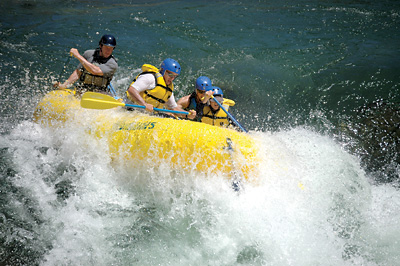
Photo courttesy of OARS (www.oars.com)
It happens season after season: By the time many California rafters and kayakers get into river mode, streams up and down the state are drying up and coming off the menu.
No doubt, we’re lucky to still have some great rivers that run into and through the summer, either via dam control or watersheds that hang high in the Sierra.
But if you appreciate variety in your whitewater diet, then spring is your smorgasbord. Not only do you have a bounty of rivers to choose from, but from March into June they’re usually at their peak ripeness, and that translates into sweet rapids and beautiful green scenery.
So get down to the pool to practice your roll, sort out your river gear, and start thumbing the guidebooks. The table is set. Get ready to dig in.
Here are eight tasty spring rivers to whet your appetite.
Cal Salmon River
Ask anyone who’s paddled the Cal Salmon and you’re likely to hear extended praise for this wild river tumbling through the Klamath National Forest near the Oregon border. “The Cal Salmon should definitely be on your to-do list,” says Jeff Kellogg of Clavey River Equipment in Petaluma.
Due to its remoteness, the “Cal Salmon” – so-called to distinguish it from the better-known (and easier) Salmon River in Idaho – is never crowded. With headwaters in the Marble Mountains and Trinity Alps, the river flows from the heart of the Coast Range into a bedrock gorge containing many Class IV rapids and at least three white-knuckle Class V rapids.
The most popular run, from Nordheimer Creek to Wooley Creek, is 10 miles long. But there are also great runs above – on the main river and on the North and South Forks – and below, from Wooley Creek into the Klamath River.
Bring your rain gear: This area can get upwards of 80” per year and spring storms are not uncommon.
North Fork of the Yuba
Draining the 8000-foot peaks near Yuba Pass, the North Fork Yuba is a medium-size river that offers up some tough rapids. The most common run is the Goodyear’s Bar run just downstream from Downieville, the well-preserved gold mining town turned mountain-biking mecca. Although mostly Class IV, this run includes the infamous Maytag, a Class V rapid with a big, sticky hole that any repairman would loathe to visit. Experts can take on 10 miles of river above, the Downieville Run, which includes the extended Class V sections of Moss Canyon and Rossasco Ravine.
There is plenty of good camping in this lush forested canyon along Highway 49. Bring your mountain bike for a multi-sport weekend.
Upper Sacramento
Despite the fact that it parallels Interstate 5, the Upper Sacramento River – 36 miles of river between Box Canyon Dam (Lake Siskiyou) and Lake Shasta – is a rewarding river experience both in terms of scenery and excitement.
Below Box Canyon Dam, the river run through a lush canyon of moss-covered cliffs with occasional side creeks and waterfalls, and nearly continuous Class IV rapids. The typical 12.5-mile day stretch serves up more than 50 rapids, providing nearly constant action. You’ll gain a completely different perspective of California’s mightiest river system; no longer will you think of it as just a big, slow, lumbering river flowing into San Francisco Bay.
Got a few extra days? Double up your adventures with a ski mountaineering trip to Mt. Shasta. When the river is running is usually the best time for climbing and skiing this magical mountain.
North Fork American
Just because you’ve been down the South Fork of the American on a scorching hot summer day with scores of other boaters, don’t think you’ve experienced the best the American River system has to offer.
The North Fork American flows through a deep, steep-walled canyon just a couple miles south of Interstate 80. It has become one of the classic advanced/expert runs in the state.
With its headwaters beginning at only 8500 feet near Squaw Valley, it fortunes are directly tied to the snowpack. Thus, once the ski resort closes, it’s only about a month or two before the river’s spigot is turned off and runnable flows are gone. With a good snowpack, you can usually count on flows between mid-March and mid-June.
The most popular run is the nine-mile Class IV Chamberlain Falls run. Just upstream is the 14.5-mile, for-experts-only Giant Gap run, which requires a two-mile hike down to the put in. If you don’t want to brave this Class V run yourself, there are a couple outfitters that offer guided raft trips. It’ll be a trip you won’t soon forget.
The Eel River
Coastal range streams like the Eel are often overlooked by rafters and kayakers come spring. But the rain-soaked Eel usually flows until June and offers one of the few long overnight float trips in California.
The Dos Rios to Alderpoint run (46 miles, 3-5 days) on the main Eel is a classic spring float with excellent scenery and a wilderness feel, despite the railroad tracks that follow its course. It features intermittent Class III rapids and numerous sandy beaches for camping.
Still more remote, the Middle Fork of the Eel is considered one of the best
Photo courtesy of Tributary Whitewater (www.whitewatertours.com)
long wilderness runs in California. It drains from a higher watershed of 7000-foot peaks in the Yolla Bolly Wilderness, thus its season runs a bit longer with the benefit of snowmelt. The Black Butte River to Dos Rios run on the Middle Eel ranges from Class II to Class IV over its 30-mile length. Got a full week? You can combine this with the Dos Rios-Alderpoint run for a float 76-mile float.
(Note: You’ll need to arrange your own trip on the Eel; there are no known outfitters at this time. A good resource is Friends of the Eel River, www.eelriver.org.)
Kaweah River
The Kaweah flows out of Sequoia National Park east of Visalia. It is one of the steepest rivers in the U.S., dropping nearly 11,000 feet from its headwaters in only 20 miles. Despite this, it is one of the lesser-known Sierra rivers.
The Kaweah deserves more attention from rafters and kayakers, as it serves up one of the most continuously rocking runs you’ll find. The common run starts at the Gateway Bridge on Highway 198, just west of the entrance station for the park. (Note: It’s illegal to kayak or raft inside the national park.) Amid large boulders, Class IV and V rapids greet you from the get-go. The action continues relatively unabated for six miles. You can take out here at the North Fork Drive bridge, but most trips float another four miles of Class II-III water (plus one IV) to the aptly named Terminus Reservoir.
East Fork Carson
Why would advanced and expert rafters and kayakers drive over the Sierra each spring to float the Class II Carson? Because it’s unique, it’s beautiful and it’s got hot springs.
Flowing eastward from Markleeville into Nevada, the Carson makes for an amazing overnight trip, with beautiful high desert ranch land views and camping spots with hot springs right on the river.
BONUS TRIP:
Illinois River, Oregon
The Illinois is in southern Oregon, but it’s about the same distance driving from the Bay Area as the Cal Salmon. A tributary of the Rogue River, the Illinois is considered by some guides to be their favorite trip in the world. Although similar in scenery to the Rogue, it has better rapids and fewer people. There are only two commercial outfitters and each is given only one permit per week.
The 32-mile run is rated Class IV-plus, with one Class V. Because it is entirely a rain-fed river and there’s no dam upstream, flows can drop out of runnable levels after extended dry periods. This is usually not a problem through April. Come May, it’s a bit more iffy.