Mar/100
Epicenter of Good Friction
Returning to the winter climbing mecca of Joshua Tree, where their knot was first tied, couple finds solitude a bit harder to come by
Words and photos by Bruce Willey

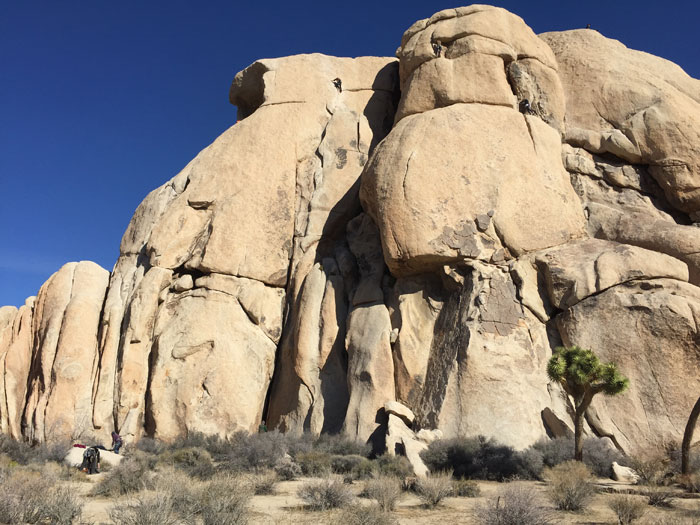
Caroline Schaumann climbs Headstone Rock in the evening light.
Trust the friction. I’m three or four body lengths above the last bolt, but who’s counting? All I know is if I my foot blows on this tenuous smear I’m going to go for the long slide. Trust the friction, my brain tells my climbing shoe again. Then inch up slowly in balance. There just might be a handhold above.
But there isn’t. Just an odious penny-pinching crimp of a hold. Here’s to the joys of a Joshua Tree 5.10 slab. A place where the cheap-ass, bad-asses of yore found it necessary to add a little spice to each climb by drilling ground-up and adding as few bolts as necessary. Then again, what would climbing be without a little bit of fear, without all those succulent brain chemicals swirling between neurons and altering perception?
“Looks slabolischious,” I hear my wife say, urging me on. Yet this encouragement does nothing to bring the next bolt closer. One more tenuous smear on the quartz monzonite nothingness and I’ll have it. Then another 20 feet or where the angle eases some to a big flake where I can sink some gear. I look down at my foot, amazed its even sticking to the steep slab. Then the next foot. No fortitude to stop and ponder. Just keep going toward the belay ledge where my sweet reward awaits. Trust the friction.
We’re out in the Echo Cove area, climbing Quick Draw McGraw (5.10a) one climb over from the famed, über classic Heart & Sole (5.10a). The Joshua Trees contort below into Dr. Seuss shapes, rhyming “Sam I am” with their funky shadows splayed on the granite dust in the late afternoon sun. I get to the flake, grabbing this nourishing hand jam for all it’s worth and look around. Easy liebacking leads to a comfortable belay where I am surprised to learn that instead of being awash in the Hallmark moment, I am simply relieved. After all, this ledge where I park my trembling mind and pull up rope is the exact same ledge I asked my wife for her hand.
Seems like a long time ago … or just yesterday. Hard to tell sometimes. Then again, when you do a lot of climbing you find yourself in one happy time warp after another. The only thing that’s changed is the baby Joshua tree that clung to this heart-shaped slab four years ago looks to be growing into a fine young adolescent tree. Calls to mind Willie Nelson’s line: “Ain’t it funny how time slips away.”
But that’s the magic of Joshua Tree. A place that scrubs the soul clean and slows the time, and for the rock climber, scrubs a whole lot else, too. The coarse granite that Josh is so famous for (read: tenaciously good friction) also scrubs the soles of your shoes and the tips of your fingers. And for the last three days we have bathed in the high desert light and slept under the blazing winter constellations.
Two weeks earlier we’d stopped at Josh to stretch our legs after our annual migration out West. Between rolling El Niño storms, we camped at the Indian Cove Campground (Helpful hint: At 1,000 feet lower than the campgrounds in the main park, it is usually much warmer), our usual Josh hangout. We woke at a leisurely pace, jettisoning city life and getting in tune with the rhythm of the desert with the help of coffee and peanut butter and banana sandwiches. With over 7,000 known routes and a guidebook that is almost as heavy as a big city phone book, we’d grab the rope and rack, drawn by the magnetic force of so much rock in this 850-square-mile national park. Now, we’ve been drawn back for more.
Climbers have been coming to Joshua Tree since the 1950s and it has slowly morphed into a world-class climbing destination. It’s not uncommon to step under a granite dome and hear a host of far-flung languages and accents, making for a Tower of Babel experience.
But all this love has come at a cost to the serenity and sanity of the place. (Hint number two: Go during the week.) Many of the classics, especially near the road, require a waiting list. And the wait can be long. For an area that prides itself on a hearty trad ethic and a ground-up approach, one can nearly shed a tear at all the top-ropes hanging from climbs. Sad, too, given that it was once considered a winter “training ground” for bigger climbing objectives. Joshua Tree probably did more for the free-climbing revolution, with climbers such as John Long, Lynn Hill, John Bachar — a list so long and heavy that to do any more name-dropping would ignite the nearby San Andreas Fault — than it’s given credit for.
Topping out on the Moose Dog Tower in Indian Cove on Third Time Is a Charm (5.10b) (Helpful hint number three: Excellent route and almost never crowded.) on a Saturday afternoon, one is likely to view what looks like an army of red ants swarming over the rocks far below. No need for alarm despite some Josh locals who insist that the place attracts the occasional UFO.
No, the ants are Boy Scouts all sporting red helmets. At first this is no cause for concern until you realize at least 25 out of a 100 of those pre-adolescent boys will inevitably become hooked on climbing. You can almost hear the faint shouts of things to come: “Dude, you dropped in on my climb. Go back to the beach.”
Still, it is easy to find some much-needed solitude from the masses with only a short jaunt into the backcountry. Walk back into the Wonderland of Rocks or out to Outer Mongolia, and you’ll feel like you have the whole place to yourself. Failing that, climb the roadside classics under the moonlight, an increasingly popular past time given the daylight crowds.
In any case, one remembers that nearly 10 million live a mere hour and a half drive away in Los Angeles County, not to mention the aptly-named Inland Empire a stone’s throw away from Josh with its four million or so masses. Such is the state of this good state of California.
We rap into the sunset, the rock still warm and blessed from another fine sunny day of climbing. Hard to believe it’s winter and we pity the poor East Coast souls from where we have come who are digging out from another snowstorm. We sit on the tailgate of the truck and pop a beer. A coyote pack wails in the distance. And we feel as though we might as well be the only ones left on this good earth.
Bruce Willey spent his childhood in San Bernardino when it was swaddled in citrus. He no longer recognizes the place when he returns. He currently lives in Bishop where he does manage to recognize the sublime beauty under the Sierra. See more of his photography at www.plumephotoproductions.com or writing at www.brucewilley.com.
Oct/091
The Highs and Lows of Slacklining

Story by Seth Lightcap • Photos by Kevin Walker
Shawn Snyder, Indian Cave Corridor, Joshua tree
Slacklining, the art of walking along one-inch wide nylon webbing, is a new school variation of circus style tight-rope walking. Born along chain link fences in Yosemite Valley, the sport of slacklining has become a recreational phenomenon enjoyed worldwide, from the beaches to the highest alpine spires.
A slackline gets its name because although the line is tensioned very tightly between two anchor points, it is not rigidly taut due to the dynamic nature of the nylon webbing. As you walk out on the line the webbing stretches underfoot and hence it feels “slack” compared to a rigid tightrope cable that does not stretch. The squirrelly and seemingly unpredictable movement of the line is what makes slacklining the ultimate balance challenge. Your entire mind, body, and soul are needed just to stay blanaced, let alone walk
the line.
The average slackline is set up between trees or posts at a beach or park and ranges from 15 to 100 feet in length. The tension of the line varies based on your equipment and desire. A tight line is easier to walk, but the rubbery bounce of a slightly looser line can be rewarding. There is always a great deal of energy in the line so getting aggressively bucked off is not uncommon. To avoid injury, most slacklines are set up within a few feet of the ground.
While rope walking has been around for thousands of years, the familiar art of slacklining along a taut length of tubular nylon webbing was invented in the early 1980s by two Yosemite rock climbers, Adam Grosowsky and Jeff Ellington. The pair picked up on the idea after walking along loose chain fences on rainy days in the Valley. Hooked on the challenge, they strung up old climbing webbing between trees around their campsites at Camp 4, the traditional campground for Yosemite climbers for over 40 years. Voila! The slackline was born.
In the summer of 1983, Adam and Jeff’s slackline antics started to draw the attention of other Yosemite climbers. Their attempt at walking on a steel cable across the gap between the Valley rim and Lost Arrow Spire, a 2900-foot deep chasm that’s 55 feet across, was especially impressive. Several more climbers began slacklining that summer, but only a select few really developed a passion for it. One of the most inspired was a young climber named Scott Balcom.
Returning to Southern California that fall, Scott and a few friends started practicing religiously and experimented with different types of slacklines. Soon Scott’s skills were dialed and he began focusing on the goal inherited from Adam and Jeff – to walk across the Lost Arrow Spire gap. For practice, Scott’s crew set up a 22-foot slackline underneath a highway that spanned an 80-foot drop. Using doubled lines for added strength, and harnesses and a tether to escape from would-be fatal falls, this “highline” was a first of its kind.
In 1984, Scott returned to Yosemite set on conquering the Lost Arrow chasm. Skilled but unable to escape his fear, the exposure proved too daunting and Scott was unsuccessful. Throughout the next year Scott trained both harder and smarter, focusing on visualization and distance perception. The training paid off and that next summer, in July of 1985, Scott became the first person to walk the gap from Lost Arrow Spire to the Valley rim.
Scott’s achievement stands proud to this day. Still the most coveted accomplishment in the world of slacklining, the Lost Arrow highline was not walked again until 1993 when Darrin Carter successfully crossed the span. Darrin would later up the ante even further by not only crossing the span in both directions, but also by crossing without a safety tether!
Though Adam, Jeff, Scott and Darrin were the pioneers, it was not until well-known rock climber Dean Potter stepped on the Lost Arrow highline that slacklining was seen in the public eye. Pictures of Dean slacklining in Patagonia ads introduced the sport to the masses and inspired the next generation of slackliners such as Shawn Synder, Corbin Usinger, and Damian Cooksey.
In today’s world of slacklining, the discipline has evolved two distinct specialities – lowlining and highlining. Lowlining is the style that a majority of slackliners enjoy because it can be practiced anywhere you can find two anchors and requires a lot less equipment. With little consequence for falling, lowlines also afford the freedom to attempt tricks on the line. The progression of lowline stunts is much like that of a gymnast on a balance beam – beginners work on moving smoothly through direction changes while the very best in the world execute front and back flips (taking off and landing on the line). Freestyle slackline competitions are even popping up where competitors perform a routine for judges.
On a highline, overcoming your fear to just walk the span is the goal. Highlines are significantly more dangerous as swinging falls can careen you back into the rock and the rigging of the line must be incredibly strong to withstand a fall midline. The exposure on a highline is immense and only those who can focus beyond their trivial fears will be successful. Despite the danger, the world’s best slackliners and rock climbers continue to push the boundaries of balance by walking highlines as long as 200 feet.
Slacklining is a graceful form of moving meditation and many regard its benefits to be Zen like. “Walking the slackline makes you look within,” notes accomplished highliner Shawn Synder. “Everytime I walk a highline it’s almost like a beautiful enlightenment … an experience that opens your eyes, softens your heart, and quiets you a little bit.”
Though rock climbers have been the foremost proponents of slacklining, walking the line can be fantastic training for any sport requiring balance. Professional surfers, snowboarders, and cyclists have taken up slackline training as a means of improving core strength and mental resolve. Walking the quivering line mimics riding through uneven terrain and improves your ability to control your center of gravity and stick to your path no matter the obstacle.
Whether you’re an aspiring surfer, climber, or Cirque de Soleil performer, learning to walk on a slackline will undoubtedly improve your performance. Part sport, part meditation, slacklining requires focus and commitment. Look for a slackline in a neighborhood near you or learn how to make one. Better balance is just a couple of wobbly steps away!