1
Jul/08
0

The Transportation Dilemma

By Jeremiah Knupp

Hybrid versus standard. Incandescent versus compact florescent. Disposable versus cloth diapers…green choices can be daunting these days.

Probably your single most important eco-decision of all is transportation. Driving ranks right up there with electricity as one of the top two causes of pollution that the average American contributes to the environment. But are buses or railways any better than automobiles?

The true environmental impact of anything can only be understood through what is known as a “lifecycle assessment.” When applied to transportation, a lifecycle assessment takes into consideration factors like the pollution caused by manufacturing, maintenance and disposal of a vehicle, along with the pollution from refining, manufacturing, and consuming fuel. It also considers the impact of the infrastructure a particular form of transportation requires, like road, track or runway construction and maintenance and refueling stations.

Luckily, there are professionals like Mikhail Chester who compute these things on a daily basis. Chester, a doctoral student at the University of California-Berkley, has spent the past three years assessing the lifecycle impacts of various forms of passenger transportation. When analyzing the impact of roadways, he takes in consideration everything from the diesel equipment used to grade the roadbed, to the toxins released during the paving process, and the chemicals used to keep the road clear during the winter.

Chester says that our current focus on fuel economy and tailpipe emissions is a good start, because 70 percent of an automobile’s environmental impact comes from its operation (60 percent for buses and 50 percent for rail). Overall, Chester’s findings rank light rail systems first, followed by buses, and lastly, automobiles.

Chester also notes that you can differentiate the environmental impact of various forms of transportation by the type of pollution they cause. For example, operating cars creates large amounts of carbon dioxide that degrade air quality, while operating a light rail infrastructure uses copious amounts of electricity, which causes sulfur dioxide, a component of acid rain.

Chester notes that his results are preliminary and must undergo a peer review for validation. But his results are some of the first from a lifecycle assessment that takes a broad look at passenger transportation.

“We’re quick to say ‘mass transit is the best,’” Chester says, “But a lot of times mass transit is put in place without study how it will be utilized. Buses or trains that are not being ridden are causing more pollution than a passenger car. But the more people that use mass transit, the more you divide that impact.”

But a light rail system isn’t going to drop us off at our favorite camping spot anytime soon. Chester feels our greatest hope for the near future is to improve the automobile infrastructure. If you live in a rural or suburban area, you can’t take the bus, but you can car-pool to work in a fuel-efficient vehicle.

“We can make automobiles less massive, sacrifice acceleration for fuel economy, and there’s no reason that every vehicle can’t be a hybrid,” he notes. “We have the technology to make automobiles better, but we’re just not willing to pay for it.”

When it comes to automobiles, Detroit has only given us what we asked for. In the United States, bigger is better: bigger cars, bigger wheels, heavier vehicles, larger engines, more horsepower. Tiny wheels and hatchbacks scream “broke college student.” Doctors and lawyers drive Cadillacs not CRXs.

Outdoor enthusiasts are not exempt from such car fetishes. Trailheads are typically crammed with rugged all-wheel-drive SUVs, prepared to tackle anything that Mother Nature can throw our way.

As a result, the average fuel efficiency for today’s auto fleet is actually less Henry Ford’s Model T, which got 28.5 miles-to-the-gallon nearly a century ago.

What about electric cars? They’re hardly zero emissions. Just because smoke isn’t belching out of the tail pipe of an electric car doesn’t mean that smoke isn’t spewing from the stacks of the coal-fired power plant that produces its electricity. A 2001 study in Japan showed that an electric vehicle whose power comes from a coal-fired plant will cause nearly as much CO2 pollution as a standard gasoline-powered car.

A lifecycle assessment also offers a harsh reality when it comes to bio-fuels like ethanol. The production and transportation of corn ethanol requires more energy than it actually provides.

We want a transportation “magic bullet,” but ultimately, reducing our environmental impact requires a lifestyle change. If you live in the city, use public transit. If not, buy a smaller vehicle. Combine trips. Car pool. Drive less. A 1955 Cadillac that gets 10 miles-to-the-gallon and is driven 50 miles per week has less environmental impact than a Toyota Prius that is driven 100 miles a day.

And it’s time to start investing in solar, wind, and renewable energy sources—for both our home and transportation needs. An electric car or bus that gets its juice from a wind farm or solar power site instead of a coal-fired power plant reduces its lifecycle emissions by over 75%. The answers, my friend, may indeed be blowin’ in the wind.

—Article courtesy of Blue Ridge Outdoors

1
Jul/08
0

Trail Building for the Long Ride

Fundamentals of Sustainable Singletrack Design

Words and photos by Seth Lightcap

From the coast to the Sierra crest, more terrain hungry mountain bikers are picking up shovels to improve old trails and create new classics each day.

But if you want to build something that will stand the test of time and countless tires without degrading into an environmental nuisance, you’ll need to follow the principles of responsible, sustainable singletrack design.

For help in assembling some essential guidelines for repairing and building trails, I’ve enlisted the expertise of several trail-building pros: Scott Linnenburger, director of field programs for the International Mountain Bike Association, and from Northstar-at-Tahoe, bike park manager Kyle Crezee and trail builder Kurt Gale.

While these tips won’t answer every dirty question you may have about trail construction, they will steer you clear of the most common pitfalls that plague deteriorating trails. If you’re serious about laying down an epic line that rips the same for the first rider as it does for the thousandth, read on.

Route Selection:

Choosing the right route is the most important element of sustainable trail design. You’ll need to carefully consider every inch of your intended line to guarantee good trail flow and avoid the ravages of erosion.

Start planning by asking questions about your available land. First, do I have permission to build here? “No.” Drop the shovel. Go ride elsewhere. “Yes.” Continue questioning … Where is the ideal trail head/end? How steep is the land? Where is the watershed? What natural features can I tie in? Of those considerations, slope and water are the most critical factors. Steep or flat, wet spots are the number one place to avoid.

Bombing a fall line can be fun, but most soil types cannot support the sustained braking. As a rule, the trail grade should be no more than half as steep as the slope the trail contours, with a maximum grade of 15 percent and an average grade of 10 percent.

To battle erosion, the IMBA recommends a strategy called “rolling contour design.” A trail designed with this strategy has an out-sloped trail tread (inside edge higher than outside) and follows a path that rolls and dips as it surfs across the hillside or ridge line. The intermittent uphill rolls kill speed and add flow while the out-sloped dips drain water. The dips are known as grade reversals. Place a grade reversal anywhere that water will potentially pool or flow down the trail.

Linnenburger swears by rolling contour design: “The end result is a trail that requires less maintenance, feels faster than it is, and lets you stay off the brakes.”

Finished planning? Dial in your layout by flagging the route then start trail cutting. The most durable contour trails are dug into the slope until the trail resembles a bench. Remember to out-slope your bench trails to shed water. As you continue cutting you’ll begin armoring problem areas and designing technical features. Only plan obstacles that feel natural to the location. The goal is always flow. Seek out trusted opinions. Northstar’s Bike Park thrives on cooperative creativity. “We use the rule of threes when making trail decisions: Three people have to agree on the design before any building begins,” says bike park manager Crezee. “Incorporating more riders builds better trails.”

Trail Armoring:

Naked dirt is like the skin on your shins. Both can take abuse, but with continued torment they filet open, fester with wounds, and heal with scars. Treat sensitive trail areas no different than your bony, exposed bits. Slap on the armor. Armor a trail by reinforcing the dirt tread. Areas where water or braking is inevitable should be the first places to protect. Typically brake-scarred locations include jump landings, steeps, and corners. Most armoring methods involve “paving” the trail with a layer or layers of rock. Location and rock access determine what technique will work best. Some areas need built up layers of rock; others you can get away with just flat boulders.

IMBA’s Linnenburger likes to use “five-man rocks” in landing zones. “If you can place two flat rocks that each take the effort of five people in an air landing your work is done.” When armoring with boulders make sure they are completely buried and immovable. If water is flowing underneath they will not stay in place. Building a grade reversal just before an armored section can help. Without access to rocks, wooden boardwalks and erosion-control matting can also make effective armor. If you go with wood, be sure to use rot-resistant lumber.

Building Technical Trail Features:

Technical trail feature design should focus on subtly blending elements into the flow of the trail, increasing the challenge while maintaining safety, and building a structure that can withstand years of weather and abuse. Here are a few tips on adding berms, ladders and logs.

Berms

Berms add serious fun to otherwise ho-hum corners. To build a berm that rides fast and requires minimal maintenance use simple geometry and rock-solid construction. Linnenburger has seen more than a few buzzkill berms and says turn radius is usually the culprit. “The most common problem with berms is that they don’t have a wide enough diameter. If the corner is too tight, riders will always hit the brakes entering and exiting.”

Braking shreds berms into nasty ruts. Wider corners allow more time to negotiate turns and less need to slow down. Choosing the best turn radius takes careful analysis of speed, slope, and soil type. Unless the corner is designed to control speed, bigger is usually better.

To withstand the forces of railing riders, a berm also needs a beefy retaining wall to push against. Building the foundation of the wall out of boulders is a good start. Gale, Northstar’s trail builder, suggests digging before building up. “It’s important to work into the hill. Dig the base of the berm into the dirt. Berm walls that are just piled will never last.” Finish the rock foundation of a berm, by covering and compacting with dirt. Armor the berm with flat stones or pavers if you can’t eliminate ruts.

Ladders and Logs

Ladder bridges and log rides are perfect for crossing wet terrain or adding trailside challenge. But if not built properly they are always the first features to die. Primary concerns are the durability of the wood and the strength of the supporting structure. For ladders, the best material to use is rot-resistant natural wood. As Northstar’s Gale says, “Natural wood will always last longer than your grandma’s old deck!” Ideal woods include cedar, redwood, white oak and manzanita. Avoid soft lumber such as pine. If you must use soft wood, use freshly cut pieces with the bark stripped off.

Here are a few ladder building gudelines:

  • Fasten decking pieces (riding surface) to stringers (lengthwise supports) no more than a few inches apart and within an inch of either side.
  • Supports should include cross and diagonal bracing.
  • Avoid letting wood touch dirt by armoring entrances and exits with rock.
  • Always use screws, not nails.

Log rides are simpler to build than ladders but materials and construction are still critical. Again, Linnenburger says the bigger the better. “Use the largest logs you can find. They will rot slower.” Logs should be securely embedded in the ground with stable entrances and exits built from rock. Shaving the log flat can also increase longevity as more riders will stick the log ride rather than fall off and gouge their pedals into it.

Respect and Maintain:

So your trail is complete. The ladders are bomber and the berms are buttery. Time to ride! As you’re riding, pay attention to how the trail conditions evolve. If you notice that a section is getting muddy or rutted don’t delay in repairing or re-routing. Respect the untold hours you put into creating the trail and put in a few more. The ability to easily fix problems before they ruin the experience is what sustainable trail building is all about. For further trail building tips, check out the IMBA’s comprehensive guidebook “Trail Solutions: The IMBA Guide to Building Sweet Singletrack.” To ride amazing trails, visit Northstar’s bike park in Truckee.

1
Jul/08
0

Still White as a Winter Moon?

Despite a couple lean snow years, Shasta’s glaciers bucking global warming trends – so far

Story and photo by Renee Casterline

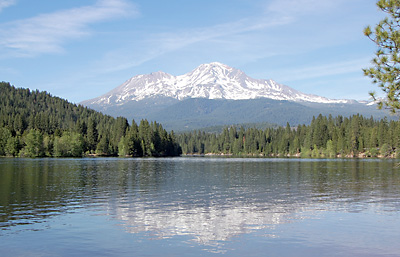
With its summit soaring 14,162 feet, Mount Shasta stands imposingly over the surrounding landscape, alone in its claim as the dominant peak of northern California. Unlike the highest peaks in the Sierra, Shasta has no peers on its flanks. It’s an absolute brooding, uncontested loner – a mountain “as lonely as God, and white as a winter moon,” as the poet Joaquin Miller memorably put it.

It is this solitude, this unrivaled claim on your attention, that brings into sharp relief just how barren the usually white-cloaked mountain has looked this spring and summer.

In mid-May, considered one of the prime climbing and skiing months, guides and rangers were bemoaning the summer-like conditions as the snow pack rapidly receded under the blowtorch of a week of 90-plus degree days. Looking up from the town of Mt. Shasta, narrow bands of snow were all that remained amid

thousands of feet of scree.

The scene was especially disheartening for climbers and skiers. It was easy to think global warming might be to be blame for the sorry conditions.

But you can’t draw conclusions from one season, of course, or even two; remember, last season’s snowpack was even worse. Indeed, things may not be as bad as they seem on California’s most prominent volcanic peak, where each year thousands of folks are introduced to the world of alpine mountaineering or come to earn their last turns of the season – sometimes six to seven grand of them in one epic run – on what many consider the best ski mountain in North America.

Glacial Enhancement?

According to a recent study by Ian Howat, a doctoral student in earth sciences at UC Santa Cruz, the Whitney Glacier on Shasta’s north slope, California’s largest, is, in fact, growing – not shrinking like most of the rest of the world’s glaciers.

By comparing photos and reviewing historical data, Howat and a team of four others arrived at the conclusion that the Whitney Glacier, the largest of seven on Shasta, has seen a 30 percent increase in size in the last 50 years.

But, as noted, you certainly wouldn’t guess that from looking at the mountain this year or last. And direct on-the-mountain observations indicate that, in last couple of years, annual glacial melt may be headed for the red.

As lead climbing ranger for the U.S. Forest Service in Mt. Shasta, Eric White spends more days on the mountain than not. He says last season the rangers saw creeks running later than normal despite the well below average snowpack, indicating increased glacial runoff. Perhaps just an anomally amid the overall growth of Shasta’s glaciers? Or perhaps a turning point followed by more lean years, rising temperatures and accelerated glacial receding? Impossible to say for sure.

But Howat’s team theorizes that the mountain’s glacial growth is likely a short-term phenomenon, the result of increased precipitation in the past half-century overcoming an increase in temperatures. With global warming, higher temps will eventually outpace precipitation, decreasing snowfall. This could result in near complete loss of Shasta’s glaciers by the end of the century, the researchers conclude.

Another Dry Year

Regardless of the bigger picture, a dry mountain makes climbing more hazardous, not too mention unpleasant. “This is the kind of mountain that you want to climb on the snow, because it’s all loose rock underneath,” says White, who’s also an avalanche specialist for the Forest Service.

This year’s snow stats have been far from encouraging: In May, after the driest spring on record, the snowpack at treeline was a paltry 51 percent of normal. And the upper slopes of the mountain were in even more dismal shape, according to Leif Voeltz, owner of The Fifth Season outdoor store in Mt. Shasta, which maintains a daily-updated mountain report (530-926-5555) for climbers and skiers, covering most routes and trailheads.

The big storms that hit early last winter were unusually cold, he noted. While they dropped lots of dry snow, the low-moisture content and high winds combined to leave the top portion of the mountain scoured. That has meant strikingly less snow on steep upper slopes for climber’s crampons to bite into and for holding loose rock in place.

Altered Routes

The fast waning conditions, estimated at least a month ahead of usual, were forcing guide outfits to alter their typical spring and summer climbing routes, veering away from some altogether.

Shasta’s most popular route by far is Avalanche Gulch. Sitting at the top of the Everitt Memorial Highway, the only paved road to treeline, Avy Gulch is easily accessible and technically easy.

“There is a reason that Avy Gulch is the number one route,” says Styles Larson, owner of Shasta BaseCamp and former guide for Shasta Mountain Guides (SMG). “It’s a gulch – you go in the gut and you come out the gut. It’s pretty hard to get lost.” Shasta’s total number of climbers has fallen back from the boom of the late 1990s when 10,000-12,000 attempted the mountain annually. The number of summit permits issued now averages 7,000-8,000. But the bulk of the

climbers, upwards of 80 percent, still head up the Gulch. If conditions like this year’s and last year’s persist, that may have to change to some degree. In mid June, the Gulch was in poor shape. Most climbers were taking an alternate route up through the Red Banks cliff band and even earlier than usual summit-and-descent times were recommended. By July, Voeltz said it would likely be completely cooked and off the list of wise options, leaving fewer routes for beginning climbers. (For more experienced climbers and those with a guide, Voeltz predicted the north side routes would be “fabulous with good, hard snow” through summer.)

Increased Rockfall Danger

Despite being less technical, Avy Gulch is highly prone to rockfall, as a group of 35 climbers with the Breast Cancer Fund’s Climb Against the Odds found out last July when they had to dodge a VW-sized boulder careening down, sending climbers scrambling and diving out of the way. Luckily, a smashed ice ax was the only casualty.

This year, Shasta Mountain Guides chose to stop taking trips up the Gulch by the end of May. “The Gulch is the most direct route, not the easiest, but it sees 90 percent of the traffic,” says Chris Carr, co-owner of SMG. “It’s a huge irony: it’s the most popular route on the mountain, but also one of the most hazardous.”

Shifting the Mess

In choosing to move their trips to other, less accessible routes on the mountain, the guide companies initiate a pattern of use that draws private climbers to those other routes like the West Face, Clear Creek on the east side, and glacier routes like Hotlum-Bolam. The climbing shops in town start telling independent climbers about those routes, shifting that traffic away from Avy Gulch. The Forest Service climbing rangers follow the climbers to routes on the east, west and north sides of the mountain.

David Cressman, a guide for Sierra Wilderness Seminars, worries about the stresses this dispersal of climbers to other routes puts on the mountain. “We’re going to see more impact as climbers spread out to those other trailheads,” he says. Maybe so. But as Mount Shasta’s veteran ranger, White says that cleanup on the mountain has greatly improved. With the instigation of the human waste pack out system in 1994 and efforts to educate climbers about Leave No Trace ethics, climbers are doing a much better job of leaving only footprints.

Some 2.5 tons of human waste are now hauled out to trailhead collection disposals annually. “Back in the mid ‘80s you could literally smell Lake Helen (a popular base camp in Avy Gulch) long before you got there,” recalls Voeltz of The Fifth Season, a former guide. There’s Always Next Year Crap is one thing we can control. Crappy snow is another we can not. And as any veteran mountain climber knows, weather and snow conditions are a bit of … well, a crapshoot.

SMG’s Carr isn’t convinced that the past two years of low snow indicate a new trend. He’s seen heavy snow years followed by dry seasons, followed by heavy snow years again. “If you look at Mount Shasta historically, we go through micro cycles of drought and then glacial growth,” he notes.

White also isn’t ready to start reformulating his approach to Shasta’s season yet. Under the increasing glare of global warming, Mount Shasta is fairing better than the Sierra, he believes, because the peak’s higher elevations and more northerly latitude offer cooler temperatures. But for how long? He speaks with the optimism of the avid backcountry skier that he is – an optimism no doubt shared by many other skiers and climbers. “I don’t think anyone has a great idea what’s going to happen next year. So I have no reason to believe that we won’t have a great season.”

1
Jul/08
0

The Last American Road Trip

Essay by Bruce Willey

It begins when you can leave town, when you leave your common sense, your guilt and a large chunk of yourself behind. It could be four years of pent-up academic frustrations. It could be the many years at a job that fleeces your ability to connect to the sweet simmering world. It could be simply that you want to let the road show you the pace. To hell with schedules, unwanted phone calls, the incessant hassles of life. To be immersed in the vicissitudes of flux at just a tad above the speed limit is nothing short of being loyal to the human spirit.

So your car or your pick-up truck is a little low in back with the tent, the sleeping bags, a Coleman stove and lantern, food, cooler, foam mattress, the beer and firewood. You will press on the accelerator and feel the precious gas pull you forward down the road. Nothing better than to see the gas gauge on full. So much promise and portent. And it begins with a full tank of gas. It always does.

But you’re guilty, as well you should be. Disbelief that you just paid well over $4 a gallon, enough to make you feel almost European. Disbelief that the oil in the earth will run dry just as sure as the mighty and seemingly endless Colorado River does not anymore empty into the Gulf of Mexico. You’ve got to do it now, now before it hits 10-15 dollars a gallon—because it will. Sooner than you think.

Common sense declares you would be doing your part to save the world by taking a long bicycle trip instead. You would. But a bicycle won’t make it to Utah in two days. So you promise yourself just one more road trip, one more time to see the ancient layers of red and tan rock carved by inches of time and water.

So you head due east, running up the flanks of the Sierra by noon. It would have taken John Muir a week to walk the same distance. Muir thought horse travel was too fast. But he knew the pleasures of wildflowers not asphalt. And besides, his former path to the Sierra is now blocked by Wal-Marts, Starbucks, and corporate farms, the air as polluted as the Los Angeles Basin. He’d be lost now, another visionary homeless man in a thumped and thrashed landscape.

You reach Yosemite’s Tioga Pass and drop down the eastern scarp of the Sierra, down into Owens Valley. At Big Pine you hang a left, and start ascending again to a narrow pass that will take you over the White Mountains, home to some trees that were already old when the Egyptians began building the pyramids. Then on into Nevada where you’ll turn right at a roadside brothel that has since gone out of business because most long-haul truckers have turned to their wives for love when it takes $1,000 to fill up on diesel.

Making Las Vegas by nightfall, you’ll camp at the Red Rocks campground. A cactus-covered hill will hide the swift creeping suburbs below, but the strip’s neon glow will still penetrate the night sky. In the morning you’ll take a long walk into the canyons of Red Rock and you will feel finally that you have reached the Southwest. The wildflowers will be blooming against the black desert patina and you’ll realize that life on earth is tenaciously bold.

Still, the alarming proximity of the city will begin to fray your nerves. So you will travel northeast through Arizona for an hour where you’ll indulge yourself with some Meat Puppets, a lazily stoned punk rock band that has musically articulated the desert better than any other band in the history of rock & roll. Once you cross the Utah border, you’ll turn off the music and let the tires and the wind take over the soundtrack. Two hundred or so miles the road weaves in and out of canyon lands, a rippling landscape so stunning and strange it seems to have the capacity to kidnap your soul.By afternoon you’ll head south into Moab where the economy, once dominated by the search for uranium to blow the world to smithereens, is now the mountain biking and motorized off-roading capital of the world. Mud splattered jeeps roar in and out of fast food joints. Motorhomes bung the highway with gas tanks that take a month’s pay to fill. Moab, a Mecca in the desert where people religiously worship the dirt road or file into guided raft trips down the Colorado River. All fueled by oil from another desert half a world and a white robe away.

So you head south, past the Hole-in-the-Rock tourist trap where you can pat a wallaby if you’re so inclined. Dipping down into Indian Creek you’ll camp for a few days amongst the junipers, the remnants of splitter cracks scabbed on your hands. You’ll build a bedroom with your tent and rocks for chairs in your open-air living room. You may even assemble a kitchen on a flat rock while the red sand slowly works its way into every cranny and hair of your body. And it will feel good; better still when you sit in the cold, mountain-fed creek.

At night you’ll make a campfire, noticing someone left their unpaid student loan bill ($38,984 due) and an outstanding medical bill ($567.34) near the fire pit. You use the bills for fodder and soon have a lively fire while you wonder about the guy who camped here before.

Next day the rain will come, bathing the sky with rainbows. The creek will come up to the floorboards as you cross it, and you will seek higher ground. So you head north to a place where desert towers stand like old, gossipy men. It will be impossible not to wonder what you will find on the tops of these summits, so you will tie into a rope and climb the ancient mud to a wild summit that ravens have vital knowledge of.

Nearing the top with 700 feet of air below your feet you think you could very easily die, especially when you are forced to belly flop onto a snout of mud-hardened rock. But you must put this thought out of your mind. If you had any sense you would remember that the world’s food supply is in trouble. The strung-out economy is a Wall Street minute from collapse. The earth’s climate is showing the strains of one too many road trips. It would do the planet a lot of good if you jumped. One less Toyota truck on the road. One less mouth to feed. One less carbon footprint. But you’re already gripped with your possible and immediate demise as it is.

As you look around, the Fisher Towers appearing as though they were made by a giant hand dripping mud from the sky, you want nothing more than to get down and drive home. To feel the road under your seat just one more time before the road trip simply becomes a thing of the past. So you rappel into what’s left of the late afternoon, knowing that this place may one day soon be too far, too expensive for your gas-driven reach.

1
Jul/08
0

High-Tech Hopes

Three Eco-Innovations that Could Save the World

By Graham Averill

In the midst of all false hype—and hope—surrounding corn ethanol and fuel cells, these three lesser-known innovations are gaining attention and research funding. Together, they represent some of the brightest opportunities for a green infrastructure, from the food we eat to the energy that powers our homes.

Nanosolar Panels

The trouble with solar right now is that it’s still too expensive. But not for long. The San Jose-based solar company Nanosolar has developed a low-cost, printable solar cell manufacturing process. Instead of the traditional solar panel, the Nanosolar product is a thin layer of photovoltaic film that converts light into energy. Powersheet solar cells cost one-tenth of conventional solar panels, can be produced at a much faster rate, and have proven to be just as efficient.

Traditional solar panels require silicon, which is increasingly rare, expensive to ship, build, and install. The silicon also has to be applied to glass, which exacerbates the shipping and installation woes. The cheapest conventional solar panels cost $3 a watt to produce. Nanosolar’s Powersheets cost only 30 cents a watt to produce, and are being marketed to the consumer at 90 cents a watt.

The company’s new production facility will churn out 430 megawatts of panels a year, more than all other U.S. solar plants combined. The first 100,000 panels are going to Europe for a 1.4-megawatt power plant. The company couldn’t have picked a better time to produce its technology: 2007 was the first full year for California’s Million Solar Roofs Initiative, which offers tax rebates for 100,000 solar roofs per year, every year, for ten years.

Test Tube Meat

In-vitro meat, (also known a laboratory-grown meat or cultured meat) is flesh that has never been part of a living animal. Scientists mix stem cells from a living or dead animal into a nutrient-heavy mixture. When the mixture is placed in a bioreactor, eventually those stem cells turn into muscle fibers. NASA has been working on in-vitro meat since 2000, but a growing number of scientists are pursuing a commercially viable form of test tube meat to help supply the world’s growing appetite for all things fleshy. People for the Ethical Treatment of Animals (PETA) has even offered a $1 million award for anyone who can develop commercially viable (and tasty) in-vitro meat by 2012.

Global demand for meat has doubled in the last 40 years and is expected to double again in the next 40 years. Meanwhile, Americans eat twice as much meat as the average earthling. All this beef consumption is an environmental nightmare. Thirty percent of the planet’s land is devoted to livestock production, a process that is responsible for a fifth of the world’s greenhouse gases—more than all of the world’s transportation infrastructure.

But greenhouse gas emissions are just the tip of the melting iceberg. 800 million people suffer from malnutrition on this planet, but 70% of all corn and soy we grow is fed to farm animals. The agriculture responsible for that corn and soy consumes half of all freshwater and contributes to three quarters of all our water pollution.

But don’t get too excited about in-vitro meat just yet. Right now, it would cost $1 million to produce a 250g piece of beef. It will likely be 20 years before we see a commercially viable in-vitro steak. The real question is: Will 20 years be enough time for Americans to get used to the idea of eating ribeye grown in a lab?

Feces Energy

Human excrement could hold the key to energy independence—at least for developing nations.

Sintex, an India-based plastics company, is investing in at-home biogas digesters to help solve India’s two greatest problems: a growing need for energy, and a desperate need to dispose of human waste. The small plastic domes turn human excrement and cow dung into fuel. Inside the plastic domes, bacteria breaks down the waste into sludge. Methane gas is captured and then used to provide gas for cooking and electricity. Household digesters in India will run about $425 and would provide enough gas for a family of four to cook all its meals while providing a byproduct that can be used as fertilizer.

It’s not likely that biodigesters will catch on in the U.S., where sanitation is paramount. However, larger models have been successfully employed to accommodate entire villages in India. And in Rwanda, overcrowded prisons are powered by feces digesters.

Several Western firms are developing similar technology that would turn hog excrement into biofuels. Untreated livestock manure poses a serious environmental threat to ground and surface water, and contributes to global warming through the release of methane gas. Belgium has installed a large methane digester on a major hog farm and six other systems are on order for farms across Europe. The U.S. could be next.

—Article courtesy of Blue Ridge Outdoors

1
Jul/08
0

The Active Activist

Dave Steindorf: “Couch Potatoes Make Lousy River Advocates”

By Pete Gauvin

Bringing water back to California’s rivers and protecting public access is no sedentary job

Although California is widely recognized to have some of the best and most plentiful whitewater boating opportunities in the world, by the time the mid-summer sun blazes over the tawny Sierra foothills there are precious few ribbons of froth left to run outside dam-control runs like the South Fork American and Tuolumne.

Over the last 10 years that’s begun to change thanks in large part to Dave Steindorf, California stewardship director for American Whitewater, a nationwide nonprofit conservation group that focuses on restoring rivers dewatered by hydropower dams, improving water quality and protecting public access.

Operating out of Chico, Steindorf, 47, helped secure the first releases in California for whitewater recreation on the North Fork Feather River in 2001. Despite this “critically dry year,” there will be three weekend releases on the North Fork this summer (July 26, Aug. 23-24, Sept. 27-28). AW also helped negotiate releases for the Tiger Creek section of the Mokelumne River (in May and June) and the Pit River (July 19-20, Aug. 16-17).

More runs may flow in the next few years. Steindorf is working on establishing releases and access on rivers from the McCloud to the Kern.

“There is something to be said for following your passion and donating your time to things you think will make a difference,” says Steindorf, a father of three who was an AW volunteer for years before joining the paid staff in 2005. “When I started this I didn’t think this would become my career. But it’s rewarding and important to feel like you’re going to make a difference for our kids and the next generation.

“There’s no better feeling than driving up along the Feather River and seeing more water in there and knowing I had a hand in that. And whether you get paid for it or are a volunteer, seeing a lasting impact like that is huge.”

A former high school economics teacher in Willows, Steindorf brings a unique skill set to his job. In addition to teaching (he has a degree in Economics and masters in Education from CSU Chico), his background includes working in outdoor retail and as a consultant working on recreation studies for hydro projects for several utilities in the West, including Pacific Gas & Electric and the Sacramento Municipal Utility District (SMUD).

Having sat on the opposite side of the table is a bit of an anomaly for a river conservation advocate. “It gives me a perspective from the other side,” Steindorf says. “A lot of this (negotiating water releases) is about building relationships with people and being able to work with a broad base of interests on all sides of the issue.”

“There certainly wasn’t any kind of prescribed plan to end up where I am now, but I think all my work experiences and interests combined to give me a good background for the job.”

His passion for rivers spools from a childhood passion for fishing, instilled while growing up in Cupertino. “My dad taught me to flyfish when I was 7 or so, and later I worked as a fishing guide up in Alaska.”

He didn’t start boating until he was in his 30s. “I had been interested in learning to kayak for a long time and it seemed like a great way to access rivers to go fishing.”

He got started in river conservation as a volunteer and club member of the Chico Paddleheads. He made a video titled “More Than Plumbing” that won the best amateur film award at the 2000 National Paddling Film Festival.

With American Whitewater, working predominately on hydro relicensing projects, he’s gained a reputation as a consensus builder. “Determining what information people need to use to make a conclusion is the first challenge,” he says. “There’s still plenty of stuff to argue on after we have a data set that we can all agree on. And if you can’t even agree on that, than we are lost.”

The Feather River relicensing process has been especially contentious over the years.

“We’re making some big changes in that flow schedule,” Steindorf says.

“There was a lot of criticism from other groups that these releases were causing harm to the ecosystem.”

“There are people who view manipulating the flow of the river for recreational boating as frivolous. Relicensing of the river that was not our first choice. We would prefer restoration of the river to provide boating access through the summer months but that would impact hydro power generation too greatly.”

“There are free flowing rivers out there that need to be protected at all cost … (But) the Feather is a system that has been significantly manipulated for more than 100 years, including pulse flows that were released throughout the summer, long before whitewater boaters came around … So this is somewhat like worrying about a dust spec in one eye while you have a plank stuck in the other.”

On the North Fork Feather, which includes the class IV-V Tobin run, Steindorf has been able to help convince agencies to provide more natural flows for the ecosystem and for boating. This means higher sustained releases with boatable flows (minimum 400 cfs in wet years; 300 in dry years) daily from May through July, while improving conditions for the overall ecosystem and meeting the needs for hydro generation.

The change in the flow schedule will not have any impact to the water levels at Lake Almanor, he stresses. “The water is coming down the system anyway it just gets put in the river bed.”

In the long run, education and getting people outdoors and into the canyons will determine whether river conservation efforts like this continue to succeed, Steindorf says.

“Most of our progress on the North Fork Feather has been due to our ability to educate the other NGO’s, agencies, and PG&E to the value of whitewater boating. However, the best way to improve people’s notions about whitewater is to get them on the river. Couch potatoes make lousy river advocates.”

1
Jul/08
0

Deeper Shade of Green

Top Five Ways to Take Green Living to the Next Level

By Graham Averill

Okay, you’ve changed all your light bulbs to CFL’s. Excellent. Now you’re curious about what you can do to color your eco-conscious lifestyle with an even deeper shade of green. Here are five tips guaranteed to make the most dramatic reduction on your carbon footprint. They require more drastic lifestyle changes than replacing your shampoo with organic botanicals, but given the alarming state of our environment, perhaps it’s time for something more drastic.

1) Eat Vegetarian: One of the most significant drains on our natural resources and contributors to global warming? Meat. The United Nations recently listed raising animals for food as “one of the top two or three most significant contributions to the most serious environmental problems at every scale, from local to global.” Growing animals for food is one of the most resource-intensive practices on the planet. Half of the fresh water consumed in America is used for livestock. Eighty percent of the agricultural land in the U.S. is used to raise animals and 70% of the grains and cereals we grow goes directly to feed farm raised animals, a process that is energy intensive. In fact, a third of all fossil fuels produced in the U.S. are used to raise livestock–which produce 130 times as much excrement as the entire U.S. population, excrement that ends up polluting our ground and surface water because a lack of regulations. The negative impact from the livestock industry is colossal, from the water we drink to the energy we consume to the 840 million starving people on this planet.

2) Eat Local: You’ve heard it before, but we’re going to say it again. On average, each ingredient on your plate traveled 1,500 miles from the farm to your belly. Eat a salad with the typical produce sold in most grocery stores, and that meal is responsible for possibly tens of thousands of petroleum sucking food miles. The solution? Cut back on products that are shipped from far corners of the world and concentrate on eating local fare grown within 100 miles of your home. Of course, the best and most local option of all is your own backyard. Plant a garden and enjoy the freshest, healthiest, and most eco-friendly fruits and veggies in town.

3) Recycle and Compost: Shockingly, only 33% of Americans recycle, which means those Earth Day specials starring Alan Alda during the ‘90s didn’t have a lasting affect on the population as a whole. We know in our gut that BRO readers already recycle their PBR empties, but what about composting? The average American produces 4.4-pounds of garbage a day–half of which is made up of organic material like food scraps, paper, and yard waste. Those same organic materials can be composted in inexpensive plastic bins, turning them into carbon-rich fertilizer for your garden. Between recycling and composting, you could feasibly cut your landfill production by 75%.

4) Walk: It’s the most simple thing you can do to reduce your carbon footprint, and yet it’s the last resort for most of us. Americans drive 12,000 miles a year on average, but 15% of all trips in the U.S. are less than a mile long. If we all substituted one short car trip a day with a walking trip, we’d save 8.4 billion gallons of gas and 8.2 billion tons of carbon emissions every year. If you can manage to drive ten fewer miles each week, you’d cut your personal carbon emissions by 500 pounds a year. Inventory the trips you make in your car and decide which ones could feasibly be substituted with a walk or bike ride. Develop a walking schedule and stick to it.

5) Consume Less: This could be the toughest habit to break. We are a species and a society that is obsessed with stuff. By the time we buy the iPod, we’re already saving for the newer, better version. “Reduce” is the first item in the old environmentalist’s mantra “reduce, reuse, recycle.” Yet America has more shopping malls than high schools. When the terrorists attacked, our president asked us to show solidarity by shopping. The average American consumes twice as much as we did 50 years ago and we spend 3-4 times as many hours shopping as Europeans. If everyone in the world consumed at U.S. rates, we would need five planets to house our goods and trash. Consuming less would have an overwhelming affect on the amount of goods produced, the amount of energy and petroleum used to produce those goods, and the amount of goods that end up in our landfills. www.storyofstuff.com.

Five More

These eco-suggestions may not have as big of an impact on global warming than the five solutions listed above, but you have to admire the innovation and level of commitment involved in each.

1) Eat Trash: A growing number of people have taken to rummaging through the garbage for food and other products in an attempt to minimize their impact on the environment. Dumpsters behind grocery stores are a hotbed of Freegan activity, as the stores are forced to throw away bread, canned goods, eggs, cereal, fruit…well before the food has expired. www.freegan.info.

2) Hitchhike: Are we really recommending you get into a car with a stranger? Not exactly. We’re suggesting you get into a car with strangers who share similar interests with you. Goloco.com is a social networking site for people looking to cut their gas consumption down by carpooling. Create a personal profile and find other commuters in your town who are religious fanatics, Obama supporters, or metal heads. www.goloco.com.

3) Vote for the Environment: The environment has gotten cursory lip service in previous elections, only to have the thunder stolen by topics like the economy and international affairs. This year, more than ever, remember that the environment directly affects big ticket items like the economy and the international relations. Log on to the League of Conservation Voters to see what environmental legislation is currently being debated in Congress as well as how Green your representatives have voted in the past. www.lcv.org.

4) Ditch the Catalogs: Twenty billion catalogs are distributed world wide every year, most of which are unsolicited. You probably get two or three random catalogs a week, which you either recycle or throw in the trash. Very few of those catalogs contain recycled paper. In fact, eight million tons of trees are cut down specifically to produce those unwanted catalogs. Check out Catalogcutdown.org for a service that will take you off the catalog mailing list (think: No Call Registry for junk mail). www.catalogcutdown.org.

5) Save the Bees, Save the World: One third of the fruits and vegetables we eat depend on honeybee pollination to thrive. It’s a disturbing figure when you consider 70% of the managed bee population in the U.S. has disappeared over the last decade. It’s called Bee Colony Collapse Disorder, and scientists aren’t exactly sure what’s causing it. A virus? Pesticides? Global warming? It’s anyone’s guess. You can help fight it by supporting honeybee research, buying pesticide free organic produce, and planting a native plant and wildflower garden. www.nappc.org.

—Article courtesy of Blue Ridge Outdoors