1
Dec/11
0

The Comforts of Ski Camping

Tips for keeping warm, hydrated and frost-bite free

Winter ski touring doesn’t have to be a sufferfest. In fact, with knowledge, preparation and the right gear, backpacking on skis in the dead of winter can be quite comfortable, says Mike Schwartz, an experienced winter camper and owner of The BackCountry store in Truckee. “I think ski touring in winter is actually a lot more comfortable than people think. Usually you don’t have to ski very far to feel like you’re deep in the wilderness — although skis can get you back to the car quickly if you do. Then you climb into your tent and sleeping bag and you’re warm and comfortable.”

Hot Water Bottles

The key is staying dry, Schwartz says, or if that’s unrealistic, knowing how to get dry. He recommends putting wet socks and gloves into your down jacket pockets and then your sleeping bag. “Filling a Nalgene bottle with boiling hot water will not only keep you toasty for hours, but speed up the drying process,” he adds. “I bring two. Camelbak-type bladders don’t help in this critical task.” You should be able to do most of your cooking and snow melting right outside your tent door, in the open or in a vestibule with ventilation, while still in your bag and down jacket. “Bring enough fuel to melt water and make sure your stove works well beforehand,” he warns. “If you’re using butane fuel canisters, they fi zzle out in the cold when they get low so just stick them in your jacket to warm them up. And protect your stove from the wind as best as possible to use less fuel.”

Cooking Inside?
Though not recommended by tent manufacturers for obvious liability reasons, Alpine Skills International, the venerable Truckee-based guide service, teaches students how to safely cook inside their tents using a hanging stove, and in the process provide some ambient heating. “The key is having good ventilation,” says ASI guide Logan Talbott, to protect against carbon dioxide buildup. This means at least two vents to provide cross ventilation, ideally one high and one low. The stove provides enough ambient warming that bulky insulation layers are usually not necessary to bring, helping to keep packs lighter and slimmer, he says. “We’re trying to keep weight down to a minimum so people can tour more comfortably and efficiently, and enjoy down skiing along the route.”

Bring a Garbage Bag
Another component of ASI’s interior-stove cooking and heating system utilizes a sturdy plastic garbage bag. Rather than going in and out of the tent to fetch snow to melt, ASI teaches campers to collect all the snow they’ll need for water and cooking in the garbage bag, compact it and bring it in the tent. By condensing the snow in the bag you get more water from it during melting, rather than heating air particles, saving fuel and weight through efficiency.

Photo by Josh Beddingfield

Over more than 30 years of guiding people in alpine environments around the world, ASI founder Bela Vadasz has found that the importance of having a steady supply of water and warm beverages without wasting too much fuel in the process cannot be
underestimated, not only for comfort, but for performance when climbing and skiing. When you’re at altitude in a cold, dry environment, performance and warmth are highly dependent on adequate hydration.

Camp Site Prep

When setting up a tent in the snow, ASI teaches students to dig out a platform and use the excavated snow to build a snow wall around the tent or at least on the windward side. This helps protect the tent in nasty weather and keeps it warmer and calmer inside. Trying to sleep in a wind-battered tent is challenging, to say the least, and potentially dangerous.

Tents need to be guy-lined to the ground or snow anchors, says Schwartz. Extra stuff sacks, filled with snow and buried, work well as “deadman” to guy your lines to. “Be prepared to dig a snow cave if you think it could really storm,” he adds. “Believe it or not, you will be warmer under the snow as you can expect it to be 32 degrees down there. And have good shovels and goggles to dig the hole. Probe around before digging to make sure it’s deep enough.”

Dreaded Wet Boots
For comfort the next morning and to guard against frostbitten toes and digits, ASI’s Talbott reiterates the importance of drying out your boot liners, socks and gloves in the tent or in your sleeping bag overnight. Even if not completely dry, at least they won’t be frozen solid when you stick your feet and hands in them. Bring some cheap VBLs (vapor barrier liners) — plastic bread bags work great — and put those over your socks before jamming your foot into your boots if your feet tend to sweat so much that it’s impossible to dry out your liners overnight. Wet boots, especially, will kill your motivation to get out of your bag in the
morning and ultimately turn you off winter camping quicker than just about anything else. ASI teaches these winter camping principles, and many other tricks discovered and honed from decades of experience in the elements, in their backcountry ski and snowboard programs.

Their two-day Sugar Bowl to Squaw Valley tour, in particular, is designed to introduce clients to ASI’s “high and light” ski camping system and serves as the ultimate prep for longer multi-day ski touring in the High Sierra and elsewhere. The Sugar Bowl to Squaw tour costs $365 and will be run on weekends in February and March this season.

See www.alpineskills.com for more information or call their winter offi ce at the Backcountry Adventure Center at Sugar Bowl at 530-582-9170.

For gear needs or advice, as well as recommendations on where to go in the Tahoe region, call or stop by The BackCountry in
Truckee (530-582-0909 or 888-625-8444), or check out their Tahoe Guidebook and Backcountry Forum at www.thebackcountry.net.
Pete Gauvin

1
Dec/11
0

Tahoe’s Ace Snowcaster

Bryan Allegretto, founder of Tahoe Weather Discussion.com, has earned a reputation as Tahoe’s most spot-on storm tracker

By Pete Gauvin

Allegretto with his son Jayce. Photo courtesy of Bryan Allegretto

For the past couple seasons, thousands of avid skiers and riders in Tahoe, as well as the resorts that depend on them, have been tuning in to an accountant to get their weather forecast.

And as you would expect from an accountant — if not necessarily a weatherman — Bryan Allegretto gets his number’s right, for the most part.

You see, BA, as he is known on his blog, Tahoe Weather Discussion.com, is not your average 31-year-old accountant. He’s first and foremost a snow-loving snowboarder who loves a good storm, and all the investigative work and calculations that go into calling one before it hits.

And it’s on that famously shaky precipice that he’s made a name for himself in the Tahoe region over the past couple years, particularly for his knack in making accurate long-range forecasts. All this, despite his lack of a meteorology degree.

From calling last season’s epic La Niña to predicting how many inches would fall at multiple locations around the Tahoe region from specific storms, BA has earned a reputation in the ski community as Tahoe’s most accurate, reliable and detailed weather forecaster.

But that’s not what he calls himself.

“I call myself a snowcaster rather than a weathercaster. All I care about is snow. I could care less what the weather is going to be. I just want to know when it’s going to snow next.”

It’s that sort of attitude that helps put him in alignment with the many fellow snow-obsessed outdoor enthusiasts that read his blog with regularity.

But it’s plainly evident that Allegretto brings a lot more to the table than just enthusiasm and an armchair-interest in weather. While he may lack credentials, his meteorological jetstream stretches back many years.

Allegretto has taken an active interest in weather since he was a grade school kid growing up in Ocean City, New Jersey, watching storms pound the coast. His father was responsible for calling in the local snowplow drivers when winter storms were brewing. It was helping his dad collect reliable data that young Bryan got his fi rst taste of forecasting.

He was hooked from then on and went on to major in meteorology at Kean University outside New York City. But after two years he took some time off to travel around the world, and having witnessed so much poverty in third-world countries, decided he should get a degree in economics instead, which he did from Rowan University.

___________________________________________________________________________________________________________________________
“The National Weather Service guys are not allowed to take the risks I do with long-range forecasts because they are so worried about accuracy … I don’t care about taking the risk. I can fall flat on my face, and it’s happened.”
___________________________________________________________________________________________________________________________

When Allegretto landed in Tahoe in 2006 to work as an accountant for Booth Creek, the former owner of Northstar-at-Tahoe and current owner of Sierra-at-Tahoe resorts, he found his weather nirvana.

“That’s when my finance career started to overlap with my weather interests … In Tahoe, snow falling from the sky is like dollars falling from the sky.”

Soon, he was doing forecasts for the offi ce and the sales and marketing divisions for Northstar and Sierra. “Eventually one of the marketing managers asked if I’d be interested in doing a blog on the Northstar site.”

That’s when things really started to, well, snowball. “There were people who didn’t even ski Northstar going to the Northstar site just because it offered a good forecast.”

It was this response that convinced Allegretto to start Tahoe Weather Discussion.com in December 2009. Last year was my fi rst full season and it was a doozy.

“Last season I honestly felt like quitting because it went on for so long … It started before Thanksgiving. I was blogging from October until the middle of June.”

Visitorship shot up fast. His site averaged about 3000 hits per day, and jumped to 8,000 during storm cycles. “I’m now up to about 10,000 visits per day,” he says.

His forecasting for ski resorts also grew. Last year he did forecasts for Northstar, Sierra, Alpine Meadows and Squaw Valley USA.

Allegretto and his wife Mikayla on Donner Summit. Photo courtesy of Bryan Allegretto

This year, Allegretto, who is married and has two young kids (ages one and three), is expanding his forecasts well beyond Tahoe by doing weather for Unofficial Networks, including their websites for resorts in the Rockies and the Northeast.

If that sounds like he’s going to be spreading himself thin, maybe too thin for his loyal followers in Tahoe, Allegretto says not to worry. “I’m always tracking everything (across the country) … The only place I haven’t really got a handle on are the Rockies because I’ve never lived there to experience them firsthand, but it shouldn’t take long.”

One reason why Tahoe Weather Discussion has become so popular is that Allegretto writes his blog in fairly plain English so readers don’t need a climate science dictionary to get a sense of what’s going on. “It takes a little more effort (to put it in lay terms),” he says. “It’s almost like translating from Spanish to English.”

But it’s his long-range forecasts that really set him apart from professional forecasters, such as those that work for the National Weather Service, an arm of the National Oceanic and Atmospheric Administration.

“The National Weather Service guys are not allowed to take the risks I do with long-range forecasts because they are so worried about accuracy and people relying on their forecasts,” Allegretto says. “I don’t care about taking the risk. I can fall flat on my face, and it’s happened.”

He cites the mistake he made last January, or “Juneuary” as many referred to it, when an extended six-week dry spell set in in the midst of the feisty La Niña winter.

Allegretto predicted the high-pressure ridge parked over California would break in a couple weeks.

“I put a lot of faith in the MJO (the Madden-Julian Oscillation index measuring seasonal circulation patterns), which acts kind of like a pseudo El Niño when it moves into the western Pacific … and can juice up the jetstream,” he says.

“My big mistake I made last January is that I thought the MJO would pull the ridge back (and the storm door would reopen). But what I learned is that when the La Niña is that strong it trumps the MJO and the MJO really has no affect on our weather.”

Last year was one of the strongest La Niña’s we’ve had and certainly the strongest Allegretto had experienced.

“When I make an error like that, I try to make a discussion out of it that explains, ‘Here’s why we were wrong.’ … But I’ve been blessed because I’ve been right eight out of 10 times.”

If he does go out on a limb and then recognizes that his prediction may not come to fruition, “I’ll slowly change the language in my writing so it’s not so abrupt. It’s kind of a writing trick.”

Though young, Allegretto considers himself an old-fashioned weather forecaster who looks at the oscillations and sea temperatures and other “teleconnections,” instead of just relying on computer models. “There are so many variables to consider,” he says. (There are links to all these forecasting tools on his website.) “Teleconnections are a way to take a chaotic atmosphere (and look for clues.) The weather is just chaos, but in this chaotic atmosphere we’ve been able to find some things that actually have some rhythms and patterns that happen over and over and over again.”

One constant is that when storms do come barreling straight off the Pacifi c, the Sierra is optimally positioned to make the most of them. “The cloud deck is not very high, often as low as 500 to a 1000 feet or so,” says Allegretto, “and as the clouds get lifted they cool. The cold air can’t hold as much moisture” and they get squeezed as they climb up the Sierra.

As soon as the clouds start dropping elevation and warming, precipitation amounts decrease. “That’s why in Truckee we can get a foot at Donner Lake and an inch in Glenshire only a few miles to the east,” he says.

That dynamic is repeated over and over again as storms march across the country. But as the first major range in line, the Sierra gets fi rst dibs.

“The West Coast is the biggest snowfall producing region in the world,” says Allegretto. “Anywhere from British Columbia down through the Pacific Northwest and Tahoe is going to get the biggest dumps in a season.”

It’s a recipe for 400 to 800 inches of snow a year — and a snowcaster’s nirvana.

1
Oct/11
0

Racing the Length of California

Former RAAM record-holder Paul Solon, 57, aims to break record

When it comes to long-distance cycling, few if any riders can turn the cranks as strong and as long as Paul Solon.

Though only three years from 60, Solon’s passion for the sport and his ability to ride at the limits of human endurance has not begun to wane.

In fact, the former Race Across America (RAAM) record-holder (LA to NY in 8 days, 8 hours; since broken) is more committed than ever and, he claims, as fit and capable as ever to establish new records.

Back in the U.S. after 10 years living and riding in Europe — including setting the record for racing across Europe (Norway to Sicily) and for racing the length of Italy — the former attorney from Marin County plans to begin in October with an attempt to shatter the record for time trialing the length of California, nonstop, from the Oregon border to Mexico.

The current record is 62 hours. Solon hopes to roll his front wheel up to Tijuana in around 55 hours or so.

“What’s it like being an elite athlete at 57 years old going after world records?” I ask him, reaching him on the phone while on a road trip through Colorado and New Mexico to survey high-altitude towns to plunk down for the winter to train after his California record attempt. He wants to attempt to reclaim his RAAM record at next year’s race, held in June.

“I don’t event think about it,” says Solon, driving his van/race-support vehicle through Colorado. “I feel like I’m getting better every year. I started late in cycling, at 34, and each year I’ve gotten better.

“If you start competing when you’re in your teens, it’s much harder to still be at it at 57 or 58 and not be burned out,” he adds. “A big part of training is how you feel mentally. If you don’t feel fresh and enthusiastic, you can’t stay motivated day in and day out.”

How do you balance work and training?

“I’m sponsored to a limited extent. I stopped working as a lawyer (about 11 years ago) and that made everything much easier. But I’m constantly looking for sponsors … I live a frugal lifestyle but I’m not suffering.

Solon’s route down California, approximately 900 miles, will follow Interstate 5. He’ll be riding on the highway much of the way, where allowed, except for a zone 30-40 miles north and south of Sacramento. After riding up the Grapevine, he’ll exit at Magic Mountain and ride secondary roads from there to the border.

The toughest part?

“For me it’s always getting to the starting line,” he says. “Once the race starts I’m in my element. … As far as the ride, the last 100 miles is always the hardest. You’re counting down every mile in your head and it’s always a bit of a guess knowing exactly how far the finish is.”

Will you sleep at all?

“No, I prefer not to, unless absolutely necessary … because you never know how you’re going to feel when you wake up.”

That’s a veteran talking … Good luck and rest up, Paul!

—Pete Gauvin

1
Aug/11
0

My Other Car is a Cargo Bike

Photo by Daniela Becker Gauvin

Sure, many cyclists can haul ass but can they haul anything else? Bikes like Yuba’s Mundo aim to change that

By Pete Gauvin

Admit it: Many of us in the outdoor sports world are cycling fiends. We ogle and fantasize about bikes according to our respective sporting dreams and aspirations, be they road, mountain, downhill, cross-country, cyclocross, triathlon …… or multiples there of.

I’ve been guilty of bike envy myself. Yet these specialized bikes, in addition to rarely being cheap, are often the ones we have to carve out time to ride. And “finding more free time” might very well be the most frequent lament in the universe.

Really, what more of us sportos need, or anyone for the matter, is a bike that fits into the fabric of our daily lives, a bike that allows us to ride more everyday, a bike that is not solely recreational but functional — whether it’s a run to the grocery store, hustling to work with all your supplies, picking the kid up at daycare a few miles away, shipping some bulky packages, or grabbing a 12-pack, some chips, TP, and oh yeah, a bag of dog food, from the corner market. Try to stuff that in your backpack.

Really, what more of us need is not a bike that can haul ass but one that can haul a lot more than that. Not only would it be good for us, it would be good for our communities.

The Mundo from Yuba Bicycles out of Sausalito is such a bike.

For not much more than the cost of a high-end suspension fork or a carbon-fiber wheelset, the Yuba Mundo ($1099 base, under $1500 fully outfitted) is a complete bike and a smooth ride that provides ultimate two-wheel, emission-free utility.

“There’s a pedal revolution in progress,” says Steve Bode, director of marketing for Yuba. “More people are wanting to use their bike for regular transport. The Mundo was created specifically so they can replace car trips with bike trips and to do that you need a bike that can carry four full grocery bags. On the Yuba you can.”

Bode adds, “A lot of people are used to riding bikes for exercise. They’ve got a road bike and a mountain bike, but nothing in their quiver that they can go to the grocery store with.”

Yuba Bicycles was founded five years ago by Benjamin Sarrazin, who helped launch another innovative Nor Cal-based cargo bike company, Xtracycle.

Whereas Xtracycle’s primary direction at the time was promoting its Free Radical frame extension to convert existing bikes into long-wheelbase utility bikes, Sarrazin started Yuba believing in the need to design a complete, rigid-frame bike that would be affordable and capable of handling significant payloads.

Rated for loads up to 440 pounds, Sarrazin says the Mundo can actually handle much more than that. Last year he hauled 544 pounds of food donations on his Mundo during the annual San Francisco Street Sweep Food Drive.

One of the unique things about the Mundo, which also helps keep the cost down, is it only comes in one size. With a low stand-over height, a long seatpost, and an adjustable stem it can accommodate riders from 5-feet tall to 6-foot-5. Virtually any one in a family can use it with a quick seatpost adjustment.

It really is comfortable, too. After riding the Death Ride in July on a whim, and on my less than ideally geared ‘cross bike, the Mundo was the only bike that welcomed my sore ass, neck and shoulders for the following week.

While the Mundo may be a utility bike that doesn’t mean it’s not fun to ride. It’s upright and with its long wheelbase has a surfy feel, sort of like a Harley without the deafening pop-pop motor. And like a pickup truck or an SUV, the Mundo rides even smoother with weight in it. A SRAM 21-speed drivetrain lets you tackle hills with surprising capability. And big platform pedals allow you to hammer no matter what footwear you’re wearing. Simple. Beautiful. Functional.

Practical considerations aside, the Mundo is also a great tool for recreational endeavors. Sarrazin himself is a former professional whitewater kayaker (he named the company after his favorite river) and is now a sponsored stand-up paddler, who regularly hauls his 12’6” Boga raceboard on his Mundo. Rather than sitting in traffic, just getting to your destination becomes an enjoyable part of the experience.

Think you might need a little power assistance? There’s a new electric version, the elMundo ($2,597 before accessories), which can cover up to 20 miles between charges. (The power kit can also be added to a standard Mundo for $1350.) With the ability to carry two kids and up to six bags of groceries (like the Mundo) and the assistance of electric power boost, Yuba bills it as an alternative to the minivan.

There are other longtail cargo bikes on the market: Extracycle now makes the Radish (starting at $999) and offers the Surly-made Big Dummy ($1849), and mainstream manufacturer Kona offers the Ute ($1099). But perhaps none are as strong, smooth and capable as the Mundo for the price.

If you make the leap, don’t skimp on accessories. At least one cargo bag, tie-down straps and a dually kickstand are mandatory for functionality and ease of use. “A utility bike without utility accessories is not very valuable,”” says Bode.

Despite or because of the poor economy and high gas prices, Yuba’s business has been tripling each year, according to Bode.

There are three benefits Yuba hopes to foster with its cargo bikes, he says:

Providing an affordable, useful alternative to car trips that significantly reduces emissions.

Improving communities by getting people out of their cars, reducing traffic and parking congestion, and creating a more inviting streetscape.

Providing a sense of well being and incidental fitness that are byproducts of commuting by bike.

That last point may pay off when you finally find the time to hop on your race bike. Remember: Cycling is not just a sport, it’s a legitimate and liberating form of transportation. You might as well put in a few miles doing the things you have to do, rather than waiting for free time to make more of itself.

____________________________________________________________________________________________________________

Yuba Mundo at a Glance

•                  One size fits all

•                  Steel frame, chromoly sideloaders

•                  SRAM 21-speed drivetrain

•                  V-brakes (disc brake capable)

•                  Strong 48-spoke wheels with 14mm axle

•                  Fenders, back deck and bell included

•                  Capacity 440 pounds plus rider

•                  Length 6.9 feet, weight 55 pounds

•                  $1099 base, under $1400 with key accessories

Key Accessories:

•                  Go-Getter Bag ($119), holds lots and weatherproof

•                  Stand Alone dual-leg kickstand ($77), eases loading/unloading

•                  Utility Straps ($20), 9-foot cam straps for attaching boxes, kayaks, surfboards

•                  Deflopilator ($22), keeps front wheel straight when parked

•                  Soft Spot ($30), padded seat for passengers

•                  Peanut Shell childseat ($159), the Mundo can accommodate two

For more info: yubaride.com

1
Apr/11
0

SLO Motion Appeal

Find trails to ride at mountainbikeslocountry.com. Photo: All Out Events

San Luis Obispo beckons outdoor athletes, car not required

By Pete Gauvin

As the halfway point between the Bay Area and Southern California, San Luis Obispo has always been a psychological midway station for Highway 101 travelers headed north and south.

But what dashboard drop-ins might not know is that San Luis Obispo, “SLO town,” has become a bit of a Central Coast petri dish for multi-sport athletes, cyclists, and outdoor adventurers of all stripes.

It’s easy to understand why when you consider the healthy ingredients that shape this easy-going community of 44,000:

•    It’s a bike-friendly college town with a vibrant downtown core.

•    It has a mild year-round Mediterranean climate moderated by its location 11 miles from the coast.

•    There’s lots of protected open space (6,500 acres) with running, hiking and mountain biking trails in and around town, even rock climbing.

•    Miles of great cycling roads bleed away into the countryside and along the coast.

•    From Pismo Beach to Morro Bay, the coast offers surfing, kiteboarding and kayaking.

•    Several inland lakes provide a place to cool off and a swim venue for triathlons.

•    A number of established events, including adventure races, road and off-road triathlons, and century rides, provide competitive motivation for local and visiting athletes.

In recent years, SLO-town’s rich outdoor sports culture, particularly in regard to endurance sports, has fomented into such a viral bloom that one might be more apt to call it “SLO-twitch town.”

It’s evolved, and/or been discovered, as the ideal training ground and proving ground for endurance athletes.

Need evidence?

HTC-Highroad, the most successful team in pro cycling the last three years, is based here.

Need verification?

“SLO is a very outdoor-fitness friendly location in general,” says Yishai Horowitz, founder and director of All Out Events, which produces the Central Coast Adventure Challenge and other races in the county (www. all-outevents.com).

______________________________________________________________________________________________________________

“SLO town caters to bikes like Arizona caters to concealed weapons — they’re everywhere and encouraged.”

______________________________________________________________________________________________________________

“You’ll find impromptu local races and rallies of all kinds, including peak-bagging challenges and hilltop criteriums. It’s just the mindset of those who settle here and take the pay cut for the inspiration that the coast, the lakes, the peaks, and the valleys give you,” adds Horowitz, a graduate of Cal Poly San Luis Obispo who chose to make it his home after getting his degree.

Need more?

Come and see for yourself. Spring may be the best time.

While SLO’s outdoor virus may be contagious, it’s unlikely to compromise your immune system.

By Road or Rail

Whether you live in Northern or Southern California, it’s a relatively easy drive, as you only have to go roughly half way toward the other and you’re at your destination.

But before you load the car, consider leaving it behind.

Amtrak provides daily service on the Coast Starlight train from the Bay Area and Los Angeles, as well as twice daily on the Pacific Surfliner from San Diego. And the station is just a few blocks from downtown.

Whatever you do, bring your bike (or bikes) with you.

SLO town caters to bikes like Arizona caters to concealed weapons — they’re everywhere and encouraged. There are bike boulevards, bike lanes, bike signals, bike racks and even bike valets; the SLO County Bicycle Coalition offers a free bicycle valet service during the Thursday night Farmers’ Market.

There are also deals for cyclists.

Book your Amtrak ticket through SLO Car Free (slocarfree.org) and get 20 percent off. Discounts are also available on lodging (10-30 percent off). Or in the case of the Petit Soleil B&B hotel near downtown, you can get a free cruiser bike rental with your stay.

Suds and Sustenance

Sure there’s lots of wine tasting in the region, but right downtown you can sample beers from the Central Coast Brewery while the mechanics at Cambria Bicycle Outfitter next door tune up your steed after a day in the saddle. Have a pint or try five beers for $5. The brewery’s tasting room is like a living room with taps, a big screen and free WiFi.

Prefer your brew caffeinated or need a quick bite, you don’t have to go far. At the same full-service address as the brewery and the bike shop (1422 Monterey St.), the Outspoken Café offers coffee, lunch specialties and fruit smoothies.

Two other downtown cafés, both funky and bike-friendly, deserve mention: Kreuzberg, CA, which serves Verve Coffee, sandwiches and wraps; and Linnaea’s Café, which features organic coffee drinks, baked goods and vegetarian eats.

For something heartier, the Creekside Brewing Company offers good pub-style comfort food and hand-crafted beers in a laidback atmosphere next to the creek.

The Central Coast Adventure Challenge is May 14-15. Photo: All Out Events

Hiking, Trail Running, Climbing

The most popular hiking area is Bishop Peak, which overlooks town and offers views toward Morro Bay. It is the highest peak (1,559 feet) of the Nine Sisters, a chain of nine volcanic plug peaks stretching from SLO to the famous Morro Rock. (Note: “The Nine Sisters” are also commonly referred to as the “Seven Sisters,” leaving two sisters unaccounted for.)

The Bishop Peak Trail is two miles long to the top and moderately steep with some switchbacks. Dog friendly. No mountain bikes. Beware of poison oak.

Bishop Peak is also the top local climbing area, offering a surprising range of climbing — sport, trad, bouldering, and top rope — on three main crags: P-Wall, Cracked Wall and Shadow Rock.

For trail running, a popular spot is the Johnson Ranch Trail, a 3.5-mile loop that starts close town at the trailhead at South Higuera Street and Ontario Road. Bikes are welcome, too.

In spring there’s a nice hike in Reservoir Canyon Natural Reserve to a couple of waterfalls. The trail is just over six miles roundtrip.

Mountain Biking

There are a number of good trails close to town and a wealth of trails throughout the county. A good online source for most all of the legal ones is Mountain Bike San Luis Obispo County, mountainbikeslocounty.com. Nearly 30 riding areas are profiled and separated into central, north and south county zones.

Highlights include the riding right above town on Cerro San Luis, commonly called “Madonna Mountain” because of the large “M” branding the side of it. But it might as well stand for “Mistaken” because it was actually put there by Mission Prep High School in 1966.

Regardless, there’s good fire-road and single-track riding, with great views toward Morro Bay and south toward Pismo Beach. After a two-mile climb to the top, you can drop down the challenging Rock Garden Trail and eventually hook up with the sweet single track of the Lemon Grove Trail.

West of town, Montana de Oro State Park, a half hour drive through the charmingly funky seaside community of Los Osos, has a bunch of smooth singletrack riding in the hills overlooking the coast. Montana de Oro is also home to great hiking and the best camping in the area. The campground has 50 sites and is right across from a great little beach called Spooner’s Cove.

Road Riding

The San Luis Obispo Bicycle Club, slobc. org, which started 40 years ago, has a full ride calendar for all abilities and dozens of suggested rides. For rides averaging 20-30 miles, look at the “SLO Poke Rides.” For longer rides, generally 30-50 miles, check out the “Favorite Rides.” For some classics, check out the “Great Rides” and “Founder Rides.”

Choose a coastal route if it’s hot inland or ride out to Lopez Lake, which has good swimming.

The second annual Morro Bay Triathlon takes place on June 5. Photo courtesy of All Out Events

For a substantial ride with climbing leaving right from town, try Cuesta Grade, a favorite loop ride just over 60 miles in length with 4,000 feet of climbing. It heads north, paralleling Highway 101 inland at first, up Cuesta Grade, and then loops west and south toward Highway 1 and Morro Bay, and back to San Luis.

The bike club hosts two century rides a year, the Wildflower Century (April 30; sold out) and the Lighthouse Century (Sept. 24; registration opens June 5).

In October, San Luis Obispo hosts the SLO Gran Fondo (Oct. 15, slogranfondo.com), which started last year and allowed weekend warriors to ride with pros from HTC-Columbia. The ride has 25, 50 and 100-mile course options.

Outdoor Events and Races

The San Luis Mountain Run 10k and 5k will be held April 17. The trail race begins at Laguna Lake Park and circumnavigates Cerro San Luis. The 10k has an elevation gain of more than 1,000 feet, and is co-sponsored by Trail Runner magazine. (www.slomountainrun. com)

The 9th annual XtremeBigAir Kiteboading Expo will be held April 22-24 in Pismo Beach (xtremebigair.com/kitexpo). Demo the latest kiting and stand-up paddling gear, or sign up for rider clinics.

Central Coast Adventure Challenge, May 13-15, is a 12-hour adventure race held on 14,000 acres of private property. There’s also a shorter Adventure Sprint race of 2-4 hours. (www.ccadventure.com)

Stage 5 of the Amgen Tour of California finishes in Paso Robles, 30 miles north of SLO, on May 19, after a 139-mile jaunt down the coast from Seaside.

The Morro Bay Triathlon on June 5 features a bay swim, epic road ride and beautiful run. Both Olympic and Sprint distances are offered. (www.morrobaytri.com)

The Lopez Lake Adventure Challenge, June 18-19, features a 6-hour adventure race on June 18 designed to bridge the gap between sprint races and 12-hour dawn to dusk races. On Sunday, there’s a 2-4 hour sprint adventure race.

The first annual Ancient Peaks MTB Classic on July 23-24 will be hosted on the 14,000-acre Santa Margarita Ranch, 20 minutes from downtown SLO. With more than 30 miles of trails, it promises to offer some of the best cross-country and downhill races in California. (www.ancienpeaksclassic.com)

Scott Tinley’s Adventures (www. tricalifornia.com) is a weekend full of multi- sport races Sept. 30-Oct. 2, held at Lopez Lake. The weekend includes four on-road triathlons (Long Course, International, Sprint and Kids) and two off-road (Extreme and Sprint), plus mountain bike hill climb time trials.

Just remember, racers, you gotta go SLO before you go fast!

1
Apr/11
0

A Current Event to Celebrate!

A contestant in the Brush Creek “Extreme Slalom” at the 2010 Kern River Festival. Photo by Tobin Josif.

Paddle, party and soak up the good vibes at a river festival this spring and summer

By Wendy Lautner and Pete Gauvin

It’s two o’clock in the afternoon and I’m sitting on a hot rock overlooking an aquamarine river swilling a cold Sierra Nevada Pale Ale. Hot air drifts up the canyon as if someone just opened the furnace door. It feels good because my skin is still cool from hours spent soaked in river water catching eddies, setting angles, and paddling hard through the river’s adrenaline-surging rapids.

I’m surrounded by some of the most fun- loving, energetic and down-to-earth people I know. Sam and Robby rig up a zip line across the river. Kate excitedly tells stories about the day’s accomplishments and close calls. Moriah, five months pregnant, cuddles into her husband, Jared, who laughs with the boys about the day’s lines. Keith, one of the organizers, stands at the dirt road above the river and scans the bikini- and-board-shorts clad group, smiling at the scene. I’m pretty sure he’s thinking about what time the band will show up.

Such is a slice of the atmosphere to be found at an annual calling that is the wacky Tupperware party of paddling culture — the river festival.

The major differences: You can sit in these plastic tubs, the skirts are neoprene, men outnumber women, and the lids go on your head. There’s also usually some friendly competition — freestyle kayak comps, downriver races, slalom races, raft races —followed by foot- stomping merry making.

Often river festivals are merely about celebrating that water flows and tumbles and churns down beautiful canyons, and the fact that it’s a whole lot of fun to share the experience of challenging it with others.

That’s why spring is the annual seal launch for river festivals. There’s plenty of water and the excitement is just as high.

______________________________________________________________________________________________________________

“River festivals aren’t always such a grand production. Sometimes it’s little more than a minimally advertised get-together at a campground beside a river.”

______________________________________________________________________________________________________________

The biggest and best known of these in our region is the Reno River Festival, which draws huge crowds to the banks of the Truckee River in downtown Reno over three days in May. It’s a great event featuring world-class paddlers, live music, introductory kayak clinics, a lively outdoor expo, a costumed mud run, and a variety of other distractions.

But river festivals aren’t always such a grand production. There aren’t always big name sponsors and organized competitions. Sometimes it’s little more than a minimally advertised get-together at a campground beside a river.

As long as it floats is the theme of the Hooligan B.Y.O.B. — Build Your Own Boat Race at the Kern River Festival. Photo by Gary Valle, PhotographyontheRun.com

Since rivers are in limited supply and the water that runs through them faces a gauntlet of competing straws, there’s usually a preservation and protection component along with the fun — such as a river cleanup day, benefits for advocacy groups such as American Whitewater and Friends of the River, and support for restoration and public-access projects.

There’s one constant throughout all river festivals and that’s the idea that when you get a bunch of river lovers together it’s a memorable time made up of easy laughs, positive vibes, and a motivation to get wet and challenge the elements, along with each other.

Every fall and winter we go our separate ways – some of us chase summer around the globe, some of us trade weekend river trips for ski trips, but every spring and summer we reunite. Some of us bring new friends. Some of us even bring newborns. We come back every year to celebrate the river and to connect with each other.

Whether you’re new to the scene or a veteran river rat, all you have to do is show up with an easy smile and an excitement for the river environment and you’ll find a welcoming community at a river festival that feels like a group of old friends.

California/Nevada River Festivals:

Kern River Festival, April 15-17 — Kernville has got one heck of a river that runs right through town plus two of the most incredible tea-cupped steep creeks in California just a throw-bag toss away. This venerable festival hosted by the Kern Valley River Council, is in its 47th year but seems to be undergoing a fresh growth spurt. One reason is the addition of screwball events like the Hooligan B.Y.O.B. — Build Your Own Boat Race, open to all skill levels paddling make-shift craft that float, at least initially. Last year 14 boats participated. More than 50 are expected this year, its second. Another is the growing momentum behind the effort to restore Riverside Park, where the festival is held, and improve the whitewater park, a project now in the permitting process that’s expected to cost over $1 million and take a few years to complete. Also new this year is a gear swap, free camping for registered boaters and a stand-up boarder cross race. For hardcore boaters the highlights will continue to be the slalom race, the first of the 2011 Sierra Cup Series, and the thrilling Brush Creek Races over a series of natural, breathtaking waterfalls. In addition to the Downriver Race, there’s also an Extreme Slalom that requires boaters to negotiate obstacles such as a roll gate and a paddle toss. More info at www.kernfestival.org.

Reno River Festival, May 6-8 — Downtown Reno’s Wingfield Park becomes a flurry of activity when the River Festival rolls into town. This world-class event features freestyle competitions, boatercross races, skills clinics, stand-up paddleboarding, sidewalks filled with food and beer vendors, yoga in the park, a double-dutch jump roping championship, and the Biggest Little Homebrew Challenge plus much, much more. www.renoriverfestival.com

The Really Cool Auburn River Festival, May 20-22 — Last year’s inaugural event was so much fun the Auburn gang teamed up with the folks in Cool to make this year’s event on the North Fork of the American River even better. Races, freestyle comps, raft trips to benefit Friends of the River, food, live music, camping and good ole fun in the sun. Visit www. auburnriverfestival.com for details.

Cal-Salmon River Festival, May 27-30 — This annual Memorial Day Weekend festival is a paddler’s festival for kayakers and rafters on the Class IV-V Cal-Salmon in Siskiyou County. For more info, www.visitsiskiyou.org, www. turtleriver.com, or stay tuned to boof.com for kayaker-specific details.

American River Festival, Sept. 9-11 — The 30th annual American River Festival includes whitewater rodeo and slalom competitions, but also places a special emphasis on families enjoying the river. Proceeds help support American Whitewater, Friends of the River, the American Canoe Association and American River Conservancy. Visit www.americanriverfestival. org or currentadventures.com for details.

Feather River Festival, Sept. 24-25 — The 21st annual Feather River Festival is held in late September to coincide with the end-of- summer water releases on the North Fork Feather’s Rock Creek and Tobin runs. It features a downriver race on the Class V Tobin run, a slalom event upstream, and a raucous party Saturday night. The festival is a fundraiser for American Whitewater and is hosted by the Chico Paddleheads so you know it’ll be a good time. www.chicopaddleheads.org

Stay Tuned:
Not all river festivals happen annually or have an organizing committee and a website, since, well, river people tend to be a go-with-the-flow bunch. For more impromptu river fests, you’ll find this season’s best information in the eddy lines on the river! Or surf over to boof.com, the message board for the California whitewater community, to keep posted on the latest tricklings.

1
Apr/11
0

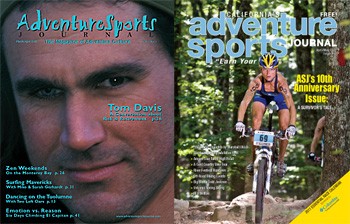
10 years of Adventure Sports Journal

Ten years ago Adventure Sports Journal was inspired by a Sierra climbing trip gone bad. Matt Niswonger and Cathy Claesson were a husband and wife team off route, lost, cold and hungry. But they pulled together, solved one problem at a time, and made it back to Highway 120, albeit miles from where they parked.

By the time they got back to the car the frustration turned to sheer joy. As they drove home the climbing experience crystallized into an epiphany about the magic of such “deep play” in the Sierra. One could do worse than to devote one’s life to such matters. Why not this quirky husband and wife team? Teachers by trade, how could they live closer to the richness of such adventures?

On the car ride home, Matt convinced Cathy that they should start a magazine that would offer a unique forum for other adventure enthusiasts in California to share their own stories of adventure, hellish or not. Traditional media at the time rarely covered nature-based outdoor sports with the possible exception of skiing. This new magazine intended to fill that void.

They settled on a name, put a mock issue together, and thought they were in business. Little did they know there is a lot more to publishing then a masthead and boundless enthusiasm. Media kits, demographic studies, CPM’s, printer contracts, distribution routes — the mysteries were many and they needed help. They took on an editor, Christa Fraser, as a partner and got some tentative advertising contracts with local businesses.

Nearly eight months later, 7,000 copies of the inaugural issue of Adventure Sports Journal were spread around Northern California from the back of a couple of barely running station wagons. It was truly a grassroots effort.

Since then, ASJ has become a favorite resource for a diverse and dispersed yet thriving outdoor sports and adventure community in California and Nevada. With a mission to provide the inspiration and beta for our readers to get out and enjoy all that our regional landscape has to offer, ASJ has strived to highlight the year-round adventure opportunities that make California and the West one of the richest regions in the world to live and play. After all, where else can you be skiing in the morning and surfing at sunset?

To commemorate our 10-year anniversary, we’ve compiled some of the highlights from our past issues stretching back to 2001. We hope that those of you who have been reading ASJ for years will remember some of the articles we’ve selected. And for those of you who are turning the pages for the first time, we hope that the excerpts that follow inspire you to get out on you own adventures — and to pick up future issues of what has grown into the top adventure sports magazine in California.
—The Editors

| 2001 |

Photo: Brian Kohl

March/April, #1
“I frantically jumped up and down, knowing that because of where I was stuck, no one could easily help me. The rocks below, with water rooster tailing and surging off of them, made for a painful swim. I looked at the rest of the rapid; it was just as challenging and dangerous as the falls. I couldn’t possibly make it through that even if I was able to get the boat unstuck.”
—Christa Fraser on rowing a fully loaded oar boat through Clavey Falls on the lower Tuolumne River

“Growing up I was really into superheroes. When I discovered climbing I was like, ‘Cool, this is a superhero sport.’”
—from the article “Risk and Retirement: A Conversation with Tom Davis.” Davis is an avid Yosemite rock hound and owner of the Pacific Edge Climbing Gym in Santa Cruz

May/June, #2
“My eyes shifted suddenly to the right and I saw a huge fin breaking the water through the second swell and the outline of a massive, grey animal coming straight toward me. Somehow, for reasons I can’t really explain, my mind refused to acknowledge what I had just seen. It just didn’t register that it was a shark.”
—Casey Stewman on his encounter with a great white

“Don’t get me wrong. I love powder. I have been skiing for a lot of years. But when the powder is a three-inch thick layer of ultra fine dirt that offers no purchase for a cross-country mountain bike, anyone might feel challenged.”
—Sarah Stout on her first lift-served biking experience at Northstar in Tahoe

July/August, #3
“The steep rocky slope of the drop off disappeared into the depths. Untold mysteries lurked below. A nearby lake was known to be 600 feet deep. Thus, relative to its size, Tulainyo could have been twice that depth. We were overwhelmed by the sense of endless space.”

—Peter Hemming on diving Lake Tulainyo in the Eastern Sierra. At 12,818 feet, it’s the highest lake in the continental U.S.

September/October, #4

Photo: David Miln Smith's Collection

“I remember climbers coming up to me in Yosemite and saying something like, ‘We’re not into commercialized competition, man.’ Once people got wind of the $15,000 purse for first prize, though, all the philosophical reservations just kind of evaporated.”
—David Miln Smith on getting athletes for NBC’s “Survival of The Fittest” TV series

November/December, #5
“The discovery of Mavericks in the backyard of hard-core Northern California surf territory was somewhat like finding the Loch Ness monster in San Francisco Bay – somehow undiscovered all these years, yet always right beneath our nose.”
—Krista Hammond on the once unheard of Mavericks surf break

“Tragically, Dano was killed in November 1998 while breaking his own record for roped free-falling. The news was shocking. Of course, nobody questioned that the stuff he did was dangerous, he just seemed to be surrounded by a special light that kept him safe from harm.”
—Matt Niswonger on rock climber Dan Osman who died at age 35 while performing a “controlled free fall” from Yosemite’s Bridalveil Falls

| 2002 |

January/February, #6
“I sold my belongings and moved to Alaska to learn the wilderness skills I would need to take a dog mushing journey to Antarctica. Call it escapism, call it denial, call it crazy—but I was determined to try.”
—Pam Flowers on her decision to quit her “normal” life and solo the Arctic by dogsled

March/April, #7
“Yet risk will always be at the frontier in climbing. As people like Chris define what’s possible from a strictly physical standpoint, in the future climbers will take Sharma-like sequences to the big faces of the world.”
—Matt Niswonger on Chirs Sharma and his influence on the sport of climbing.

May/June, #8
“Advocating strength and redemption from the humiliation of World War I, the newly elected Nazi party threw unprecedented sums of money at Willy Merkl’s proposed 1934 assault on the world’s tenth highest peak. For Merkl, a mediocre climber and a railway engineer, the funding was a dream come true, but at a price: the pressure to succeed was intense and came from high up, probably from Hitler himself.”
—Matt Niswonger on the 1934 Nazi attempt on Nanga Parbat

July/August, #9
“For his second expedition down the Grand Canyon, one-armed John Wesley Powell strapped an armchair atop a wooden dory, which he named the Emma Dean, and read Sir Walter Scott’s Lady of the Lake out loud to his men.”
—Christa Fraser on John Wesley Powell’s first descents down the Grand Canyon in 1869 and 1871

September/October, #10
“To give you an idea of just how civilized McMurdo is, I had just arrived in town, an F.N.G (f-ing new guy). I was walking down the main hallway and then I stopped. Jaw dropping, I turned and recognized a Wells Fargo ATM. Yes, an ATM.”
—Matt Rutishauer on living at McMurdo Station while ice diving in the Antarctic for marine research

“As the wind howls, the Taugwalders and Whymper stare at the severed rope in despair. Whympher gathers himself first. He tells the Taugwalders that they will die, too, if they don’t pull themselves together.”
—Looking back at Edward Whympher and his tragic quest to summit

Photo: Schneider & Vandergrift Inc./Terri Schneider

the Matterhorn in 1864

November/December, #11
“Many people in our society want to be somewhere else rather than where they are in their lives. They remain in the “can nots” and the “should nots” and the “what ifs” of everyday life until one day they wake up and realize that they’ve lived in that “did not” world for over 40 years.”
—Terri Schneider on adventure racing

“Immediately, we’re in trouble. First up are 12 miles of roller blading—our weakest event. Karen already has a wound the size of a small pizza on her leg from a spill she took during a last-minute training session and Chris just isn’t comfortable with wheels strapped to his feet. Our goal at this point is modest: stay out of last place.”
—Jordan Reiss’ experience in an urban adventure race

| 2003 |

January/February, #12
“I expected the trip to be long and hard, and I wasn’t disappointed. There were some moments when I felt certain that the ride was by far the most stupid-ass idea that I had ever attempted in my life, and I had no idea how I was going to make it out the other side.”
—Sarah Beaver on her 2,987-mile southern transcontinental bike ride from California to South Carolina
“We start to rope up. Nima goes off belay to clip Evan in and – vanishes. Magid, who saw it, says he fell on his back and was flying head first down the lip toward the face. What I saw was the fastest self-arrest in history and one of the biggest smiles – he stopped about ten feet from me.”
—YOSAR team member Michael Freeman off-duty on Khumbu in Nepal

March/April, #13

“As we scraped across every rock on that ‘non-paved’ road at 15 miles an hour, my anger growing with each dent in the oil pan, I made a solemn promise to myself: The next time I drove into Baja it would be in a big, bad-ass, 4-wheel drive truck.”
—Krista Hammond deep in the Baja desert searching for surf

“Time took on a more circular meaning on the river. At put-in I hid my watch for the duration of the trip.”
—Daniel Spero on rafting the Colorado River through the Grand Canyon

May/June, #14
“Twenty days is a long time to be alone aboard a boat whose cabin is smaller than a VW bus, and standing headroom is not an option.”
—Skip Allan describes his living quarters while sailing 2000 miles from San Francisco to Oahu in the 2002 West Marine Pacific Cup Race

Photo: Dave Stewart

“Dealing with fear has been a big part of my return to climbing. My biggest struggle has been conditioning my mind to believe that I can climb hard again.”
—Peter Carrick on getting back into climbing after being struck by lightning on a climb in Utah

July/August, #15

“It was fun – a bunch of chicks in the woods riding all day, trying out our new chops, then cooking and eating massive amounts of pasta, talking non-stop story and a little smack.”
— Jacquie Phelan talks about the early days of professional mountain biking with writer Ramona d’Viola

“I couldn’t deploy my parachute, since deployment kills all forward speed and immediately uses up about 100 vertical feet.”
—Wingsuit daredevil Rob Kelly has a close call while flying past a granite stone cap

September/October, #16
“The birthplace of surfing is Hawaii, but it took a Californian to bring the sport into the modern age.”
—Krista Hammond on the evolution of surfing

“OK, let’s really make it interesting. Let’s run as tight a schedule as possible and plan the road trip down to the minute with absolutely NO room for errors.”
—Paul Romero of Team Epi-SOLE planning his trip to the starting line of Cal Eco’s 24-hour adventure race in Yosemite

November/December, #17

Photo: Chris Falkenstein

“Eric also stumbled off of our bivy ledge while attempting to turn over the tape in the player while I was making dinner. I wasn’t tied in due to the comfortable size of the ledge, so I assumed he wasn’t either. All I saw when I leaned over the ledge was a headlamp falling to the ground. I thought Eric was attached to it. A dreadful feeling came over me for a moment. I thought to myself, ‘I finally get a great partner and he falls off the route while drunk. Great.’”
—Eric Rasmussen reflects on some of his wild adventures in Yosemite Valley

“At one point I was slightly maddened by having my clothes on, so I ripped them off in a village and tossed them in the garbage.”
—Overdressed in Borneo, Terri Schneider takes it off while racing in the Eco Challenge

| 2004 |

January/February, #18
“Brad and Bob were nearly mad with hunger. Somewhere along this stretch of the journey they were able to catch and kill a small squirrel.”
—Brad Washburn’s near fatal experience while climbing Mt. Lucania in the Yukon

“There is a reason that early Homo Erectus didn’t dive – he wanted to survive. Fortunately, the first part of learning to dive appeals to our modern brain. Otherwise, my inner Neanderthal would have hightailed it out of there pretty quickly.”

Photo: Nikki Brooks

—Editor Christa Fraser learns how to dive

March/April, #19
“These are all things we train for: big surf, winter conditions, low light, victims near rocks. But in 12 years of lifeguarding never have I worked under all of these conditions at once.”
—Lifeguard Haven Livingston, pushed to the limit when unprecedented surf required rescuers to save multiple victims up and down the Santa Cruz coast

May/June, #20
“After his accelerated climb up Half Dome, Florine ran down the cables on the backside to the valley floor and bought an ice cream bar. On his hike to the base of El Cap, Florine ran into his friend Steve Schneider, who told him that just 24 hours earlier well-known speed climber Dean Potter had come to Yosemite to do the “Big Linkup” before him.”
—Speed climbers Hans Florine and Dean Potter race to be the first to complete the “Big Linkup,” a solo ascent of both the face of Half Dome and El Capitan’s Nose in one day

“Back at camp, we beam with satisfaction and physical relief, and celebrate with a backcountry potluck dinner (cook whatever you have, pass the pot around with a couple of spoons in it, return, cook, pass…), ibuprofen, great stories, and laughter about hairy situations and shared discomforts.”
—Editor Pete Gauvin after a treacherous day of climbing and skiing Shasta’s Hotlum-Wintun route

July/August, #21
“Like many epic ideas that take hold of our imagination, the Death Ride was born out of the same illogical desire that possess people to climb big mountains – because they can, maybe.”
—Pete Gauvin on the birth of one of California’s most difficult single-day events, The Death Ride: Tour of the California Alps, 129 miles, five passes and 16,000 feet of climbing

September/October, #22

“But the ‘Ray Way’ is much more than cutting the handle off your tooth brush. And it is certainly not about rushing out to buy the latest in ultralight gear. On a deeper lever, it is more about overcoming the commercially promulgated view of nature as an adversary that one must continually prepare to do battle against and adopting a more rhythmic, harmonious approach to backcountry travel.”
—Pete Gauvin on Ray Jardine and the revolution of lightweight wilderness travel

“We did absolutely nothing. A fascinated curiosity dampened our protective impulses. It was as if we were watching Mutual of Omaha’s Wild Kingdom live: ‘Now let’s return to the field, where Bill is about to get nuzzled by a 400-pound bear’.”
—Bob Walton’s friend has a close encounter with a Yosemite bear


November/December, #23

“What Lynn proposed to do was a gymnastic challenge that was almost shockingly ambitious: to use her fingers and toes to physically climb every inch of the route, using her ropes and gear as a safety net only.”
—Matt Niswonger on Lynn Hill’s 1993 free climb of the Nose Route on El Capitan in a day

“Completing what amounted to six weeks of the most intense physical activity of their lives, the team found the excesses of civilized society to be just as harrowing as the journey itself. Rowell noted that somewhere along the way they had lost not only their capacity to enjoy civilization, but even the simple emotions of love and beauty that come with all the experiences.”
—Seth Lightcap looks back on Galen Rowell and the 1980 American Karakoram traverse expedition

| 2005 |

January/February, #24
“There is a fine line between passion and addiction. Passion connotes a ravenous love, often at the edge of control. Addiction suggests a habitual fixation, usually beyond control.”
—Seth Lightcap explores his love for backcountry snowboarding

“Rather than dismissing the Sierra pioneers as eccentric loners as many in previous generations had, the extreme bohemians like Robinson cast them in a different light: they celebrated them as some of the first people to come under the spell of a truly wild and magical place.”
—Matt Niswonger explores how the “extreme bohemians” of the Sierra, including Doug Robinson, Yvon Chouinard, and Royal Robbins, sparked an outdoor movement in the early ‘70s that continues to this day

March/April, #25
“So why this late inclination to surf? Three reasons: It’ll save me from golf, which has claimed the minds and bodies of some of my best friends. It’ll give me another reason to go into the water now that my usual body boarding buddies are chained to land by work and families. Mostly I want to learn because, after 20 years of lying prone in the ocean, I want to evolve. I want to stand up on my feet and see how it feels.”
—Jerry Kay explains his urge to learn to surf at 58 years of age

May/June, #26
“The magic of a good surf film is that it can turn a landlocked youth into a surf dreamer without ever having ridden a wave.”
—Krista Hammond on the evolution of surf films

“The best way to survive an adventure race, particularly an event that takes longer than 24 hours, is to bring your mom along and let her take care of you and bring you cookies and your carefully packed gear to every checkpoint along the way.”
—Karen Lundgren and Paul Romero of Team Epi/SOLE explain the importance of support crews on expedition length adventure races

Photo: Jono Stevens


July/August, #27

“They always say, ‘Hurry the bus is leaving now!’ So you rush to get on the bus, hoping your luggage makes it to the top of the same rig, and wait for the driver to start the engine. It’s hot and you are crammed in tighter than a Tokyo subway. You wait and wait until you realize that time is metered entirely different here. Nothing is ‘on time,’ things just happen when they happen.”
—Melissa Stevens getting used to El Salvadoran time on her Central American surf odyssey with husband Jono Stevens

“The National Park Service is missing an opportunity. Because the Half Dome trail is the first wilderness experience for many hikers, it is an ideal place to teach backcountry etiquette – if we can summon the will and resources to do so.”
—John Yewell on the importance of proper trail etiquette for the growing crowds hiking Half Dome’s cable route

September/October, #28
“It’s just after midnight and I’m sandwiched between two Irish gals. It’s hot and there’s a lot of heavy breathing, squirming and giggling going on. But hedonistic our arrangement isn’t. We’re all fully dressed.”

Photo: John Mallory

—Liam Gallagher travels to the Sierra on the legendary Green Tortoise bus

“In a country that tries to avoid walking whenever logistically possible, he lives to walk.” —Pete Gauvin on through-hiker Scott Williamson, who has hiked the Pacific Crest Trail seven times and was the first to yo-yo it in one season

November/December, #29
“Where is the no-pain-no-gain, survival-of-the-fittest-fastest-richest-and-most-popular-culture of team tryouts from my high school days? The formative experiences that inflated some egos and prematurely punctured others, sometimes turning kids off athletics altogether?”
—Kimberly Bird explores the surging popularity of high school mountain biking leagues in Northern California

| 2006 |

January/February, #30
“While eating my glistening fresh fruit, bragging how good it was, the old Aztec woman took a ladle of brackish water out of a soiled 5-gallon paint bucket under the table and proceeded to pour it over the fruit cups to keep them looking glossy.”
—Ian Elman learns that you can never be too careful with the food when you are traveling in Mexico

“Trekking up the Dur Chu, I learned one of my first trekking lessons: When hiking up a river valley, as beautiful as its waterfalls may be, you will soon be ascending. And the more spectacular the falls, the steeper the ascent will be.”
—First-time trekker Drew Miller gets trail wise in Bhutan

March/April, #31
“Leaving the security of solid rock for the thin air of the chasm makes even hardened climbers cringe.”
— Matt Johanson on Lost Arrow Spire’s famous Tyrolean traverse in Yosemite

May/June, #32
“Rather than tempt your maker with carefree disrespect, better to just suck it up and join the faithful throngs observing Cathedral’s congregation hours. Even with the crowds, you’ll still find plenty of granite enlightenment. Unlike surfers, climbers frown on dirty looks when racking up at the bottom.”
—Bruce Willey on the importance of getting an alpine start before climbing Tuolumne’s Cathedral Peak. The author was almost caught in a thunderstorm after getting a late start on the climb.

July/August, #33
“I remember when I first began adventuring solo many years ago. My father asked (more than once): “Aren’t you going to

Photo: All-Outdoors, www.AORafting.com

carry a gun with you?” As any self-respecting daughter would do, I flexed my biceps and replied, “These guns!”

—Petit Pinson shares her passion for experiencing the wild solo, and encourages other women (and men) to do the same.

“You find yourself popping open a beer at the takeout and it tastes just a little better than normal. The sky seems a little bluer, the air crisper. You stand a little taller. And on Monday, back in the office, when your coworker asks about your weekend, you reply with a simple, “Good.  Really good.” They wouldn’t understand anyway.”
—Geoff Jennings on California’s Class V classic, Cherry Creek

September/October, #34
“The echoed voice from the past of a cantankerous Shasta Mountain Guide telling me, ‘Step, kick, kick, plant your axe – rest!’ resonates as I come closer to the grail of 29,035 feet.”
—Robert Chang recall’s his Northern California roots on an ascent Everest

“Above all, going to surf camp as an adult is really, really fun. How many mornings are you stoked to get up early because you know you get to do something enjoyable all day? How often are your big responsibilities for the day re-applying sunscreen and rinsing out your wetsuit?”
—Maria Vitulli on the growing popularity of surf camps

| 2007 |

January/February, #35
“Some of the world’s best long-distance runners, the Tarahumara have been known to routinely run several hundred miles in five days during competitions or even just while getting around to perform everyday tasks – farther than I think I’ve ever biked in that time.”
— Karen Kefauver shares her mountain biking trip to Mexico’s rugged Copper Canyon, home to the indigenous Tarahmara people

“Witness a skier gracefully skating up a Sierra valley in half the time it would take a tele skier with climbing skins, and the discipline immediately entices.” 
—Seth Lightcap reflect on how new backcountry skis restyle ancient Nordic discipline

March/April, #36
“With care and appropriate skill, there is nothing like the feeling in your gut as you approach the horizon line on a 20-foot waterfall.”
— Geoff Jennings shares the thrills of creek boating

“Turn by turn, section by section, dropping down the great white expanse, our efforts were rewarded.” 
— Andrew Sawyer on spring skiing on Mt. Lassen

May/June, #37
“Pulled forward like a disobedient dog on a leash, my feet lost contact with my board and I was pitched headlong over the falls as the wave broke with a booming crash of whitewater.”
—Thomas S. Garlinghouse shares his surfing adventure in El Salvador’s “Wild East”

“On my knees, I take a final stroke and cut my hand on a rock just beneath the surface. It seems appropriate that I’ve given the ocean a piece of myself at the start and finish of my crossing. A toll, perhaps, for my successful passage?” 
—Ryan Pingree’s reflections on the 32-mile QuicksilverEdition Molokai to Oahu Paddleboard Race.

July/August, #38
“The squirrely and somewhat unpredictable movement of the line is what makes slacklining the ultimate balance challenge.”
—Seth Lightcap on the history and current popularity of slacklining

September/October, #39
“If flatwater paddling is the equivalent of road biking, and whitewater paddling is more akin to mountain biking, upriver paddling might be the waterborne counterpart of cyclocross.”
—Pete Gauvin behaves like a salmon while paddling a sea kayak upstream on the Sacramento River

“His refusal to rate his climbs and emphasize “chasing numbers” has inspired others to look for deeper meaning in the act of climbing.”
—Matt Niswonger on Chris Sharma’s deepwater soloing project in Mallorca, Spain.

November/December, #40
“Perhaps the most important thing to bring on a winter mountaineering trip is the right mindset. Don’t push for a peak in winter with an “at-all-costs” approach, which can backfire … The mountains will still be there whether you tag the top this time or next.”
—SP Parker gives tips on winter mountaineering and getting out in the “off” season.

“The climbing began with moderate climbing up fractured slabs, then quickly switched to exposed jamming and smearing. Many holds, cracks, and ledges were filled with snow. Several hundred feet above the talus slopes it became apparent that my only escape from the arete was up. The climber’s game had proven dangerously intoxicating once again.”
—Andrew Sawyer makes an impromptu free solo of the classic Sierra climb, the Swiss Arete.

| 2008 |

January/February, #41
“In addition to big fir planks and whisky-fed courage, there was one other key ingredient the miners needed for speed on the hill: Good dope.”
—Pete Gauvin on the history of “longboard” ski racing in the mining camps of the Northern Sierra and the concoction of racing wax applied to their 14-16 foot skis

“Climbing was an extension of backpacking. People came as backpackers that couldn’t get to the top of the peak. Nowadays they come from the climbing gym. So they don’t really have that deep-rooted feeling of love for the mountains already in place.”
—Bela Vadasz of Alpine Skills International shares how things have changed over his 30 years as a mountain guide

March/April, #42
“By the time many California rafters and kayakers get into river mode, streams up and down the state are drying up and coming off the menu.”
—Pete Gauvin shares top spring river trips and reminds us to not let the runoff pass us by

“There were other pros in big trucks with their names painted on them and lots of logos. In contrast, I had brought my mom, my uncle, and a bike mechanic friend from home.”
—Rebecca Rusch makes the transition from professional adventure racer to 24-hour mountain biking

May/June, #43
“Part of the attraction to surfing is the fulfillment that comes from being part of a wild, untamed environment.”
—Ian Fein on the fear of sharks while surfing in the “Red Triangle”

“Indeed, stand-up has become the latest surf-inspired offshoot to grab a following, and it appears poised to last, as the reasons for its recent growth spurt go well beyond bare-chested celebrities. The practical, physical and sporting advantages of stand-up paddleboarding are numerous and compelling.”
—Ramona d’Viola explores the surging popularity of stand-up paddleboarding

July/August, #44
“There is something to be said for following your passion and donating your time to things you think will make a difference.”
— American Whitewater Stewardship Director Dave Steindorf of Chico shares his passion for protecting California’s rivers and providing public access

“If hang gliding and paragliding were a major sport you would have already heard of Kari Castle. Which is odd considering the sport’s extreme element. I mean strapping on a snowboard and launching ten feet in the air is one thing. Strapping yourself under some poles and fabric and flying off a hill only to catch some thermals and go up to an altitude that would scare the shit out of most birds is entirely another matter.”
—Bruce Willey introduces ASJ readers to record-setting, high-flying Kari Castle of Bishop

September/October, #45
“It is fine to race in California’s dust and sunshine, but I want to play in the mud, so we go for the rainy season.”
—David Gill, a cyclocross race organizer in Santa Cruz County

“Competition and cooperation. They are another of those big dualities we get to chew on. Like pride and humility. Like fear and desire. Climbing set them a stage, and alpine air encourages the rumination. How you play them out affects everything, from getting laid to the future of humanity.”
—Doug Robinson ponders the nature of alpinism in the High, and mild, Sierra

November/December, #46

“The sport wasn’t big enough to exclude anyone. The whole point was to persuade people to experience the satisfaction that comes from earning turns, not from the style of the turn.”
—Die-hard telemark skier Craig Dostie shares his decision to have his California-based publication, “Couloir,” be inclusive of all downhill disciplines, opening up the backcountry to a much wider audience

“We’re not telling anyone how to live their life. We’re just trying to show people a way to put adventure and fun back into snowboarding while respecting the environment.”
—Chris Edmunds of Leeward Cinema talks about his film “My Own Two Feet,” in which they turned their back on mechanized travel and hiked into the backcountry to get footage

| 2009 |

Photo: Mark Nadell

January/February, #47
“I was soon convinced that if I were to try the crossing, she certainly would be my choice of a companion. She changed my opinion that a woman’s place was definitely only in the home.”
—Dennis Jones first-hand account of his remarkable first ski crossing of Tioga Pass with “Miss” Milana Jank, a German alpinist and ski ambassador, in 1932

“However you ski The Great Ski Race, whether as a super-fast competitor or as a casual tourer, it is one of those community bonding events that you will enjoy year after year.”
—Mark Nadell shares the experience of the West’s largest cross-country ski race, The Great Ski Race from Tahoe City to Truckee

March/April, #48
“It wasn’t rocket science. You get an old bike and try to make it a little more useful in the dirt.”
— Mountain biking pioneer Charlie Kelly reflects on the evolution of off-road bikes

May/June, #49
“The reason people surf for 40 years or longer is because you don’t spend much time as a surfer on your feet riding waves. You almost never feel faded.”
— San Francisco surfer and author Matt Warshaw talks to ASJ about the surfing lifestyle

July/August, #50
“As I stood in the meadow watching my dog run through the tall grass, I thought to myself, I don’t know how much closer a person can get to heaven on earth than this.”
— Dave McNeill on hiking the Eastern Sierra high country above Bishop

September/October, #51
“On the one hand, there is this incredible danger. If you fall you are dead after you are 50 feet off the ground. But on the other hand you are completely safe if climbing within your limits. And there is the feeling that you are doing something you shouldn’t be doing—free soloing has that sort of intrigue.”
—John Bachar reflects on his sport just two weeks before falling to his death while free soloing the Dike Wall near Mammoth

“Originally, it began as an ambitious 2,500-mile off-road route from Montana to Mexico along the Continental Divide. But as the twirling globe slowed to a stop, our fingers ran all the way down the longest continguous mountain range in the world.”
—Jacob Thompson shares his epic pedal from Alaska to Patagonia down the backbone of the Americas

November/December, #52
“Few downhillers know what an adrenaline rush it can be flying down a narrow, winding trail on a couple lightning-fast skinny sticks.”
—Tim Hauserman from the article “Nordic Relief for Alpine Skiers,” on the misconceptions gravity-fed skiers have about cross-country skiing

| 2010 |

January/Februay, #53
“This is what we do for fun. We bundle ourselves up and head out into the elements enjoying its carefree pleasures and enduring its heaping shares of whoop-ass. And what better metaphorical experience – joy and laughter, discomfort and fear, struggles and uncertainty – could a newlywed couple embarking on a lifetime together have in one trip?”
—Wendy Lautner writes about her backcountry ski honeymoon in Patagonia

March/April, #54
“After a year of battling Stage Four cancer and enough infused chemo to light Las Vegas, I was in search of more strength. The leapin’ lizards, cherry gnarr-gnarr type that makes even the worst situations open into starbursts.”
—Robert Frohlich about his search for mojo at Glacier Point during his battle with cancer

“The challenge of steadying your shooting hand while gasping from race-pace Nordic skiing is like a doctor trying to operate after running up flights of stairs.”
—Seth Lightcap on the sport of biathlon and the new training center at Northstar

Photo: Tommy Bensko

May/June, #55
“Being a practical middle-aged fellow I care no longer for foolish risks nor needless expense. I paddle the waters of Lake Tahoe every summer to celebrate my love affair with mountain life.”
—Robert Frohlich on kayaking Lake Tahoe, simple and care free

“Steamer Lane is like a surf auditorium built for show-offs. It breeds the worst in localism and the best in surfing acrobatics. Not surprisingly, the two often go together.”
—Jamal Yogis in an excerpt from his book, “Saltwater Buddha: A Surfer’s Quest to find Zen on the Sea”

July/August, #56
“Windsurfing is like dancing with a partner on a surfboard … Kiteboarding feels like you’re dancing solo on the board, hooked at the waist with a wind-powered umbilical cord.”
—Experienced windsurfer Craig Dostie in “It’s Not Sailing, It’s Flying,” about taking his first lessons in kiteboarding at the Delta

“The Oakland A’s gave him a tryout in 1973. Fortunately, his fastball wasn’t big-league material and he realized his fortunes were more likely to be determined by his ability to deliver a deft sentence than a strike on the outside corner.”
— Pete Gauvin on prolific San Francisco newspaper columnist and guidebook author Tom Stienstra

September/October, #57
“John was killed on a Highway 395 after hitting a deer on his motorcycle on his way to climb Excelsior Mountain … Too often it’s not the mountains that take good mountaineers but just getting to them.”
—A remembrance of John Fischer (1946-2010), noted climber and owner of the Palisade School of Mountaineering, by Bruce Willey

November/January, #58
“So if not full circle, at least I’ve come a long ways. And that’s why they call it practicing rather than doing yoga. It’s the process that counts. The results are just a by-product.”
—After years of denial and protestation, climber Bruce Willey finally comes to terms with yoga in his piece, “The Reluctant Yogi”

“The Brissendens persevered and not only rebuilt Sorensen’s, but also helped rescue Hope Valley from future development. … In 1985, along with other local activists, they helped create the Friends of Hope Valley. The nonprofit helped to preserve 25,000 acres of open space in Hope Valley and eastern Alpine County through the Trust for Public Land.”
—The late Robert Frohlich recounts the history of a favorite Sierra getaway, Sorensen’s Resort. “Fro” passed away in October from cancer.

“It doesn’t take very long for dedicated Tahoe ski bums to hear the stories from the many skiers and riders who use Squaw as training ground for the bigger, wilder terrain in Alaska. I knew I had to go, but how was I going to afford the trip?”
—Brennan Lagasse on the seeds of his mission to leave ski tracks on each of the world’s seven continents

| 2011 |

February/March, #59
“Dozens of wild haired, loose souls began settling in South Lake Tahoe. Once they got there, they did whatever the hell they wanted. They twirled on skis and practiced precision mogul turns. They built jumps, did back flips, puffed on joints and did more back flips.”
—Jeremy Evans on the golden age of ski bumming at Heavenly

“Give me the long steady hills and even the flats, but my chicken feathers flutter on the downhills. When I see a sign that says 12% grade, I put on the brakes and feel the breeze of dozens of riders roaring past.”
—Tim Hauserman enjoys the Chico Wildflower Century as a rookie over the age of 50

1
Apr/11
0

Amgen Tour of California: A High and Mighty Course

Will Armstrong be missed?

America’s top stage race enters post-Lance years as big as ever

By Pete Gauvin  •  Photos by Doug Pensinger

This year’s Amgen Tour of California may be the most intriguing course in the event’s six-year history. It begins in Tahoe, completes a full loop and a half of the lake, spilling across a state line for the first time into Nevada, like the Tour de France often does into the Swiss Alps or the Spanish Pyrenees.

Indeed, like a brash, upstart American racer, the Tour of California has grown into the international showcase for California and pro cycling that race promoters always thought it could be.

It’s now established itself on the cycling calendar in May near the head of the peloton of elite races even amid the Euro classics. In fact, the eight-day race is the only American race listed on the international professional cycling calendar and takes place right in the middle of Giro d’Italia (May 7-29).

“This is an exciting year for the Amgen Tour of California,” says Andrew Messick, president of AEG Sports. “We have a great route that is the most challenging to date and we have the biggest field of teams ever assembled in the race’s history, so we couldn’t be more pleased about this year. Each year it gets more difficult to determine our host cities and roster of teams because the level of interest in our race continues to grow.”

And that growth appears to be continuing with or without Lance Armstrong, cycling’s poster-boy for the masses, who quietly retired from pro competition for a second time in February after a less-than-dominating comeback.

The race, it seems, has generated enough of its own momentum that it no longer needs to draft off Armstrong’s mainstream-media publicity.

Last year’s tightly contested race, the first time the tour was not won by an American, and the first time it was held in the more inviting weather of May rather than February, helped to increase the tour’s profile among both casual and hardcore cycling fans.

It was voted by readers of Cyclingnews the third best stage race in the world after only the Giro d’Italia and the Tour de France, two of cycling’s three Grand Tours.

Australian Michael Rogers of powerhouse team HTC-Columbia won by nine seconds over American time-trial specialist David Zabriskie of Garmin-Transitions, with Levi Leipheimer of Team RadioShack, the three-time winner from Santa Rosa, in third place, just 25 seconds back.

More than two million people came out to watch the race in person.

“Unlike other sports, cycling lets fans get right into the action,” says Messick. “They are on the course, cheering the cyclists on, waiting to get autographs as the cyclists sign in at the beginning of each stage. It’s a great feeling to be able to give our fans the opportunity to see the same guys that compete in the Tour de France right here on U.S. soil.”

For elite cycling teams, the Amgen tour provides an appealing stateside tune-up for the Tour de France in July.

For recreational riders across the state, as well as many non-riders, the race captivates their attention with intriguing courses that vary from year to year, showcasing California’s diverse terrain and roping in fervent cycling communities. The course lottery creates a buzz that lingers and spreads with each year’s announcement.

THE COURSE

This year the buzz is palpable in the Tahoe-Truckee region, where the first two stages go off, despite a staggering snow year that doesn’t look like it’ll leave much time for locals to transition from skiing to cycling.

Beyond the racing spectacle, the crowds and publicity promise to be a dream come true for Tahoe PR people and businesses during the typically slow spring shoulder season.

Stage 1: The amount of snow still blanketing the peaks in mid-May when the race circles the lake on the 118-mile first stage from South Lake Tahoe to Northstar should make for a stunning backdrop for spectators, not to mention TV and web-cast viewers around the world. There will be three King of the Mountain climbs during the stage; two at Emerald Bay and one at Spooner Summit.

Stage 2: Day two’s epic stage starts at Squaw Valley at 10:15 a.m., where it’s likely some folks might be watching the action in their ski boots. The juxtaposition of California’s winter and summer activities will only be further enforced as riders head for Truckee and up and over Donner Pass (a KOM climb) on Old Highway 40, where the snowbanks are likely to be well over rider’s heads, on down Highway 20 through Nevada City, finishing at the State Capitol 133 miles later.

By the way, for cyclists who know that Old Highway 40 ends at Cisco Grove, the TOC course will indeed merge on to Interstate 80 for several miles to link up with Highway 20. A few clueless truckers will no doubt fume at being inconvenienced for a short while for having to defer to lycra-clad men with shaved legs.

Following the first two stages, the race enters more familiar territory with some interesting twists.

Stage 3 backtracks a little from downtown Sacramento to Gold Country, starting in Auburn and running 122 mostly-flat miles to Modesto along the eastern edge of the Central Valley. From Auburn, racers will speed down Auburn-Folsom Road to Folsom, one of the most popular rides in the Sacramento area, and south through Ione and Oakdale, finishing with two circuit laps in downtown Modesto, a popular repeat host city of the tour.

Stage 4 brings the tour to the Bay Area, entering Silicon Valley through the backdoor with an 82-mile stage from Livermore to San Jose that goes out Mines Road and climbs up the backside of Mt. Hamilton to Lick Observatory (4,130 feet). Riders then speed down the front side to the valley only to turn back up Sierra Road for a 3.5-mile, 1700-foot climb with a 10 percent average grade. It’s advertised as the first mountain top finish in the tour’s history, though another bigger one awaits a few days later.

Stage 5 moves to the Monterey Peninsula, returning the tour after a two-year absence, and begins the transition from Nor Cal to So Cal with a 139-mile ride from Seaside to Paso Robles along Highway 1 and the dramatic Big Sur coast. Just south of Cambria, the ride turns inland up Santa Rosa Creek Road and rolls through the Central Coast wine region into downtown Paso Robles, the site of an exciting sprint finish in 2009.

Stage 6 will see riders tilting onto aero bars in Solvang’s Danish-styled village for a 15-mile time trial through the sunny fields of the Santa Ynez Valley (Solvang is Danish for “sunny fields,” don’t you know). Except for last year, Solvang has hosted the time trial in every Amgen Tour. Although mostly flat, there’s a short but steep climb up Ballard Canyon. Traditionally this stage helps separate the contenders from the chasers.

Stage 7 moves to the prime training ground of many local racers in greater Los Angeles, going up, down and back up the San Gabriel Mountains from the college town of Claremont, a.k.a. “the city of trees and PhDs,” to the Mt. Baldy ski area. The 76-mile stage will be the Alpe d’Huez of the Tour of California, finishing with a 2.5-mile climb featuring 10 switchbacks to the base of Mt. Baldy (6,500 feet).

Stage 8, 80 miles from Santa Clarita to Thousand Oaks, returns the tour to the home city of its title sponsor, Amgen, a global biotech firm headquartered in Thousand Oaks. The stage starts just east of Interstate 5 and heads west on Highway 126 into Ventura County. It then climbs up Balcolm Canyon, the final KOM climb of the tour. The race winds up with five flat and fast circuits through Thousand Oaks, where the winner will be crowned.

THE COMPETITION

Nineteen international and professional cycling teams are due to compete in this year’s tour. Each team wiil have an eight-man roster, making for 152 riders in all.

Leipheimer told Cyclingnews that he is confident that he and Team RadioShack can win a fourth tour, after last year’s third place. The 37-year-old said he is particularly looking forward to the uphill finish at Mt. Baldy.

Other cyclists to keep an eye on include up-and-coming Americans like Peter Stetina of Team Garmin-Cervélo, Ben King of Team RadioShack and Tejay Van Garderen of HTC-Highroad.

“We feel a lot of responsibility with this race,” adds Messick. “We are not only promoting the great sport of cycling within the U.S., but we’re highlighting the beautiful state of California and helping to foster the talent of young American cyclists who will be the future of the sport.”

1
Dec/10
0

Editor’s Note

Why “Earn Your Beer?

Team ASJ: Pete, Cathy & Matt. Photo: Daniela Becker

Despite California’s richness and influence in the world of self-propelled outdoor sports, it’s a big and fractured community, just like the state itself.

As California’s regional outdoor magazine, we’ve been trying to come up with some metaphorical duct tape that unites outdoor interests of various stripes and sensibilities under one big canopy.

We asked ourselves: What’s the one common denominator that cuts across the wide world of outdoor pursuits, whether you prefer wool and knobbies or lycra and slicks, fat skis or skinny, one board or two, flatwater or whitewater, hiking boots or running shoes, sport climbing or trad, longboard or short, standup or prone, randonee or tele, ultralight or the kitchen sink?

The answer, quite simply: Beer.

22
Oct/09
0

Pre-hab, not Re-hab!

Stomp the slopes and reduce injury risk with these preseason-training principles

Story and photos by Pete Gauvin

If you are one of those avid winter athletes who tend to slide off the back end of the fitness wagon each fall and then regret it, I can relate.

No matter how many pledges I make to carry my summer fitness gains to the ski season ahead, my best intentions are often derailed: Shrinking daylight, chilly weather, wavering motivation, deadlines, overly indulgent brew-pub visits, Sunday papers, holiday parties, weak coffee … My rap sheet of excuses is longer than my skis. Clinically speaking, I refer to it as Seasonal Affective Lethargy (SAL).

Are we alone? I don’t think so. Fall, for many an outdoor athlete, has got to be the toughest time of the year – mentally, logistically, pragmatically – to stick to a fitness program. It seems we’ve all got increased obligations, whether it’s work or school or fantasy football leagues.

The price of this seasonal drift? Each winter, after my first days of lunging and plunging on my tele skis, I am hobbled. A hundred-year flood of lactic acid saturates the pulverized tissue of my thighs and glutes. The first month of the season is spent recovering, trying to ski myself into shape, while sidestepping the serious injuries I’m courting because of my lack of due diligence.

“Lots of people say they’ll ski themselves into shape and that’s why we see a lot of early season torn ACLs (anterior cruciate ligaments),” says Truckee-based Physical Therapist Darcy Norman, confirming my worst fears.

As clinic director at the Tahoe Center for Health & Sports Performance and chief PT for the North American Ski Training Center (NASTC), whose home office sits conveniently above his clinic in Truckee (some might say disturbingly close), Norman witnesses it every season.

“(Early season) conditions are often poor and you’re not on top of your game,” says Norman, who grew up ski racing in Canada and raced collegiately at Washington State University before going to PT school. “But injury prevention is a very hard business to sell because so many of us assume we’re never going to get injured, especially when we’re young and resilient.”

I’m not sure I qualify for either of those any more. And while I’ve skirted serious injury over 20 years of skiing, nagging ailments and crackling knees inform me that it’s time to stop rolling the dice with my cavalier approach.

So I went to Norman to find out how best to prepare for the season ahead. In addition to training numerous alpine and cross-country skiers, he works with the T-Mobile cycling team, NFL football players, and world-class triathletes. He promptly debunked some commonly held notions and enlightened me with some training wisdom that came as news flashes to the deep recesses of my gray matter. Like you, I thought I knew it all!

**************************

1. What’s Your Limitation?

“When it comes to skiing, we have to determine what’s holding people back,” says Norman. “Is it lack of skill, their equipment, fitness or their ability to move correctly?”

Some time ago, Chris Fellows, the director of NASTC, came to him, completely miffed as to why some of his students were coming back year after year but not getting any better. Through some basic movement analysis, Norman discovered they were biomechanically limited. “We found out they couldn’t even squat correctly,” he says. They could not keep the upper and lower leg bones stacked and in alignment, due to poor muscle balance in the hips and knees. This “movement impairment dysfunction” would have to be addressed with strength and flexibility exercises before significant improvements could be made in their skiing.

“I want to make people good athletes first and then they can learn the skills of their sport,” Norman says. “Sometimes you’ll have a good, say, runner, but they’re a terrible athlete because they’re very inefficient in their movements, and that’s a big reason why they’re prone to injuries. They’re robbing Peter to pay Paul.”

Norman’s first step with any athlete is performing what he calls a “functional movement screening.” It includes seven tests that look at a person’s overall stability and mobility – i.e. both joint and muscle movement. The first three tests help determine a person’s balance, the stability or instability of their foundation, in three key movements: an overhead squat (for symmetrical-stance balance), an inline lunge in a telemark or striding position (for asymmetrical balance), and a hurdle step (for single-leg balance). Four supplementary tests follow to determine shoulder mobility, hamstring and hip flexor strength and flexibility, linear stability and rotary stability.

“Once that’s done it gives us an idea of whether this person needs more motion training or do they need more stability training. From there, we test their VO-2 (oxygen capacity) to see what their (heart rate) threshold is and see what kind of cardiovascular shape they’re in. Then we can give them their appropriate heart range to train in. Between knowing what the person’s cardio-vascular shape is like and knowing what their mobility and stability is like, we have a pretty good predictor of what that person’s injury rate will be.”

“If you move well and you are in great shape, that’s optimal. If you move well but are not in good shape, then you might start out real well but once you run out of gas, you start having a hard time and start compensating, which can lead to injury.”

2. Think Prehab, Not Rehab!

Like our national health care system, we are prone to thinking about treating the backend of physical liabilities rather than preventing them in the first place. So Norman emphasizes prehabilitation, not rehabilitation. That means actively working to address deficiencies. “Typically the things we need to do the most are the things we practice the least because we’re not good at them,” he says.

Flexibility is a common bugaboo frequently ignored, as is explosive power training among people who emphasize base training (see next tip) – long, steady efforts generally designed to improve cardiovascular fitness. But it can also mean addressing specific muscular imbalances, such as knee dominance or hip dominance. Among skiers, hips are frequently an area overlooked. Norman suggests a variety of exercises utilizing mini-bands (flat elastic bands that are a couple inches a wide and provide varying degrees of tension), his favorite training tool.

3. Don’t Let Base Training Turn Into a Rut

The importance of base training to improve your cardio fitness should not be overlooked. But Norman says there’s such a focus on base training these days that many people stop there and don’t train their bodies to move fast, to react reflexively with bursts of speed and power. “They lose that pop,” as Norman puts it.

“If power is involved, and it’s involved in every sport, then you need to train it … Part of the problem is once people get out of organized sports there’s less focus on power training.”

Indeed, as people age, they tend to spend more time going long and slow – an ability that’s not going to diminish much with age – and less on stop-and-go exercise that involve more explosive muscle movements, which naturally fade with the years but can be substantially preserved and enhanced by power and agility training. In the case of resort skiing and snowboarding, which are more akin to running a bunch of intervals than a marathon, the benefits of power and agility training can make for dramatic improvements.

Road cycling and running, for instance, are great activities for building endurance, but due to their repetitive straight-ahead nature, poor for building the reflexes and agility necessary in downhill skiing and snowboarding. Norman suggests mixing in mountain biking and trail running to improve balance, stability, and reflexes if you’re training for the slopes.

4. Weight Training for the Real World

“Another big problem I see is weight training,” Norman says. “In the U.S. it was popularized by bodybuilding, which focuses on single-joint movement. Out in the real world we use multiple-joint movements.”

Norman favors resistance training and plyometric exercises that recruit multiple joints and muscle groups, such as lunges and squats, to better simulate the forces and motions encountered on the hill.

For athletes trying to develop more strength and power, he suggests increasing the number of sets and decreasing the number of reps. “Once you establish power you want to work on elasticity – the ability to repeat that movement and maintain consistency of performance” without a dramatic dropoff. Ideally, he says, you should be able to perform your last set at 90 percent of your initial effort.

5. Focus on Core Stability, Not Just Strength

No matter where you turn in the fitness world it seems everyone harps about the importance of core strength. That’s fine, Norman says, but the emphasis on core strength has created some misconceptions.

“There’s core strength and there’s core stability and they’re two totally separate things. Core strength is your ability to move through a motion, such as a crunch or a sit-up. A core stability exercise is when you’re spine is not moving and you’re stabilizing around a force. That’s what we need in skiing, or any sport really. You can have really high core strength but very poor core stability. Everyone thinks we need to do all these crunches, side crunches and sit-ups. But the real question is can you keep this stable and pull something across your body without it pulling you back.”

Core stability is not necessarily a byproduct of strength, but they do compliment each other, he says. Stability is more “global and neurologic-driven,” while strength is more of an isolated muscular contraction. “You do need some of one to have some of the other, but you can be very stable and not very strong,” he says.

For skiers, particularly telemark skiers, Norman recommends performing lots of cross-body movements on resistance machines to improve core and rotary stability. “Without good rotary-stability it’s like shooting a canon from a canoe,” he says. “You want to turn that canoe into a concrete platform.”

**************************

Armed with these training principles, I hope to tailor my fitness for a rewarding, injury-free season from the first turn to the last. … If I can just keep SAL from setting in.