Oct/090
Riding Solo
Steve Wigen’s achievements stand out even among cyclists with two legs
Story and Photos by Ramona d’Viola

Steve Wigen is an endurance athlete, a cyclist to be exact, who picked up the long-distance habit later in life. Like so many of his ilk, the 49-year-old Wigen is one of those people who can put his head down into a head wind, crank away for hours and find it enjoyable.
Some years ago, Wigen, an avid traveler, was in need of an adventure when he decided upon a cross-country bike trip. With little more than a bedroll and a few necessities stuffed into a well-worn messenger bag, he rolled out of California on his 18-speed Nishiki. His ultimate destination would be his home state of Minnesota. Not being in much of a hurry, however, Wigen took a southerly route in hopes of catching the Tour of Georgia and star rider Lance Armstrong before turning north.
He rode about 4,000 miles in four months, solo. Covering that amount of mileage under one’s own power and without support is an impressive accomplishment. What makes it extraordinary in Wigen’s case is that he has only one leg.
In 1986, while waiting to cross a street in San Diego’s bustling Pacific Beach district, Wigen and his brother, David, were sharing a bag of cookies when he noticed a car going way too fast heading their way. He had just enough time to shove his younger sibling out of the way before being struck.
“David got tossed down the street, but I took the full impact before I could get out of the way,” he recalls. “I made eye contact with the driver briefly before he struck me, but I don’t remember much of him.”

Wigen, still conscious, lay in a heap on the sidewalk – his left leg severed inches below the hip joint – and watched in dismay as the car sped away.
Wigen’s femoral artery had been ripped apart and was spurting blood at an alarming rate. He remembers looking up at a car making a turn, but the severity of the situation didn’t register with the passenger, and the car continued without stopping to help. He was in danger of bleeding to death when a student leaving his martial arts class came to his aid. Using his rank belt as a tourniquet, the student kept Wigen from bleeding out until an ambulance arrived.
The hit-and-run driver was never apprehended.
After several weeks in the hospital, Wigen was released to the care of his family. He began his recovery process by learning to walk again with a prosthesis. But with only a few inches of femur bone left, he found the fitting apparatus for his new limb uncomfortable. It was painful to walk or stand for any length of time, although sitting was also uncomfortable.
One of Wigen’s friends, a woman cyclist, recognized the frustration he was experiencing due to his lack of mobility and suggested he try riding a bike.
Although dubious at first, Wigen bought a bike and made a couple of minor modifications to accommodate his prosthesis. He removed the superfluous left crankset and attached a specially fitted cup off the seat tube using a short handlebar stem. For his cross-country trip, Wigen attached a PVC tube in the space his leg would occupy, and carried his handmade, ultra-light sleeping gear inside of it.
When riding, Wigen’s shiny articulated ‘leg’ folds in half and clips to itself mid-thigh; his metal knee joint is supported by the specially designed cup.
He taught himself how to pedal with one leg, pushing and pulling throughout the entire 360° stroke – exaggerating out of necessity the pedaling technique recommended by top cycling coaches. He has perfected it by logging more miles than most able-bodied riders. Upon first glance, you might miss that he has only one leg – until you see the sole of his shoe pointing skyward as he pedals past.

“I’m most comfortable when riding,” he says. “The discomfort of the prosthesis disappears when I’m in the saddle.”
At about the same time he took up riding, Wigen began to study Tai Chi and yoga. He credits these disciplines for helping him actualize his recovery. Without a trace of the self-pity commonly referred to as “victim’s mentality,” Wigen constantly pushes the boundaries of his ‘handicap.’
An aspiring sailor, Wigen lives aboard his boat in San Diego Bay. He’s become a crewmember-in-training on a former Lipton Cup winner named Brushfire – a 52’ Sparkman & Stephens racing yacht, owned by Craig Mueller, another amputee sailor. Mueller, a local sailing legend, is a major benefactor to “Challenged America,” an organization dedicated to teaching handicapped people how to sail.
Wigen plans another marathon ride in Australia, maybe with some company this time around. He hopes to garner pledges for each mile he rides and create a scholarship to assist kids seeking higher education in poor rural areas throughout the world. For Wigen, the bike is more than transportation – it’s his magic carpet to adventure and independence. Adventure with a higher purpose. Independence without limits.
May/080
Behind the Swell of Stand-Up Paddling

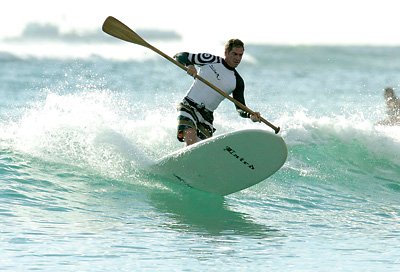
Lance Hookano surfing his SUP.
Photo by Sander Nauenberg.
Imported from Hawaii, hybrid sport growing from Santa Cruz to Lake Tahoe
By Ramona d’Viola
In the blush of first light, on the island of Moloka’i, a conch shell bellows from the shores of Kaluako’i Beach. The kahuna has blessed the gathering of paddleboarders and their crews, bidding them good luck and a safe passage. The sound of his shell horn breathes life into the still morning. On cue, dozens of men, and a handful of women, charge into the surf for the annual Moloka’i to Oah’u Paddleboard Race. Their goal: To reach the southeast shore of Oah’u in as little time as possible.
The line-up features an impressive cast of international paddleboarders: the formidable Australians, the competitive Californians, and a smattering of super-fit European and Japanese watermen. Punctuating the string of prone paddlers are several hulking Hawai’ians — standing upright with paddles in hand — powering away toward the choppy channel, looking very much like the glyphs of their ancestors.
For the Honolulu beach boys who taught surfing at Waikiki’s waterfront, grabbing a paddle from a nearby outrigger made for easy trips to and from shore, especially with a sunburned tourist in tow. Now the accidental practice of stand-up paddleboarding (SUP), once rooted in convenience, has been improved upon by innovation, perfected in competition, and in the last few years blossomed into a bona-fide sport of its own.
Gaining Exposure
Witness the likes of über-surfer Laird Hamilton slaloming mountainous waves, carving perfect arcs with paddle in hand. And rock-star Sting, struggling along in calm Caribbean seas, proving it ain’t that easy. A stand-up paddleboard recently showed up in People magazine, of all places, on the shoulders of big-screen hunk Matthew McConaughey (BTW: I only look at the pictures – I don’t actually read the magazine).
Well, the media exposure was another spoonful of confirmation that this sport, once thought of as a fringe pursuit practiced mostly by aging surfers with troublesome backs, had crossed the foam line and was now riding a swell of pop-culture legitimacy – a development which more than likely would curl the toes of a few veterans, although it’s unlikely they would even notice.
Indeed, “stand-up” has become the latest surf-inspired offshoot to grab a following, and it appears poised to stay, as the reasons for its recent growth spurt go well beyond bare-chested celebrities. The practical, physical and sporting advantages of stand-up paddleboarding are numerous and compelling.
Broad Appeal
Dan Gavere was an early SUP adopter. A former pro whitewater kayaker, Gavere is a sales rep for Werner Paddles, a leading kayak and canoe paddle manufacturer that recently brought its expertise to the SUP market. The Hood River, Oregon-based road warrior credits the sports’ popularity to its increased visibility — on the water and in the press.
“With the continued cross-pollination between paddle sports and surfing, there’s more opportunities for people to access the ocean in a variety of mediums, whether there’s waves or not,” he says. “Stand-up paddling is another niche for the ever-evolving water sports market.”
As sales rep for the Southwest U.S. and Hawaii, Gavere is a frequent visitor to oceans sports epicenters like Santa Cruz, where he has seen a jump in his SUP sales at outlets like Kayak Connection, which sells the boards and offers rentals and classes.
Not everyone coming to stand-up paddleboarding is a surfer, nor do they want to be. According to Gavere, stand-up paddle surfing takes many of the negative aspects of traditional surfing out of the equation.
“You’re standing upright, you can see the waves from further out, you have the extra power a paddle provides, and you don’t have to jump to your feet … That prone to upright snap gets harder as you get older,” laughs Gavere.
There is great interest among a broad range of outdoor enthusiasts, says Kayak Connection owner Margeret Collins, including surfers, wind surfers, kayakers, and others that want to stay fit and in the outdoors.
“It is a great workout that keeps us outside and out of the gym,” says Collins, who enjoys getting out on the water in the morning. “It’s very meditative and very close to nature.”
Surf-bred, Not Surf Dependent
Saltwater isn’t the only province for SUPs. There are growing numbers on lakes and rivers, too. Laird Hamilton even paddled one down the Grand Canyon. On Lake Tahoe, SUPs are becoming a common sight and are sold in shops such as Tahoe Paddle & Oar in Kings Beach. There’s even a race on the lake each summer; the second-annual Ta-Hoe Nalu Stand-up Paddle Classic, a 7.4-mile race, takes place on Aug. 16 this year, www.ta-hoenalu.com.
“A great thing about the sport is that you don’t need the ocean,” says Duke Brouwer, marketing director for Surftech, the Santa Cruz-based board manufacturer. “Wherever there’s a body of water there’s an opportunity to stand on your board and go for a paddle. I’ve seen guys fishing off their SUPs on rivers … and recently heard of some guys planning a four-day stand-up paddle tour of Lake Powell with packs and sleeping bags.”
That’s why shops like Aquan Sports in San Carlos and California Canoe & Kayak in Oakland are finding SUPs to be a great new market – because they cross over from the surf to flatwater paddling on the bay and local lakes. Now surfers and paddlers in the Bay Area and elsewhere who can’t make it to the coast that often can get a great surf-style workout closer to home.
For kayak paddlers, stand-up paddling provides a fresh, heightened perspective when out on the water.
In San Diego, SUPs have become a popular cross-training tool for triathletes in its protected bays and along the coast. It makes for a phenomenal low-impact workout, Brouwer says. “It works not only your core muscles but engages all of your major muscle groups (to paddle and balance on the board).”
Another factor behind SUP’s surging popularity, Brouwer notes, is that the sport is very easy to learn – at least on flat water. “The boards are very stable and you can have the paddle wired after about a half an hour on the water.”
In the Sacramento area, SUP classes are offered through the summer at the Sacramento State Aquatic Center on Lake Natoma (916-278-2842; www.sacstateaquaticcenter.com). The introductory classes ($30 for the public) are three hours long; all equipment is provided. Check the website for dates and times.
Expert Swell Catchers
In surf and on the open ocean, SUPs can demand a considerably larger skill set than on flatwater. With their length and speed, stand-up paddleboards are ideal for catching ocean swells that don’t crest. Called “runners,” learning to ride these moving mounds of water is like hitching rides on a conveyor belt of hills.
The runners in the channel between Moloka’i and Oahu are legendary. The refraction waves generated by water slamming into land mass gives an experienced stand-up paddler a huge, albeit potentially dangerous, advantage. Several years ago, I watched Buzzy Kerbox rocketing along Oahu’s China Wall on his stand-up board, paddling into giant waves, and surfing them all the way into the bay. It was the first time I’d seen a stand-up paddler, and I was intrigued — if not awe struck.
“With the extra paddle power, you can get, and stay, in the pocket,” says Gavere. “Your paddle becomes a tiller, or gets hoisted overhead for surfing the hell out of a seemingly endless wave.”
SUP Full Disclosure
There can be some downsides to the sport, admits Gavere. “The extra gear, the cost of equipment, and unfortunately, localism. Not all surfers have embraced us.”
Provincial knuckleheads aside, enthusiasts are growing in number as paddleboarding, kayaking, and outrigger clubs see their ranks embracing a new sport. With categories showing up with increasing regularity at paddling competitions of all ilks, stand-up paddling might be the missing link among all camps.
“It’s one of the hardest workouts I’ve ever had,” says surfer, prone and stand-up, Tom Duryea. “It requires equal parts balance, power, agility, and endurance. But once you’re moving, it’s fast, really fast.”
Duryea, a familiar name in the winner’s circle at traditional belly-on-the-board paddleboarding competitions, has recently applied his impressive fitness to the stand-up variety of the sport. “I like to try any kind of watercraft, and stand-up paddling requires a whole new set of skills,” says Duryea, two-time winner of the Santa Cruz Paddleboard Union’s annual Jay Moriarity Memorial Paddleboard Race, and three-time Catalina Classic champion.
“You’re much more exposed to the wind and wake when you’re stand-up paddling, so balance is crucial. But, it allows for training with a more social aspect, in all types of conditions,” adds Duryea. “From flat and calm in the bay, to big and bumpy in ocean.”
Although stand-up paddleboards are versatile watercraft, if you’re interested in trying one, common sense and courtesy should hold sway – e.g. don’t paddle out into a crowded break, and don’t paddle into conditions beyond your ability. Remember, you’ve got a paddle and a whole lot more board to handle.
Aside from a few agro surfers, Gavere rates Santa Cruz as one of his favorite places to put in. “I caught a wave at Indicators and connected the dots all the way into Cowell’s,” says the lifelong waterman. “Santa Cruz is the perfect place for stand-up, whether you want to surf or just explore.”
One thing’s for sure: The rebirth of this ancient sport and its adoption in places so far in distance and climate from the islands would impress any kahuna.