Sep/080
Big Wheels Gaining Traction
Riders waking up to advantages of 29-inch mountain bikes
By Pete Gauvin

Big wheels in their element. Photo by Anna Siebelink
One needs only to glimpse a monster truck show to know that big wheels roll over objects easier. So why have mountain bikers stuck to one wheel size for nearly three decades, one that’s three inches smaller than a standard road wheel nonetheless?
It seems quite counterintuitive: big wheels for smooth surfaces, smaller wheels for rough surfaces. But that’s how it’s been, and perhaps that’s the primary reason why the bike industry and riders have been cautiously slow to recognize the advantages of larger wheels off road.
That reluctance has begun to erode, however. “29ers,” as they’re known for their larger 29-inch wheels, have negotiated the technical switchbacks to the summit of industry acceptance. Nearly every major bike manufacturer now offers at least one 29er model, and parts, from tires to suspension forks, are readily available.
Now that the supply trail has opened up, the bikes are picking up momentum in the marketplace and on trails nationwide – and momentum, as most anyone who’s ridden a 29er will attest, is one of their best attributes.
Age group racers and single speeders were some of the first to embrace 29ers. They realized that the best way to smooth out the trail is not with expensive, complicated suspension systems (not that they don’t help), but with a few extra inches of wheel radius (and maybe some suspension, too, but less critical than with 26” wheels). Now avid recreational riders are catching on to 29ers.
Speaking of wheel radius, the 29-inch wheel size is a bit misleading. The rims are actually the same size as 700c road wheels. But with a knobby tire the outside diameter of the wheel is close, but not quite, 29 inches.
Inches sminches. I count myself as a 29er convert because of the way they ride. In fact, I can’t imagine ever buying a 26” wheeled bike again, no matter how revolutionary or how touted the suspension system is. If I was determined to go full suspension, I’d go with a 29-inch model. But hop on a quality 29er and you may not see the need.
For the past year, I’ve been riding a steel hardtail 29er with front shocks (see the adjoining review on the Niner M.C.R.), primarily on the rough, rock-strewn trails around Truckee and North Lake Tahoe. From steep uphills on loose singletrack to granite stair-step drops, the 29er takes them in stride. With the 29er, I ride stronger, faster, longer and more comfortably.
And it’s been good for my muscular-skeletal health, too. When I finish a joint-rattling ride, the norm around Truckee, I don’t feel nearly as pummeled. (Certainly, the vibration-dampening Reynolds 853 steel frame helps too.) And I’ve not gone over the bars once on my 29er, which used to be a semi-regular occurrence for me on my 26” bike (now relegated to commuter use, kayak shuttles and happy hour excursions).
The big wagon-like wheels (the pioneers, after all, relied on taller wheels to settle the West) just aren’t as prone to falling into a wheel-trap or getting spooked by sleeping trail goblins. It helps, too, that my center of mass – I’m a wiry 6-foot-2 – is lower relative to the axle height of the wheels, putting me in less of a perched ass-over-iron launch position. Keeping my keister on, or just above, the seat is good for long-term health.
Particularly if you are over six feet tall, 29” wheels make great sense. But many smaller riders are won over by them, too. Single speeders swear they can climb hills that they could not on 26” bikes because the larger wheels provide a bigger contact patch for better grip and are less perturbed by rocks and such in their path. On sandy, loamy trails the wheels float higher and are less prone to washing out. On downhills, the rolling momentum and directional stability of 29ers means they aren’t deflected as easily, adding confidence at speed, allowing perhaps for a little more – speed.
Chris Sugai, co-founder of Niner Bikes, a small manufacture out of North Hollywood that makes nothing but 29ers, boldly says that if it weren’t for the fact that many racers are sponsored by companies which push 26-inch bikes, most of them would be racing on 29ers.
Perhaps some day they will. Meanwhile, they might want to encourage their sponsors to check out a monster truck show next time it’s in town.
Mar/080
Sizing up Two Epic Tours: The Sierra High Route and Alps Haute Route
High Traversing
By Anna Siebelink
Heading Off Across the Sierra
I go to lift it, but it doesn’t move. I try again and the behemoth barely budges. Impossible, I think, as I look across the parking lot at my three partners. Amused smiles fire back, along with an, “I’ll help you.”
Help me? This is only day one in the parking lot at 6300 feet. What about the next eight days? Hoisting the pack is only the beginning. How can I possibly lug this load over 12,000-foot passes?

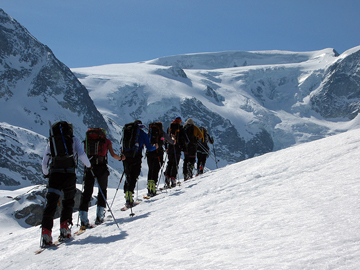
Route up to Col de la Serpentine from Dix hut, Haute Route. Mark Houston
We’re at the Symmes Creek trailhead, in the high desert sage out Onion Valley Road west of Independence, about to embark on the Sierra High Route. Pioneered by Dave Beck in 1975, this ski tour became an instant classic. Beck envisioned this line across the southern Sierra as California’s answer to the famous Haute Route of the Alps. Traversing 50 spectacular miles from the Owens Valley near Mt. Whitney to the grand conifers of Sequoia National Park on the west, the route crosses the highest portion of the Sierra, including six major passes that top 12,000 to 13,000 feet.
Considering my overloaded backpack, some 70 pounds with skis and boots attached for the initial hike in – more than half my body weight – the idea of reaching the west slope’s giant sequoias begins to slip from the realm of conceivability. Am I insane? Do I really need these crampons? This rope? This tent? This food?
I think of my friend Doug Robinson, the respected climber and mountaineer and my former partner in the guiding business Moving Over Stone. In 1985, he did the High Route three times. The second time, returning to the east side after guiding a group west, he went extra light and bombed the route solo in just over 22 hours. (See Robinson’s sidebar, “Rapid Transit on the Sierra High Route,” p. 12.)
My gawd! What would he think of my ridiculous pack?
I get a boost hoisting the shoulder-strapped pantry/gear closet on my back. I teeter a bit, widen my stance and gain my balance. The beast is on! Hope for a successful journey trickles again.
I don my MP3 headphones. Yes, despite flack from my partners, I am bringing music and a couple extra ounces. I’ll need something to take my mind off the burden on my back as I huff 6000 feet up to Shepherd Pass. Due to sparse snow cover, much of it will be hiking.
I face west, look up at the mountains, smile and take the first step.
Commencing the Haute Route
Two years later, I stand awaiting the opening of the first tram going up the Grand Montets, in Chamonix, France, the starting point for the Haute Route of the Alps.
This famed 6-8 day ski tour begins in Chamonix, nestled at the foot of Mont Blanc (4,808 meters/15,774 feet), the highest mountain in the Alps, and traverses some 60 miles through the heart of this awe-inspiring range. From France, the route crosses into Switzerland on the first day and ends at the base of the Matterhorn in Zermatt. It generally stays above 3000 meters (9800 feet), descending into dramatic valleys from time to time, traverses over 10 passes (Verbier version), the highest ones cresting 3300 meters (nearly 11,000 feet).
There are two variations of the Haute Route, one via Verbier and a harder version that traverses the Plateau du Couloir. The Haute Route via Verbier is by far the most popular version and what we are setting off to do.
I am travelling with five others from the States. We are led by IFMGA-certified (International Federation of Mountain Guides Associations) guides Kathy Cosley and Mark Houston. They recently moved their home base from the cowboy/climbing community of Bishop to the café/alpinism world capital of Chamonix. With more than 25 years of guiding experience, they have guided variations of the route 15 times. (Kathy has also guided the Sierra High Route a few times.)
The pack cradled against my back is barely detectable, even after stuffing a few extra pounds of chocolate in it. I step onto the packed tram with about 100 others with ski mountaineering gear. Most are either starting the Haute Route themselves or heading off on other mountain tours.
The Intrigue of Skiing High

Photo courtesy of Anna Seibelink.
Exploring on skis is a bug I caught early and never lost. Growing up in Sweden, I would often “tour” to school on my red wooden skis and leather boots. Gliding deep into snowy mountains, self-propelled, seeing spectacular landscapes rarely seen by others, challenging your stamina and your skills, is the sort of adventure that never fails to capture my imagination. At some point, skiing the highest route across ranges such as the Sierra and the Alps becomes an intriguing goal.
In the Alps, I found many people, young and old, who share and live that dream. Each year thousands of skiers set off to ski the Haute Route or portions of it. It’s hard to estimate the exact numbers, says Cosley. “A lot of people do bits and pieces at a time. During April, the Vignettes Hut (on the most popular section of the route) may host around 80 people per night,” or more than 2000 people over the course of one month.
That vastly exceeds the number of skiers traversing the Sierra High Route. In fact, although it’s difficult to document, it’s likely that more people do the Haute Route in one season than have ever done the High Route.
“I have only once encountered another party on the trip,” says Todd Vogel of the Sierra Mountain Center, a Bishop-based guide company, who has guided the route eight times.
High and Highly Unique
High Route-HauteRoute Beta
Sierra High Route
Permits:
Your direction of travel determines which agency youobtain permits from.
If you go from east to west:
Inyo National Forest
Office in Bishop
351 PacuLane
Phone: 760.873.2400
If go from west to east:
Sequoia and Kings Canyon national parks
Phone: 559.565.3766
MoreInformation:
Siebelink’s 2004 crossing was profiled in a series ofarticles in the Reno Gazette-Journal by Martha Bellisle, “Over the Top: A Weekin the Heart of the High Sierra.” You can find the articles online at www.rgj.com.
Books:
- Steve Roper: The Sierra High Route: Traversing Timberline Country
- R.J. Secor: The High Sierra: Peaks, Passes, and Trails
- John Moynier: Backcountry Skiing California’s High Sierra
- Out of print, but still considered one of the best resources if you can find a copy, is David Beck’s Ski Touring in California.
Guides:
Alpine Skills International
11400 Donner Pass Road
Truckee, CA 96161
Phone: 530.582.9170
Sierra Mountain Center
174 West Line Street
Bishop, CA 93514
Phone: 760.873.8526
Sierra Mountain Guides
148 Willow St.
Bishop, CA 93514
Phone: 877.423.2546
Beyond following a lofty line across mountains on skis, the similarities between the High Route and the Haute Route soon end.
The High Route is much more of a wilderness experience.
The beauty of this tour is the quiet, solitude and vastness of the terrain. “There is more a feeling of being out on one’s own, away from civilization,” Cosley says.
The challenges are to carry all that is necessary, rugged living conditions and hard work, both to make and break camp and to cook meals. Slipping out of a warm sleeping bag into a frosty morning to make breakfast takes toughness. But once up, there’s deep pleasure in sipping from a warm mug and soaking in the incredible views.
“Because of bigger, heavier packs, the skiing is more a mode of transportation than a pleasure in itself,” Cosley says. “The pleasure is in the journey, the wildness, and the achievement.”
The Haute Route, in contrast, is more of a skiing experience.
The complex system of huts in the Alps facilitates going light and allowing one to enjoy the downhill turns. “There are few places in the world where skiers can travel unencumbered, in the heart of the mountains, over high cols, hidden valleys, and immense glaciers,” Cosley says.
Then, at the end of the day, you get to relax in a warm hut, enjoy a hearty meal cooked by someone else and wash it down with cold beer or a bottle of wine. Later, you can settle into a game or cards or chat with fellow ski mountaineers from all over the world, before turning in to a shared bunk room with pillows and blankets provided (most skiers carry lightweight silk sleeping sacks).
The huts also provide a comfy refuge during storms when continuing on may be hazardous. This is key because, unlike the Sierra High Route, the Haute Route traverses glaciated crevasse fields and steep cols that require expert route finding and decent visibility. The possibility of falling into a crevasse and high avalanche danger can make travel unsafe. Holing up in a hut or even skiing out to a village are options when storms descend on the Alps.
The Sierra High Route is much more committing. Once you get in the heart of the tour, there are no easy outs if storms roll in. It may be best to just hunker down in the tent with a book. In California, a blue-sky day is usually not far behind.
The price of the Haute Route’s popularity is that you may share the terrain, at times, with a small parade of ski mountaineers. This typically happens when setting off in the morning and when crossing some of the passes. Worse is when others track up your powder field, heaven forbid.
On the High Route, this is not a concern. You’ll likely be carving corn slopes for only you and your mates to see.
Out in the Open, Out in the Outhouse
Perhaps no experience exemplifies the differences between the High Route and the Haute Route more than going pee in the middle of the night.
On the High Route, you slither out of your bag, crawl out of the tent, and waddle into the cold night to find a spot in the snow. When you look up, the deep black sky is salted with stars. It’s magical!
On the Haute Route, the experience is, for the most part, more mundane, and warmer. The Vignettes Hut, though, deserves special mention. Here, one has to walk a narrow path along the side of a cliff to an outhouse perched right at the edge. The hole drops off into air. It’s quite a long drop.

Anna Siebelink. Photo: Scott Sady
The Common Thread
The differences between the High Route and the Haute Route, though numerous, are in the end mostly superficial. At their core, these two tours of a lifetime share a bedrock commonality.
“Both have the feeling of the epic journey, the satisfaction of covering a significant distance with important difficulties, essentially under your own power,” Cosley says.
So whether you enjoy quiet solitude in deep wilderness or hearing multiple languages spoken over a glass of wine, bunking in huts or carrying it all on your back, the High Route and the Haute Route reward you in a similar fashion.
They are both a singular experience of journeying on skis through stunning mountains that you’ll remember for the rest of your life.
Anna Siebelink is a physical therapist and ergonomics consultant. Formerly a ski and climbing guide with Moving Over Stone, she splits her time between Truckee and the Bay Area. She did manage to carry that overloaded pack across the Sierra.