Aug/110
Not All Who Wander Are Lost
Charmed by a stray catahoula hound, an Eastern Sierra farmer searches for a new canine climbing companion
Words and photographs by Bruce Willey
About 20,000 years ago, give or take, a wolf decided to hell with spending all day hunting. Why not instead hang around these groups of semi-sophisticated apes who use hunting clubs and arrows? In return for helping out with a few chores such as locating food and a few well-placed barks at the lions creeping around camp, the wolves could pick up a few scraps and bones, not to mention far more time for long naps. The symbiosis worked all too well.
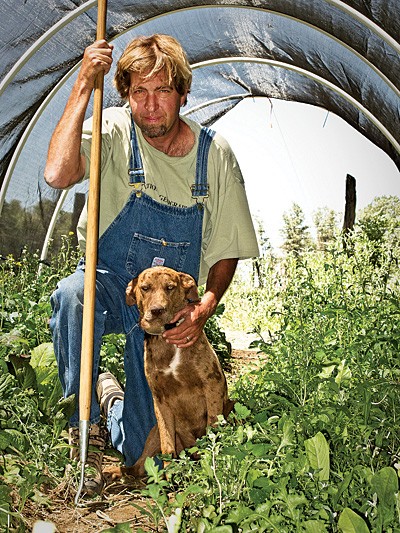
Fast forward to early this summer and this less than sophisticated ape found himself staring into the eyes of a catahoula hound. He was sick and when I patted him my hand reeked of dead squirrel. His prison papers from the pound said he’d been given up because he “was an aggressive herder of livestock.” This seemed an impossible accusation for such a small, frail, skinny pup. Despite his sorry shape, to me the dog looked wholly promising.
This wasn’t the first time I’d had a run-in with a catahoula leopard dog. Three years earlier a dog of unknown origin showed up in my front yard. Around the dog’s collar was a piece of rope, frayed and dirty. I took it for a stray. The dog himself (after looking under the hood) was mottled grey and brown with big webbed paws and an oversized head. I gave him a drink of water and he lapped it down quickly, looking up at me with such kindness that I felt, at the risk of slipping poorly on a balmy patch of sentimentality, nothing short of an instant connection with the dog.
I figured the dog would have some water and then be on its way to wherever it was going. Leash laws? What be-damned leash laws? Many local dogs are often seen doing what they wish in the Owens Valley, which to my human perception consists of a cat chase or two, a dip in a glacier-fed creek, and running hither and thither for the good feel of it.
This is probably entirely wrong. A lot of dogs, no doubt, are simply—or rather, sophisticatedly—on the hunt for a glittery smell off a light pole (urban) or a fence (rural), taking in the smell of estrus of a heated and perhaps amenable bitch or the acrid testosterone levels of a male indicating intent of territory. The 220 million scent cells per all-powerful nose (in comparison to our mere five million) must blissfully rapture them into the nimble world of dog.
But instead it stayed. It lay down with a great sigh and preceded to ogle me while I worked. I looked over its coat (clean), its heavy tongue (healthy) and its glassy eyes (jaundice?!).
I Google-searched “dogs glassy eyes.” A few pecks down I noticed a picture of a dog that looked very much like the dog before me. I’d never heard of the breed before.
For good reason I’d resisted the urge to get another dog after witnessing my Karla, a German Shepard, die a long painful death due to hip displacement 20 years ago. With dark thoughts now, I hear her back claws dragging on the sidewalk. Though she was no doubt in intense discomfort, even terrible pain, Karla insisted on taking a walk with me. We walked slowly at dusk, she behind me while I talked to her in quiet, reassuring tones. We found some grass and sat down while I rubbed behind her ears. It was the last walk we would take.
That heart-wrenching story aside, dogs can put a real damper on your freedom. It always perplexes, even dismays me a little, to see guy walking his dog with a plastic bag and a pooper-scooper. It calls into question the master/dog continuum and human dignity. Of course it’s the right and proper thing to do if you’re a dog-owner, the latter a term that completely justifies the good deed of picking up shit in your leisure time.
The Internet search for catahoula yielded more information than I could take in one sitting, but a few things stuck out. For one, the hound is Louisiana’s state dog and appropriately enough possess webbed feet, making them premier swimmers.
The breed’s history borders on the mythological. This from the snobbery of the Official United Kennel Club: “They are believed to be descended from crosses between Native American dogs, Red Wolves (some of whom lived as pariahs on the outskirts of Indian villages), and the dogs brought to the New World by Spanish conquistadors, probably mastiff-types and sight hounds.”
Which is another way of saying the catahoula is basically a versatile mutt with the papers to prove it.
That day I coaxed the dog in the truck and went climbing at the Buttermilk boulders above Bishop. The dog was hesitant at first, but soon was pulling off moves that would give a bighorn sheep pause. I began to really like this dog and by late afternoon gave it a name: Birkie, after Birch Mountain that rises above Big Pine.
For the next four days we climbed, played fetch, swam in creeks and lakes, played fetch some more. I never became a “dog owner” because Birkie insisted on taking a crap once he was on Los Angeles Department of Water and Power land. Birkie was never short of pure loveliness and at night he slept at the foot of our bed where we heard and fathomed his dreams.
On the fifth day, in an effort to do right and perhaps get Birkie some shots and a license for his new collar, I took him to the dog shelter. As it turned out someone had called, someone who knew his real name, someone who would be right over to pick Birkie up. I threw a stick across the dusty parking lot of the shelter and then sat down waiting for Birkie to run back to my side. He liked to be petted on his large cheeks, then across the top of his head between his floppy ears. I sadly obliged.
When the owner arrived, Birkie didn’t even move when his rightful name was called. In fact, I can’t recall what the man called his dog. But eventually Birkie was persuaded in the back of the truck. I went inside the shelter and the two women in the office recognized my sorrow.
“We’ve got a few really nice dogs up for adoption,” one of them said. They trotted out some big dogs, the size of Birkie. “Let me think on it,” I said.
And I did. But I was unable to get Birkie out of my thoughts. Friends come and go, some for a few weeks, some for decades. It’s the sad truth of it all. Birkie had visited for a little less than a week, but in that time I could feel the earth going around the sun; had smelled the sagebrush with more clarity and perhaps more canine clairvoyance than I had ever mustered. To me Birkie will always be lost in the sense of the J.R.R. Tolkien saw, “Not all those who wander are lost.”
So for the next few years my wife scanned the dog shelter websites in search of a replacement for Birkie. After him, we were convinced that another catahoula was the right, perhaps the only kind of dog for us. But we wondered: would we ever be able to do a multi-pitch climb or go for an extended stay in the backcountry? National Parks were out unless we wanted to walk around the sights close to the road with a leash. So would Indian Creek, Utah, our annual post-spring hangout.
We weighed the pros and cons, all of which became a useless discussion once we found a catahoula at a shelter awaiting adoption, a dog that had been rescued from death row in Modesto.
We traveled over the big hill as soon as the weather cleared and found him living amongst 40 or so other dogs, skinny, sick, but with his big personality still intact. We gathered him in the car for the long drive home over 9,600-foot Sonora Pass.
At the Walker River we stopped to give him a drink of water and a name. Because he’d been caged for so long, his back legs splayed out and he walked like a cowboy who’s been on a horse all his life. Nevertheless, he walked into the water with little hesitation. We named him Birkie.
After a host of shots and de-worming pills, Birkie’s health improved. We gave him a dog pack, which he wore on the approaches to the climbs in Pine Creek Canyon. With the pack on he became focused, trading playful puppyhood for working-dog status. And he took to the talus, his wide feet gripping edges and pawing across slabs like sticky rubber.
His confidence grew, perhaps too much. Gearing up for a climb on the PSOM Slab, I watched in horror as Birkie casually walked a diagonal line across a 5.8 steep slab, a 40-foot fall should he slip. It was like finding out your son likes to solo rock climb. I was afraid that if I called him he would slip when he turned around. But his paws smeared on the rock and he came back to a stern warning that he misunderstood for not sitting when asked.
At first he anxiously whimpered when we left him on the ground, but gradually he got the idea that what goes up must come down. Simple physics for sure, but pretty good for a dog.
And once he understood that snow was a good medium for sliding it was pretty hard to tear him away from a snow patch. A Cajun dog taking to snow: who would have thought?
John Muir had his Stickeen and Peter Croft has PeeWee. Birkie won’t become famous like those dogs. Much depends on the dog’s owner, or rather its companion, which is the politically correct way to say it.
But Birkie’s reputation continues to grow with the other dogs at the crags. He’s certainly met more people and dogs in his short lifetime than I have in my long one. I suppose he has to; his time on this earth is short, measured in dog years.
So Birkie is growing up pretty fast, each day full of new experiences whether on the farm with the cows, goats, and chickens or out at the crags, wandering the sagebrush slopes or navigating through a maze of talus. One day soon we’ll take him mountaineering when he has a sense of mortality under his collar.
For now, though, he’s just a dog enjoying being one.
Bruce Willey is a farmer living in Bishop who still dabbles in climbing, writing, and photography when he’s not tending his crops. See more of the farm (and the farm dog) at www.bishopcreekfarms.com.
Dog Etiquette in the Great Outdoors
All the proper wilderness etiquette that applies to humans also applies to dogs. Ask yourself: would you dig a hole in a nice green meadow? Would you shout at the top of your lungs? Would you poop on the trail or near a water source? Would you bite a fellow hiker if he were moving up the trail faster than you? If you answered yes to any of the above, stay home and camp in the backyard.
Leashes: Always obey leash laws. National Parks mandate that your dog be on a leash at all times and don’t allow them on backcountry trails. Even in places where leashes are not required, carry one in your hand. That way you can immediately put your dog back on leash should you run into another troubled dog or hiker who is uncomfortable with dogs.
Poop: Just as you would pack out or bury your own waste, always do the same for your dog.
Behavior and Training: Don’t bring a dog into a wilderness area until you have absolute control of your dog by voice command.
Barking: Keep your dog from disturbing the peace at all times.
Wildlife: If your dog chases wildlife, keep it on a leash. Period. And no barking.
Pack Animals: When a pack train approaches, keep your dog on a leash and don’t allow it to bark.
—Bruce Willey
Nov/100
The Reluctant Yogi
After years of denial and protestation, a climber finally comes to terms with yoga
Story and photos by Bruce Willey
Like most people and a few mules that are set in their ways, I harbor a lot of preconceptions and I’m not easily converted. So I’ll just say my wife made me do it.
She’s a gazelle-like creature whose been doing—or “practicing” as they like to call it—yoga for most of her adult life. She cajoled (“It’ll be good for your climbing”), begged (“Please, for me”), manipulated (“You’re going be a creaky, old man”), and threatened (“No sex for you”) until one day she just hauled my stiff ass to a yoga class.
Driving to my first toga class I dug deep into my extensive prejudices against yoga. These included a litany of complaints and shrewd judgments: Yoga is for women and if men are into it they’re only doing it to pick up women. Yoga is a multi-billion dollar business that, in a blatant colonial sort of way, appropriates another culture for its own gain. Yoga is a spiritual enterprise for Indians that is wholly confused as a yuppie exercise regime. And so on.
Satisfied with this denunciation of the yoga industrial complex, my imagination turned to the impending class, a class no doubt that would be crammed with stern and rubbery women in Jane Fonda wear, contorting their limbs around their necks, disproportionately strained and sweaty.
We arrived at a dance studio in downtown Bishop. Yeah, the Mule Capital of the World, pop. 3500, has a dance studio. Or did. This was nearly five years ago. Inside I was led into a small closet holding the tools of the trade—cork blocks, belts, bolsters, and mats—props that I would soon come to know as munificent Roman torture devises. We quietly sat down on the wood-floored room that was filled not with stern, overly serious woo-woo women, but a lone man and the yoga teacher, Mary Devore.
We Omed three times in unison and sang a sweet little song. So far it felt like kindergarten. And then Mary called out a pose and I imitated, as best as I could, the wife and the man who wore old jeans. I’ve long forgotten what poses we did that day, but I do recall struggling through each of them as if learning a new (body) language all the while thinking this was the most ridiculous way to humiliate one’s self.
But it indeed stretched tendons and muscles I didn’t know I had, and stretched time, too. I kept looking at the clock on the wall, wondering when this fresh hell would be over. And the man in jeans, struggling through the poses like me? He turned out to be John Fischer. I figured, if a bad-ass mountaineer like him could muster the humility I could too.
Almost five years later I’m still a long ways to be converted. I don’t own a stitch of yoga-specific clothing or possess my own rubber matt, though it has crossed my mind to attend class in a loincloth like yoga master B.K.S. Iyengar is seen wearing in the black and white photographs hanging in the Bishop studio simply to shock my classmates.
So if not full circle, at least I’ve come a long ways. And that’s why they call it practicing rather than doing yoga. It’s the process that counts. The results are just a by-product. Am I a better person? A better climber? Yeah, maybe. I stoop a bit less. My former back pain has vanished. My posture is more self-assured. Climbing-wise, my high steps are higher, my stemming is wider, and on a good day my concentration is more refined. Best, I’m less biased and more open-minded to try new things. Or at least I like to think so. The wife says I’m still stubborn, though.
Being away from Bishop for large chunks of the year has meant that I’ve been forced to sample other yoga teachers and classes, all with mostly disastrous results. One class in Berlin stands out as particularly angst-like and brutal. The only English word the teacher seemed to know was “Streeetch!,” a word he used with certain malice and authority. “Danka” and “Nein,” were the only words of German I knew, none of which I had the foresight to employ until the class was thankfully over.
It was a level one class, but Germans, if I may be allowed one sweeping cultural stereotype, do everything twice as long, twice as hard, and twice as intense. After that class I vowed to never break my monogamous teacher-student relationship with Mary. After all, she had tender knowledge of every previous, current, and future injury lurking in my frame, and with limitless compassion knew the limits of my own faith in yoga to heal these afflictions.
She also possessed a sixth-sense; an intuition about what kind of class would offer my body and mind the most restoration. Coming down from a multi-day backcountry climb the class focused on the legs. A week pounding nails or gardening and we worked on the upper body. I never thought I was capable of saying this, but on the Eastside, deep in the deepest valley where Birkenstocks are shot at by cowboy boots, the universe is possibly aligned. To what extent and aligned to what, I’m not sure. But perhaps its time to contemplate that Bishop might be another one of those numinous vortex zones like Mt. Shasta or Sedona. The local chamber of commerce probably won’t mind since Main Street (Hwy 395) lives and dies on tourist dollars.
In the last five years the Bishop Yoga and Massage Studio has grown too. It has its own space and is thriving despite what many naysayers believed would be a short-lived misguided experiment; the wrong business for the wrong town. “I didn’t have any expectations,” Mary Devore says.
Mary began practicing yoga with her mother at the tender age of four. Her grandmother had taught yoga and meditation in Oregon back in the 1940’s, long before most Americans had even heard of the 2200-year old devotional practice. After obtaining a doctorate degree in botany and climbing extensively throughout the West, Mary developed a following in Santa Cruz, where she taught yoga for 10 years. But climbing and her husband/climbing partner, Tai, lured her away from a place where yoga studios are as ubiquitous as mule stalls and fishing stores are in Bishop. Through quiet persistence Mary has built up another strong following and nowadays it’s advised to show up a little early to claim a spot for you and your mat.
And that’s what I do once a week on Thursday mornings. It’s a wall class, which means we use straps attached to the wall to assist in getting deeper into the pose. Sort of like training wheels for the yoga set. The class is popular, filled with kindly, generous, unserious women who don’t at all look like Jane Fonda. I like them all and look forward to their company. Though yoga is about getting to know the self better, this class seems more about community, a community of women who for various reasons—age, injury, enlightenment, or just staying in shape—are attune to their bodies and minds. If, on rare occasions, a man shows up, I’m the first to tell him that he’ll need to earn his alpha male status … From me.
So what exactly is this practice of yoga? I’m obviously the wrong guy to ask. So I asked Mary one day after her class.
“Yoga is the stilling of the mind,” she says, “and the way you do that is stilling the fluctuations. You have to control the fluctuations and the way to do that is through all the limbs of yoga.”
Mary could tell I was confused just as she could see my long-ago surfing injury deep in my knee.
“You still the fluctuations of the mind through practice and detachment,” she continued. “Practice is practicing the moral and spiritual disciplines, Asana (poses) and breath. And the whole part of detachment is when you start working on concentration, meditation. Because once you’re in a state of concentration you’re focusing on one point. At that point you don’t have time to have fluctuations. You detach from worldly desires. And when that one point goes into a steady flow, then you have reached a point of meditation.”
Ah! Which is, without putting too fine a point on it, exactly like climbing.
“Exactly,” she says.
Mary says yoga is complimentary to all kinds of sports, but especially the kind of sports that meld a full state of concentration with deep physical activity—surfing, climbing, running, cycling, skiing, in other words.
“Flexibility, strength, meditation, concentration, balance. It’s huge,” she says. “When you come to know the postures, when you are strong and firm in the postures, the mind becomes steady and the spirit, the soul becomes delighted, becomes happy.”
From Bishop to Berlin, Bruce Willey does his small part to support the yoga industrial complex, recognizing it does indeed benefit his climbing and marital relations. See more of his work at www.brucewilley.com.
Jul/100
Growing Green on the Eastside
In the land of little rain and scrubby sagebrush, a climber morphs into gardener to find some roots
By Bruce Willey

Dirt Farming Climber
June, the finest month of all, the earth in full tilt soak of the sun. Late afternoon light spills over the Sierra Crest and under the lenticular clouds. I’m sitting under an unknown grape, a vine with a trunk the girth of a large man’s thigh. It might have been planted when this house was built in 1918 … or not. Then again, there are always a lot of surprises with this old house that my wife and I bought this spring in downtown Bishop.
And this being a magazine with adventure in its title, perhaps it best to mention, there’s been a lot of that too, sometimes enough to rival any epic I’ve found on the rocks or in the water. Colonies of subterranean termites occupy my dreams at night; tearing down a wall to find a secret door leading to what might have been called a water closet at one time occupies my day. All the while, between framing up a wall or painting another coat of primer, I yearn up to the High Sierra, unable to decide whether I should be slinging an ice axe or a framing hammer.
But it’s the garden that has proved the biggest adventure of all and the reason we added “fixed rate lock,” “APR,” and “impound account” to our limited financial (in every sense of the word) vocabulary. When we saw the house we were sort of unimpressed. It was small, shoddily built, and smelled of 91 years of humanity. That is until we laid eyes on the big backyard sporting fruit trees and a long abandoned garden plot overrun by relentless Bermuda grass. We made an offer after mulling it over for three weeks only to discover another real estate idiom: 60-day escrow.
With the summer growing season fast approaching this meant only one thing. In order to get a garden growing we would be forced to become trespassers. The owner lived out of the area and we asked if we could simply water his property. He agreed. We watered in accordance to our agreement but we also hand weeded out a 40-by-25 foot plot, hauling four pick-up loads of the insidious grass to the dump. Meanwhile, a block away where we rented a small studio, we planted seedlings in plastic containers and peat pots.
Sierra climbing legend and skilled building craftsman, John Fischer, came over to look at the place we intended to buy. He shrugged at the visible dry rot, the leaning walls, the squeaky floor, the mounds of earth out back. He was silent for a while, not a good sign since we were planning on hiring his expertise on the work we would no doubt get in over our head. Finally he said (and I quote him loosely since there is no way to verify exactly what he said because John tragically died June 5 after hitting a deer on Hwy 395; Ed. Note: Look for a tribute to John Fischer in our September issue), “You probably know the story of French climbers Lionel Terray and Louis Lachenal, mountain guides in Chamonix who became itinerant farmers to make ends meet. Most days found them looking at their hoes then up to the high peaks then down at their hoes again. They looked at each other, dropped the hoes and grabbed their packs and headed up into the mountains.”
By the time escrow had closed beginning of May the garden was planted. Yet John Fischer’s underhanded but wise metaphor rang in my head. The only way to solve it I figured was to install an automatic-drip system with a timer. That way we could go into the backcountry for at least four days and still have a well-watered garden. Problem solved, we headed off to Vegas for the 17-pitch classic Epinephrine in Red Rocks. When we returned, scrubbed and scabbed by the notorious chimneys, the plants had grown twice as fast than if we would have been staring at them each day. Funny how that works.
So, a couple months since we have become Eastside farmers, reckon it’s time I take you on a garden tour from where I’m sitting. I moved from the unknown grape to under the cherry tree and feel rather like Bacchus with my wheat beer and a mouthful of fresh plucked cherries. Much like a climber who finds pleasure in doing a good route again just to show it to another climber, there’s not a gardener I know who doesn’t want to give a tour around the rows of vegetables and herbs so lovingly tended.
We’ll begin in what I’ve dubbed the Midwest ode to monoculture — corn, sunflowers, and soybeans. Monsanto isn’t welcome here, so they’re the only crops that hearken back to my paternal genetic roots in North Dakota. The only thing missing is wheat waving in the wind, which partly explains the hefeweizen in my hand. Next year. But I’m most excited about the corn seed I scored from an organic seed company. Propagated from a 4,000 year-old Anasazi Indian archeological site, I’m hoping this blue, yellow, and red kernel sweet corn will tap into North America’s rich agricultural past before white men like me arrived. Maybe I’ll even have some psychedelic visions after eating it and I’ll chip petroglyphs into the rocks I’ve pilfered from Bishop’s Tablelands (where many glyphs are found). But this is no doubt also the thinking of the white man in me. If all else fails at least I’ll deserve some federal farm subsidies for growing this much corn.
Next we move to what we call the salad bowl, another ode, but this time to the Salinas Valley, a hop down the 101 from Santa Cruz where I got my gardening chops started in the first place. Here we have lettuce, arugula, broccoli rabini, chives. Only thing missing is the artichoke and the Brussels sprout to round out the geographical metaphor. Again, next year. Given that Bishop has not a wisp of cooling sea fog, I’ve placed an arch of PVC pipe draped in shade cloth to make the leafy lettuce think they might not exactly be sweltering under the summer heat and bolt (or is it revolt?) into flower before wilting.
A row down, we arrive at a row of bean poles with of course beans climbing and writhing up the string and wire. That’s what they do best. Garlic covers the edges along with New Zealand spinach, Swiss chard, and watermelon radishes—green on the outside, deep red on the inside. I suppose it’s a good name but I hope they still taste deeply like radishes.
Then the ubiquitous tomato row next door crowned by a tarragon bush that I left from the previous owners gardening wisdom. Apparently these two plants are companions, the marjoram keeping pests away and providing a nice flavor to salads. At the end of the tomato row—mostly heirlooms and a cherry toms— is a small watermelon patch that has suffered then recovered twice now from late season frosts.
A row down and we arrive at the root crops—beets, carrots, sweet potatoes, and more garlic. Some of these seedlings were devastated by earwigs, especially the carrots. Which is why I hear the grating sound of my wife cutting plastic bottles with a dull knife to fit over the plants. She seems to think the earwigs will have a more difficult time climbing up the smooth plastic. With organic gardening if it works 20 percent of the time you might as well call it a triumph as long as you have another method—companion planting, attracting helpful insects to eat the not-so-helpful pests and the like—taking a another 20 percent swath. Most times, though, you just find a healthy resignation at nature’s persistence both in favor of your efforts and the one’s you can’t avoid.
Last we arrive at the hot feet row, the dancers of the garden, the squash, the sweet potatoes, the crook-necks and Kumi-Kumi squash (a native Maori squash). I thought of growing some zucchini but thought better of it after hearing my uncle’s yarn: “The only time we lock our doors in Maine is during zucchini season.”
I’ve had to ask myself what does this all mean? Well, it’s decidedly in line with the slow food movement. Though we haven’t bought a vegetable from Von’s supermarket in three weeks, living as we are on lettuce, broccoli rabini, radishes, beets, and chard, we would have starved while we watched our seedlings turn into proper, edible plants. Now each time we eat there’s an overwhelming hint of the good earth that we toiled in. Gardening, we’ve found is the slowest food movement out there and sometimes the slowest is the most satisfying.
Wendell Berry, one of the first great food and gardening writers, wrote that “the corporations will grow, deliver, and cook your food for you and (just like your mother) beg you to eat it. That they do not offer to insert it, pre-chewed, into your mouth is only because they have found no profitable way to do so.”
I’d like to think we are not growing our own for political reasons or we think it’s the end of the world. But maybe we are in some ways. There are definite tangibles that I can’t explain away with a gardening bias. We’re climbing harder, filled with more energy. The taste is different, too, drenched with flavor and I suppose if I were a meat eater it would be akin to eating something that roamed freely rather than slaughtered on a factory farm. The vegetables have a fibrous zest, almost a gamey aspect to them. And if I prevail to discuss what comes out the other side with the hopes you are not having lunch, my bowel movements have gone from G-flat sharp to G-major with Mahleresque proportions and even profundity helped along by a good book.
But we’ve all become bone-tired of another gardening article eschewing the virtues of growing your own while making a stab into the heart of big agriculture/petro-chemical industry. Yes, it’s the right thing to do probably, if you can find some land and some precious time. The good thing is the country is shifting slowly in the right direction. There’s an organic White House garden to replace the solar panels that Reagan ripped down. People are beginning to question what and if it’s food they are eating. We see more and more organic vegetables even in places like Wal-Mart. Farmer’s markets bring it all down to the local level with a garden of your own being as local as it gets. It’s mainstream and turning into a veritable movement.
But food politics and movements seem far removed from this garden. The plants could care less (or do they?). A little water (thanks LA Water and Power), good soil, a loving pat on a leaf now and then is all they require. Time to put down the hoe, then. The mountains are calling.
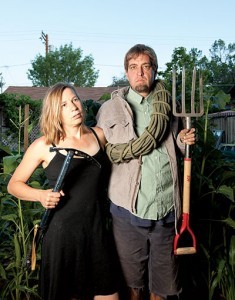
Thanks to their automatic-drip system, writer Bruce Willey and his wife Caroline Schaumann can sow seeds and multi-day climbing adventures all at once. You can read more of his fertile words at www.brucewilley.com and witness his camera work at www.plumephotoproductions.com.
Mar/100
Epicenter of Good Friction
Returning to the winter climbing mecca of Joshua Tree, where their knot was first tied, couple finds solitude a bit harder to come by
Words and photos by Bruce Willey

Caroline Schaumann climbs Headstone Rock in the evening light.
Trust the friction. I’m three or four body lengths above the last bolt, but who’s counting? All I know is if I my foot blows on this tenuous smear I’m going to go for the long slide. Trust the friction, my brain tells my climbing shoe again. Then inch up slowly in balance. There just might be a handhold above.
But there isn’t. Just an odious penny-pinching crimp of a hold. Here’s to the joys of a Joshua Tree 5.10 slab. A place where the cheap-ass, bad-asses of yore found it necessary to add a little spice to each climb by drilling ground-up and adding as few bolts as necessary. Then again, what would climbing be without a little bit of fear, without all those succulent brain chemicals swirling between neurons and altering perception?
“Looks slabolischious,” I hear my wife say, urging me on. Yet this encouragement does nothing to bring the next bolt closer. One more tenuous smear on the quartz monzonite nothingness and I’ll have it. Then another 20 feet or where the angle eases some to a big flake where I can sink some gear. I look down at my foot, amazed its even sticking to the steep slab. Then the next foot. No fortitude to stop and ponder. Just keep going toward the belay ledge where my sweet reward awaits. Trust the friction.
We’re out in the Echo Cove area, climbing Quick Draw McGraw (5.10a) one climb over from the famed, über classic Heart & Sole (5.10a). The Joshua Trees contort below into Dr. Seuss shapes, rhyming “Sam I am” with their funky shadows splayed on the granite dust in the late afternoon sun. I get to the flake, grabbing this nourishing hand jam for all it’s worth and look around. Easy liebacking leads to a comfortable belay where I am surprised to learn that instead of being awash in the Hallmark moment, I am simply relieved. After all, this ledge where I park my trembling mind and pull up rope is the exact same ledge I asked my wife for her hand.
Seems like a long time ago … or just yesterday. Hard to tell sometimes. Then again, when you do a lot of climbing you find yourself in one happy time warp after another. The only thing that’s changed is the baby Joshua tree that clung to this heart-shaped slab four years ago looks to be growing into a fine young adolescent tree. Calls to mind Willie Nelson’s line: “Ain’t it funny how time slips away.”
But that’s the magic of Joshua Tree. A place that scrubs the soul clean and slows the time, and for the rock climber, scrubs a whole lot else, too. The coarse granite that Josh is so famous for (read: tenaciously good friction) also scrubs the soles of your shoes and the tips of your fingers. And for the last three days we have bathed in the high desert light and slept under the blazing winter constellations.
Two weeks earlier we’d stopped at Josh to stretch our legs after our annual migration out West. Between rolling El Niño storms, we camped at the Indian Cove Campground (Helpful hint: At 1,000 feet lower than the campgrounds in the main park, it is usually much warmer), our usual Josh hangout. We woke at a leisurely pace, jettisoning city life and getting in tune with the rhythm of the desert with the help of coffee and peanut butter and banana sandwiches. With over 7,000 known routes and a guidebook that is almost as heavy as a big city phone book, we’d grab the rope and rack, drawn by the magnetic force of so much rock in this 850-square-mile national park. Now, we’ve been drawn back for more.
Climbers have been coming to Joshua Tree since the 1950s and it has slowly morphed into a world-class climbing destination. It’s not uncommon to step under a granite dome and hear a host of far-flung languages and accents, making for a Tower of Babel experience.
But all this love has come at a cost to the serenity and sanity of the place. (Hint number two: Go during the week.) Many of the classics, especially near the road, require a waiting list. And the wait can be long. For an area that prides itself on a hearty trad ethic and a ground-up approach, one can nearly shed a tear at all the top-ropes hanging from climbs. Sad, too, given that it was once considered a winter “training ground” for bigger climbing objectives. Joshua Tree probably did more for the free-climbing revolution, with climbers such as John Long, Lynn Hill, John Bachar — a list so long and heavy that to do any more name-dropping would ignite the nearby San Andreas Fault — than it’s given credit for.
Topping out on the Moose Dog Tower in Indian Cove on Third Time Is a Charm (5.10b) (Helpful hint number three: Excellent route and almost never crowded.) on a Saturday afternoon, one is likely to view what looks like an army of red ants swarming over the rocks far below. No need for alarm despite some Josh locals who insist that the place attracts the occasional UFO.
No, the ants are Boy Scouts all sporting red helmets. At first this is no cause for concern until you realize at least 25 out of a 100 of those pre-adolescent boys will inevitably become hooked on climbing. You can almost hear the faint shouts of things to come: “Dude, you dropped in on my climb. Go back to the beach.”
Still, it is easy to find some much-needed solitude from the masses with only a short jaunt into the backcountry. Walk back into the Wonderland of Rocks or out to Outer Mongolia, and you’ll feel like you have the whole place to yourself. Failing that, climb the roadside classics under the moonlight, an increasingly popular past time given the daylight crowds.
In any case, one remembers that nearly 10 million live a mere hour and a half drive away in Los Angeles County, not to mention the aptly-named Inland Empire a stone’s throw away from Josh with its four million or so masses. Such is the state of this good state of California.
We rap into the sunset, the rock still warm and blessed from another fine sunny day of climbing. Hard to believe it’s winter and we pity the poor East Coast souls from where we have come who are digging out from another snowstorm. We sit on the tailgate of the truck and pop a beer. A coyote pack wails in the distance. And we feel as though we might as well be the only ones left on this good earth.
Bruce Willey spent his childhood in San Bernardino when it was swaddled in citrus. He no longer recognizes the place when he returns. He currently lives in Bishop where he does manage to recognize the sublime beauty under the Sierra. See more of his photography at www.plumephotoproductions.com or writing at www.brucewilley.com.
Sep/091
Up and Down amid Brobdingnagian Stones
Two fools rediscover the Aiguille du Fou, Smoke Blanchard’s lost route in the High Sierra
By Bruce Willey
I had just climbed to one of those belays where living feels beautiful and life is sweet. Tying off a horn I call down “off-belay” to Greg with a certain amount of relief. Time, then, to fondle the view from 200 feet of the arête and wait for him to pull through the cruxes made apparent by the slow progress of the rope.
“Blimey,” Greg declares, fighting up the lichen splattered slab that had given me much pause. “Blimey” again, as Greg nearly pulls a teetering block into his lap, the same block I’d whispered by with all the delicacy of encountering a psychotic hooligan in a dark alley.
Far below, the town of Bishop squats in the Owens Valley, and across the canyon the red Piaute Crags meld into the white granite of Mt. Emerson. Hmmm, I think: Ralph Waldo Emerson, the New England transcendentalist, communing with the California Indians in geologic metaphor, no doubt under the rhapsodic whim of endorphins from the last hair-raising pitch.
Greg comes around the corner into view.
“Nice lead,” he says. “My heart was in my throat on that one.”
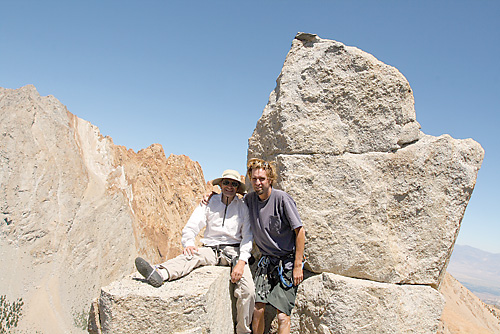
We are attempting the Aiguille du Fou, a long-forgotten route in the High Sierra authored by Smoke Blanchard, the pioneer of the Buttermilks and Buddhist truck driver, who when he wasn’t climbing and guiding, drove up and down Highway 395 with a load of explosive propane hitched to his tractor. Smoke had also written a book, long out of print, called Walking Up and Down in the World: Memories of a Mountain Rambler. It contained our only clue where the route went, or for that matter, where the Fou was.
Smoke climbed the Fou countless times, writing: “Another strange turn to this climber’s brain is my preference for repeating the same peak or route or experience over and over. I told my wife that this trait keeps me monogamous. Told all of them—mostly it works.”
He’d named the “Fools Needle” after the one that shares its namesake in France, rising high above Chamonix and made famous by the photograph of John Harlin on its summit edging out over the void like a scared surfer. “If Chamonix can have one I don’t see why we can’t too,” Smoke once remarked.
The Sierra version, though, had long slipped into obscurity, and despite Smoke’s legendary status as one of Bishop’s most prolific climbers of the older generation—second only to Norman Clyde—nobody in town seemed to know where the Fou was. They’d heard of it, yes. But they didn’t know if it had been climbed since Smoke passed away in 1976, thrown into the Mojave Desert from the back of a pick-up truck.
The Fou was also not listed in any guidebooks or topo maps. Even R.J. Secor’s otherwise comprehensive The High Sierra: Peaks, Passes, and Trails failed mention of the 11,000-plus foot ridge that sports the Aiguille du Fou. Same went for fruitless late-night Googling, for which I later regretted after violating myself. So when Greg called me to see if I would like to do some detective work and try to find and climb the enigmatic Fou, I didn’t even blink.
Though now settled in Bishop, Greg Smith hails from England, which accounts for all the “blimeys.” Like Smoke, Greg is a gentleman mountaineer. Compact, civilized, and graying around the edges of post-middle-age, he still manages to get into the backcountry no matter the season, whether on skis, boots, or kletter shoes. He also succumbs to the history of High Sierra climbing with all the tweedy zeal of a professor.
But Smoke was vague at best. In the written account of Fou, told in the royal “we,” as in, “We start up the Piaute Pass Trail with a pleasant half-hour stroll through cool and beautiful forest,” he mentioned that in order to get the correct start, “we” first needed to find six red-fir trees “that leaked south out of their normal range.”
I’m no arborist, but sure enough, as we round a bend in the trail, we spot at least five reddish firs. And so we head off trail to an immense and imposing ridge that leads straight up to a needle-like summit.
Getting on the actual arête proves the crux. There was no mention of hard climbing at the foot of the buttress, climbing that would likely have been out of the realm for Smoke with his retractable ice axe/walking cane, stiff leather boots, and the obligatory two bottles of wine in his knapsack that he wrote were somewhat essential to the route.
Had an avalanche wiped out the lower two pitches in that last half century? Mountain geology tends to dismiss human route descriptions with all the indifference of an aloof cat.
Soon enough, though, we royally find ourselves running straight into his narrative … “It is possible to fall off, and on the next pitch or two this possibility is sobering to contemplate.”
We stumble onto a ledge, obviously the place where Smoke would break out the nuts, cheese, French bread, and white wine (“Red we save for the summit,” he wrote) before moving onto what he called dessert—the sharper, exposed aspects of the arête.
Having only brought a red, we move higher until the needle comes into full view. “Phoo-ey!” Greg exclaims. “Sure looks phallic to me.” Like bloodhounds picking up a promising scent, we are giddy that we have actually found and are indeed on Smoke’s lost route. No fools are we.
We solo up easier ground passing more narrative signifiers including an unmistakable six-inch ledge that leans over a couloir a hundred feet below. We squeeze by, as Smoke wrote, “this ledge (that) lacks handholds, and a waist-high bulge midway along makes sucking in the gut essential.”
Reaching the top of the ridge we sit down beneath the needle. Though Greg and I could hardly be classified as homophobes, we find ourselves embarrassed by the Fou’s size and girth, feeling small in the presence of such priapic grandeur.
“Fools we are,” Greg says, looking west along the ridge. “This isn’t the Fou. It’s over there.”
A bigger, dare I say more handsome needle, lays along a knife-edge arête and up a reddish slab, jutting proudly into the sky. We consult Smoke’s book: “Towers and notches, hidden bypasses, magically revealed key ledges, passages to the left and round-abouts, make a wonderful winding rock road, ever fresh…. It ejects us squirming, scratched, and breathless onto the top of the second of a great pile of Brobdingnagian stones.”
Brobdingnagian? What the hell could Smoke have meant? Nevertheless, we mount the bony mule arête, scuttling “ever fresh” across it. Indeed we squirm, we are scratched, and we’re even a little Brobdingnagian (lowland dictionary in hand: From “Gulliver’s Travels,” adjective, “gigantic”) not to mention breathless by the time we reach the true summit.
There, we break out the cheese, bread, and the bottle of red, toasting Smoke, reveling in our intuitive foolishness. We sunbathe in the warm Sierra light, reading from the book on how to get down: “A Z-shaped double rappel from a rather rickety anchor, where one might install a new sling through a rusty soft piton to keep the adrenalin levels manageable.”
And sure enough there it is, the old pin, the eye bent downward and the webbing rotted away to oblivion. Greg and I are by now both a little tipsy but with a new sling and a back-up anchor slung around a solid block, we lean out carefully off Smoke’s piton into the chute. It holds our weight. And it holds the years much in the way that Smoke’s writing has.
Through “alpine meadows, timberline trees, and flower-banked laughing streams,” as Smoke put it, I watch Greg happily amble down ahead of me. It gets me thinking how the very act of going up and down—from boulder problem to month-long siege on Denali—makes fools out of us all. Happy fools, for sure, but fools nonetheless. And I’m reminded how Smoke had ended his elegant and mostly accurate description of the Aiguille du Fou. “Pity the poor peak-bagger who, by nature of his obsession, cannot return over and over to an unknown, unsung, but near-perfect Fool’s Needle.”
We will no doubt climb the Fou again. For two dutifully married blokes like Greg and I, maybe it’s imperative. If nothing else, it will keep us monogamous.
———————————————-
Bruce Willey is a freelance writer slash photographer with an emphasis on slash. Dividing his time between Big Pine, CA, Berlin, Germany, and Hotlanta, Georgia, Willey has been published in most of the American climbing mags, but claims ASJ is his favorite. See more of his work at www.brucewilley.com
Jul/090
Born Again Rock Stars

Bishop’s world famous Rubber Room saves one sole at a time
Story and photos by Bruce Willey
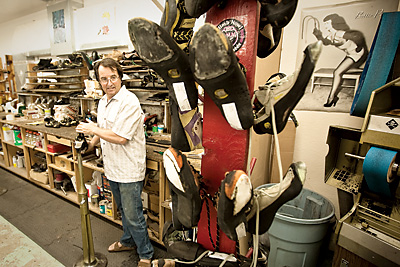
Whipping the shoes into shape, Tony Puppo resurrecting another pair of climbing shoes while Betty Page keeps order.
Years ago, when I was a young, naive lad, I brought a pair old Boreal rock shoes to be resoled at the Rubber Room in Bishop. The resoling shop’s logo—a cartoonish scantily clad, rubber-wearing dominatrix found in climbing magazines—shared a certain salacious fervor more likely to be found in the back of a big-city weekly where the term “massage” is thrown around rather loosely. So with this image planted firmly in mind with the spike of a six-inch heel, I hesitated at the door half expecting to be whipped and spanked. And I would have deserved it given the sorry state of my worn shoes.
Instead I was greeted by a man who called himself Tony, who, as I recall was indeed not wearing a rubber mask and chaps. Indeed, loud metal music did not play through a stream of red lights and smoke, and I was not led into a room in the back to be humbled by the torrid-haired dominatrix. In the main, it was a rather benign experience.
I placed the shoes on the counter, Tony picked them up and looked at the soles while I signed my name and address, then told me the shoes would be ready in about two weeks. They were and my shoes felt and climbed better than the day I bought them. I’ve been going back ever since.
Tucked behind a beauty shop, a bar, and across from a local grocery store in downtown Bishop, the Rubber Room has been recycling worn-out climbing shoes and making them new again for 10 years in its current location and nearly 30 years altogether. And lest the sexy advertising ploy be lost in the semantics of feminism, or rock climbing for that matter, let it be known it was conjured up by a woman; none other than Nan, Tony Puppo’s wife. Betty Page was the inspiration and her image still hangs—whip in hand—in homage to the shop’s motto: …where discipline, training, and integrity fill all your rock shoe resole needs.
After countless resoles on my granite and sandstone scrappers, done up to perfection by the Rubber Room, I decided to go to the source of all that good rubber in search of its soul—without putting to fine a point on it.
It should not come as a surprise that the Rubber Room faces straight up to the Sierra Crest (Mt. Tom, Basin Mountain, Mt. Humphreys) and the Buttermilk country, scene after scene of so much lost rubber. And secondly the place smells like a rubber plantation. Tacked to the wall are climbing pictures, faded by the Sierra light that streams in the door most afternoons, and several trees of shoes in various stages of repair make for a small forest amongst shoe horns, sanders, and other industrial cobbler machinery. NPR News plays on the radio. So much for the dominatrix image.
Simon Vickers, sporting a handlebar mustache and close-cropped hair, sits at the computer taking care of the in-and-out box. About 50 percent of the shoes come from California. The rest come from elsewhere in the U.S. and beyond. The Rubber Room has received shoes from as far away as Australia, South Africa, even Israel. In the last decade they have resoled as many as 25,000 pairs, averaging a little less than 300 pairs a month.
Master cobbler and Rubber Room owner Tony Puppo is working on a shoe, the old sole ground away to make for the new. He trims around the edges of fresh rubber with a pair of scissors, then bangs on the rand with a hammer. Wearing a white untucked shirt, jeans, and sandals, he’s as unpretentious a man as they come with a quick smile and an easy laugh. As he works I ask him about the history of the Rubber Room.
The Coefficient of Friction
Puppo came to Bishop in 1976 for the climbing and skiing. For a year he flipped eggs, falling in with the small climbing scene at the time including Rick Wheeler, James Wilson, and Bob Harrington. Bishop wasn’t the climbing Mecca it is now and if you didn’t own a mule you were considered an outsider. Puppo isn’t one to spray about his achievements, but a look in any Bishop guidebook reveals many a classic climb that he authored.
Wheeler and Wilson, who had opened a climbing and backpacking store selling Patagonia seconds and sleeping bags on Main Street (now Wilson’s Eastside Sports), asked Puppo if he wanted a job. At the time they were fixing cowboy boots, women’s heels, mountaineering boots, and rock shoes. Puppo joined the team in 1981 and learned the cobbler craft pretty much by doing it under the watchful eye of his mentors, including Dan Asay who still shares the Rubber Room space with his own shoe-making business. Asay began cobbling when he was a hippie in Berkeley and now makes custom boots for those with “buggered up feet” as Tony puts it, and those who have had the misfortune of losing their toes—one man, his whole foot—to frostbite.
Puppo hired Nan who later turned out to be his wife and the couple bought out the business from Wilson. In 1999 they moved to their present location. Unfortunately, Nan took a fall while bouldering, breaking her back. She is still suffering from nerve pain and no longer works behind the cobbler’s bench.
“I’ve always tried to figure out how they (the climbing shoe manufacturer) put it together without having been in the factory,” Puppo says. “Nobody has the lasts from say 5.10 or La Sportiva because they’re locked in a vault and are worth millions of dollars. They’re untouchable,” he continues. “If you get the pattern for a last and go away with it that’s certainly considered industrial espionage.”
Puppo gives me a short lesson on rock shoe anatomy, explaining that a shoe’s fit is determined by its last—think “foundation” of the shoe. “If you look at a shoe they are very complicated as far as the pieces of leather that go together to build a shoe,” he says. “And the simpler the shoe the more simply they fall apart. They also don’t hold their shape as well. Whereas the more technical shoe hold their shape and work for you because of the way they are constructed.”
As far as the best rock climbing shoe, Puppo hesitates, not willing to step on anyone’s toes, so-to-speak. But he does say, “Everyone’s top of the line model is more of a joy to work on than their price-point shoe. A beginner shoe is usually on a beginner foot who destroys it. We have a mountain of shoes with gaping wounds in the toes. Had they stopped a week before they might have been saved.”
“May I express my pet peeve about toe draggers?” Simon says from behind a large metal shelf of shoes ready for shipment to their owners. Simon hails from Santa Cruz and enjoys working with his hands. Prior to his gig as a cobbler he used to work for Rock Lobster, building bike frames.
“You bet,” Puppo says.
“I just wish people knew what the rand is. Take care of your rand ‘cause your rand is what supports your climbing edge. There’s no integrity to the shoe once you’ve wrecked your rand.”
“It’s like coming into a auto repair shop with a flat tire and saying, ‘My car doesn’t run anymore. Can you fix it?’” adds Puppo. “People don’t do that to their cars but they do it to their shoes.”
With this kind of talk, I sense the cobblers may soon be getting out their whips and donning rubber suits. And since they have just resoled a pair of my shoes, a pair that I continued climbing on past the sole and into the rand, I think it best to go. Best to go out on the granite and feel the beautiful friction of new soles, of rubber meeting rock. To sense the discipline, the training, the integrity. And because of all this, I’ll no doubt be back.
The Rubber Room can be reached at 175B North Main Street, Bishop, CA 93514, (760) 872-1363 (toll free at 888-395-ROCK) or email them at resole@rubberroomresoles.com. See their Website: www.rubberroomresoles.com. Dan Asay’s custom boots can be reached at (760) 872-2688
May/091
Zen and the Art of Surfboard Maintenance
Riding the wave between Zen and surfing, Jaimal Yogis pens a book that balances the connections between both
By Bruce Willey • Photos by Siri Scull

Any self-respecting surfer who’s paddled out into the ocean’s fury and caught a wave knows that Zen and surfing are inseparable. It’s just that most don’t know it—yet. Now with Jaimal Yogis’ new book “Saltwater Buddha: A Surfer’s Quest to Find Zen on the Sea” (Wisdom Publications, 256 pages, $14.95) the connection between the two is at last articulated, coming full-circle into the reflective light of the ocean.
This breezy, coming-of-age tale is in fact a memoir, a quest for pelagic vitality and terrestrial enlightenment all rolled into the spiritual spindrift of Zen. Much as surfing requires countless days spent flailing at the mercy (and often merciless) power of the ocean, Yogis’ Zen quest is just as hard earned. But by using Zen to comprehend surfing and surfing to sort out Zen, “Saltwater Buddha” gets about as close as any previous surf narrative to answering the question: What are all those surfers doing out there bobbing in the cold water for hours only to catch a few brief moments of bliss?
Yet ask any surfer the essence of surfing and you’re likely to get a roundabout answer that is as convoluted and mysterious as a kelp forest. Yogis, on the other hand, manages to retain much of the mystery, imparting Zen as a way to find the deeper meaning in life both in and out of a wetsuit.
One of the answers, among many that Yogis proposes, is that Zen and surfing are somewhat historically linked. “Just about the time Bodhidharma showed up in southern China, the Polynesians, largely regarded as the most deft sailors ever, were navigating by the stars to Hawaii, where surfing was most likely born,” Yogis writes in “Saltwater Buddha.”
Another parallel emerges: Religion tried to squash surfing on the Islands and anti-religion outlawed Zen in China.
But it’s the energy of water and waves themselves that perhaps make the most fluid connection in the book. And as anyone who has caught a wave knows, the ride transcends time. Awareness is heightened. Focus is all encompassing. You are one with the wave, one with the ocean. “There was only this and this and this,” he writes. “Just power and presence.”
Like the ebb and flow of the tides, “Saltwater Buddha” floats between the esoteric surfing/Zen connection and the real life of a young man coming to terms with adulthood. He makes his escape from his wave-less, drugs and drinking teenage life in Sacramento to the island of Maui. There he buys a used surfboard and begins his introduction into the world of surfing. Following the young lad in his search for saltwater enlightenment is at times painful. Yogis realizes he must grow up, accept the responsibilities of adulthood while retaining the innocence of his Zen quest. What better place to move to? Why, Santa Cruz of course.
There, amongst the organic background of Zen centers, yoga studios and macrobiotic vegetables, he encounters the infamous “surf Nazis.” A red tide of testosterone seeps out of their wetsuits and pollutes the water with un-Zen-ness.
While surfing the agro-crowded Steamer Lane, Yogis is forced to reconcile with this disconnect, a challenge that continues to this day for the saltwater Buddha. “If you can see that the person is acting stupid because he or she wants to be happy just like you,” he says in an interview with ASJ, “but literally hasn’t been given the tools to connect to the deeper part of himself or herself, you can feel compassion and hopefully avoid conflict.”
Yogis now lives in the San Francisco neighborhood of Ocean Beach. Just 29-years old, he says he wrote the book, in part, to investigate the connections between Zen and surfing and explain these connections to himself as much as for his readers. He is currently a freelance writer who holds a Masters in journalism degree from Columbia University. (His chapter on surfing in New York City is especially frightening.) His writing has appeared in Surfers Journal, Sunset, San Francisco Magazine and others.
“Within that investigation,” he says, “I hoped that there would be glimpses at the heart of surfing and the heart of Zen, and that this would help people see these traditions with more respect and authenticity, something that is often lost in marketing schemes and the blur of modern life.”
Though Yogis is not the first to point out that surfing has lost much of its “soul” to the commercialization of the sport, he may be the first to make the point that both Zen and surfing have been marketed beyond recognition. “For people who are more interested in authenticity,” he says, “I think we can try to live that authenticity—live from our Buddha nature, you might say—that means constantly asking ourselves if we’ve been caught by a marketing scheme or if we’re really living our own truth, whether that relates to surfing, Zen, or something else entirely.”
With “Saltwater Buddha” due to hit bookstores this month, Yogis says he wants his readers—both surfers and non-surfers, Zen and non-Zen aficionados—to find a little self-acceptance in the book. And “hopefully they’ll have fun reading it too.”
It’s a tall task to ask of a little book, but one that Yogis deems entirely possible. All told, it’s pretty simple: “I guess what I’m trying to say,” he writes at the conclusion of “Saltwater Buddha,” “is that I’m learning to not want to be someone else, to just be who I am, as is, with nothing extra added on.”
Freelance writer/photographer Bruce Willey, an incurable latent surfer and newspaper editor from Santa Cruz, now splits his time between Atlanta, GA, and Big Pine in the Owens Valley, where he finds his Zen side near daily in the crags of the Eastern Sierra or pulling the steep sandstone of the Southeast. You can find more of his writings, musings and photographs at www.brucewilley.com
Sep/080
Eastside Lowdown
Front country cragging under the shadow of the High Sierra Crest
Words and photos by Bruce Willey
To be frank, I thought about starting this story with an epic. Some hanging on the thin edge thing: frozen fingers grasping for a nub, a hair-raiser of a lightning storm scrubbing the inside of your helmet, being skinned alive by a fall on run-out slab. It sells magazines and stokes campfires, not to mention touches the void that is ego.
But I’m happy to report that climbing is more fun when you manage to avoid these stories in the first place. When fear is replaced by experience (see above), or when you find heightened conviction with vigorous hands and feet, and the common assurance of such things as a rope attached to a good, maybe even loving partner.
And my epics have left me with more laugh lines than grey hairs and are pedestrian anyway. Stories that come screaming down out of the Andes, Alaska, or prodigiously out of the Himalayas, are best experienced from the comfort and privacy of a water closet accompanied by a long Mahleresque movement.
Thanks to the Sierra Nevada, where the weather vacillates most often between perfectly fair to even more fair, and the rock is, for the most part, constitutionally solid, California stories scuff the edges of the pastoral. No wonder Muir went up a pine tree in the midst of a windstorm or soloed Mt. Ritter in shepherd boots. It sold stories and fueled lowland awareness to preserve something that made it difficult for Muir to keep his feet on the ground.
This is not to say Sierra climbers are, as a bunch, cowards. It’s just that they operate in a medium that is a perfect mixture between a Mediterranean and desert clime. Try finding a book titled Minus 148 Degrees or The Savage Mountain regarding the Sierra. Won’t happen. Instead, one is more apt to find something more akin to John Tyndall’s Hours of Exercise in the Alps. Doug Robinson’s apt title, A Night on the Ground, A Day in the Open comes to mind as does Smoke Blanchard’s Going Up and Down in the World, both of which are actually about the Sierra, both low and high. After all, the Sierra forgives most of the time and even loves you back with all the loyalty of a good dog.
But in the interest of keeping your attention (and to show how swashbuckling I become under stress), I would like to get one story out of my system. Plus, it begins at the south end of the front country Eastern Sierra climbing continuum—where this story begins.
******************************
My wife and I were climbing in the Alabama Hills, as we do many an evening after we finish our work. It’s cooler then as the long shadows from Mt. Whitney and Williamson splay across the monzonite domes, slowly chilling the rock that has been baking in the summer sun. Topping out on a dome, sometimes it’s very possible to feel as though you’ve landed in Joshua Tree minus the rangers, the picnic tables, the expensive camping, and, well, the Joshua trees. Some have gone so far as to call the Alabama Hills the “poorman’s Joshua Tree” which is sort of true considering the general lack of good crack climbing and the non-existent entry fees. But after climbing here a few years, we’ve begun to question the wisdom of the maxim, not to mention question whether we want to ever go back to Joshua Tree when the Alabama Hills is, for lack of a better term, so much a wonderland of rocks.
Mostly comprised of sport climbs on cinematically beautiful domes (enough westerns, car commercials, and music videos have been filmed here to cross the Sierra Crest several times over), the Alabama Hills is slab climbing at its near best. Some call it crumbly choss. And yes there is a bit of that. Nevertheless, we find ourselves continually drawn back to the sharp edges of granite plates exfoliating into the desert scrub.
So here we are in the Loaf area, so-called because Meatloaf filmed a music video while at the height of his fame and limitless passion to rock! with sweaty abandon. I unpack the rope bag and leave it on the ground underneath the climb when I realize I’ve forgotten the water. No big deal: sometimes it’s more than practical to belay on the tailgate of your truck with a cold drink in the other hand. While I fetch water, my wife Caroline explores the base of the domes, ticking off climbs she intends to do.
When I get back, she picks up the rope bag and carries it from one dome to the next, to a climb that looks good to her. She ties in, chalkes her hands, and begins climbing. After clipping three or four bolts, I look down at my feet—clad in my usual summer attire of snake-proof sandals, mind you—and see a western diamondback slither out of the rope bag.
I yell up at Caroline: “Clappeschlonge, Clappeschlonge,” a word I recently acquired in her quest to teach me her native language. Stepping backwards a few feet, I count seven rattles on its tail. But the “clapping snake” (rough translation) is well behaved, crawling casually away into a stand of bushes. He’d gotten a free ride in the rope bag, carried by Caroline next to her chest. Without plunging too far into anthropomorphic serpent behavior, the snake probably thought the rope was a skinny 10.5mm cousin of his and crawled in to say hi. As with most things, climbing’s most horrendous moments are experienced in hindsight.
The Alabama Hills are like that; the good and bad sink in later. It’s a wild paradise despite its John Wayne reputation of shattered beer bottles, ATVers dusting up the roads, and above, F-16 fighter jets that dogfight in and around the clouds. On one climb in the Ghosts area called Elephant Hunting (5.10b) you smear and pinch on small craters produced by men pretending to be movie stars pretending to be cowboys shooting at the wall with rifles.
Late evening, as usual, finds us squeezing one more climb out of the dusky light. Bats swoop by in the utterly quiet air and always a great horned owl can be heard asking the question of who we are. By then we know it’s time to shed our harnesses and grab a beer out of the cooler before heading home to Big Pine for homemade burritos.
Or not. The other night, post snake encounter and under a full moon, we kept climbing. I’ll venture going up the Shark Fin Arête (5.7) to peer at Mt. Whitney lit up in lunar light is one of the best things one can do on the Eastside. From here the Owens Valley, flanked by the White Mountains and the Sierra Nevada, stretches for as far as the eye can see by the moonlight. And time, finally, for that midnight burrito.
******************************
For the last three summers, my wife and I have made our home in Big Pine, thirteen miles south of Bishop. We’re climbers by trade, writers and teachers by profession. The latter leaves us a lot of freedom, the former not a lot of money. But from the moment we met each other in Joshua Tree (of all places to meet another climber) we were already planning on living large and deep in the Owens Valley. Somehow we’ve managed to pull it off and will continue to idly dig deeper roots until we are, without sentiment, buried here in the warm ground.
When we first moved here we focused on classic peaks and climbs in the backcountry. Having both climbed in the Sierra for at least one collective lifetime before meeting, we brought together a long list of have and have-nots. Yet beginning the first month of our first summer in the Sierra, we began to see that elevation and proportion is single-minded.
That certainly is the case with the High Sierra, where the eye draws upwards whether you’re a peak-bagger, rock climber, or mountaineer. It’s fair to say more people have summitted Mt. Whitney than have climbed in the Alabama Hills or the sweeping aprons of white granite of the Whitney Portal in plain view on the way up. It’s understandable. The “eye on the prize” blinds our vision.
Aside from the occasional bouldering session in the Buttermilk, I too neglected to see the front country climbing possibilities. I came to the Sierra with only two or three days off from work and I wanted something big, something that would stick to my lowland memory. Or more truthfully, something that would justify driving through Los Banos in the Central Valley on the way back to Santa Cruz, gas station coffee rattling my tired bones at three in the morning. Begging St. Christopher for a shower, a bed, shut-eyes, real food—never sure which should come first.
So why not just live here? A twenty-minute drive to the trailhead into the Palisades was all it took to sign a lease on a one-bedroom cottage, a cottage so close to Highway 395 it would be quieter if you slept in the sleeper of a semi—and sometimes it feels as though you are.
“Never mind,” says my German mother-in-law, her favorite expression, one that she uses to mean your priorities are in order.
******************************
With afternoons free for climbing we began seeking things that wouldn’t take all day to approach, or climbs we could do when the proverbial July thunderstorms threatened to thump the high country. Peter Croft’s The Good, the Great, and the Awesome dipped occasionally into front country climbing and for us, gave the inspiration to start exploring. Cardinal Pinnacle seemed a good climb to start.
Croft’s description is apt: “A half hour drive from downtown (Bishop), a twenty minute hike to the base and you’re there: 500 feet of fine grained granite perched at over 9,000 feet, offering the highest quality multi-pitch climbing in the Bishop area.”
We’ve ended up climbing it more than half a dozen times since, and it’s the first place we take visiting friends on the wonders of the Eastside tour. The West Face, in particular, is, for its grade, one of the best 5.10’s anywhere. Perfect crack climbing goes up four pitches of blindingly white granite that gets nothing short of the “awesome” rating in Croft’s book.
The West Face is tacked together from a few routes, joining the last two pitches of Cucumbers (5.10a) midway. So last July, when a friend of Caroline’s came up from Las Vegas we took her up it. And since I’d promised Mike Gable, a local physical therapist that I would also take him up Cardinal as he slowly tortured my frozen shoulder (a side-effect of climbing without rest, he tells me) into submission, we made a party of two rope teams.
Elizabeth Tai is an accomplished and determined climber who is comfortably at home in Red Rocks, Nevada. Gable has recently just picked up climbing since he moved here through Bishopian osmosis. He treats a lot of climbers, and already is climbing hard 5.10’s. But little trad experience. So I gladly accepted the sharp end.
We lazily made our way up the route, stopping to take pictures and hang out at the belays made more beautiful by Evolution Range on one side and Owens Valley on the other. Caroline and I had spent many a fine day on this rock and it was good to be showing it off. Most climbers, when they reach the top, rappel off the Prow. In four raps (with two 60m ropes) you can reunite with your proper shoes and snacks that you left at the base.
But Mike had failed to mention that he’d only rappelled maybe thirty feet in his life, and now he stood at the exposed tip of the prow, fingers shaking, and scared silly of the sudden exposure. I coaxed him with about the same voice he’d used on my arm. And off he went, spinning in mid-air. I could nearly hear his heart beating over the wind. Coiling rope at the bottom his smile returned and didn’t stop until I dropped him off at his small home on a leafy downtown street in Bishop.
******************************
It’s been said that Sierra gentleman mountaineer, Smoke Blanchard, was the first to discover some of the front country secrets. Though no stranger to alpine climbing in the Sierra and elsewhere, including Alaska, the Pacific Northwest, and the Himalaya, Smoke took special interest in the Buttermilk and Pine Creek a tad bit above Bishop.
One the few Buddhist truck drivers to grace 395 (hence the nickname), Smoke saw new possibilities in the boulders and crags like no one before him. Maybe it was a Zen thing, but soon Smoke had created a grade III or IV climb in the Buttermilk that roamed over boulders and small peaks. Now part of Bishop lore because only a few people are alive to remember it, the route is simply called Smoke’s Rock Course.
Doug Robinson knew Smoke back in the day and he offered to show me the course, or what’s left of it as committed to memory. The sixties were good to Doug, and he actively took part in the Golden Age of Yosemite including the honor of being considered the father of clean climbing in America. But his experience is finely misted by so many other climbs, not-to-mention all the late night imbibes around a campfire, that his own history sometimes fails him.
Nevertheless we set off for what he believed was the start of the route (or maybe the middle) and soon found ourselves in a dirty chimney on the Skindiver, a prominent rock that stands sentinel as you drive into the Buttermilk. Topping out on the raven guano summit, we looked over at the Peabodies that Doug had discovered to be an excellent source of fun three decades before Bishop became the bouldering Mecca of the West. “Back then bouldering was one of the laziest things you could do and still be climbing,” I remember Doug saying, accompanied by a laugh that tilts his whole trunk dangerously to the side, especially on sharp summits.
For most of the morning and afternoon we meandered up and down the rocks until we came to a place where both of us couldn’t remember the time of day or the rest of the route. It didn’t matter. Smoke called our activity “Buttermilking” and would lead large groups of people on the course while the more gentrified members of the Bishop community had a picnic in the granite sands below. Forty, even 50 or so years later, climbers are still “Buttermilking” and Smoke would no doubt been both perplexed and positive about all the crashpads, sticky rubber, and chalk. He climbed in leathery mountain boots and a cane, after all.
“There is no way that I know of to pass on by paper the feeling that permeates the person who steps out of the shower with epidermis cleaned and tingling from crystal scrapes, muscles pleasantly tired, joints well-oiled, and mind and spirit glowing from a full day of Buttermilking,”
Walking back to the car, this quote from Smoke was fully recounted verbatim from Doug’s memory. And that a shower was every bit as good as Smoke had described.
******************************
Bishop wasn’t always that world-class climbing destination that it is now. Back in the sixties, John Fischer, local longtime guide and owner of the now defunct Palisade School of Mountaineering, remembers that “most, if not all of the climbers in Bishop could fit inside Smoke’s small living room.” Not so much anymore, though there’s still probably more people that own mules (or want to, like me) than there are climbers here.
Much of the climbing back then was done in a humble, quiet manner much as it is done today. Locals climbers like Robinson, Fischer, Gordon Wiltsie, Jay Jensen, Dave Sharp, Tony Puppo, Dale Bard, Marty Hornick, Marty Lewis, John Moynier, James Wilson, Alan Bartlett (who along with Erret Allen, wrote the first guidebook to the area, now out of print) and many others too important not to mention, immediately saw the potential in their backyard. They pushed all the obvious lines, and then some.
Later, as sport climbing came into fashion (and what a fashion statement that was), the Owens River Gorge got worked over with over 700 routes going into the volcanic tuff. Lycra gave way to crashpads in the early 90’s with Chris Sharma coming over the hill to put up some of the most iconic and sought-after bouldering problems in the world.
Indeed, this very brief, glossed-over history does no justice to the Bishop climbers who were bold and visionary. But even now, there is a flurry of new route development, taking guidance and inspiration from those who came before. And with the new guidebook, Bishop Area Rock Climbs: The Climbing Guide to the Eastern Sierra—South by Lewis and Croft, climbers are, once again, about to have their focus wholly rearranged.
Nowhere is this new route activity more apparent than Pine Creek Canyon. Up a road nine miles north of Bishop, Pine Creek is the de facto local destination for Bishop climbers whether it’s a quick climbing session after work or a weekend’s worth of granite and scrub leisure. Kept cool by the 6,500- foot elevation and the sun that hides itself behind the massive Wheeler Crest in the afternoon, Pine Creek is a perfect summertime crag.
“To find this in my backyard ten minutes away—obviously it was always here—but to rediscover it and start fiddling around and I said ‘holy shit this is another gold mine as far as possibilities,’” says Lewis, while he stands in his yard in Round Valley. His dogs sniff around his legs, and Peewee, Peter Croft’s dog lounges on the porch. “All these slot canyons have interesting things. There’s going to be stuff going on up here for years to come.”
The main attraction is the Pratt’s Crack area, so named after Chuck Pratt, who spied and climbed the perfect offwidth splitter. It’s one of the first things to catch a newcomer’s eye when coming into the canyon aside from the vestiges of what used to be one of the largest tungsten mines in the world. A five-minute walk from the car and you’re passing the Mustache Wall (“It was right under our noses the whole time,” Lewis says) with enough sport climbs to fill several enjoyable days, or in my case, summers. Further around the corner, up canyon, the black diorite is broken by Pratt’s Crack and the stirring yet unattainable (for most) Ecstacy (5.13a), Tommy Herbert’s rap-bolted vision. Around another corner is John Fischer’s masterpiece, Sheila, climbed in 1975 or thereabouts, and probably the first 5.10 on the Eastside.
“I remember putting an old Chouinard hexcentric in there at the crux and working a long time to make it acceptable,” Fischer says. “Jay (Jensen) was amazed. I found the one place in that flared flake where I could cam it. It would probably hold a fall.”
The crux still gives even solid 5.10 climbers a moment of pause before reaching around the corner and liebacking into the tight squeeze chimney.
And Pine Creek keeps going on either side—and up! Robinson once quipped that Pine Creek and the Wheeler Crest has more climbable rock than Yosemite Valley. One day his statement may prove correct. But even now it’s one of the reasons when my wife and I draw straws to decide where to climb, Pine Creek always seems to be the last straw. Often we meet our friends Tai and Mary Devore who own Bishop Yoga and Massage. (Tai is also a manager at Wilson’s Eastside Sports.) It’s always a non-alpine start, but the days are full. We often climb until the sun’s shadows climb up the backside of Mt. Tom, climb until we are satisfyingly bushed.
Tai and Mary are rapidly pushing new lines to the left of the Pratt’s Crack area. Tai spends so much time in one narrow little slot canyon that he’s made a fine talus couch that would make a stone mason proud to belay from. So much time, in fact, he’s given over to calling it the Addiction Gully. This is your brain on granite.
“Out of the Eastern Sierra lowland crags, Pine Creek is the most friendly. The friendliest approach, the good stone,” says Tai as he ropes up to do Gala Tumble (5.10d) that his wife put up last year. “Pine Creek is cool because you can have an adventure even on a sport climb. Battling it out and getting over those fears. We started coming up here enough that I started to want to put up my own routes. So it’s really about choosing your own adventure.”
******************************
Five in the morning and the crust of the Palisade Glacier feels good under the meager four prongs of my instep crampons. The Palisade Crest is the first to receive the day’s light, and reveling in the alpine glow, my wife and I climb towards what the Piute Indians called the “Guardian of the Valley,” Ninamishi, AKA Mt. Sill. This 14,000 peak watches over us at night as we sleep in Big Pine. It would be a shame to let a summer go by without climbing it.
Tramping past erratic boulders teetering on the ice, I let my mind wander over the summer. Always, when we move here in the spring, we think we have so much time. But then it passes and all of the climbs, whether in the high country or front country, meld into one long memory that seems too charitable to remember properly. The only evidence we have to show for it is our sun-rinsed skin, scabbed hands, and the annual trip to the Rubber Room where Tony Puppo will tear off the soles of our rock shoes and cobble them new again.
We solo up the first two pitches on the Swiss Arete (5.7) enjoying the early morning sun that warms us after the glacier crossing. At the headwall we rope up and simul-climb the rest of the route in an hour. We notice that we are faster and more sure. All the front country climbing has translated unequivocally into the backcountry.
By early evening we’ll be home, making burritos. This is how it’s meant to be. And the next day, still feeling the long approach to Mt. Sill in our legs, we’ll be back, back to cragging in the front country. The only problem is deciding what to climb next. Caroline will probably want to go to Pine Creek again, and I’ll push for Alabama Hills if it’s not too hot or Whitney Portal if it is. Either way, it will be good.
Jul/080
The Last American Road Trip
Essay by Bruce Willey
It begins when you can leave town, when you leave your common sense, your guilt and a large chunk of yourself behind. It could be four years of pent-up academic frustrations. It could be the many years at a job that fleeces your ability to connect to the sweet simmering world. It could be simply that you want to let the road show you the pace. To hell with schedules, unwanted phone calls, the incessant hassles of life. To be immersed in the vicissitudes of flux at just a tad above the speed limit is nothing short of being loyal to the human spirit.
So your car or your pick-up truck is a little low in back with the tent, the sleeping bags, a Coleman stove and lantern, food, cooler, foam mattress, the beer and firewood. You will press on the accelerator and feel the precious gas pull you forward down the road. Nothing better than to see the gas gauge on full. So much promise and portent. And it begins with a full tank of gas. It always does.
But you’re guilty, as well you should be. Disbelief that you just paid well over $4 a gallon, enough to make you feel almost European. Disbelief that the oil in the earth will run dry just as sure as the mighty and seemingly endless Colorado River does not anymore empty into the Gulf of Mexico. You’ve got to do it now, now before it hits 10-15 dollars a gallon—because it will. Sooner than you think.
Common sense declares you would be doing your part to save the world by taking a long bicycle trip instead. You would. But a bicycle won’t make it to Utah in two days. So you promise yourself just one more road trip, one more time to see the ancient layers of red and tan rock carved by inches of time and water.
So you head due east, running up the flanks of the Sierra by noon. It would have taken John Muir a week to walk the same distance. Muir thought horse travel was too fast. But he knew the pleasures of wildflowers not asphalt. And besides, his former path to the Sierra is now blocked by Wal-Marts, Starbucks, and corporate farms, the air as polluted as the Los Angeles Basin. He’d be lost now, another visionary homeless man in a thumped and thrashed landscape.
You reach Yosemite’s Tioga Pass and drop down the eastern scarp of the Sierra, down into Owens Valley. At Big Pine you hang a left, and start ascending again to a narrow pass that will take you over the White Mountains, home to some trees that were already old when the Egyptians began building the pyramids. Then on into Nevada where you’ll turn right at a roadside brothel that has since gone out of business because most long-haul truckers have turned to their wives for love when it takes $1,000 to fill up on diesel.
Making Las Vegas by nightfall, you’ll camp at the Red Rocks campground. A cactus-covered hill will hide the swift creeping suburbs below, but the strip’s neon glow will still penetrate the night sky. In the morning you’ll take a long walk into the canyons of Red Rock and you will feel finally that you have reached the Southwest. The wildflowers will be blooming against the black desert patina and you’ll realize that life on earth is tenaciously bold.
Still, the alarming proximity of the city will begin to fray your nerves. So you will travel northeast through Arizona for an hour where you’ll indulge yourself with some Meat Puppets, a lazily stoned punk rock band that has musically articulated the desert better than any other band in the history of rock & roll. Once you cross the Utah border, you’ll turn off the music and let the tires and the wind take over the soundtrack. Two hundred or so miles the road weaves in and out of canyon lands, a rippling landscape so stunning and strange it seems to have the capacity to kidnap your soul.By afternoon you’ll head south into Moab where the economy, once dominated by the search for uranium to blow the world to smithereens, is now the mountain biking and motorized off-roading capital of the world. Mud splattered jeeps roar in and out of fast food joints. Motorhomes bung the highway with gas tanks that take a month’s pay to fill. Moab, a Mecca in the desert where people religiously worship the dirt road or file into guided raft trips down the Colorado River. All fueled by oil from another desert half a world and a white robe away.
So you head south, past the Hole-in-the-Rock tourist trap where you can pat a wallaby if you’re so inclined. Dipping down into Indian Creek you’ll camp for a few days amongst the junipers, the remnants of splitter cracks scabbed on your hands. You’ll build a bedroom with your tent and rocks for chairs in your open-air living room. You may even assemble a kitchen on a flat rock while the red sand slowly works its way into every cranny and hair of your body. And it will feel good; better still when you sit in the cold, mountain-fed creek.
At night you’ll make a campfire, noticing someone left their unpaid student loan bill ($38,984 due) and an outstanding medical bill ($567.34) near the fire pit. You use the bills for fodder and soon have a lively fire while you wonder about the guy who camped here before.
Next day the rain will come, bathing the sky with rainbows. The creek will come up to the floorboards as you cross it, and you will seek higher ground. So you head north to a place where desert towers stand like old, gossipy men. It will be impossible not to wonder what you will find on the tops of these summits, so you will tie into a rope and climb the ancient mud to a wild summit that ravens have vital knowledge of.
Nearing the top with 700 feet of air below your feet you think you could very easily die, especially when you are forced to belly flop onto a snout of mud-hardened rock. But you must put this thought out of your mind. If you had any sense you would remember that the world’s food supply is in trouble. The strung-out economy is a Wall Street minute from collapse. The earth’s climate is showing the strains of one too many road trips. It would do the planet a lot of good if you jumped. One less Toyota truck on the road. One less mouth to feed. One less carbon footprint. But you’re already gripped with your possible and immediate demise as it is.
As you look around, the Fisher Towers appearing as though they were made by a giant hand dripping mud from the sky, you want nothing more than to get down and drive home. To feel the road under your seat just one more time before the road trip simply becomes a thing of the past. So you rappel into what’s left of the late afternoon, knowing that this place may one day soon be too far, too expensive for your gas-driven reach.