1
May/09
0

Surf Culture’s Custodian

An interview with San Francisco surf author Matt Warshaw

By Colleen Corcoran

Photo: Kevin Starr

Matt Warshaw prefers the relentless whitewater of Ocean Beach to the glassy So Cal curls of his youth. Surf books, magazines, videos and DVDs line the walls of his surfer’s library. There, inside his San Francisco home, behind blankets that block the windows of temptation, he has toiled…

From the Aaberg brothers to Zuma Beach, the 816-page “Encyclopedia of Surfing” (2003) consumed more than three years of Warshaw’s life.

“Mavericks: The Story of Big Wave Surfing” (2000) begins, in its own roundabout way, with a Hawaiian riding a tidal wave, wraps in Jaws, Todos Santos, surfboard design, Mark Foo, and undersea topography, and bottoms out in the Quicksilver Contest days.

The former Surfer magazine editor is also the author of, most recently, “Photo/Stoner: The Rise, Fall, and Mysterious Disappearance of Surfing’s Greatest Photographer” (2006), “Surf Movie Tonite! Surf Movie Poster Art, 1957-2005” (2005), and “Above the Roar: 50 Surfer Interviews” (1997), among others.

As surf culture’s head custodian, he’s even created a database with more than 18,000 detailed records of surf articles from 1960 to today, as well as books, movies, contest results and more.

In this interview he shares his thoughts on his path to becoming surfing’s leading chronicler, the evolution of the sport, the uniqueness of the San Francisco surf scene, and the difficulty of integrating surfing into a productive, balanced life.

His literary niche:

I mean, I’ve been called a surfing historian. I’ve taken so many history classes. The history books are all so awful … Since I’m called a surfing historian, I’m just a surfing historian… I never really feel like I can look ahead and say anything of interest. My whole career is look what’s happened and trying to distill it or find a theme or two and looking back and analyzing that. I’m not particularly imaginative.

How surfing has changed:

I’m kind of of the opinion that the sport has sort of become so nostalgic. I sometimes get a little tired of how smug we are as surfers. We have this great thing – it lends this attitude that we’re too cool for the rest of you. There’s always been plenty of surf. The only thing that’s different is how many people there are in the water, because the rest of it – the commercialization of surfing – is not that hard to tune out. It’s not hard to tune all that shit out. If you want to get surf without that many people, it’s not that hard to do… Ocean Beach is a pretty good example, except the crowds at least doubled in the 15 years I’ve been out here. That’s hard if you’re really in love with a surf break. I tend to think it wasn’t that much better than in the past. There’s a lot to recommend being a surfer right now – wetsuits, surf forecasting. It’s seems to me that it pretty much evens out.

“Maverick’s: Fearsome big-wave surf break located just west of the Pillar Point headland in Half Moon Bay, California, 25 miles south of San Francisco; the heavily publicized focal point for West Coast big-wave riding since the early ‘90s… Three Half Moon Bay surfers rode the inside waves at Pillar Point in the winter of 1961, and the break was named after Maverick, a white-haired German shepherd who followed the group into the water. But it was 18-year-old goofy foot surfer and local carpenter Jeff Clark, beginning in 1975, who did the real pioneering work at Maverick’s… ‘It just goes to show,’ Clark told the [New York] Times, in one of his many gruffly theatrical quotes, ‘that no matter how prepared you are, [at Maverick’s] you’re in Neptune’s playground.’” – The Encyclopedia of Surfing

Finding his career path:

I was editor at Surfer and I quit at 30 to finish school and finish college ‘cause I was a dropout. Finished at Berkeley and ended up at a PhD program at UCLA and dropped out. Decided to become a surfing authority sort of. Before I wrote the Encyclopedia, I started putting together a surf literature database. My dad said, “Well, if you’re going to be a surf authority, why don’t you do a surfing encyclopedia?” And I said, “Well, maybe I will.” So it was sort of his idea …

The Encyclopedia of Surfing was a big book, and it was a giant effort. It was the only one that came out exactly how I thought it was gonna come out, and it is the one that I’m proudest of and by far took the most work. And it was also a book that was never done before.

Everything surfing in one place:

Once I had the databases I could research with a few keystrokes. People who like databases can really bore to tears other people what are not interested in it. It’s this miracle research tool… If someone is doing a documentary on surfing in the ‘70s, on the rise of pro surfing in the ‘70s say, then that’ll take me a few searches to do, and put together a few three-ring binders of that subject. And it might be a couple of days work for me, but it would be stuff (others) wouldn’t be able to do period.

On settling in Nor Cal:

I turned 30 and I’d been on the beach since I was seven or six or something, and I’d been in So Cal my whole life, and suddenly I just thought I wanted to try something else, something different. I felt I was getting to old maybe for the Surfer magazine audience. So I talked my way into Berkeley and it was great. I actually did return to So Cal when I was in the PhD program, but it wasn’t for me. I wanted to be up here. I fell in love with San Francisco and really wanted to be up here. I wanted something different … I liked that surfing up here wasn’t yet quite as commodified. There was one surf shop – Wise – (and) it was in a much smaller building…

Surfing in San Francisco:

San Francisco is this great surf break, but it’s a pretty self-contained thing. It hasn’t had much ripple effect in the bigger surf world. It’s just a big giant mostly, often raw and often sloppy. It faces so much into the wind and swell. It’s not that often that it really comes together. When it does, it’s a fantastic break. You need a half dozen things that need to be in alignment even on a good day. If one of them is out of whack, it’s a really frustrating surf break. It’s sort of like surfing in general. The reason people surf for 40 years or longer is because you don’t spend much time as a surfer on your feet riding waves. You almost never feel faded. And Ocean Beach does that one better because it’s always harder to be in the right spot on the right day. It’s a weird thing to say because the effect of that is you end up wanting it more so you just keep surfing. The little bits that you get are amazing.

On balancing life and surfing:

I’m 46 now (at time of interview last year), and I’ve been surfing since I was eight and it is all still pretty gung ho. I’m still able to go out twice a day if it’s good, and almost 40 years of surfing. That’s really repetitive. Today, a good example – it was perfectly fine surf and I spent an hour or so in the water and enjoyed myself and got out of the water pondering what you just asked. It’s not what I remember it when I first moved up here. I will surf for the rest of my life. The degree with which surfing had me by the throat – I’m kind of relieved I’m not the slave I was for decades where when the surf’s good, it’s not, ‘drop everything.’ I got married and that made a difference. The edge just came off my fanaticism. I still surf a lot, and it’s just down-shifted a tiny bit recently…

I’d never do anything else. I’ve tried everything else and there’s never been anything that even caught my eye… There’s not a whole lot to say about surfing. It’s how you make surfing fit into your life just for the simple reason that waves don’t come when you want them to come. Try to make deadlines and be on time, and be on time for dinner and holidays, and be able to drop everything when the surf’s good and have a life outside is really difficult. It’s just challenging. Even if you’re just a happy stoked beginning surfer, it’s really hard if it gets into your blood to not have it change your life in ways not like if you’d picked up golf or tennis.

On being “nobly maladjusted”:

A lot of people – surfing just eats their life up and they end up in middle age with very little else. It’s pathetic… Surfers are nobly maladjusted in terms of doing what most people would expect us to do…

Surfing hasn’t given me any insight into anything. The only thing that I might have any insight on is that if your lucky enough to be able to choose to do something that you really want to do, and if you can do it and keep your life in balance… It just made me sort of not that interested in gathering stuff and being a – the money doesn’t seem to mean all that much. There’s a certain value in having experience instead of money. I think the deal is people don’t discover the thing they want to do and they still want to dedicate themselves to something, so they become a lawyer. If you can find something you really want to do and stay with it, it’s a good a way to live and it’s often not what other people are doing…

Leaving Surfer to come back to school – it was a long two to three years of playing catch up and still is to this day. To focus this much on one thing can be detrimental to your development in other areas of your life. I was really lucky in a lot of ways – my family’s been right behind me. I knew from a really young age that I wanted to surf and surf a lot.

I feel I’ve barely managed to, but I’ve managed to.

1
Mar/09
0

Cruisers, Clunkers and the Origins of the Off-Road Bike

Sitting Down with Mountain Bike Pioneer Charlie Kelly

By Colleen Corcoran • Photos by Wende Cragg

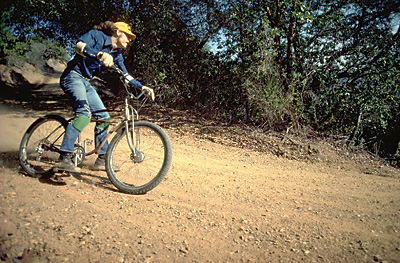
Charlie Kelly hauling denim down Repack’s Camera Corner, late 1976, on
his 50-pound modified Schwinn Excelsior. Notice the safety gear –
knee pads, elbow pads, leather gloves and boots – sans helmet.

A pickup truck parade that includes a pink 1953 Chevy leaves the last outpost of civilization – the leafy, hippie oasis that is Fairfax – heading up into the hills, with 50-pound bicycles and two chronometers … To Repack. The Repack trail drops 1,300 feet in 2.1 miles down the east side of Pine Mountain. At the top is an open ridge with views of Mt. Tamalpais, Marin, the San Francisco Bay, and the blue sky beyond. Fred Wolf and Charlie Kelly started the race down Repack, on Oct. 21, 1976, to be precise.

It was here that the words “mountain bike” and the subsequent craze began. Junkers, clunkers, bombers, ballooners, cruisers – paper boy bikes is what they were – $5 Schwinn Excelsior frames rigged with motorcycle levers, thumb shifters co-opted from five-speed touring bicycles, rear-wheel coaster drum brakes, and, eventually, a ten-speed derailleur.

“Hardly anyone ever asks me,” says Charlie Kelly, “but if I had to pick the day mountain biking started, it was the day in September 1977 that Joe (Breeze) rolled out his first Breezer inspired by Repack.”

Kelly’s ragged Schwinn beater had broken. Fellow dirt cycling revolutionary Joe Breeze built him a new steed – the 18-speed, 38-pound bicycle that would soon open other influential eyes to the possibilities of geared, fat-tire off-road bikes.

In 1979, the revolution shifted gears when Breeze and Otis Guy brought a primitive Breezer to Tom Ritchey on his Peninsula mountaintop. Until then, the mustachioed and wild-eyed Ritchey had been riding wire bead road tires across Santa Cruz Mountain hiking trails. He decided, upon seeing the Breezer, to build his own fat-tire frame.

This is how it would come to pass that Ritchey, the fastest frame builder in the West, strung together nine beautifully anonymous frames with no thought as to who would buy them or why. From his prolific garage workshop he wandered into the wet fog, thrashed around in the Bermuda Triangle of open space, and returned to fillet braze bicycles by the light of a woodstove.

“Want to help me assemble these and sell them?” Gary Fisher asked Kelly one day.

“Why not?” Kelly shot back.

They collected a few hundred dollars to open a bank account called “MountainBikes” and started assembling their bikes in living rooms and on kitchen tables. Ritchey made the frames, everyone pitched in to assemble them, and Fisher promoted. “It was such a big turn on,” Fisher recalls – to transform this gear-head freak show into a somewhat organized eccentricity of common purpose.

On the slopes of Repack, the bikes were tested and re-tested, disappearing in a rooster tail of dust past the Inside Line, the Knoll, Camera Corner, the Knob, the Sandbox – an alias to every twist or pile of rubble – followed by straightaway, out-of-control flashy 50-foot sideways skids to stops in front of a lone three-foot rock called simply the Rock. By the end of the blitzkrieg, the coaster brake grease would all but vaporize in an exhaust of smoke. It needed to be repacked. Hence, “Repack.”

Over the course of nine years, 24 races were held. By the end of it, MountainBikes had become “Fisher MountainBikes.” Tom Ritchey became “Ritchey Design Inc.” Charlie Kelly became Kelly Piano Moving Company. Pianos on strings floated high above the bay. And as the trio divided, an industry emerged – one that could be sometimes greedy, sometimes wonderfully slick, and generally a little bit wild and ridiculous behind the scenes.

In 1996 and again in 1997, with mountain biking in full, ubiquitous bloom, the usual suspects returned to Repack wearing Levis, lumberjack flannel, high boots and leather gloves to relive the first 2.1-mile descent.

The grooves had been rearranged, rocks had rolled to other resting places, trees had grown, but the art of it was exactly as it had been – to control your out-of-controlness on banked and rippled surfaces, feathering brakes just so, opening up and crouching low, accelerating fast, and yet living it all in slow motion. The spirit of Repack – the unofficial R&D lab for the first mass-produced mountain bike – remained.

Last year, I sat down with Kelly to interview him in a Mill Valley coffee shop. A swarm of caffeine-loading mountain and road bikers, many on the latest high-cost steeds, provided a time-warp contrast of the evolution of bicycling that Kelly’s witnessed over the last 40 years. Casual and earthy like the old school Marin native that he is, Kelly still rides frequently and remains in contact with many of the original Repack riders.

On Adapting Town Bikes to the Wild:

CK: Because we were all such dedicated hardcore cyclists, the limitations of the money-is-no-object bike are apparent right away. You can’t ride this thing to the grocery store, you know, and you can’t exactly haul freight with it. So if you’re gonna be a committed full-time hippie cyclist living without a car, well, you need something besides your money-is-no-object bike.

And so we kind of went to the other extreme and got town bikes. And it’s not like we were the first people who ever thought of that, because town bikes were already happening at every beach in Southern California. Everybody had a town bike ‘cause it’s level, you walk four blocks, and who cares. You want something that nobody would steal anyway.

So Gary (Fisher) and I got town bikes, and it was like an old one-speed with a coaster brake, you know, bare bones – for 15 or 20 bucks you could have one of these things. And we started riding ‘em around. And we weren’t even the first people in Marin to take our bikes on the dirt, but we did eventually …

You gotta understand, this house that Gary and I lived in – bachelor pad was probably not enough of a description. We’re talking about a place where you ate standing up. What we considered a dining room – work bench, vise, grease on the wall, bikes hanging from the ceiling.

And Gary had brought home one day – he’d bought a tandem. He’d gone to the flea market and somebody had dismantled their tandem, and the thing was just like in a box and would require lots of money and lots of time to make this thing work, but it was like 15 bucks, you know, and what it had that was interesting was this enormous drum brake, 5-speed rear hub which Gary immediately put onto his ballooner bike.

We weren’t even the first to do that, because some other guys had beat us to that. But we were the first in our area to do it. And now the first ride with Gary, who’s got this bike that now weighs 10 pounds more than even my already heavy bike, but at the same time he just totally trucks right away from us on the hills. It was like, ok, drum brakes, five speeds, we’re there. It’s a tandem part. You could get it if you special ordered it, and so we did.

On The Repack Races:

CK: We started putting on a race which was really the thing that made Marin County maybe more of a hub for this sort of thing than other places. Because we weren’t doing anything different than a lot of other people in a lot of other places. It wasn’t rocket science. You get an old bike and try to make it a little more useful in the dirt, and other people had done that.

But when we started racing, then people started going, “Well, what if money was no object?” The whole idea was, well, you know, I’ve got a 50-dollar bike. And that kind of flipped it when we were racing. You go, well, what if I spend a thousand bucks? What would I have? And then… So eventually a few of us did and thought that we had all the bikes of that sort that the world would need. But apparently we hadn’t.

On Joe Breeze and the Origin of Off-Road:

CK: If anybody invented the mountain bike, it’d be Joe Breeze because he sat around and basically decided every element of it. And up until Joe did that, everything had basically been patched together from what was around. And so, I mean, if I’ve gotta give credit to anyone, I’ll give it to Joe, but he won’t accept it. So we’ll leave that hanging.

I believe that (the mountain bike) was a product of critical mass ‘cause nothing we did hadn’t been done before. What happened was we did it in a crowd big enough to accelerate the process. ‘Cause my friend, John Scott, 1953, 20 years plus before we did anything – he built a bike pretty much identical to what we did in the ‘70s. But boy, if that market was not ready for it in the early ‘70s, it was way not ready for it in the early ‘50s. And so … he was the one bike geek in the whole wide world that he knew of … like this lone voice in the wilderness, and nothing ever came of it. But, in fact, he had all the same ideas.

So I think that critical mass, plus I think the world was ready for it a little more, you know. By the time we were hitting the streets with mountain bikes, the ‘70s was a bike boom, so there were a lot of people on bikes. There was a lot of bike awareness. I got lucky, and plus I was lucky enough to know Joe Breeze.

On MountainBikes Inc. Attending its First Trade Show:

CK: We walked in with our entire exhibit in one trip which is, well, it was two bicycles, a card table, and maybe a couple of boxes of cheaply-printed literature. So we’ve got a pretty funky display there, and right across the road you’ve got Shimano – spent eight million bucks on their display. It’s got sound and lights. It’s got dancing girls. It’s got models and it’s got bicycles. They’re paid. They’re taking shifts on the bikes because they’ve gotta ride bikes all day, you know. And they’ve got this disco theme. … It’s like money is no object.

So we’re pretty much getting ignored by all the adults, but the guy from Omaha – the guy who sells lawnmowers and bicycles, he’s there. Not at all a bike fanatic like us, but he’s walking by and he’s smoking a cigar. He’s got his 12-year-old kid with him … (and he) sees the bike – and you don’t have to explain a thing to him. The 12-year-old kid makes all the connections. It’s like, duh – heavy duty, cool, gears, brakes, big tires.

What’s to say? … The adults didn’t see it, you know, and so, I mean, that was quite a reaction because the kid would do, “Wait a minute, dad, dad, dad! Dad, I’ve gotta stop and check this thing out.” And a couple of those kids getting so insistent on their dads actually put a crowd in front of our place a couple of times …

This guy comes up to us and says, “You know guys, I just love your passion. You’re what’s great about the bike market. But I gotta tell ya, this stuff is going nowhere. The future of bicycles in America is aerodynamic components.”

We were so bummed to find that out because we were staking our futures somewhere else. But it’s a great story because the guy was absolutely dead wrong. And he was one of those industry insiders that presumably someone paid to know about that stuff.

On Early Bike Design and R&D:

CK: Specialized – those guys bought four bikes from us in 1980, and in about eight or nine months they had their bike on the market and it was basically identical to what they bought from us.

When the bikes were first starting to crack the market, around 1980, there were a number of different designs. I have a roundup of about 15 different bikes that were on the market, and the Ritchey – the bike that Gary and I were selling and Tom was making – is the one that looks like all the mountain bikes that were built for the next five or six years. Because, basically, rather than any R&D, people just knocked off what we were doing, and not a lot is patentable on the bike.

So basically we did the R&D for the industry, and only after all these other companies had a few years of building bikes and had their own stable of fanatic bike engineers and riders and so forth to do their R&D, well then it started branching out. But really, the first four or five years of the mountain bike industry … we had done R&D for everybody … All they did was copy what we did.

It really jumps out at you when you see this picture of all these bikes collected together from 1980, and there’s one that all the bikes two years later looked like … So Specialized was one of the first to jump on that. And at this point

I don’t really care. I cared then. I don’t care now.


Colleen Corcoran is a writer based in San Francisco. She is currently working on a book about adventure sports in California and beyond.