1
Jan/04
0

Trans-Sierra Winter Trek

by Matt Johanson


As we gazed over Tuolumne Meadows and countless snow-covered pinnacles on the horizon, we saw not a soul and scarcely a sign that people had ever been there. It was hard to believe we were in one of the world’s most famous and popular parks, visited by more than 4 million people every year. To reach the 9,450-foot summit of Lembert Dome in summer involves an easy hike, but to earn that same view in winter we had to ski for two days to even get close, and then trudge upwards through several hundred feet of deep powder. We had carefully hiked the final steps over rock and ice to reach a patch of bare granite atop the mountain of snow . The amazing view from the peak was our reward. The whole point of visiting Tuolumne Meadows in winter is to be one of the few to enjoy the perfect tranquility and spectacular snow covered landscape. The amenities that summer visitors enjoy are scarce.

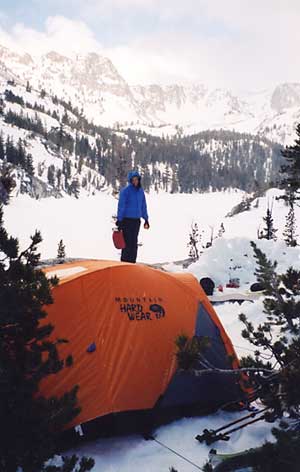
Crossing the mountains on cross country skis from east to west was our goal, starting in Lee Vining and finishing in Yosemite Valley. We spent five days in early April to cover 35 miles plus side trips. Our three-man team consisted of me, my friend Cliff DeYoung (both in our early thirties), and Cliff’s father Richard DeYoung, the fittest and toughest 61-year-old I know. We are all experienced if not expert skiers. We took many preparation trips, both in Yosemite and the Lake Tahoe area. On one trip, after a surprise storm buried our tent at night near Lassen Peak, I figured we were ready for anything.

Tioga Pass was our destination the first night—eight uphill miles from the winter gate east of Lee Vining on Highway 120. To our surprise, a crowd of people waited at the road closure for a ride from one of the few motorists with winter access: a driver for Tioga Pass Resort. Tioga Pass Resort, a privately-owned cluster of cabins just two miles west of Yosemite’s Tioga entrance is a convenient first stop for skiers crossing the mountains. Dinner, breakfast and a pick-up ride to the snow line are all included with TPR’s package, and we watched the truck’s driver take a pack of tourists up the mountain. We chose to forego commercial assistance and trek in alpine style, so we set off on foot under heavy packs, scoffing at the “softness” of the resort guests. Privately, though, I found little satisfaction in plodding up a paved highway in ski boots. Within two miles, Cliff felt blisters forming. An hour later, the pick-up approached on its final run.

“You guys wanna ride?” asked TPR’s driver Stacy Lewis. “You talked us into it,” I said. Stacy took us about two miles, from 7,800 feet to the snow line at 8,800 feet, and even offered to haul our packs in the snowcat the next two miles to the resort. That was going too far, we decided, and politely declined. We had four miles and about 1,100 feet of elevation gain between us and Tioga Pass. “We should make it to the pass tonight, shouldn’t we?” Richard asked. “If you don’t, you’ve got no business doing the trans-Sierra,” Stacy replied.

How Did You Get That Up Here? Skiing on good snow, we reached Tioga Pass Resort in an hour. A friendly crowd, warm fire, and the promise of a hot dinner tested our resolve, but we pushed on towards the pass, reaching
it in an hour. Normally, camping at the 9,943-foot pass would be inadvisable due to high winds, but the warm and calm conditions were inviting. For better or worse, this meant we would have access to a nearby pay phone,
half buried but operational. We spent a peaceful evening in our four-season tent, dining on soup, rice and leftover steak which we ate with bare hands right out of tin foil. Big, bright and countless stars filled the clear
sky, until a moon rose so bright it seemed to turn night into day.

It was only eight downhill miles from Tioga Pass to the next common destination, Tuolumne Ski Hut, a public cabin that serves as a campground office in summer. Near a host of exciting winter attractions such as Cathedral and Unicorn peaks, the hut provides shelter and modest comfort to up to ten skiers on a first-come, first-serve basis, at no cost . We arrived at 1 p.m. on our second day, claiming three of the four open beds. That evening, our fellow cabin guests put our meal of rice and noodles to shame with their dinner menu: beer, wine, salad, a hearty stew, and cheesecake. How had they carried such a backbreaking load? They took advantage of a large food locker provided by the park service. Many winter visitors cache non-perishable food during the fall, and we earnestly wished we had done so, though one friendly skier offered us his surplus pickles, olives, cheese
and salami.

Together the nine of us passed a pleasant evening. I called my wife on the pay phone and checked on the Giants, who had just swept three games from the Dodgers behind a barrage of Barry Bonds’ home runs. Women teased the men about snoring, and men stoked the fire hot enough to make a sauna of the cabin, trying to entice the women to disrobe. Sweating like a pig, I stripped down to my shorts. The women held tough.

“I can’t believe you can come here for free,” laughed Dave, chief fire-tender and an accomplished skier. Only a handful of people visited the hut in December, January and February, according to the guest book. On most nights, it was vacant. Many more came in March and April, and the cabin actually overflowed on our second night. Ten skiers slept inside and a family of four camped nearby. They did not seem pleased to spend a long night in their tent away from our warm stove.

Shall We Tell Them How Easy It Was? We relished the waterfalls and snowy granite domes of the trek’s fourth and longest day. We had grunted up many long hills by this point, but here I found the first technically
challenging skiing comprised of runs down long, shady ice slopes. We skied about two hours from the hut to an amazingly turquoise, frozen Tenaya Lake, where we paused to eat and refill our water bottles. We considered it important to rest and hydrate before Olmstead Point, a notorious avalanche hazard and the most serious obstacle of the trip.

The avalanche danger of Olmstead Point became clear as we approached. Facing into the sun, its steep slope seemed to be 40 to 45 degrees—a perfect combination to encourage snow slides. Sure enough, the trail of a previous avalanche crossed our route directly. A cause for concern, it had motivated me to attend a basic avalanche safety seminar prior to our trip. On the bright side, fresh snow had not fallen for more than ten days. Still, we took basic precautions. Before entering the hazard area, each of us tied on an avalanche “tail,” a thin, 50-foot length of rope. Should an unexpected snow slide bury one of us, the others could quickly find him as long as they could find any part of the tail. Resolving to move quickly, I led at double time, followed by Richard and Cliff. As we crossed the hazard, I wondered what I would do if the slope were to suddenly slide. Turn downhill and try to escape the avalanche? I doubted the plan would work, but the alternative of being buried alive was even less appealing. Five breathless minutes later, we reached more level terrain, where we relaxed and admired the view of Tenaya Peak, Tenaya Lake and Polly Dome. Olmstead Point also boasts an awesome view down Tenaya Canyon and a unique perspective of Half Dome. From a short distance past Olmstead Point, skiers must leave Tioga Road for the first time and either follow Snow Creek Trail or devise another route to Yosemite Valley. After camping near Mount Watkins, we started this descent in earnest on the fifth and final day. Though mostly downhill, this leg of the trip can be the most difficult because of inconsistent snow and the challenge of route finding. We took our
first falls on snow that was sometimes icy and fast, and other times slushy and slow. After a few aggravating hours of trudging over downed logs, boulders and snow patches on a steep grade while trying to reacquire the trail, we reached bare earth again and hiked down the switchbacks near North Dome. Despite fatigue, our spirits rose as we completed the last leg of the journey back to civilization.

“Are we going to tell everyone how easy it was?” Richard asked. The Trans Sierra is not always easy, though. Conditions for us in early spring had been nearly perfect, but good weather and snow are never guaranteed. A foot of fresh powder would have made our work twice as hard, and every one of our warm-up trips had been far more difficult. Only strong and experienced skiers should even consider a trip like this. Help in an emergency will be unlikely. If you’re ready for it, though, there’s no finer backcountry skiing in California. “My only regret,” Cliff said, “is that we didn’t do this a long time ago.” Catching the bus at Mirror Lake, we enjoyed our trip across the valley like a victory lap.

1
Jan/04
0

SCUBA DIVING FOR NEANDERTHALS

by Christa Fraser

We were all perfect divers in the womb, our dive instructor, H, told us on our first night of scuba diving class. This made sense. We did once live in an amphibious state in the womb. Then he went on to tell us that
because we were learning to dive in Monterey Bay, which some consider to be the Mt. Everest of scuba diving, we would be reborn as dive Sherpas by the time we passed the class. Let’s just say I wasn’t reborn as Tenzing Norgay.

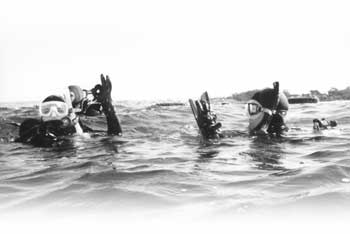
Learning to scuba dive isn’t just about becoming friendly with your air tank and schlepping 60 pounds of gear, it is mostly about training and using your brain. We were constantly reminded to bring our brains below the surface, like any piece of good equipment. The problem was determining which brain to bring—the modern, evolved one which allows you to rationalize sucking oxygen from a tube while swimming with the fish, or the primitive one which tells you to get the hell out of there so you can breathe. It really was a tough decision.

The Higher Mind

Modern brains differ greatly from those of our ancient ancestors like Homo Erectus. We are able to compute, think in the abstract and create technology. It isn’t hard to see that diving is a result of the modern brain. We had to develop the equipment that allows us to submerge ourselves for long periods of time and learn how to compute safe dive times and depths. Most importantly, we had to be able to imagine ourselves breathing underwater. There is a reason that early Homo Erectus didn’t dive—he wanted to survive. Fortunately, the first part of learning to dive appeals to our modern brain. Otherwise, my inner Neanderthal would have hightailed it out of there pretty quickly.

Our PADI certified dive class, held at Aquarius Dive Shop in Monterey, started inauspiciously. In fact, I felt a little elation that what I thought was going to be a three hour class turned into a one hour introduction before we were excused. I felt like we were given leave to play hooky and it was only the first night of class. This is going to be easy, I thought.

“Finish your PADI Go Dive book and watch all the videos by the next class. Oh, and have all of the Knowledge Reviews and quizzes complete, too,” H told us. No problem.

After watching some really groovy PADI dive videos from the eighties (there is a reason we don’t wear neon green, pink and purple simultaneously anymore) I became really psyched. My boyfriend, Matt, sat on the couch watching the videos next to me. By the time the first video finished teaching about lung bursts and alternative air supplies, I was proudly rattling off the different pressure, volume and density ratios. Matt stared at me skeptically and asked, “Are you sure you can do all that?

”Oh, come on. I always ace tests,” I said. He looked back at the screen, where divers were now perfectly performing a buoyancy test in a pool.

“OK,” he said, but he looked worried.

I have always done well in school.That said—I usually had one of the lowest quiz scores in the dive class. I knew that I was in over my head before we ever got in the water, and then a young skin diver/ lifeguard
named James informed us that it was our medulla oblongata that governed our primitive functions, like breathing and heart beat. Um, how do you spell that? Well, I was sure that my medulla big olgoba wasn’t going to be in charge of my diving. I knew that my intellect would be in control.

H went on to tell us about the Zen of Scuba and how we would learn to control our breath, slow down our respiratory system, learn to meditate without actually meditating. He explained that we would learn to fly underwater.

Then we hit the pool.

The Primitive Mind (Located in the Hind Brain)

Some of the guys who were our dive masters were very big, muscled men who whispered things about being in the Special Forces and such. I suspected that they were operating out of that very lower section of brain which sits above the spine and acts like a bunch of twitching electrical fibers and drinks a lot of beer. Actually the instructors were great. I was the one who was reduced to operating from those twitching bundles as soon as I stepped into the swimming pool of the Monterey Travel Lodge where we would do our first dive simulations.

Gary, a big guy who was once in special ops, was assigned to instructme specifically, because…let’s just say that I had special needs.

There is something about donning a seven mil wetsuit and a seven mil vest that can make even a spelunker feel a bit constricted. Then you put on a buoyancy control vest, a 20-something pound weight belt, a neoprene hood,
booties, and to top it off fins, thick gloves, a mask, and a snorkel. You put this mouthpiece in your teeth and start breathing from the tank that you have strapped to your back and jump in the pool. It does not feel natural.

My mind panicked a bit (I should admit that I lost a contact during the swimming test, so my first experience scuba diving happened while I was virtually blind). Everyone else was calmly following instructions and doing their exercises. It took me four tries to clear my mask of water and then another four tries to take my mask off completely and replace it without schlurping up a bunch of pool water. But by the end of class, after following Gary around for a couple of hours, I had relaxed quite a bit and was becoming exhilarated by the sensation of breathing underwater.

The next week in the pool, I felt relaxed and excited. Jim, a sweet old salt and dive demon, instructed me and a student named Colleen, who probably weighed less than all of her gear put together. I felt like my higher brain had won the battle. I would be super stud under water when we went into the actual ocean.

The Really Primitive Mind

Hyperventilation is a response by the medulla oblongata to distress. My ability to rationalize using up three-fourths of my air supply before I even got my forehead wet, however shows that my thinking brain was still working,
at least on the surface.

My dive buddy, Monica, and our dive instructor, Lance seemed like my personal buoys at times. The visibility was reduced to several feet and so the three of us were holding hands or touching at all times. In fact, one of the clearest things I saw on all four of those dives were Monica’s eyes, big and brown and keeping me rational.

We had to do four check-out dives in the ocean over a two day period. I used an hour’s worth of air just swimming out to the buoy. On the very first dive, we had to take off our masks and replace them underwater. At one point I tried to surface without finishing the exercise. My mind saw the undulating light of day straight above (about 15 feet) and I kicked off the bottom and headed straight up. H tugged on my leg, and brought me back to my rational mind. I calmly replaced my mask, cleared it and then got the thumbs up from him. Apparently, I had brought the wrong brain with me on that first dive.

I cleared all of my skills. Although getting my weight belt back on over the bigger tank they gave me the second day was not pretty. Thankfully, Lance kept a hold on it so it didn’t sink. Finally, on the fourth dive, we were allowed to do a fun dive, although we had to do it by compass. It really was amazing to be skimming the ocean floor and checking out the starfish, sea cucumbers and sandabs while breathing underwater. I felt very safe and reassured by my dive partners. We navigated perfectly, and I had barely used up any air! By the time we hit the beach, we were excited to dive again.

I didn’t magically morph into a superhero diver in just three weeks. In fact, if Wonder Woman looked as bad as I did in 14 millimeters of neoprene, she would have been fired. What I did learn, though, was that
I could understand a lot of technical stuff, get my gear set up and keep myself calm enough underwater to discover a whole new world. I didn’t quite get to the Zen of Scuba, but at least I learned to stop hyperventilating. My medulla oblongata is such an air hog.

1
Jan/04
0

Rippin’ Round the Palisades

by Seth Lightcap

Driving up the road to Glacier Lodge last March, looming Mt.Alice looked huge. Flipping open a topo map and my tattered copy of Paul Ritchens’ 50 Classic Backcountry Ski and Snowboard Summits in California, I measured up Mt. Alice and our intended route. Scoffing past the, “Snowboards: Not Recommended” bit, I sought words of encouragement, and read aloud to my two partners, Nick Sovner and his dog, Max, “The circumnavigation of the Palisades is an arduous ski mountaineering MINI expedition through some of the most rugged alpine terrain in the Sierra Nevada.” I got no reply. I could tell they were both looking at Mt. Alice and the surrounding terrain. Mouths open, they stared at the vast landscape. There was nothing “mini” about it.
Arriving at an empty trailhead around 1 p.m., the air was dank. The dripping pines glistened as the sun shown through onto the fresh snow. I stretched out my pesky leg cramps and watched Max casually sniff at a pine bough in a snow drift. Perched with precision, Max shook off a drip from his coat and radiated his veteran snow demeanor. I turned back to the truck, eager to begin gearing up. Nick had already unloaded the boards and was elbow deep loading his pack. Game On!

A recent crossover from snowboarding, Nick was touring on telemark skis. True to my roots, I was piloting a splitboard. A splitboard is a hybrid snowboard that can split in half to become skis (see product review page 42). The splitboard allows the dual reality of efficient skiing on the way up and blissful snowboarding on the way down. As I had already skied about 150 total miles on my 170cm Burton with few issues, I was ecstatic about challenging my schizophrenic chariot to a true epic in the Sierras.Finessing this expedition would finally give me the ammunition I needed to crush two-planker naysayers who spout about a snowboard’s limitations in the backcountry. As far as I knew, no one had ever attempted a Palisade circumnavigation on a splitboard. …And so the journey began. Three Donner Summit snow warriors, poised for an extended journey into a massive winter Valhalla. We had all seen many nights under the winter stars, but such a journey around the Palisades would be our most committing adventure yet. Inspired by the write up in Paul Ritchen’s guide book,I had convinced Nick that this expedition was THE adventure to fill his spring break from Humboldt State. Without requiring any car shuttling, the 30 mile trip would take us up the North fork of Big Pine Creek, around the remote Western flank of the Palisade Range, and back down the South fork of Big Pine Creek. The route began at 7800 ft and climbed five 12,000+ ft passes, crossing the Sierra Crest twice in the process. I reasoned we would spend five nights in the snow.

Prepared, and giddy with energy, we hid the car key, and began mounting our skis. Max was already down the trail. The first six miles of the journey followed the North Fork trail up Big Pine Creek. Slogging through 18 inches of fresh snow and pesky manzanita, we camped in the trees just above First Lake in the shadow of beloved Temple Crag. Watching the sunset on Temple’s gothic aretes and massive pillars, we dug in our Mega-Mid tent, humbled to have just entered what we knew to be holy land. The next day Max had us up and charging at first light. We ditched the trail and took a high traversing line above Second and Third Lakes dropping back to the valley floor at Fourth Lake. Arriving aside Fifth Lake around noon, we found what would be our last open water source. Everyone guzzled the icy melt water and recharged. The first sustained steep push lay just ahead. Matching each other step for step, Nick’s telemarks and my splitboard both worked flawlessly as we switchbacked up the massive headwall that guarded the drainage below Jigsaw Pass. Stoic in the face of deadly exposure, Max scurried on top of the crust as Nick and I busted steps one at a time.

Upon reaching 11,700 ft. at 3:30 p.m. we dug in for the night. Sleeping in the trees at 9000 ft had been comfortable, so we figured digging our shelter into a four foot deep hole next to a rock might help recreate that warmth 2500 ft. higher. Two hours effort paid off, and we slept relatively
warm despite Max’s attempts to steal my sleeping pad. Awoken to bluebird skies, Nick led the rally to the Crest. The final 400 feet of climbing gave us a chilling reminder of the committing conditions that guard the Sierra Crest mid-winter. We clung to our edges and perched on our poles, as steep icy crust led us through broken exposed rock. Nick’s telemarks gripped a bit better than my splitboard initially, but upon engaging my crampons and tightening my skins I gained the crest just behind him. Looking off of Jigsaw Pass at the glorious peaks of King’s Canyon,we took a reverent break and stood in awe of the snowy serenity awash around us.

Eager to make our first turns in three days, Nick and I clamored over the rocky crest and looked down the western escarpment hoping for a powdery chute to descend. Instead we looked off into nearly 500 feet of nasty steep rock mixed with narrow tongues of loose snow. A tattered bamboo wand marked a
narrow rocky entrance. The downclimbing that ensued was by far the crux of our trip. The steep snow made for sketchy kick stepping and the loose rock made for horrible down climbing. More in touch with the rock, I zig zagged my way down intermittent rock steps. Nick’s plastic tele boots allowed him to kickstep through the crust so he moved snow patch to snow patch. Max charged down head first, running laps around us both. A stressful hour later we reached terra firma—a 500 ft. snowfield that dropped to the basin at Bishop Pass. Assembling my splitboard for the first time in three days, I took a deep breath and launched into some of the most rewarding turns I have ever made. Ripping through the shin deep, wind blown powder I felt unconscious. Nick and I milked that sweet pitch for every vertical inch. Catching a hidden rock, Nick took an unexpected fall, but even a tweaked ankle couldn’t rip off his plastered smile.

The rest of the afternoon we crossed 12,000 ft. Bishop Pass and blasted a bit further, setting camp in a drift directly below Thunderbolt Peak. The dawn of day four found us a bit cold, but still energetic. Setting a preliminary goal of a camp below Norman Clyde Peak, we had three 1500 ft. passes to climb and descend. Tackling Thunderbolt Pass with ease, we plotted our line to Potluck Pass, and dropped in for our second helping of turns. Returning to our skis and skins we traversed below North Palisade and made good time ascending Potluck Pass. Nick’s telemarks and my split skis handled the variable snow with grace.

From the top of Potluck we spied our final pass for the day, the inconspicuous Cirque Pass. Cirque Pass is a narrow break in a major ridge jutting away from Mt. Sill and gaining its threshold proved to be quite intimidating. Peering over the southern edge at almost 4 p.m. we quickly
stowed the skins, and dropped into a technical descent through fall lines that fell off into jutting cliffbands. Nick proved himself the worthy partner and photographer as he passed on a few dream-like exposed lines to safely guide himself rock band to rock band while shooting pictures. More at ease with my bulky pack, I hucked and played with every drop and constriction on my splitboard. Arriving at the basin below Norman Clyde Peak, an eerie fog rolled in and we dug out a home for our last night
west of the Sierra Crest.

That night below Norman Clyde Peak was miserable. Icy condensation rained from our tent walls with every gust of wind, leaving me no choice but to cover my face with my jacket to escape the frost. Sleeping with a jacket over my face at 11,000 ft. quickly led to hypoxia and I would awaken tearing the jacket away to gasp for breath. Everyone slept horribly. The wind died with the dawn and we finally got some decent sleep as the sun hit the shelter.

The final day west of the crest we contoured above beautiful Palisade Lakes. Traversing the rolling slopes far above the lakes put my split ski skills to the test. Spooked about slipping on the split skis, it was my turn to make the cautious traverse lines and take the pictures. Nick casually made the turns as Max chased us both. Hooking around to the east, we arrived at the base of Southfork Pass around 1 p.m. We inhaled some lunch and began our final climb. Steep switchbacking on exposed slopes gained us a narrow tongue of loose talus on which we scraped our way up the final 300 ft. to the top of the Sierra Crest.

Gaining the 12,560 ft. Southfork Pass, my eyes lit up. What lay to the east is what backcountry dreams are made of. A 500 ft. funneling chute of soft wind pack that emptied out into the massive southern drainage of Big Pine Creek. After negotiating the narrow chute exit, a descent of over 3000 vertical feet still awaited us. Before dropping into the chute we checked that our transcievers were beeping, and dug a hasty pit to get an idea as to the stability of the snowpack in the chute. The snowpack seemed nicely consolidated, so we geared up for the descent. Nursing his tweaked ankle, Nick chose a lower point to drop from. I made off with the glory turns,
punching several tight slashes right off the crest, before pointing the hole shot. Screaming out into the massive snowfield below, I once again found
religion. Floating through the countless gullies and small headwalls of the Big Pine drainage, we rode and skied for over two and a half miles. Choosing lines picture perfect for our respective styles, Nick and I frolicked as Max chased our tracks. Although we could have easily descended all the way to the trailhead that day, we stopped short and camped one last night at Willow Lake. Legs weary and souls aflame, we celebrated our achievement and slept womb-like under the shadows of the Palisades. The next morning, we loaded up, and pushed on to the final descent. What we expected to be a no-brainer down the main drainage ended up coercing us into very committing territory. Riding tree to tree next to exposed rushing water made for a fitting ending to the adventure. Snowline forced us to give up the now tic-tac descending and we hiked out the last half mile in the snow and dirt to the trailhead. The truck held clean socks, cold beers, and offered our first interaction with other people in six days. Questioned as to our journey, we spoke in tongues still unintelligible to anyone but ourselves. No one asked us a second question and we sought no more answers. The Palisades had pushed us hard, but all worry and suspicion were now gone. No technology, no guidebook, and no physical or mental limitations could take back our success.A snowboarder, a telemarker, and a dog had completed the journey of a lifetime.

1
Jan/04
0

Are you ready for an adventure race?

by Rebecca Rusch, Team Captain

This is a question that should always enter your mind in any sport (actually in everyday life). Being prepared
for whatever is thrown at you and being able to deal with it takes a lot of patience and training. With adventure
racing, you are not only relying on yourself, but also on your teammates being prepared for a race. So, how
do you do this as a team? Well, our team has been both over prepared and under prepared for races in the past.

Obviously, the earlier races in my career are ones I felt less ready for than races we’ve done recently. There is A LOT to be said for just having experience. Just getting out there and getting your feet wet teaches the proper skills and mindset. That’s the beauty of adventure racing: it’s unpredictable! It’s often not the most physically prepared or the fittest teams that win. Instead, it is the
teams who race smart and are able to adapt to whatever the race course and their teammates throw at them who dominate. Maintaining flexibility and patience is the key. The only way to develop those qualities is to get out and race or do long training trips with your teammates and friends.

Adventure races are also such a HUGE undertaking that someone
entering one might think, “Am I ready? Did I train enough? Did I forget something?” I remember one race in particular, my very first Eco Challenge and only my second race ever. It was probably the most unprepared and frightened I have felt in my whole life. A 24-hour race seemed like an eternity to me. My background was cross country running in high school and college where the two and three mile races seemed long. Most of my fear was due to lack of experience and knowledge. I really had no idea what I was getting in to. I had done one 24 hour race that happened to be an Eco Challenge qualifier. I was like a deer caught in the headlights the whole way. We won the race, nonetheless, and were invited to Australia.

In preparation for that Eco Challenge in Australia, I tried to approach my training in a methodical
way. Looking back, my preparation was anything but methodical. My approach consisted of simply trying to run, bike,
and paddle as much and as hard as I could. I was also working at the time. Realistically, I was training
a couple hours a day at most. There were probably four different weekend days when our team would do a bike
for perhaps two hours, then paddle for two hours. This was the extent of my preparation. The rest of the time I spent worrying about how slow and unprepared I was.

So, we went to Australia and sprinted out of the starting gate like a bunch of stallions. I had that deer in the headlights look on my face again and was just trying to hang on with the pace the guys, who had more experience than I did, were setting. I kept my mouth shut and stumbled along. It was a furious 36 hours. We arrived at a few of the check points in first place
and were rolling along among the top five. I knew we didn’t belong there. To make a long story short, two guys on the team pooped out just a day and a half into the race. One of my teammates was suffering hallucinations, vomiting and was worn ragged. The other one had worn severe holes in his feet.
We had been going so fast that he felt uncomfortable asking us to stop so he could take care of his blisters. The other two of us, feeling fresh still, had to drop
out with the rest of our team. Four days later, watching the winners cross the finish line was bitter
sweet. I knew that our team had not been prepared or realistic about the pace we could keep. Not finishing
that race was the most valuable lesson I could have learned. I vowed then to come back to one
day finish an expedition race. That was seven years (and thousands of race miles) ago.

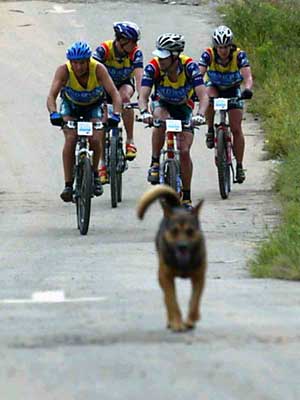
Team Montrail is made up of badasses Rebecca Rusch, Patrick Harper, John Jacoby, Novak Thompson, and Justin Wadsworth. Together, their resume includes Olympic Skiing, whitewater raft guiding, guiding rock climbing, teaching adventure racing, carpentry, business banking and parenting. Which just goes to show that adventure racers truly are human like the rest of us. After winning the Raid Gauloises in Kyrgyzstan this past June, though, they appeared to be super heroes. After all, only 12 teams out of 36 were even able to finish the course of the race that many consider to be the toughest in the world.

They are currently sponsored by Revo, Red Bull, Sugoi, Suunto, Petzl, Leki, CamelBak, NRS, Gregory and Aloksak, Emergen-C and Giro, among others.

To find out more about Team Montrail and learn a few of their winning secrets, visit their web page at www.teammontrail.com