1
Sep/08
0

The Ultimate Rush

A first-time skydiver discovers new frontier

By Karen Kefauver

Photo: Adventure Center Skydiving

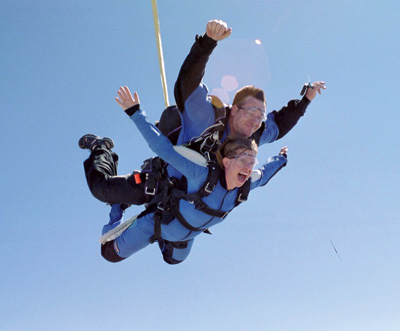
Nothing compares to skydiving for the sheer adrenalin rush. Immersed in the moment, Karen forgets the recommendation to keep one’s mouth shut – to avoid the discomfort of wind flapping the cheeks like sheets in the wind.

When my friend Christian Fine of Capitola invited 165 of his closest friends to go skydiving last September, I was one of nine men and women who said, “Yes!” The excursion, in honor of Christian’s 40th birthday, would fulfill his long-held dream of plummeting through the air with a parachute. Since my mountain biking season had wrapped up, I had more free time on the weekends. Plus, a crisp fall day would provide ideal conditions for a jump: clear skies and little wind.

Call me courageous or foolish, but I agreed to jump out of an airplane flying at 18,000 feet elevation then hurtle through the heavens at 120 miles per hour until the parachute deployed.

I just hoped I would live to tell about it.

I called Adventure Skydiving Center in Hollister to learn more about the company and spoke to the owner, Tim Sayre, a former air traffic controller. He described the detailed safety training that would be offered for my tandem jump (in which I am strapped to an instructor). I also checked the website’s “Frequently Asked Questions” and found the tongue-in-cheek answer to “Is skydiving dangerous?” oddly reassuring: “Of course it’s dangerous. You get out of a plane three miles above the earth. And gravity does work … it rules supreme. The only thing between a skydiver and ‘deceleration trauma’ is a chunk of nylon about the size of your living room.”

At least these folks were honest. I was ready to go!

On a sunny Saturday, our Santa Cruz delegation carpooled to Hollister Airport, a 50-minute drive. As we passed sprawling pastures and modest ranch houses, I avoided thinking about what was to come. I snapped to attention upon arrival when I had to read and sign four single-spaced pages of release forms and pay my $230 in cash (discounted group rate).

Our safety briefing was conducted by Raff, a jumpmaster who had completed more than 12,000 jumps over 20 years. He explained that we would be jumping tandem-style, which is common for first-time skydivers. The instructor strapped to us is responsible for deploying the parachute — and the backup parachute, if necessary. After the safety briefing, I shimmied into a blue one-piece jumpsuit (no silver sparkly suits available) put on my aviation goggles and felt ready to fly to the moon.

I was shocked upon climbing into the small plane. Instead of individual seats, there were two metal benches, one on each side of the plane. I had not expected a first-class cabin, but I never imagined that the jumpers and instructors would be squished like sardines in a tin.

As the plane climbed higher, my stomach churned and my heartbeat quickened. At 18,000 feet, the highest altitude permitted for a tandem jump in California, the door opened. The wind roared. A chorus of flight attendants screamed in my head: “The airplane door should NEVER open except in the event of an emergency!” I could barely hear my instructor two inches away. I was numb with fear as I watched my friends, paired with their instructors, exit the plane. Now it was my turn.

“Go!” shouted Sebastian. He nudged me toward the gaping maw of the plane. Perched on the edge, looking at the sprawling patchwork of colored land below, every fiber of my being froze. Suddenly, I lost my desire to topple into the sky. I panicked! Ignoring my hesitation, Sebastian lunged forward and we somersaulted into the air together. I screamed as loud as I could in protest. The free fall, sacred moments of absolute freedom for many skydivers, seemed to last an eternity. In reality, it clocked in at about 90 seconds.

When the parachute finally jolted open, abruptly slowing our speed, I felt tremendous relief — for a moment. We began spiraling in tight circles and my stomach churned. As the parachute gently whooshed back and forth, I fought waves of nausea. “Are you doing that on purpose?” I shouted over the wind. Sebastian nodded. “Please don’t!” I begged. I thanked him for refraining from further stunts. No one had mentioned that motion sickness is a fairly common side effect in this aerial sport.

I have never been so grateful to be back on terra firma. We hit the ground fast, but landed on our feet. I felt dizzy and relieved. I was congratulated by friends – all of whom had survived the jump (though one had needed his back-up parachute). Our gang of newly minted skydivers piled into the company van to drive seven miles back to Hollister Airport. We compared notes.

“I was a little freaked out right before the jump,” birthday boy Christian admitted. “But I took a deep breath, found my center, relaxed and kept my eyes open. I felt very liberated – just me and the sky.”

“I liked having the built-in expert on my back,” said Margaret. “It was very reassuring.”

“I think I am going to be sick,” said Alan.

Alan and I subsequently lost our lunches. What I temporarily lost in calories was well worth what I gained. My first time skydiving showed me that I am willing to push the envelope in my risk-taking. Most importantly, by trying this daredevil sport, I ventured into a new frontier of aerial adventures – perhaps paragliding next? I am not sure if I will jump again, but I sure am glad that I can relive the thrill by watching the video footage of my glorious skydiving debut.

Karen Kefauver is an adventure travel journalist based in Santa Cruz. To view her skydiving video, visit http://karenkefauver.blogspot.com. Her next adventures will be whale watching in Brazil and mountain biking in Peru. Contact her at www.karenkefauver.com

1
Sep/08
1

From Dawn to Dark in the Palisades

Running five fourteeners in a day along the Sierra Crest

Words and Photos by Seth Lightcap

Craning my neck to see off the ledge I scan the terrain above me. I can see a blocky route that could go, but it looks sketchy. We’ve been testing that kind of chunky choss all day … no bueno.

Gotta be here somewhere … I scoot out a little bit farther towards the edge of the ledge.

Bingo! The dihedral corner crack appears. Tucked just out of sight behind the block above me it’s obviously the line. A couple exposed face moves guard the corner’s entrance but my mind has already relaxed: I see feet, I see hands, I see summit.

Anxiety turns to anticipation …

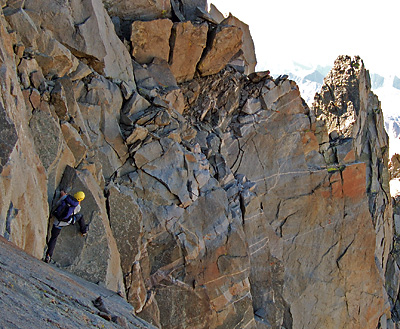
Re-chalk, check feet, test holds, holler a quick, “It goes!” to my partner Pete, and begin to pull down. I lift off the ledge, fancy free onto the easy fifth class. The crown jewel awaits but 60 feet ahead – the 14,242 foot summit of North Palisade, our third 14,000-foot summit of the morning, the high point of our route, but miles from the end of the day’s journey …

Menacing yet mesmerizing, the mighty peaks of the Palisades range are undoubtedly one of the finest escarpments of alpine granite in not only the Sierra Nevada, but in the lower 48. While there are worthy craggy crests in all the western mountain ranges there are few as bold and lofty as the legendary Palisades outside of Big Pine.

Starting from the north with the 13,893-foot summit of Mt. Agassiz, the knife-edge ridge of the Palisades continues south for nine rocky miles before hooking east to the 13,388-foot summit of The Thumb. Along that precipitous crest, the ridge rolls and tumbles over six 14,000-foot summits – Thunderbolt Peak, Starlight Peak, North Palisade, Polmonium Peak, Mt. Sill, and Middle Palisade.

For the mountaineer and climber, these six stoic summits and the traverses between each one are the stuff dreams are made of: You can dance along the rocky crest enchaining peak after pinnacle from sun up to sun down and then some. With few true vertical headwalls and relatively solid ledge systems everywhere, the required up and down climbing is challenging but never ridiculous. Rappels and a stiff boulder problem or two might interrupt forward progress, but tagging the intertwined summits of the Palisades has been an attainable goal since the early days of Sierra adventure.

While all of the Palisades’ fourteeners were summited individually between 1903 and 1931, the first two men to traverse a majority of the treasured summits in one push were John Ohrenschall and John Mathias in 1958. Cruising along the crest for two days, the pair climbed five of the six fourteeners while riding the ridge from Thunderbolt Peak to Mt. Sill.

Since Ohrenschall and Mathias’ visionary adventure, their path has slowly become the “regular” route amongst the many possible traverse variations. Current consensus pegs the ridge between Thunderbolt and Sill as the most elegant section of the Palisades as it can be climbed in a single day and ticks off five of the six highest peaks.

When I first laid eyes on the Palisades in 2000, I was on the top of neighboring Temple Crag. The raw skyline of the Palisades looked terrifyingly long and heinously loose. I envisioned that every inch of the traverse would crumble underneath me the minute I stepped foot upon it. The available guidebooks of the day did little to dissuade my fears. Their route descriptions emphasized the serious length, sustained exposure, and intermittent widow-maker blocks. Summitting the fourteeners was still tempting, but only because they were the big daddies of the range and I yearned for such rarified air. In my five-tennies that summer, the Palisade traverse sounded like a death wish … and an awfully long approach at that.

How wrong I was.

Late last summer, on a glorious September day, my good friend Peter Chapman and I sacked up and bagged the Thunderbolt to Sill traverse. Having heard rumor that it really wasn’t that loose, and armed with a head full of beta thanks to Peter Croft and Kris Haney, we decided that not only were we worthy of the challenge, we were freakin’ amped to slay it. The Palisades were ours for the taking!

The adventure that ensued was every bit as classic and epic as we had dreamed of. Aside from an overzealous false start the day before, our day on the crest went off like lightning – we popped up before dawn, flashed the route, and smoldered back to the car just after sunset … wasted.

Knocking it out camp to car in about 17 hours, the key to our success was speed and confidence. Though we felt the anxious energy that buzzes your brain before any unknown outing, our gung-ho attitude toward the challenge rocketed us out of the gate, while experienced alpine footwork carried us to the finish line in good style.

The crux of the route was the sheer concentration required of such a big push. Other than the summit spire of Thunderbolt Peak, the technical climbing demands are 5.7 and below with only intermittent fifth class sections at that. To run the route safely you just have to make sure you’re paying attention to every block and rock you touch. The ridge is really not that loose, but then again it’s not that solid either.

So what’cha think? You know you wanna summit these sublime fourteeners. If you’re an experienced Sierra mountaineer and you can move fast over five-easy terrain there is really nothing to it but to do it. Well, actually there is 17-odd miles of trail and talus hiking, some loose scrambling, 5.9 bouldering at 14,000 feet, two rappels, and a little something you might call slogging involved. But that’s the fun part right?

To put you in the mood, here’s another few flashbacks from our trip to give you a taste of what’s in store should you undertake the mission:

Leaving the car …

It’s 9 pm and we’re lolly gagging at the South Lake trailhead. The plan is to jump over Bishop Pass via headlamps, bivy just further at Thunderbolt Pass, race up the southwest chute of Thunderbolt pre-dawn, ride the ridge to Sill, then drop west through Glacier cirque and slog back around the west side of the crest back to Bishop Pass then home. A mega day, but do-able. Just gotta get a little sleep …

Bzzzzzz … bzzzzzz … buzzkill. The watch alarm strikes 4 am and I look up from my bag to gray skies above Bishop Pass. We hadn’t made it all the way to Thunderbolt Pass. Pete barely stirs. Crap! It’s cloudy, were behind schedule on distance, and I’m undeniably still exhausted. “Pete … wake up … What do you think?”

Indecision … indecision … decision. We rest all day, move camp to the nearest water below Thunderbolt Pass, and charge the next day. A little hardman-status lost, but undoubtedly a good call. We’re fed and in bed by sunset. When the alarm sounds at 4 am the next day we roar alive, giggling and leaping up the talus of the ascent chute by 4:2O.

Summiting the crux spire of Thunderbolt Peak …

“You’re taller, I bet you can reach those holds easier.”

“I don’t know man. It looks pretty dicey. You’re the rope gun. Jump on up there right quick.”

… and so goes the 6 a.m. conversation as we sit underneath our first summit of the day and the technical crux of our route – the summit spire of Thunderbolt Peak.

Towering maybe 25 feet above the jagged boulders at its base, the pinnacle looks tall and the fall looks gruesome. If it took any protection the 5.9 face would be a one move wonder but there is no way to protect it and the off angle face has few discernible features. Pulling up to the rusty summit bolt will require a spooky mantle on miniscule footholds.

Pete decides he will give it a go. Stoked, I put up my arms to spot him. Within less than a move I’m guiding Pete back to the ground. Just getting on the thing is tricky.

“What did Croft say… Use your buddy?”

Within seconds we understand. I lean my 6’6” ladder-like frame into the rock. Pete balances a killer foothold on my shoulder.

Wham, bam, summit. One down.

Rapping into the U-Notch …

“Check this natty anchor Pete. Let’s use this one.”

We’ve already passed up a couple tattered rap stations complete with flaky, sun-bleached webbing. I grab the red, gold, and green rasta-colored webbing collection and inspect its condition. Looks irie mon. No obvious sun damage and not too dry. Now its time to lace up our rap lines.

In a tricky move to save pack weight, we brought a 30-meter piece of 8.5 mil rope and a 4-meter piece of 2 mil Kevlar tech cord. The plan is to girth hitch the 8.5 mil rope through the anchor and back onto itself with a carabiner, then tie the Kevlar line onto the carabiner. After the rap, we’ll use the Kevlar line to pull the carabiner down the rap line freeing our rope from its temporarily fixed position on the anchor.

The system knots up nicely and soon I’m leaning into the rap line testing to see how badly the carabiner gets cross loaded into the rap ring. Nothing terrible. Unweighting the line we then test the friction of the Kevlar line, pulling the carabiner. Buttery.

I’m off. Pete busts into a chorus of Steel Pulse’s rasta anthem “Red, Gold, and Green” as I drop off the first overhang and outta sight. The rap and subsequent rope retrieval goes smooth and soon were climbing out of the U-Notch on to the blocky ridge leading to our fourth summit – Polmonium Peak.

For More Beta:

For further information about climbing in the Palisades check out Peter Croft’s guidebook, “The Good, The Great, and The Awesome,” RJ Secor’s guidebook, “The High Sierra – Peaks, Passes, and Trails,” or read a bazillion accounts of various climber’s ascents on web forums like summitpost.com or supertopo.com. If you’re keen on making the trek but would like professional assistance, hit up Alpine Skills International, Sierra Mountain Guides, or Sierra Mountain Center. These organizations guide the route each summer over several days.

1
Sep/08
0

Eastside Lowdown

Front country cragging under the shadow of the High Sierra Crest

Words and photos by Bruce Willey

To be frank, I thought about starting this story with an epic. Some hanging on the thin edge thing: frozen fingers grasping for a nub, a hair-raiser of a lightning storm scrubbing the inside of your helmet, being skinned alive by a fall on run-out slab. It sells magazines and stokes campfires, not to mention touches the void that is ego.

But I’m happy to report that climbing is more fun when you manage to avoid these stories in the first place. When fear is replaced by experience (see above), or when you find heightened conviction with vigorous hands and feet, and the common assurance of such things as a rope attached to a good, maybe even loving partner.

And my epics have left me with more laugh lines than grey hairs and are pedestrian anyway. Stories that come screaming down out of the Andes, Alaska, or prodigiously out of the Himalayas, are best experienced from the comfort and privacy of a water closet accompanied by a long Mahleresque movement.

Thanks to the Sierra Nevada, where the weather vacillates most often between perfectly fair to even more fair, and the rock is, for the most part, constitutionally solid, California stories scuff the edges of the pastoral. No wonder Muir went up a pine tree in the midst of a windstorm or soloed Mt. Ritter in shepherd boots. It sold stories and fueled lowland awareness to preserve something that made it difficult for Muir to keep his feet on the ground.

This is not to say Sierra climbers are, as a bunch, cowards. It’s just that they operate in a medium that is a perfect mixture between a Mediterranean and desert clime. Try finding a book titled Minus 148 Degrees or The Savage Mountain regarding the Sierra. Won’t happen. Instead, one is more apt to find something more akin to John Tyndall’s Hours of Exercise in the Alps. Doug Robinson’s apt title, A Night on the Ground, A Day in the Open comes to mind as does Smoke Blanchard’s Going Up and Down in the World, both of which are actually about the Sierra, both low and high. After all, the Sierra forgives most of the time and even loves you back with all the loyalty of a good dog.

But in the interest of keeping your attention (and to show how swashbuckling I become under stress), I would like to get one story out of my system. Plus, it begins at the south end of the front country Eastern Sierra climbing continuum—where this story begins.

******************************

My wife and I were climbing in the Alabama Hills, as we do many an evening after we finish our work. It’s cooler then as the long shadows from Mt. Whitney and Williamson splay across the monzonite domes, slowly chilling the rock that has been baking in the summer sun. Topping out on a dome, sometimes it’s very possible to feel as though you’ve landed in Joshua Tree minus the rangers, the picnic tables, the expensive camping, and, well, the Joshua trees. Some have gone so far as to call the Alabama Hills the “poorman’s Joshua Tree” which is sort of true considering the general lack of good crack climbing and the non-existent entry fees. But after climbing here a few years, we’ve begun to question the wisdom of the maxim, not to mention question whether we want to ever go back to Joshua Tree when the Alabama Hills is, for lack of a better term, so much a wonderland of rocks.

Mostly comprised of sport climbs on cinematically beautiful domes (enough westerns, car commercials, and music videos have been filmed here to cross the Sierra Crest several times over), the Alabama Hills is slab climbing at its near best. Some call it crumbly choss. And yes there is a bit of that. Nevertheless, we find ourselves continually drawn back to the sharp edges of granite plates exfoliating into the desert scrub.

So here we are in the Loaf area, so-called because Meatloaf filmed a music video while at the height of his fame and limitless passion to rock! with sweaty abandon. I unpack the rope bag and leave it on the ground underneath the climb when I realize I’ve forgotten the water. No big deal: sometimes it’s more than practical to belay on the tailgate of your truck with a cold drink in the other hand. While I fetch water, my wife Caroline explores the base of the domes, ticking off climbs she intends to do.

When I get back, she picks up the rope bag and carries it from one dome to the next, to a climb that looks good to her. She ties in, chalkes her hands, and begins climbing. After clipping three or four bolts, I look down at my feet—clad in my usual summer attire of snake-proof sandals, mind you—and see a western diamondback slither out of the rope bag.

I yell up at Caroline: “Clappeschlonge, Clappeschlonge,” a word I recently acquired in her quest to teach me her native language. Stepping backwards a few feet, I count seven rattles on its tail. But the “clapping snake” (rough translation) is well behaved, crawling casually away into a stand of bushes. He’d gotten a free ride in the rope bag, carried by Caroline next to her chest. Without plunging too far into anthropomorphic serpent behavior, the snake probably thought the rope was a skinny 10.5mm cousin of his and crawled in to say hi. As with most things, climbing’s most horrendous moments are experienced in hindsight.

The Alabama Hills are like that; the good and bad sink in later. It’s a wild paradise despite its John Wayne reputation of shattered beer bottles, ATVers dusting up the roads, and above, F-16 fighter jets that dogfight in and around the clouds. On one climb in the Ghosts area called Elephant Hunting (5.10b) you smear and pinch on small craters produced by men pretending to be movie stars pretending to be cowboys shooting at the wall with rifles.

Late evening, as usual, finds us squeezing one more climb out of the dusky light. Bats swoop by in the utterly quiet air and always a great horned owl can be heard asking the question of who we are. By then we know it’s time to shed our harnesses and grab a beer out of the cooler before heading home to Big Pine for homemade burritos.

Or not. The other night, post snake encounter and under a full moon, we kept climbing. I’ll venture going up the Shark Fin Arête (5.7) to peer at Mt. Whitney lit up in lunar light is one of the best things one can do on the Eastside. From here the Owens Valley, flanked by the White Mountains and the Sierra Nevada, stretches for as far as the eye can see by the moonlight. And time, finally, for that midnight burrito.

******************************

For the last three summers, my wife and I have made our home in Big Pine, thirteen miles south of Bishop. We’re climbers by trade, writers and teachers by profession. The latter leaves us a lot of freedom, the former not a lot of money. But from the moment we met each other in Joshua Tree (of all places to meet another climber) we were already planning on living large and deep in the Owens Valley. Somehow we’ve managed to pull it off and will continue to idly dig deeper roots until we are, without sentiment, buried here in the warm ground.

When we first moved here we focused on classic peaks and climbs in the backcountry. Having both climbed in the Sierra for at least one collective lifetime before meeting, we brought together a long list of have and have-nots. Yet beginning the first month of our first summer in the Sierra, we began to see that elevation and proportion is single-minded.

That certainly is the case with the High Sierra, where the eye draws upwards whether you’re a peak-bagger, rock climber, or mountaineer. It’s fair to say more people have summitted Mt. Whitney than have climbed in the Alabama Hills or the sweeping aprons of white granite of the Whitney Portal in plain view on the way up. It’s understandable. The “eye on the prize” blinds our vision.

Aside from the occasional bouldering session in the Buttermilk, I too neglected to see the front country climbing possibilities. I came to the Sierra with only two or three days off from work and I wanted something big, something that would stick to my lowland memory. Or more truthfully, something that would justify driving through Los Banos in the Central Valley on the way back to Santa Cruz, gas station coffee rattling my tired bones at three in the morning. Begging St. Christopher for a shower, a bed, shut-eyes, real food—never sure which should come first.

So why not just live here? A twenty-minute drive to the trailhead into the Palisades was all it took to sign a lease on a one-bedroom cottage, a cottage so close to Highway 395 it would be quieter if you slept in the sleeper of a semi—and sometimes it feels as though you are.

“Never mind,” says my German mother-in-law, her favorite expression, one that she uses to mean your priorities are in order.

******************************

With afternoons free for climbing we began seeking things that wouldn’t take all day to approach, or climbs we could do when the proverbial July thunderstorms threatened to thump the high country. Peter Croft’s The Good, the Great, and the Awesome dipped occasionally into front country climbing and for us, gave the inspiration to start exploring. Cardinal Pinnacle seemed a good climb to start.

Croft’s description is apt: “A half hour drive from downtown (Bishop), a twenty minute hike to the base and you’re there: 500 feet of fine grained granite perched at over 9,000 feet, offering the highest quality multi-pitch climbing in the Bishop area.”

We’ve ended up climbing it more than half a dozen times since, and it’s the first place we take visiting friends on the wonders of the Eastside tour. The West Face, in particular, is, for its grade, one of the best 5.10’s anywhere. Perfect crack climbing goes up four pitches of blindingly white granite that gets nothing short of the “awesome” rating in Croft’s book.

The West Face is tacked together from a few routes, joining the last two pitches of Cucumbers (5.10a) midway. So last July, when a friend of Caroline’s came up from Las Vegas we took her up it. And since I’d promised Mike Gable, a local physical therapist that I would also take him up Cardinal as he slowly tortured my frozen shoulder (a side-effect of climbing without rest, he tells me) into submission, we made a party of two rope teams.

Elizabeth Tai is an accomplished and determined climber who is comfortably at home in Red Rocks, Nevada. Gable has recently just picked up climbing since he moved here through Bishopian osmosis. He treats a lot of climbers, and already is climbing hard 5.10’s. But little trad experience. So I gladly accepted the sharp end.

We lazily made our way up the route, stopping to take pictures and hang out at the belays made more beautiful by Evolution Range on one side and Owens Valley on the other. Caroline and I had spent many a fine day on this rock and it was good to be showing it off. Most climbers, when they reach the top, rappel off the Prow. In four raps (with two 60m ropes) you can reunite with your proper shoes and snacks that you left at the base.

But Mike had failed to mention that he’d only rappelled maybe thirty feet in his life, and now he stood at the exposed tip of the prow, fingers shaking, and scared silly of the sudden exposure. I coaxed him with about the same voice he’d used on my arm. And off he went, spinning in mid-air. I could nearly hear his heart beating over the wind. Coiling rope at the bottom his smile returned and didn’t stop until I dropped him off at his small home on a leafy downtown street in Bishop.

******************************

It’s been said that Sierra gentleman mountaineer, Smoke Blanchard, was the first to discover some of the front country secrets. Though no stranger to alpine climbing in the Sierra and elsewhere, including Alaska, the Pacific Northwest, and the Himalaya, Smoke took special interest in the Buttermilk and Pine Creek a tad bit above Bishop.

One the few Buddhist truck drivers to grace 395 (hence the nickname), Smoke saw new possibilities in the boulders and crags like no one before him. Maybe it was a Zen thing, but soon Smoke had created a grade III or IV climb in the Buttermilk that roamed over boulders and small peaks. Now part of Bishop lore because only a few people are alive to remember it, the route is simply called Smoke’s Rock Course.

Doug Robinson knew Smoke back in the day and he offered to show me the course, or what’s left of it as committed to memory. The sixties were good to Doug, and he actively took part in the Golden Age of Yosemite including the honor of being considered the father of clean climbing in America. But his experience is finely misted by so many other climbs, not-to-mention all the late night imbibes around a campfire, that his own history sometimes fails him.

Nevertheless we set off for what he believed was the start of the route (or maybe the middle) and soon found ourselves in a dirty chimney on the Skindiver, a prominent rock that stands sentinel as you drive into the Buttermilk. Topping out on the raven guano summit, we looked over at the Peabodies that Doug had discovered to be an excellent source of fun three decades before Bishop became the bouldering Mecca of the West. “Back then bouldering was one of the laziest things you could do and still be climbing,” I remember Doug saying, accompanied by a laugh that tilts his whole trunk dangerously to the side, especially on sharp summits.

For most of the morning and afternoon we meandered up and down the rocks until we came to a place where both of us couldn’t remember the time of day or the rest of the route. It didn’t matter. Smoke called our activity “Buttermilking” and would lead large groups of people on the course while the more gentrified members of the Bishop community had a picnic in the granite sands below. Forty, even 50 or so years later, climbers are still “Buttermilking” and Smoke would no doubt been both perplexed and positive about all the crashpads, sticky rubber, and chalk. He climbed in leathery mountain boots and a cane, after all.

“There is no way that I know of to pass on by paper the feeling that permeates the person who steps out of the shower with epidermis cleaned and tingling from crystal scrapes, muscles pleasantly tired, joints well-oiled, and mind and spirit glowing from a full day of Buttermilking,”

Walking back to the car, this quote from Smoke was fully recounted verbatim from Doug’s memory. And that a shower was every bit as good as Smoke had described.

******************************

Bishop wasn’t always that world-class climbing destination that it is now. Back in the sixties, John Fischer, local longtime guide and owner of the now defunct Palisade School of Mountaineering, remembers that “most, if not all of the climbers in Bishop could fit inside Smoke’s small living room.” Not so much anymore, though there’s still probably more people that own mules (or want to, like me) than there are climbers here.

Much of the climbing back then was done in a humble, quiet manner much as it is done today. Locals climbers like Robinson, Fischer, Gordon Wiltsie, Jay Jensen, Dave Sharp, Tony Puppo, Dale Bard, Marty Hornick, Marty Lewis, John Moynier, James Wilson, Alan Bartlett (who along with Erret Allen, wrote the first guidebook to the area, now out of print) and many others too important not to mention, immediately saw the potential in their backyard. They pushed all the obvious lines, and then some.

Later, as sport climbing came into fashion (and what a fashion statement that was), the Owens River Gorge got worked over with over 700 routes going into the volcanic tuff. Lycra gave way to crashpads in the early 90’s with Chris Sharma coming over the hill to put up some of the most iconic and sought-after bouldering problems in the world.

Indeed, this very brief, glossed-over history does no justice to the Bishop climbers who were bold and visionary. But even now, there is a flurry of new route development, taking guidance and inspiration from those who came before. And with the new guidebook, Bishop Area Rock Climbs: The Climbing Guide to the Eastern Sierra—South by Lewis and Croft, climbers are, once again, about to have their focus wholly rearranged.

Nowhere is this new route activity more apparent than Pine Creek Canyon. Up a road nine miles north of Bishop, Pine Creek is the de facto local destination for Bishop climbers whether it’s a quick climbing session after work or a weekend’s worth of granite and scrub leisure. Kept cool by the 6,500- foot elevation and the sun that hides itself behind the massive Wheeler Crest in the afternoon, Pine Creek is a perfect summertime crag.

“To find this in my backyard ten minutes away—obviously it was always here—but to rediscover it and start fiddling around and I said ‘holy shit this is another gold mine as far as possibilities,’” says Lewis, while he stands in his yard in Round Valley. His dogs sniff around his legs, and Peewee, Peter Croft’s dog lounges on the porch. “All these slot canyons have interesting things. There’s going to be stuff going on up here for years to come.”

The main attraction is the Pratt’s Crack area, so named after Chuck Pratt, who spied and climbed the perfect offwidth splitter. It’s one of the first things to catch a newcomer’s eye when coming into the canyon aside from the vestiges of what used to be one of the largest tungsten mines in the world. A five-minute walk from the car and you’re passing the Mustache Wall (“It was right under our noses the whole time,” Lewis says) with enough sport climbs to fill several enjoyable days, or in my case, summers. Further around the corner, up canyon, the black diorite is broken by Pratt’s Crack and the stirring yet unattainable (for most) Ecstacy (5.13a), Tommy Herbert’s rap-bolted vision. Around another corner is John Fischer’s masterpiece, Sheila, climbed in 1975 or thereabouts, and probably the first 5.10 on the Eastside.

“I remember putting an old Chouinard hexcentric in there at the crux and working a long time to make it acceptable,” Fischer says. “Jay (Jensen) was amazed. I found the one place in that flared flake where I could cam it. It would probably hold a fall.”

The crux still gives even solid 5.10 climbers a moment of pause before reaching around the corner and liebacking into the tight squeeze chimney.

And Pine Creek keeps going on either side—and up! Robinson once quipped that Pine Creek and the Wheeler Crest has more climbable rock than Yosemite Valley. One day his statement may prove correct. But even now it’s one of the reasons when my wife and I draw straws to decide where to climb, Pine Creek always seems to be the last straw. Often we meet our friends Tai and Mary Devore who own Bishop Yoga and Massage. (Tai is also a manager at Wilson’s Eastside Sports.) It’s always a non-alpine start, but the days are full. We often climb until the sun’s shadows climb up the backside of Mt. Tom, climb until we are satisfyingly bushed.

Tai and Mary are rapidly pushing new lines to the left of the Pratt’s Crack area. Tai spends so much time in one narrow little slot canyon that he’s made a fine talus couch that would make a stone mason proud to belay from. So much time, in fact, he’s given over to calling it the Addiction Gully. This is your brain on granite.

“Out of the Eastern Sierra lowland crags, Pine Creek is the most friendly. The friendliest approach, the good stone,” says Tai as he ropes up to do Gala Tumble (5.10d) that his wife put up last year. “Pine Creek is cool because you can have an adventure even on a sport climb. Battling it out and getting over those fears. We started coming up here enough that I started to want to put up my own routes. So it’s really about choosing your own adventure.”

******************************

Five in the morning and the crust of the Palisade Glacier feels good under the meager four prongs of my instep crampons. The Palisade Crest is the first to receive the day’s light, and reveling in the alpine glow, my wife and I climb towards what the Piute Indians called the “Guardian of the Valley,” Ninamishi, AKA Mt. Sill. This 14,000 peak watches over us at night as we sleep in Big Pine. It would be a shame to let a summer go by without climbing it.

Tramping past erratic boulders teetering on the ice, I let my mind wander over the summer. Always, when we move here in the spring, we think we have so much time. But then it passes and all of the climbs, whether in the high country or front country, meld into one long memory that seems too charitable to remember properly. The only evidence we have to show for it is our sun-rinsed skin, scabbed hands, and the annual trip to the Rubber Room where Tony Puppo will tear off the soles of our rock shoes and cobble them new again.

We solo up the first two pitches on the Swiss Arete (5.7) enjoying the early morning sun that warms us after the glacier crossing. At the headwall we rope up and simul-climb the rest of the route in an hour. We notice that we are faster and more sure. All the front country climbing has translated unequivocally into the backcountry.

By early evening we’ll be home, making burritos. This is how it’s meant to be. And the next day, still feeling the long approach to Mt. Sill in our legs, we’ll be back, back to cragging in the front country. The only problem is deciding what to climb next. Caroline will probably want to go to Pine Creek again, and I’ll push for Alabama Hills if it’s not too hot or Whitney Portal if it is. Either way, it will be good.

1
Sep/08
0

Like Surfers Gone Alpine

Pondering the nature of alpinism in the High, and mild, Sierra

By Doug Robinson


Hidden in plain sight: the untouched north face of Birch Mountain, seen as you drive up to the Palisades. Still, it took several years to notice, then decades to go climb it.

Photo Doug Robinson

“What is alpinism, anyway?” Terry Kearney was starting to rave as we burned through the last of our fuel. It was the morning after our second bivy. The sun played coy with our perch on the north face of Birch Mountain, in the outer orbit of the Palisades. “Is it all speed-aided 72-hour push up some heinous M8 wall? Is it just Steve House and the latest mad Hungarian? I love reading about that stuff, but I’ll never touch it. Maybe it’s more like two old men sharing one Ramen and no coffee for breakfast.”

Laughter broke out. High on this California version of alpine, we were starting our third day on an untouched north face in the Sierra, which after all is a semi-desert mountain range. Climbing in early May so the face would be sure to have snow on it, we hadn’t done a move over 5.6. Above us lay a bewilderment of ridgelines, not to mention lurking pockets of stacked terror blocks.

We’ve long since abandoned the direct. (Although, we keep telling ourselves, we can always come back for that.) We have no pretense of the cutting edge here. Like Terry, I’m in awe of the alpine feats of Dean Potter and Timmy O’Neill in far off Patagonia, and of everyone who has set a front point to Changabang (a steep, rocky 22,520-foot peak in the Indian Himalaya). But here we are instead, pacing through sagebrush approaches in running shoes like errant surfers. Everyone knows California sports some stout rock climbing. But our alpine zone, like our weather, is often a bit gentler. This is more like what my Palisades mentor Smoke Blanchard called “mild mountaineering.” We could care less; we’d much rather revel in our good fortune to be nowhere else but right here. No envy, no regrets, just pile on the fun-hogging. To us, alpinism means less. And more.

Anyway, powered by six noodles we sidled west over a black ridge, down two raps, and chopped a full pitch of steps across a crescent of couloir. Not exactly the direct line.

“Holy fuck! Rock!” I snapped the belay tight. A loose block had rolled onto Terry’s ankle, searing his shin. A moment of blind panic, then another moment of regaining composure. It’s OK … this time.

The wariness is constant. Bands of looseness have cropped up ever since we stepped off the snowfield approach onto blocky fourth class. That was two days ago now, and in spite of long stretches of stellar solidness and dreamy incut holds – like snaking right up the center of the first buttress easy as you please – the teetering and hanging stuff keep punctuating. If the architecture of this north face is reminiscent of Temple Crag – which is only 8 miles away – then the wariness of stacked blocks and loose flakes is familiar too. As Robinson Jeffers put it, “History falls on your head – like rocks.”

Terry remembers. Two years before, we were climbing on Temple Crag itself when a head-sized block clipped his shoulder. We patched him up and went on. His wife, Mauri, was more freaked than Terry – she had dislodged it at a touch. Mauri and I watched in terror, the long moments lengthening, as the block ricocheted. Terry poised like a cat, waiting out its sudden, random re-direction. It lurched again; Terry made his split-second move. The block whizzed through the spot his head had just left. His helmet wouldn’t have helped much.

That day on Temple Crag, we went on, engaging the upper pitches of the Moon Goddess Arete. I had never done the second half of that climb – not in 35 years of guiding on the crag. See, there’s a bail-out spot half way, left into a gully. Mighty handy for slower parties, and it’s true that I’m not known for putting much alpine into my alpine starts. So it was an adventure that afternoon to unfold the traverse to the right and the steep crux above. I raced up it, climbing fluidly and pushed by darkness, thinking that the upper pitches actually felt less loose. Since then, that high crux pitch has claimed two lives.

So I’m going to come right out and say what’s been building inside me for years now: the Moon Goddess is no longer a rock climb. It’s just gotten too loose. Stay off. Do the Venusian Blind instead. I’ve hesitated mightily to say this because it seems crazy that a climb has gotten looser. Much more likely, I figured, that I was just getting old and conservative. Logical for the change to be in me – creeping old-fart-ism.

But then I ran into an odd story that sparked me to propose the theory of the Atomic Broom (for the full story see the sidebar, “The Atomic Broom Theory” at the end of this article ).

The gist: During the height of the Cold War 1950s, there were hundreds of atomic bomb tests at the Nevada Test Site (a total of 1,021 “announced” nuclear blasts between 1951 and 1992, of which 921 were underground.) The test site is 65 miles northwest of Las Vegas, roughly 100 air miles east of the Sierra Crest. These blasts sent shock waves unobstructed into the high peaks that, over time, shook much of the loose rock from its tenuous moorings.

When the golden age of Sierra climbing got underway in the ‘60s and ‘70s, little did we know that our mountain stage had been swept of its customary level of loose rock. In the decades since, that loose rock has begun to return to its pre-Cold War levels, and some of the climbs that were established during that golden age have now become exceedingly more shaky and dangerous.

*******************

So alpine is loose. What else? Snow? Ice? Sure.

A pitch of step-cutting up perfect neve has gained us access to this promising exit ridge, way up the north face of Birch Mountain. Carrying a light axe is the key to this highway, the perfect complement to mountaineering in approach shoes. If you work the timing. We came early in May for the relief of snow blanketing a grinding scree slope at the foot of the ridge. Way more fun to kick steps. Not to mention a handy snowpatch to melt for water last night at the bivy. Another the night before. This early in the season, though, actual ice won’t happen until later.

Even in this seemingly-desert range it does get icy. Back in our days as basking Armadillos, barefoot and indolent at our sandy Palisades camps during that golden age – now receding into a glaze of forgetfulness – ice axes drip-dried against a boulder. Couldn’t even approach any of the peaks without them. We might wait patiently until October to sharpen them up and add crampons, but by then the untouched ice gullies above had taken on a flinty gleam. And our ability to climb them was freshly enhanced. Curved axes! Rigid crampons! Yvon Chouinard – the original surf rat gone alpine – delivered a set to me at 12,500 feet on the edge of the Palisade Glacier. They were hot off of his forge in Ventura that October of 1969. And the next day, clawing our way up the brittle V-Notch, his ice climbing revolution became undeniable. Vertical could wait a few years; that day, just the ability to cling to ice so dense you could peer into its crystalline depths was astonishing.

Alpine is the jagged edges of our planet that poke up so high they run into airplanes. Peaks that tear at the jet stream and call down weather. Ice in the desert indeed. At least a little while longer. The Palisade Glacier, shrinking at an alarming rate, seems 40% less than its bulk in the ‘60s. The bergschrund on North Pal yawns wider now as its glacier pulls away. Many are the parties these days who scratch their heads at the gaping ‘schrund, its upper wall overhanging like a breaking wave. They’re forced to wonder: this is fourth class? Not any longer. Half the summer now the only way around it is a solid pitch of 5.7 granite. As our global summer lengthens, this classic’s reputation as a moderate climb recedes. Love it while it lasts.

Alpinism is what we commit up here, with our heads bumping into the jet lanes.

*******************

Climbing alpine can mean a V1 boulder problem in the midst of fourth class. Had one of those today on our first try at an exit ridge, the one that turned us away. We tossed the rope up over the edge of the ridge above to protect the tricky friction face. Nice minimalist technology. Leaving no trace. But also no exit. Couldn’t get up it, so reluctantly we sacrificed a wired stopper, the only tiny trace we will leave on this entire mountainside, to lower and regroup.

I had another bouldery moment later in the summer on the striking North Ridge of Lone Pine Peak. It’s a climb that keeps drawing me back too. So it was maybe my fifth or sixth trip up there (alpinism, for me, is also losing count) – and 80 feet out I was abruptly stemming for life up an open book gone vertical. Legs splayed, approach shoes smearing. No pro in, naturally, and the rope billowing out below me, but I was more concerned with cumulus and distant thunder. Another climb that’s just a 5.6. I won’t challenge the rating, but it’s huge and one does wander. So out on a buttressy interruption of “it’s a ridge, stupid” route finding, and committed to a corner I’ve never seen before and likely couldn’t find again, my next move is .10- and I’ll get seriously pummeled if this reachy smear breaks traction.

Alpine is airy. And some of those Sierra ridges are sharp enough to cut you. I’ve seen them cut ropes. Purple nylon fused to the acute edge of a block. Broken body inert on the rocks below.

We try the next ridge over. Like climbing into the upper limbs of a birch, more possible ways branch out. This one has low relief, standing out only 70 feet from the bedrock of the north face. Maybe this will be the passage that breaks us out of the maze. It has the right feel of fine big blocks mortised together by the underlying grain of the granite, and mercifully solid. And it’s holding exactly to the modest grade. We scurry upward with summit fever.

*******************

Alpinism can be generous, although this climb has been a piss-poor example, and I feel tainted by the whole competitive secrecy thing that built up around it. I got into a pissing match with Mike Strassman over it. Friends and work-mates, with a shared creative history – we made the original Moving Over Stone video together, which verged on art — and suddenly we’re sneaking around scheming on copping the first ascent. Hoping to name it after my dead friend not yours. Surfers are far worse, though, hoarding secret breaks and sneering kooks right out of the lineup. “Valleys go home!” But cavers get the paranoia award. I’ve heard of iron bars locked across ‘their’ territory. What if you found another entrance and were tunneling for daylight when you came up hard against the other side of somebody’s bars, hard up against their crude attempt to hoard a corner of the cosmos? I think Smoke Blanchard got it closer to right after trailing an early Buttermilk bouldering session: “the gentlest form of competition I’ve ever seen.” That impulse to compete will always be there. However, day by day we can choose how much we engage with it.

Hoarding is silly anyway, in the face of the thousands of untouched walls littering the Sierra backcountry. Consider the scene a few months later, at the other end of this alpine season. I found myself in a valley directly west of Mt. Whitney. Alpine Lake is the only named feature. Glancing up, I mistake an airy, sculpted ridge for Mt. Russell’s famously graceful Fishhook Arete. But no, it’s a nothing on an unnamed peak. A couple of miles west of the Fishhook.

It was interesting to cross Whitney-Russell Col and see all footprints turn toward Russell, with only two sets this year going west into this alpine variety pack. Six hundred foot walls of vertical white granite rise right behind our camp on the south face of Mt. Hale. And a mile away looms the north face of Mt. Hitchcock, with 800 to 1200 foot ridges and walls sculpted out of the same dark granite as Temple Crag and Middle Cathedral Rock. I had to check Secor’s guidebook to believe it, but on the whole mile-wide sweep of that wall there is one trivial fourth class line up a gully.

So go for it. Gleaming unclimbed walls are everywhere. I want to climb them all myself, but bigger than that is the urge to share. Don’t forget, though, that they are guarded by sweat. The quickest approach over Whitney-Russell Col climbs 5000+ feet. Very alpine – at least in the hot, sandy-canyon way of the Sierra. We pay in our own fashion for all this fine weather. Anyway, that approach is a great workout, probably builds character, and is drop-dead beautiful. No doubt it confers hardman points. Taking it on is meditative too.

By the time we hiked out the Whitney Trail we’d had a 10,000-foot jaunt. Ten up, ten down. No summit, either, though we did get nine pitches up a cool line on the untouched West Face of Whitney, before bailing in twilight and scrambling half the night back to camp. The climbing had edged into 5.9 on white granite cleaved into large blocks, standing up into the sky. On our next try, two years later, Michael Thomas and I pushed through to the summit, though it took us fully 20 pitches and we couldn’t unrope, exhausted, until 2:30 in the morning. We’ll be back there too, I hope; half a dozen more ridges lie alongside, all untouched. Maybe next time we’ll run into you out there too?

Competition: it’s not a bad thing. It sharpens us, keeps the juices flowing. It makes us reach harder and raises the whole standard of climbing. In the long run we’ve come by it honestly enough; competition is our evolutionary heritage. But so is co-operation. Family, language, a community of effort. We’re not always good at those things, the newer and more fragile tools in our kit, but they’re fully as crucial to who we are and where we’re going together. Tie on in.

So alpinism is also an old friend showing up out of the blue at 10,000 feet. I was loaded down with freight, excess baggage lashed all over my pack, staggering wearily toward the road; Rick McUsic offered an empty pack and inspired conversation on the downward reach.

Competition and cooperation. They are another of those big dualities we get to chew on. Like pride and humility. Like fear and desire. Climbing sets them a stage, and alpine air encourages the rumination. How you play them out affects everything, from getting laid to the future of humanity. Even to whether it has a future. Will us humans make it out of here alive?

Climbers have chosen an active life. And at this digital stage of human culture, simply getting active can seem like a throwback. A bit crude, like rustling up a coonskin cap and playing mountain men. We can be our own best caricature. Patronizing snickers arises from overstuffed rooms. A frontier fetish, perhaps? But ever since that literal frontier recoiled from the shore of the Pacific and washed back on itself, the higher ranges inland and the great sweeps of desert between them have been as good a Wild West as I’ve found. And staring down off this virgin north face of Birch Mountain hidden for generations in plain sight, we’re breathing the thin, sharp air of the frontier. Sure Pakistan would be cool, but the High Sierra is right at hand and we’re pretty committed up here for a couple of guys just three days off our keyboards. Out of fuel and getting thirsty and pushing beyond the 13,000-foot parallel. Turn back to the rough granite, then, commit to this new ridge. Push upward into the unknown.

Alpinism is an answer to the question of why the reckless survive. A pretty rhetorical question it is to us, though, lacing snug our boots and pulling down toward the ultraviolet beyond. And sure enough that twisted desert poet Arthur Rimbaud got it right that “women love those fierce invalids, home from hot climates” which offers the promise of a sweet, sweaty immediacy to what is otherwise an evolutionary abstraction.

I’m teased by that moment of clarity, just as I reach to mantle another block on the ridge. Then another bolt strikes out of this blue. Laughter wells. A self-aware flash, realizing just this: that realization happens. Deceptively simple. And it brings me – well, not “to my knees,” because of course I’m in the middle of a move, but it does make me pause. It changes everything.

Alpinism sharpens my thoughts, my mental acuity. Insight: what part does it play in the arc of your being? Ever get derailed by a penetrating observation? Sure, and up here it seems to happen more often. It’s like I think more fiercely. Useful for an old guy, still half wild, cruising – or is it striving? – in the alpine zone. More dualities. Poles to pull us apart, poles to knit our selves together. At least up here I’m forcibly reminded to contemplate these things as much with my feet as with my overstuffed brain. Stay nimble. It’s useful for dodging the patches of rickety rock on this ever-loosening, ever-loving alpine terrain. And it’s just as crucial for sidestepping the choss of history. That too seems to be growing ever looser around us. Nimble is another way to be humble. Getting too puffed up with yourself just makes it harder to wisp through the next keyhole of insight.

Alpinism gets tired. The climbing became stellar again once we branched onto our true exit ridge, but after six more pitches we were happy to unrope. We kicked around the summit for a while. Browsed through the register, full of the enthusiasm of skiers ripping skins for an epic descent of the south slopes. We added a note commemorating our effort to the great Bardini, now that he has transcended all rockfall. Then we got distracted by unclimbed walls and ridges littering the skyline. Even caught ourselves getting enthused. Lifting, momentarily, out of the serene glow of completion into the enticement of virgin rock deeper into the backcountry.

Finally, we jumped onto the snow and glissaded fully 5000 feet, dreaming of burgers as we shuffled out through sage and meadows of blooming iris. It was the easiest alpine descent either of us could remember.

Doug Robinson, a Sierra guide for more than 40 years, is author of “A Night On the Ground, A Day in the Open.” When not musing in the mountains, he bivies in Santa Cruz County.

The Atomic Broom Theory

Was the High Sierra preternaturally cleaned of loose rock by weapons testing in Nevada? The evidence keeps tumbling down, says veteran climber Doug Robinson

By Doug Robinson

After some four decades of guiding the Palisades, widely regarded as the most impressive alpine region of the High Sierra, the crash of rockfall began scaring me off certain climbs, such as the classic Moon Goddess on Temple Crag. At first, I figured the change was within me, a creeping old-fart-ism, not an actual change in the rock.

But then I ran into an odd story that sparked me to propose the theory of the Atomic Broom. Daniel Wenger is another graying climber, who took up this ascending passion after 60. We often swap belays at Pacific Edge, our local gym in Santa Cruz. One day Daniel told me about backpacking into the Palisades in 1952. He was awakened before dawn by a sickly yellow flash in the eastern sky, followed by a huge rocking blast, and then rockfall from every peak in the cirque.

Decades of living in the Palisades all summer have gotten me used to bomb blasts. The deep rumble of target practice rolls in from the Nevada Test Site, slightly over a hundred air miles away. Those bombs, even conventional weapons, would pulse our eardrums. But Daniel’s story sounded a whole lot bigger.

Then it hit me: Atomic Bomb. That’s right when a lot of them were blown off, an even hundred above ground, in the desert north of Las Vegas. The Cold War. H-bombs, even. Scores of atomic tests, and they went on for years. As a kid I saw the photos in Life magazine. The Army had even lined up troops a few miles away, to see if they’d be able to fight afterward. And then, decades later, when the radiation damage began showing up with cancer clusters downwind in Utah, the Army had conveniently “lost” their lists of which guys were in those tests.

But back to the rockfall they triggered. Booming down off every peak in the cirque.

We started showing up in the Palisades not that long afterward, in the early ‘60s. First Don Jensen, who made the first ascent of the Moon Goddess with clients in 1969, and then my crew from Yosemite. Unconsciously, we calibrated our sense of the relative solidness of the rock. But quite unknown to us the whole east-facing rampart of the highest Sierra had been scoured by the Atomic Broom.

Think about it. Those were the biggest explosions mankind – compulsively playing with fire – has ever ignited. Mega-tonnage of blast power rolled out massive shockwaves through the atmosphere. Those pulses cleared the Inyo Mountains and the Funeral Range above Death Valley and slammed into the eastern escarpment of the High Sierra. It’s a direct hit on the highest walls up under the crest, where the shock wave scoured the East Face of Whitney and the magnificent ribs and buttresses of Mt. Russell. They were about 100 miles from Ground Zero, with the Palisades barely a few miles further.

That’s where young Daniel awoke to the result: rockfall pouring off of every peak, rattling the Sierra dawn.

The atomic blasts went on for years, nearly a thousand of them in all, if you count the biggest explosions that were detonated underground. Often enough they too breached the surface. The highest Sierra was being relentlessly swept by the Atomic Broom.

We had waltzed into a landscape artificially swept clean of loose rock. Who knew?

Then, gradually over the five decades following, each year’s frost-wedging has teetered more blocks. Things are returning now to a normal we have never known. Normal for the peaks, but it feels loose to us.

It just happened that all those first ascents, our little golden age of technical walls and airy aretes in the High Sierra from the late ‘60s through the early ‘70s, were done in a period of unusual solidness, a historical anomaly. We were innocent beneficiaries of the Atomic Age.

1
Sep/08
0

Big Wheels Gaining Traction

Riders waking up to advantages of 29-inch mountain bikes

By Pete Gauvin

Big wheels in their element. Photo by Anna Siebelink

One needs only to glimpse a monster truck show to know that big wheels roll over objects easier. So why have mountain bikers stuck to one wheel size for nearly three decades, one that’s three inches smaller than a standard road wheel nonetheless?

It seems quite counterintuitive: big wheels for smooth surfaces, smaller wheels for rough surfaces. But that’s how it’s been, and perhaps that’s the primary reason why the bike industry and riders have been cautiously slow to recognize the advantages of larger wheels off road.

That reluctance has begun to erode, however. “29ers,” as they’re known for their larger 29-inch wheels, have negotiated the technical switchbacks to the summit of industry acceptance. Nearly every major bike manufacturer now offers at least one 29er model, and parts, from tires to suspension forks, are readily available.

Now that the supply trail has opened up, the bikes are picking up momentum in the marketplace and on trails nationwide – and momentum, as most anyone who’s ridden a 29er will attest, is one of their best attributes.

Age group racers and single speeders were some of the first to embrace 29ers. They realized that the best way to smooth out the trail is not with expensive, complicated suspension systems (not that they don’t help), but with a few extra inches of wheel radius (and maybe some suspension, too, but less critical than with 26” wheels). Now avid recreational riders are catching on to 29ers.

Speaking of wheel radius, the 29-inch wheel size is a bit misleading. The rims are actually the same size as 700c road wheels. But with a knobby tire the outside diameter of the wheel is close, but not quite, 29 inches.

Inches sminches. I count myself as a 29er convert because of the way they ride. In fact, I can’t imagine ever buying a 26” wheeled bike again, no matter how revolutionary or how touted the suspension system is. If I was determined to go full suspension, I’d go with a 29-inch model. But hop on a quality 29er and you may not see the need.

For the past year, I’ve been riding a steel hardtail 29er with front shocks (see the adjoining review on the Niner M.C.R.), primarily on the rough, rock-strewn trails around Truckee and North Lake Tahoe. From steep uphills on loose singletrack to granite stair-step drops, the 29er takes them in stride. With the 29er, I ride stronger, faster, longer and more comfortably.

And it’s been good for my muscular-skeletal health, too. When I finish a joint-rattling ride, the norm around Truckee, I don’t feel nearly as pummeled. (Certainly, the vibration-dampening Reynolds 853 steel frame helps too.) And I’ve not gone over the bars once on my 29er, which used to be a semi-regular occurrence for me on my 26” bike (now relegated to commuter use, kayak shuttles and happy hour excursions).

The big wagon-like wheels (the pioneers, after all, relied on taller wheels to settle the West) just aren’t as prone to falling into a wheel-trap or getting spooked by sleeping trail goblins. It helps, too, that my center of mass – I’m a wiry 6-foot-2 – is lower relative to the axle height of the wheels, putting me in less of a perched ass-over-iron launch position. Keeping my keister on, or just above, the seat is good for long-term health.

Particularly if you are over six feet tall, 29” wheels make great sense. But many smaller riders are won over by them, too. Single speeders swear they can climb hills that they could not on 26” bikes because the larger wheels provide a bigger contact patch for better grip and are less perturbed by rocks and such in their path. On sandy, loamy trails the wheels float higher and are less prone to washing out. On downhills, the rolling momentum and directional stability of 29ers means they aren’t deflected as easily, adding confidence at speed, allowing perhaps for a little more – speed.

Chris Sugai, co-founder of Niner Bikes, a small manufacture out of North Hollywood that makes nothing but 29ers, boldly says that if it weren’t for the fact that many racers are sponsored by companies which push 26-inch bikes, most of them would be racing on 29ers.

Perhaps some day they will. Meanwhile, they might want to encourage their sponsors to check out a monster truck show next time it’s in town.