1
May/09
0

One Cold Stroke at a Time

Swimming the length of Lake Tahoe remains a rarefied aquatic testpiece

By Seth Lightcap

Photo: Dan Rogers

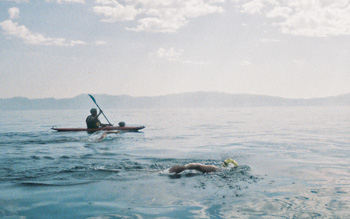
Tahoe’s Karen Rogers out for a multi-mile swim in glassy Tahoe conditions. Rogers plans on swimming the length of Lake Tahoe in August 2009 after three years of training.

At 6225 feet and holding a colossal 122 million acre feet of sapphire blue water, Lake Tahoe is not only the crown jewel of the Sierra but also the largest alpine lake in North America and the eighth deepest in the world.

While the biggest, tallest, or longest alpine anything usually attracts quest-driven endurance athletes like powder junkies to first chairs, surprisingly few marathon swimmers have swam the 22-mile length of Big Blue. To date, only 12 warm-blooded souls have succeeded, although at least one more has it in her sights this summer.

Understanding why just a dozen swimmers have completed the challenge is a no-brainer for Dean Moser, the unofficial record keeper of Tahoe marathon swimming and crew captain for two successful Tahoe length swimmers. “Swimming the length of Lake Tahoe is akin to climbing Mt. Everest,” he says. “It’s a huge feat.”

“A swimmer can get really beat up by the elements,” adds Moser. “All of the finishers have been very strong swimmers with significant cold water experience. It takes an incredible athlete to overcome the altitude and frigid fresh water for that length of time. That’s why so few people have ever done it.”

The first swimmer to meet the challenge was a 29-year-old South San Francisco bartender named Fred Rogers who took off from Kings Beach on the morning of Aug. 28, 1955, and arrived on the South Shore 19 hours later. However, the distance of his route, measured at 19.96 miles, came up a little short. Though Moser gives credit to Rogers as the first successful swimmer, he no longer considers Rogers’ 19.96-mile route an official Tahoe length swim.

“A full-length Tahoe swim must be between the extreme south and north shores – say Tahoe Keys or Camp Richardson in the south to Incline Beach or Hyatt Beach in the north. The route should be around 21 miles.” The third person to complete the swim (and youngest ever), 13-year-old Lenore Modell, swam nearly that long of a route in 1963. But it was Dave Kenyon who first knocked out the true long course when he swam 20.81 miles from Tahoe Keys to Hyatt Beach in 1989. Blazing the swim in 9 hours and 20 minutes, Kenyon also holds the speed record.

Every successful swimmer has had a boat to accompany them as they swam but most of those who have swum in the last two decades have obeyed the “English Channel rules” of no physical contact with the boat nor any other person aside from receiving food. Having an attentive boat crew feeding him consistent and ample calories was vital for Santa Cruz-based marathon swimmer Bruckner Chase in 2005.

“Swimming in the cold temperatures nutrition is absolutely critical,” Chase says. “During my Tahoe swim I drank 8 ounces of a carbohydrate, protein, and fat mix every 20 minutes and then ate a GU packet at the top of every hour.” Chase battled rough waters for the last third of his swim. His rigorous training was the only thing that kept him churning, he says.

“Having completed several Ironman events I knew what it was like to race for 9 to 10 hours. Aspiring swimmers should log as many as 6-to-9-hour training swims as they can. You need to know the energy costs of long hours in the water and how your body will react to it … And if you can’t tolerate cold water, don’t bother. Not everyone is wired to do high altitude cold-water swimming but I think more people are capable of it than they think. I’m surprised more folks haven’t swam the length. It was one of the best experiences I have ever had in the water – an amazing swim in an amazing place.”

This summer, at least two more brave athletes plan to make an attempt: Lafayette’s Tom Linthicum, 51, hopes to be the first to swim the length twice (he successfully crossed in 2006), while Tahoe’s own Karen Rogers looks to be the sixth ever female finisher. Rogers, 41, has been training for the last three years in anticipation of the attempt and dreams of a glassy day on the lake when she pushes off from Camp Richardson in early August. “The perfect day would be to not battle any chop. My hope is that when I enter the water it is absolutely and perfectly still. Any sound of water lapping on the shore at 3 a.m. will be a sign that the winds will pick up throughout the day.”

Calm waters would be an energy saver for Rogers, but she knows she cannot count on 10 tranquil hours so her immediate training focus has been on increasing her endurance and perfecting her calorie intake. “My feeding regiment is still a work in progress. We’re experimenting with adding protein, fat, and maybe even a little caffeine to the mix. The caffeine would only be for the last hour or two as it can cause hypothermia.”

Every month leading up to her August attempt Rogers will be adding an hour to an epic training swim. In May, she’ll try a seven-hour swim in San Francisco Bay; in June, an eight-hour swim. Rogers hopes the long hours in the water will help her learn to overcome the “swimmer’s depression” that she has fought on previous mega-swims. “During some of my longer swims I’ve gone through periods of serious depression. At about the four or five hour mark I just feel terrible … I get angry. Battling through that anguish and regaining my confidence will be the biggest challenge I will face swimming the length of Tahoe.”

If and when she does stand on Hyatt Beach triumphant, it will fulfill an aspiration much older than even her three years of intense training suggests. “When I was seven years old my dad took me for a bike ride at Camp Richardson. Looking out on the lake I told my father that someday I would swim across. Hearing that, he said to me, ‘There is no doubt in my mind that you’ll do that.’ It’s been on my life list ever since.” To read more about Karen Roger’s preparations for her length of Tahoe swim, visit her blog at swimtahoe.blogspot.com

1
May/09
1

Zen and the Art of Surfboard Maintenance

Riding the wave between Zen and surfing, Jaimal Yogis pens a book that balances the connections between both

By Bruce Willey • Photos by Siri Scull

Jaimal Yogis Surfing

Any self-respecting surfer who’s paddled out into the ocean’s fury and caught a wave knows that Zen and surfing are inseparable. It’s just that most don’t know it—yet. Now with Jaimal Yogis’ new book “Saltwater Buddha: A Surfer’s Quest to Find Zen on the Sea” (Wisdom Publications, 256 pages, $14.95) the connection between the two is at last articulated, coming full-circle into the reflective light of the ocean.

This breezy, coming-of-age tale is in fact a memoir, a quest for pelagic vitality and terrestrial enlightenment all rolled into the spiritual spindrift of Zen. Much as surfing requires countless days spent flailing at the mercy (and often merciless) power of the ocean, Yogis’ Zen quest is just as hard earned. But by using Zen to comprehend surfing and surfing to sort out Zen, “Saltwater Buddha” gets about as close as any previous surf narrative to answering the question: What are all those surfers doing out there bobbing in the cold water for hours only to catch a few brief moments of bliss?

Yet ask any surfer the essence of surfing and you’re likely to get a roundabout answer that is as convoluted and mysterious as a kelp forest. Yogis, on the other hand, manages to retain much of the mystery, imparting Zen as a way to find the deeper meaning in life both in and out of a wetsuit.

One of the answers, among many that Yogis proposes, is that Zen and surfing are somewhat historically linked. “Just about the time Bodhidharma showed up in southern China, the Polynesians, largely regarded as the most deft sailors ever, were navigating by the stars to Hawaii, where surfing was most likely born,” Yogis writes in “Saltwater Buddha.”

Another parallel emerges: Religion tried to squash surfing on the Islands and anti-religion outlawed Zen in China.

But it’s the energy of water and waves themselves that perhaps make the most fluid connection in the book. And as anyone who has caught a wave knows, the ride transcends time. Awareness is heightened. Focus is all encompassing. You are one with the wave, one with the ocean. “There was only this and this and this,” he writes. “Just power and presence.”

Saltwater Buddha Book CoverLike the ebb and flow of the tides, “Saltwater Buddha” floats between the esoteric surfing/Zen connection and the real life of a young man coming to terms with adulthood. He makes his escape from his wave-less, drugs and drinking teenage life in Sacramento to the island of Maui. There he buys a used surfboard and begins his introduction into the world of surfing. Following the young lad in his search for saltwater enlightenment is at times painful. Yogis realizes he must grow up, accept the responsibilities of adulthood while retaining the innocence of his Zen quest. What better place to move to? Why, Santa Cruz of course.

There, amongst the organic background of Zen centers, yoga studios and macrobiotic vegetables, he encounters the infamous “surf Nazis.” A red tide of testosterone seeps out of their wetsuits and pollutes the water with un-Zen-ness.

While surfing the agro-crowded Steamer Lane, Yogis is forced to reconcile with this disconnect, a challenge that continues to this day for the saltwater Buddha. “If you can see that the person is acting stupid because he or she wants to be happy just like you,” he says in an interview with ASJ, “but literally hasn’t been given the tools to connect to the deeper part of himself or herself, you can feel compassion and hopefully avoid conflict.”

Yogis now lives in the San Francisco neighborhood of Ocean Beach. Just 29-years old, he says he wrote the book, in part, to investigate the connections between Zen and surfing and explain these connections to himself as much as for his readers. He is currently a freelance writer who holds a Masters in journalism degree from Columbia University. (His chapter on surfing in New York City is especially frightening.) His writing has appeared in Surfers Journal, Sunset, San Francisco Magazine and others.

“Within that investigation,” he says, “I hoped that there would be glimpses at the heart of surfing and the heart of Zen, and that this would help people see these traditions with more respect and authenticity, something that is often lost in marketing schemes and the blur of modern life.”

Though Yogis is not the first to point out that surfing has lost much of its “soul” to the commercialization of the sport, he may be the first to make the point that both Zen and surfing have been marketed beyond recognition. “For people who are more interested in authenticity,” he says, “I think we can try to live that authenticity—live from our Buddha nature, you might say—that means constantly asking ourselves if we’ve been caught by a marketing scheme or if we’re really living our own truth, whether that relates to surfing, Zen, or something else entirely.”

With “Saltwater Buddha” due to hit bookstores this month, Yogis says he wants his readers—both surfers and non-surfers, Zen and non-Zen aficionados—to find a little self-acceptance in the book. And “hopefully they’ll have fun reading it too.”

It’s a tall task to ask of a little book, but one that Yogis deems entirely possible. All told, it’s pretty simple: “I guess what I’m trying to say,” he writes at the conclusion of “Saltwater Buddha,” “is that I’m learning to not want to be someone else, to just be who I am, as is, with nothing extra added on.”

Freelance writer/photographer Bruce Willey, an incurable latent surfer and newspaper editor from Santa Cruz, now splits his time between Atlanta, GA, and Big Pine in the Owens Valley, where he finds his Zen side near daily in the crags of the Eastern Sierra or pulling the steep sandstone of the Southeast. You can find more of his writings, musings and photographs at www.brucewilley.com

1
May/09
0

Droppin’ the Royal Gorge

Staring through the spray at one of California’s most epic kayak runs

By Seth Lightcap

Photo: Don Beveridge

Eric Strittmatter lines up for the first of two consecutive 50-footers at Heath Springs.

For such a benign particulate substance a water molecule sure does pack a punch when it’s rolling with a posse. Collect and confine them in a steep canyon and the power of the assembled molecules can be more intimidating than any gang that ever walked the streets.

The upper stretch of the North Fork of the American River, the Royal Gorge, is one such chasm where water has ruled with an iron fist for generations. Until the most recent one, that is, when a few brave and talented boaters have tamed – or at least lived to tell about – its furious gravitational forces.

Although it drains a million acres of Sierra crest snowpack backing up to the North Tahoe ski resorts of Sugar Bowl and Squaw Valley, the headwaters of the North Fork lie at about 8500 feet, not especially high, which means its boating season is shorter than many other Sierra rivers – stretching from spring into early summer in wetter years.

But what the river lacks in seasonal length, it makes up for in punch. Early surveyors didn’t decide to name the top portion of the North Fork, a cleft in the earth up to 4000 feet deep, the “Royal Gorge” for its aristocratic nature.

The continuous churn of water grinding through the craggy Sierra bedrock has created an unruly river that plummets at an average of 195 feet per mile through a 16-mile chasm, losing elevation in large and sudden doses, as in waterfall after waterfall, a half dozen in excess of 50 feet.

Now California is home to numerous world-class runs, both extreme and less so. But the Royal Gorge cataract, with its eye-popping falls and countless chewy Class V rapids, has been called by the growing handful of elite kayakers that have paddled it as one of the finest and most beautiful Class V+ runs on this green earth.

That it’s even considered runnable is testament to just how far whitewater kayaking has come. None of California’s pioneering paddlers of the ‘70s, ‘80s or early ‘90s would attempt it. Not until 1998 was the Royal Gorge christened by paddlers, when a team consisting of famed boaters Scott Lindgren and Tao Berman, as well as Dean Cummings, Clay Wright and Tom Waclow, tested its plumbing.

Although it’s seen descents by dozens of bold boaters since, its burly reputation has barely budged. Broken paddles, broken bodies, lost boats, scary portages, trespassing tickets – it’s become legendary for all that and more. But as the crew found in 1998, there is an honest-to-god runnable waterway lurking in that gorge parallel to and just a few miles south of Interstate 80 from Donner Summit. You just gotta have the skills and the moxie to grease the challenge.

Picking the right water volume is the first critical decision of making this three-day, 40-mile run (16 miles of Royal Gorge plus 24 miles on the Generation Gap and Giant Gap runs). According to Lindgren, who appropriately enough pioneered the Royal Gorge stretch since it’s practically in the backyard of his hometown of Auburn, 1000 cfs is ideal. But catching that flow with the access road plowed to the put-in can be tough some seasons.

If you do find the put-in bridge, don’t worry about a trespassing ticket. “There is no Royal Gorge access controversy,” Lindgren told ASJ in March. “The access is a public road to a public bridge. After our trespassing problems in 1999 we had a lawyer battle with the North Fork Association whose land the road runs through. They ended up dropping the charges and the case got thrown out before it went to court.”

“A year round NFA caretaker might harass you, but he has no legal right nor jurisdiction to stop you,” Lindgren added. “The road is a public road. Period.”

Though Johnny Law won’t stop you, a deep snowpack might. In 2007, a foursome of kayakers that included James McLeod and Jared Noceti of Sacramento found an answer to that problem, however.

“The road was still snowed in so we rallied our mountain bikes down to the put-in dragging our boats behind us,” McLeod says. “We locked them up hidden in the woods and came back for them a month later when the road had opened.” (See video of their bike-n-boat mission under “Royal Gorge” at broadbandsports.com)

Once in the river the freakish fun begins straight away at the Heath Springs waterfalls, two consecutive 50-footers. Not looking to huck at Heath Springs? Watch out for the portage, says Shannon Carroll, the former women’s waterfall world record holder.

“If you don’t want to paddle the Heath Springs waterfalls you end up having a big portage to put back in just above the crux gorge,” says Carroll. ”Watching guys scramble down the mountain side with kayaks on that portage was probably the scariest part of the trip. A piece of rock broke loose and landed on a kayak knocking it into the river. I’ve never seen kayak boys move so quick. Had we lost a boat there we would have been, well … up the creek without a boat. Craziness.”

After Heath Springs the river drops into the crux rapid, a mandatory paddle.

“When you run these amazing rapids there is something about being isolated in the deep dark granite corridor,” says McLeod. “It brings a heightened awareness to every paddle stroke, every moment, all of your senses are turned up a notch.”

The three other classic falls of the run are Rattlesnake Falls, Scott’s Drop, and Wabena Falls.

Scott’s Drop was first run by Lindgren, of course. It took seven years for a second descent.

“My drop is a 45-footer into a 50-foot slide,” says Lindgren. “It’s pretty technical paddling and gets portaged frequently. There are rumors that I didn’t scout it before running it, but that’s not true. I scouted it as much as I could from the top.”

Rattlesnake Falls at 50-plus feet is next. Carroll recalled the last time she ran it:

“By the time we got to Rattlesnake two people had broken paddles so if anyone broke another on the falls they’d be faced with a steep and arduous hike out with their boat. I chose to run the falls anyway and stuck with my ‘feather technique’ – I tuck the paddle alongside the boat as I drop so that it feathers into the water on entry. Works every time.”

“But other people began getting creative,” Carroll laughed. “Some of the guys tossed their paddles at the top of the drop. Worked for a few, but tossing his paddle caused one guy to drop awkwardly and eject from his kayak on impact. Extracting the boat from the eternal eddy recirculating at the bottom of the drop was quite the rescue mission. The paddler was fine though.”

The proverbial last-but-not-least is Wabena Falls (elev. 3,800 feet), the biggest waterfall on the run – a “no-brainer,” Lindgren claims, because it’s a “70-foot vertical waterfall into a nice calm pool.”

The drop is the finale of the 16-mile Royal Gorge stretch as the next North Fork section, Generation Gap, a stout 10-mile Class V run in its own right, begins, followed by the slightly easier 14-mile Giant Gap run.

If you’re tempted by the Royal Gorge, you’d better be an extremely talented and confident boater for there is good reason it is not profiled in any guidebooks or on any whitewater websites. Running the gorge is a deadly serious and sustained multi-day adventure. There’s no shortage of opportunity for something to go wrong. And unless you’re packing a Satellite phone, help is not on the way.

“Running the Royal Gorge you feel very vulnerable,” says Carroll. “There’s no one that can help you out there. It is you and your crew versus the elements. That’s why it’s always good to be with a group of people you trust. You want to be confident that everyone will make good decisions for themselves and do all they can to help rescue someone if need be.”

But sometimes the reward is worth the exposure.

“Within a few steep rapids and drops you are completely engulfed in a magical, seemingly other worldly paradise of cedars and granite,” says McLeod. ”And you know full well that there is another 39 miles of Sierra gnar before you will see another road. It’s like paddling down a mountain side.”

“The Royal Gorge is a gem,” adds Lindgren. “There is no doubt about it. It’s as good as it gets.”

1
May/09
0

Paddling with an Aloha Spirit

Mendocino to Lake Tahoe, Nor Cal now home to 20 outrigger canoe clubs

By Pete Gauvin • Photos by Corlyce M. Olivieri

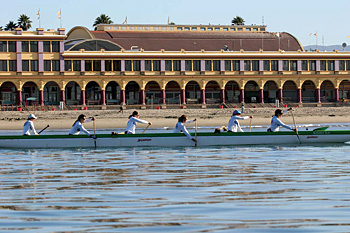
By day, Tony Francis is the manager of a group of technical writers for Apple Computer. After hours, he’s an avid outrigger paddler and president of the Akau Hana outrigger Canoe Club in Santa Cruz, one of 20 such Northern California clubs from Monterey to Mendocino to Lake Tahoe.

Tony and his wife Jeri Ann, both 53, got involved six years ago.

“I loved to surf and be on the water, and in summer when the swell got small, my wife and I were looking for a sport to do together. We tried sailing and sea kayaking … and then tried outrigger paddling. We enjoyed the teamwork aspect to it and the competition, and it’s a sport that we could do together, men and women. It’s a great family sport.”

Indeed, it’s an extended family, as well, one that just keeps growing as more people discover that outrigger paddling is a vigorous full-body workout that comes with a welcoming Aloha spirit of camaraderie and community, what Hawaiians would term “ohana.”

“Our club in Santa Cruz, less than three years ago had 27 people in it,” says Francis. “Now we have over a hundred.”

The club now puts three women’s crews (6-person teams) and two men’s crews in 10 to 12 races a season. Many of the club members also participate in OC1 (solo outrigger canoes), OC2 (two-person), and surf ski (kayak-style sit-on-top craft sans outrigger pontoons) races, notably with the WaveChaser Paddle Series (www.Wavechaser.com) in the Bay Area and Santa Cruz.

History

One of the oldest sports in existence, outrigger canoeing has been practiced for more than 5000 years. A thousand years before Columbus landed in America, Polynesians navigated the South Pacific in outriggers. Outrigger canoe racing is popular in many Pacific Rim countries. Modern clubs were founded in Hawaii during the early 1900s.

It made its way to California in 1959, when Toots Minville, a pioneer of outrigger canoe racing started the Newport Beach to Catalina race. The sport came officially to Northern California in 1978, with the founding of the Northern California Outrigger Canoe Association (www.NCOCA.com), which now consists of 20 clubs. The clubs paddle on nearly every large body of water in the region, including the ocean and San Francisco Bay, numerous lakes, the Petaluma and Sacramento rivers, and the north and south shores of Lake Tahoe.

Competition

Paddlers race throughout the year in distances ranging from 500-yard sprints to 40-plus mile endurance events.

Last summer, the NCOCA hosted the World Sprint Championships at Lake Natoma in Sacramento. Elite teams from around the world participated. Crews came from New Zealand, Australia, Fiji, Tahiti, Hawaii, France, Germany, Italy, Canada, and multiple U.S. states, including New York and Texas.

An NCOCA club from Sacramento, Hui O Hawaii, fielded a men’s Senior Master crew and a women’s Senior Master crew, each of which finished first in the world.

The most competitive crews paddle for the San Francisco Outrigger Canoe Club, says Francis, although clubs from Redwood City, Marin, Sacramento, Santa Cruz and other cities have highly competitive crews, too.

“The competitions are fun and inclusive, with age classes ranging from children to great grandparents, and with male, female, and coed divisions,” says Francis. Teamwork is key. “Every seat position in a six-person crew has a distinct responsibility and skill requirement, and every member of the crew relies on every other member to uphold their responsibility in the boat.”

Nature and Adventure

In addition to the highly competitive aspects, outrigger crews enjoy paddling in the natural elements, the opportunity to see wildlife including whales, sea lions, and dolphins without mechanical interference, and the rush of catching a surf on rolling ocean swells.

There are also some unique outrigger expeditions. Last August, a group of paddlers from Santa Cruz joined a group of Hawaiian and other California paddlers on an open ocean crossing, paddling 480 miles in 73 hours to Kure Atoll on the final leg of a journey connecting all of the islands in the Hawaiian chain.

Community and Culture

The NCOCA and its member clubs are all nonprofit organizations.

“There’s not much commercial backing or sponsorship,” says Francis. “Outrigger canoe paddling is our passion, and we love to share it with our family, friends, and communities. It’s part of the spirit of the outrigger culture that all these people spend all this time and energy to make it happen, organize training and races and community events … and then are literally pulling the water together.”

Cultural interaction with the Pacific Islands is a fun and important aspect of outrigger canoeing. The clubs regularly host luaus, Polynesian dance performances, Hawaiian music festivals, and other events.

“Hawaii-ana – the music, dance and sports – is an appealing element for a lot of OC paddlers,” says Francis. “The California OC clubs really have a huge cultural connection with Hawaii, as well as Polynesia, Tahiti and Tonga.”

Join the Mix

There’s plenty of opportunity for outrigger neophytes to get into the mix. Most clubs have at least one training session a week that is open to newcomers. For Akau Hana in Santa Cruz, it’s Sunday at 9 a.m.

“It’s an activity that everybody in the family can participate in,” Francis stresses. “Most clubs have programs for people interested simply in recreation and fitness along with programs for people interested in world-class competition. Most NCOCA clubs have programs for children, and some clubs have programs for physically disabled paddlers.”

Northern California Outrigger Canoe Clubs

1
May/09
0

Surf Culture’s Custodian

An interview with San Francisco surf author Matt Warshaw

By Colleen Corcoran

Photo: Kevin Starr

Matt Warshaw prefers the relentless whitewater of Ocean Beach to the glassy So Cal curls of his youth. Surf books, magazines, videos and DVDs line the walls of his surfer’s library. There, inside his San Francisco home, behind blankets that block the windows of temptation, he has toiled…

From the Aaberg brothers to Zuma Beach, the 816-page “Encyclopedia of Surfing” (2003) consumed more than three years of Warshaw’s life.

“Mavericks: The Story of Big Wave Surfing” (2000) begins, in its own roundabout way, with a Hawaiian riding a tidal wave, wraps in Jaws, Todos Santos, surfboard design, Mark Foo, and undersea topography, and bottoms out in the Quicksilver Contest days.

The former Surfer magazine editor is also the author of, most recently, “Photo/Stoner: The Rise, Fall, and Mysterious Disappearance of Surfing’s Greatest Photographer” (2006), “Surf Movie Tonite! Surf Movie Poster Art, 1957-2005” (2005), and “Above the Roar: 50 Surfer Interviews” (1997), among others.

As surf culture’s head custodian, he’s even created a database with more than 18,000 detailed records of surf articles from 1960 to today, as well as books, movies, contest results and more.

In this interview he shares his thoughts on his path to becoming surfing’s leading chronicler, the evolution of the sport, the uniqueness of the San Francisco surf scene, and the difficulty of integrating surfing into a productive, balanced life.

His literary niche:

I mean, I’ve been called a surfing historian. I’ve taken so many history classes. The history books are all so awful … Since I’m called a surfing historian, I’m just a surfing historian… I never really feel like I can look ahead and say anything of interest. My whole career is look what’s happened and trying to distill it or find a theme or two and looking back and analyzing that. I’m not particularly imaginative.

How surfing has changed:

I’m kind of of the opinion that the sport has sort of become so nostalgic. I sometimes get a little tired of how smug we are as surfers. We have this great thing – it lends this attitude that we’re too cool for the rest of you. There’s always been plenty of surf. The only thing that’s different is how many people there are in the water, because the rest of it – the commercialization of surfing – is not that hard to tune out. It’s not hard to tune all that shit out. If you want to get surf without that many people, it’s not that hard to do… Ocean Beach is a pretty good example, except the crowds at least doubled in the 15 years I’ve been out here. That’s hard if you’re really in love with a surf break. I tend to think it wasn’t that much better than in the past. There’s a lot to recommend being a surfer right now – wetsuits, surf forecasting. It’s seems to me that it pretty much evens out.

“Maverick’s: Fearsome big-wave surf break located just west of the Pillar Point headland in Half Moon Bay, California, 25 miles south of San Francisco; the heavily publicized focal point for West Coast big-wave riding since the early ‘90s… Three Half Moon Bay surfers rode the inside waves at Pillar Point in the winter of 1961, and the break was named after Maverick, a white-haired German shepherd who followed the group into the water. But it was 18-year-old goofy foot surfer and local carpenter Jeff Clark, beginning in 1975, who did the real pioneering work at Maverick’s… ‘It just goes to show,’ Clark told the [New York] Times, in one of his many gruffly theatrical quotes, ‘that no matter how prepared you are, [at Maverick’s] you’re in Neptune’s playground.’” – The Encyclopedia of Surfing

Finding his career path:

I was editor at Surfer and I quit at 30 to finish school and finish college ‘cause I was a dropout. Finished at Berkeley and ended up at a PhD program at UCLA and dropped out. Decided to become a surfing authority sort of. Before I wrote the Encyclopedia, I started putting together a surf literature database. My dad said, “Well, if you’re going to be a surf authority, why don’t you do a surfing encyclopedia?” And I said, “Well, maybe I will.” So it was sort of his idea …

The Encyclopedia of Surfing was a big book, and it was a giant effort. It was the only one that came out exactly how I thought it was gonna come out, and it is the one that I’m proudest of and by far took the most work. And it was also a book that was never done before.

Everything surfing in one place:

Once I had the databases I could research with a few keystrokes. People who like databases can really bore to tears other people what are not interested in it. It’s this miracle research tool… If someone is doing a documentary on surfing in the ‘70s, on the rise of pro surfing in the ‘70s say, then that’ll take me a few searches to do, and put together a few three-ring binders of that subject. And it might be a couple of days work for me, but it would be stuff (others) wouldn’t be able to do period.

On settling in Nor Cal:

I turned 30 and I’d been on the beach since I was seven or six or something, and I’d been in So Cal my whole life, and suddenly I just thought I wanted to try something else, something different. I felt I was getting to old maybe for the Surfer magazine audience. So I talked my way into Berkeley and it was great. I actually did return to So Cal when I was in the PhD program, but it wasn’t for me. I wanted to be up here. I fell in love with San Francisco and really wanted to be up here. I wanted something different … I liked that surfing up here wasn’t yet quite as commodified. There was one surf shop – Wise – (and) it was in a much smaller building…

Surfing in San Francisco:

San Francisco is this great surf break, but it’s a pretty self-contained thing. It hasn’t had much ripple effect in the bigger surf world. It’s just a big giant mostly, often raw and often sloppy. It faces so much into the wind and swell. It’s not that often that it really comes together. When it does, it’s a fantastic break. You need a half dozen things that need to be in alignment even on a good day. If one of them is out of whack, it’s a really frustrating surf break. It’s sort of like surfing in general. The reason people surf for 40 years or longer is because you don’t spend much time as a surfer on your feet riding waves. You almost never feel faded. And Ocean Beach does that one better because it’s always harder to be in the right spot on the right day. It’s a weird thing to say because the effect of that is you end up wanting it more so you just keep surfing. The little bits that you get are amazing.

On balancing life and surfing:

I’m 46 now (at time of interview last year), and I’ve been surfing since I was eight and it is all still pretty gung ho. I’m still able to go out twice a day if it’s good, and almost 40 years of surfing. That’s really repetitive. Today, a good example – it was perfectly fine surf and I spent an hour or so in the water and enjoyed myself and got out of the water pondering what you just asked. It’s not what I remember it when I first moved up here. I will surf for the rest of my life. The degree with which surfing had me by the throat – I’m kind of relieved I’m not the slave I was for decades where when the surf’s good, it’s not, ‘drop everything.’ I got married and that made a difference. The edge just came off my fanaticism. I still surf a lot, and it’s just down-shifted a tiny bit recently…

I’d never do anything else. I’ve tried everything else and there’s never been anything that even caught my eye… There’s not a whole lot to say about surfing. It’s how you make surfing fit into your life just for the simple reason that waves don’t come when you want them to come. Try to make deadlines and be on time, and be on time for dinner and holidays, and be able to drop everything when the surf’s good and have a life outside is really difficult. It’s just challenging. Even if you’re just a happy stoked beginning surfer, it’s really hard if it gets into your blood to not have it change your life in ways not like if you’d picked up golf or tennis.

On being “nobly maladjusted”:

A lot of people – surfing just eats their life up and they end up in middle age with very little else. It’s pathetic… Surfers are nobly maladjusted in terms of doing what most people would expect us to do…

Surfing hasn’t given me any insight into anything. The only thing that I might have any insight on is that if your lucky enough to be able to choose to do something that you really want to do, and if you can do it and keep your life in balance… It just made me sort of not that interested in gathering stuff and being a – the money doesn’t seem to mean all that much. There’s a certain value in having experience instead of money. I think the deal is people don’t discover the thing they want to do and they still want to dedicate themselves to something, so they become a lawyer. If you can find something you really want to do and stay with it, it’s a good a way to live and it’s often not what other people are doing…

Leaving Surfer to come back to school – it was a long two to three years of playing catch up and still is to this day. To focus this much on one thing can be detrimental to your development in other areas of your life. I was really lucky in a lot of ways – my family’s been right behind me. I knew from a really young age that I wanted to surf and surf a lot.

I feel I’ve barely managed to, but I’ve managed to.