1
Oct/11
0

2011/2012 Season Pass Deals

If you haven’t already done so, now is the time to buy your season pass for the upcoming snow season, as many resorts will be increasing their prices after October.

Start here, and then consult the website of your favorite resort to complete your due diligence and get the right pass for you. Keep in mind, all prices are subject to increase by opening day or sooner. Many resorts use a hotel-pricing model — i.e., if sales are slow, reduced rates will last longer.

A few deals deserve special mention this season. The Triple Threat College Pass allows students to skip the weekend madness and experience Kirkwood, Alpine Meadows and Homewood for only $199. That’s three resorts for $199. The Tahoe Value Pass at $379 gives generous access (standard blackouts) to Heavenly combined with six- days-a-week access to Northstar (Saturdays excepted). For So Cal shredders, $659 gets you unlimited access to both Bear Mountain and Snow Summit.

Finally, try to attend one of the Snowbomb events in early November, taking place on consecutive weekends in San Francisco and San Jose. For more info, check out www.sfskifest.com. Many good deals to be had — in some cases discounted season passes are available,— plus swag, beer and wine tasting make these events a fun way to save some money this season.

Alpine Meadows • $459/$599/$799

The $799 Pass is unlimited for Alpine and Homewood, with some blackout dates at Kirkwood. Lesser prices only get you Alpine Meadows with blackout dates, and Homewood, but no Kirkwood access. Many other excellent options exist including an exciting unlimited pass for college students at all three resorts for $329. Prices valid at least until Oct. 31. www.skialpine.com

Bear Mountain • $459

Pass is unlimited access. Pass includes full privileges at Snow Summit resort for an additional $200. Expires Dec. 4. www.bearmountain.com

Bear Valley • $469

No blackout dates. Upgrade to unrestricted cross- country ski access for an additional $90. Price good until opening day. www.bearvalley.com

Boreal • $279

Unrestricted. Includes night skiing. Price set to increase Oct. 31. www.borealski.com

China Peak • $339

Unrestricted pass. Price increases Nov. 1.

Diamond Peak • $454

Unrestricted pass. Price increases after Oct. 31.

Dodge Ridge • $349

Preseason sale ends on Oct. 31. www.dodgeridge.com

Heavenly • $649/$379

$649 gets you Heavenly and Northstar unrestricted with Vail’s EpicMix functionality. The Tahoe Local’’s Pass gets you Heavenly with standard blackout dates and Northstar minus Saturdays for $379. Many other options exist. Prices only guaranteed through Oct. 16, but last year held firm until late November. www. epicmix.com

Homewood • $399

Pass is unlimited at Homewood. Probably better to spend an additional $50 to get the Alpine Meadows Filtered Pass, which includes Homewood privileges and limited Alpine Meadows access. Homewood prices valid through Dec. 19. www.skihomewood.com

Kirkwood • $799/$649

Same deal as the Alpine Meadows Unfiltered pass except the inverse holds true— $799 purchase at Kirkwood gives you unlimited Kirkwood and Homewood, with some restrictions on your access to Alpine Meadows. Probably better to shell out the full $799, as $649 gets you unlimited access to Kirkwood, but no Homewood or Alpine privileges. Prices usually increase after opening day, but are ofÞcially subject to change without notice. www.kirkwood.com

Mammoth • $799

Pass is unlimited, but price increases to $999 after Nov. 12. www.mammothmountain.com

Mountain High Resort • $349

Unrestricted pass that includes night skiing. Price good until Oct. 31. www.mthigh.com

Mt. Rose • $377

Unlimited access. Price changes Oct. 31. www.mtrose.com

Mt. Waterman • $300

Unrestricted. www.mtwaterman.org

Northstar • $649/$379

See Heavenly for details. www.epicmix.com

Sierra-at-Tahoe • $369

Unrestricted. Price to increase in October. www.sierraattahoe.com

Snow Summit • $299

Probably better to buy a Big Bear pass and get the upgrade to both resorts. See Bear Mountain. www.snowsummit.com

Squaw Valley • $439-$739

Unrestricted. Many other options are available for restricted access. Opening day is Nov. 23. www.squaw.com

Sugar Bowl • $799

Price for unrestricted pass to increase after Oct. 31. www.sugarbowl.com

Tahoe Donner • $279

Unrestricted. www.tahoedonner.com

1
Feb/11
1

Mammoth Extends Reach

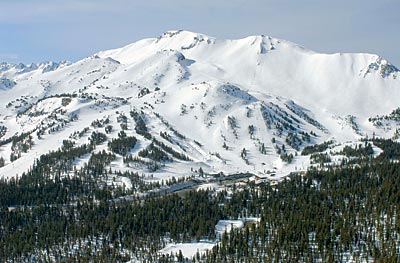
Mammoth Mountain is a massive sleeping volcano that last erupted some 50,000 years ago when it was even bigger, perhaps as high as 18,000 feet. The Main Lodge is bottom right.

Mammoth Mountain is a massive sleeping volcano that last erupted some 50,000 years ago when it was even bigger, perhaps as high as 18,000 feet. The Main Lodge is bottom right.

With daily flight service from the Bay, Mammoth lures Nor Cal skiers to the High Sierra

By Pete Gauvin  •  Photos by MMSA/Peatross

It is only by virtue of geographic inconvenience that Mammoth Lakes is considered more a playground for Southern California than Northern California. If it were not for a wall of snow-caked mountains in the way — chiefly Yosemite National Park and the Ansel Adams Wilderness — Mammoth would likely be Nor Cal’s winter alternative to Tahoe.

Look at a map: Mammoth is directly east of the Bay Area, at virtually the same latitude as Hayward and San Mateo. By way of the bird, the Bay Area is closer to Mammoth than Los Angeles. If you had wings, you might care.

Without them, the drive to Mammoth in winter is more than most Nor Cal skiers want to undertake; some 6-8 hours from the Bay Area on clear roads. Plus you have to drive right by the temptations of Tahoe — and we hear there are some decent mountains to ski there, too.

Indeed, for Bay Area and other Nor Cal skiers, “Mammoth” … well, that might as well describe the drive. And so, heretofore, Mammoth has largely been left to Southern Californians, who have no significant mountain passes to cross, nothing approaching Tahoe in their path, just a few hundred miles of sagebrush-lined asphalt to channel them up the backside of the Sierra.

That’s not going to change. But with the advent of direct flights from San Francisco and San Jose this season, Bay Area skiers and boarders can now jump the topographical fence in little more than an hour and find themselves at one of the most unique, dramatic and naturally well-endowed ski mountains in North America.

Winging It
Through April 25, there is one flight daily out of SFO on United (departing 3:50 pm), and one flight out of San Jose on Horizon (12:30 pm weekdays; 3:10 weekends). (There are two daily flights from LA.)

And the cost of flying is on par with driving. Flights range from as low as $29 one way from San Jose, $59 one way from SFO. If you’re flexible, there are some tremendous weekday deals. Through February, Mammoth is offering a four-day/four-night midweek fly, ski and stay package for $99 a day from San Jose, $109 from SFO. (Check mammothmountain.com/flyskistay for details.) For comparison, a one-day adult lift ticket runs $92.

Once on the ground, it’s easy to get around without a car. It’s only an eight-mile shuttle ride from the airport to the closest lift. In town, the free Mammoth Trolley runs every 20 minutes until 2:30 in the morning.

You can grab a coffee in town at the Looney Bean and head for the mountain, enjoy a pint of Real McCoy Amber Ale from the Mammoth Brewing Company at the popular Whiskey Creek restaurant and bar, or head to the actual brewery tasting room (open daily 10-6) two blocks away for a full sampling. There’s the also the Euro-style pedestrian village at the base of the mountain with a selection of shops, bars and eateries.

Blessed by Geography
There’s the Sierra and then there’s the High Sierra. Though often used interchangeably, they are not one in the same. The true High Sierra, as noted author/guide John Moynier has pointed out, begins near the northern boundary of Yosemite and Matterhorn Peak, the northern most 12,000-foot peak in the Sierra, and extends southward 175 miles through the Whitney Zone.

Mammoth and sister resort June Mountain are the only developed ski areas in the true High Sierra, where the relief from sageland to summit is most dramatic.

Due to its geographic position and altitude, Mammoth often gets more snowfall than Tahoe resorts, an average of 32 feet annually. This season it nearly equaled that by January with an astounding 370 inches.

Sitting on the eastern flank of the range, one would guess the mountain might suffer from the rainshadow effect. But the San Joaquin River canyon funnels Pacific haymakers up to a low section in the Sierra Crest allowing moisture-laden air to cross to the east side, where it’s wrung out by the broad volcanic peak topping 11,000 feet.

The mountain, which has been snoozing since its last eruption some 50,000 years ago, is the remains of a humungous volcano that may have been as tall as 18,000 feet. Imagine, for a second, the vert we’d be talking about had it not blown its top!

Still, Mammoth more than justifies its name. The resort’s base of nearly 8,000 feet is as high as some Tahoe resorts, yet it still offers more than 3100 feet of vertical. It’s all sprawled over 3500 acres served by 28 lifts (including three gondolas) and three base areas: Canyon Lodge, Eagle Lodge and Main Lodge.

All this in a stunning Alps-like setting framed by the steepled summits of the High Sierra and long views of the Great Basin out east.

On the Mountain
Mammoth’s upper mountain is entirely above treeline and offers some of the steepest skiing in the West, including the famous Cornice Bowl. Beginner and intermediate skiing can be found all over the mountain.

The backside, close to a thousand acres and served by only two lifts, Chairs 13 and 14, is a good place to find both sunshine and powder. It features big bowls up top and well-spaced tree skiing below. Hemlock Ridge just beyond Santiago Bowl is a great place to hike for turns. After about a 400-foot vertical hike, a steep descent leads down to Chair 14.

Though not well publicized, Mammoth has an open-gate policy. The most popular expression of this is skiing off the top of the Mammoth Crest, a big palisades running right behind Mammoth Mountain toward the south, with multiple runs that all drain back to the Tamarack/Twin Lakes area, where the Tamarack Lodge and cross-country center are located. The most popular and unique out-of-bounds run is “Hole in the Wall,” a steep chute through a lava tube that forms a natural tunnel.

From Tamarack, you can catch a free shuttle bus that runs every hour on the hour back to the village and town.

If you work up an appetite but don’t want to leave the slopes, keep an eye out for Mammoth’s latest culinary creation, the Roving Mammoth, a snowcat that roams the mountain like an all-terrain taco truck, selling burritos for $5.50.

If you like your burritos with lots of corn, wait till spring. That’s when Mammoth’s ‘Great Corn Factory’ produces that buttery hero snow ripe for carving and serves it typically longer than any resort in the country. Last year, Mammoth was open until Independence Day.

June Mountain
For a change of pace, Mammoth tickets are also good at June Mountain, a hidden gem of a resort about 10 miles north on Hwy 395. There’s a shuttle roughly every hour, opening the possibility for a double day.

Overlooking the June Lake Loop, with jagged mountain peaks right behind it and views of austere Mono Lake out east, June is more of a purist’s mountain. No roaming burrito snowcats here.

Although it gets less snow than Mammoth, about 250 inches a year, June is known for its powder because it’s so uncrowded for its size. While a weekend at Mammoth can draw 20,000 people, a big day at June is 2000 people. And its acreage is still substantial, about two-thirds the size of Mammoth. It has seven lifts and 2,500 feet of vertical with a variety of terrain, including some great tree skiing.

Tamarack Cross-Country
Another great way to mix up a week of skiing at Mammoth is to stretch out the legs and lungs on the 19 miles of groomed trails at Tamarack Cross-Country in the scenic Lakes Basin. Adult day passes are $27. The ski school run by two-time Olympian Nancy Fiddler can help iron out your skating or diagonal stride imperfections. Snowshoe trails are also offered.

However you choose to wrap up a trip to Mammoth, with the new flight service there’ll be no worries about fatiguing yourself because you’re facing a long drive home. Enjoy your wings.

21
Oct/09
1

Ice, Wind, Cold, and Sierra Cement

A little hardship makes for a ‘best ever’ Yosemite-to-Mammoth ski traverse

By Matt Johanson


Andy Padlo skis near Thousand Island Lake.

Photo by Matt Johanson

Four days into a 50-mile winter trek, our team reached a steep and formidable icy slope. We quickly recognized that this grade was our most hazardous obstacle so far, because to climb it we would have to risk a wild slide down an incline that would drop a skier several hundred feet below, and not at all gently.

Our four-man group – myself, my cousin Andy Padlo, our buddy Cliff DeYoung and his father Richard – was skiing from Yosemite National Park to the town of Mammoth Lakes, a trek we planned to complete in about six days.

Under a clear March sky on our fourth day, we approached 11,056-foot Donohue Pass, the highest point of our route. Once we reached it, a long, gentle descent would take us within striking distance of Thousand Island Lake. From there, we thought, one long day would take us to hot showers and a feast in Mammoth Lakes.

The icy slope was steep, but every other route to the pass was steeper, so there was little choice but to attempt it. Andy led the way toward safer ground, leaving only scratches on the hard ice that resisted every effort to gain solid footing on it. The rest of us cautiously followed, leaning into the incline, wishing we’d brought the ice axes and ropes that we left behind to save weight. That mistake could lead to a dangerous epic if a falling skier slammed into a tree or a rock in a high-speed heap.

Hut Full of Food and Beer

Mistakes and epic survival scenarios constantly occupy the minds of mountain travelers, especially in winter. Everyone makes mistakes, but nobody likes epics – except when they’re over, you’re still in one piece and you’ve got a riveting story to tell about a crisis averted. So the idea is to keep mistakes small, learn from them, and not let them spiral into trouble of epic proportions. We felt we had the experience (i.e. we’d learned from enough mistakes) to make the trek to Mammoth, the toughest winter outing any of us had attempted.

Cliff and Richard started the trip from Yosemite Valley, hiking and then skiing two tough days to reach Tuolumne via the Snow Creek Trail. This grunt of an approach features abundant trail breaking and an elevation gain of 4,500 feet. The DeYoungs and I skied this route in reverse on our first trans-Sierra trek three years earlier, but I found the uphill direction very unappealing.

Andy and I chose a slightly faster route to the hut from the east, starting near Lee Vining and skiing up Highway 108 over Tioga Pass. Skiers can make good time on this snow-covered ribbon of asphalt, but the 17-mile trek from the road closure to the Tuolumne Hut is no cheapie. After eight hours of hard labor, we arrived ready for a hot meal and a warm fire.

The DeYoungs reached the hut first and staked out our territory. The hut has ten beds and is available all winter at no charge on a first-come, first-serve basis. Another benefit of the shelter is the food cache area. Visitors can store food in the hut’s adjacent bin each fall for hearty meals in the winter. So besides the stove, lights and beds, we enjoyed a dinner of ground beef, mashed potatoes, cookies and very cold beer.


Members of the Yosemite-Mammoth team enjoy the view from the top of Donahue Pass.

Photo by Matt Johanson

‘Get Your Fat Ass on Skis’

Our schedule called for rest and recreation around the hut on the following day, and then a final weather assessment before we committed to ski to Mammoth. That leg of the trip worried me; the same route had denied Andy and me the year before.

We started from Mammoth Lakes that time. Our progress across San Joaquin Mountain was painfully slow. It was mid-April after a light winter and extended patches of bare earth forced us to hike in our clunky ski boots. We took our skis off time after time to hike through bushes and over talus, sapping our energy as well as our momentum. The conditions held us to a glacial pace for two days, until we called it quits and turned our blistered feet around. This aborted outing didn’t quite rate as epic, but it was no fun either.

A year later, a week of day trips from Tuolumne Hut sounded more attractive to me than another run on San Joaquin Mountain. Tuolumne has plenty of peaks to bag and there was little chance of an epic that way. The forecast we got via the hut’s pay phone predicted clear skies for several days. I also found some words of motivation in the hut’s log book, written by a visitor the previous year.

“Get out of your gas-guzzling SUVs and get your fat ass on a pair of skis, you average American,” the skier scolded his readers. “You can do better.” When I saw the author of this get-tough prose was none other than my longtime friend Cliff, I knew I’d have a hard time backing out of the Mammoth run. I could only hope that attempting the punishing terrain of San Joaquin Mountain again, not to mention the other as yet unknown challenges of the route, wouldn’t be a mistake we would all regret.

Stuck in ‘Cement’

Skiing south down Lyell Canyon along the John Muir Trail was supposed to be flat, easy and scenic. We had to settle for one out of three, as clouds obscured our view, and the heavy, sticky snow made progress slow and difficult. They call it “Sierra cement” for a reason. Did we bring enough wax? Fearing we hadn’t, we tried to stretch our supply as far as possible, though that meant dragging pounds of clumping wet snow beneath our skis for miles. This mistake, which became apparent as we committed to reaching Mammoth, did not fill me with confidence.

Camping in the low point of a canyon, which traps cold air like a pool of ice water, is a mistake we had made before, so we intended to climb part of the way toward Donohue and pitch our tents in warmer climes. But we underestimated the Sierra cement clinging to our ski bottoms. We might as well have been dragging anchors. The setting sun forced us to stop for the night just before beginning the climb to Donohue Pass, at more or less the exact cold spot we had planned to avoid. So we flattened the powder and dug in as best we could, climbing into our sleeping bags before the temperature plummeted.

A blue sky greeted us the next morning with the promise of a sunny day, but before the sun arrived, clear skies meant frigid air. Our thermometer read 0 degrees Fahrenheit. Tearing down camp and gearing up as quickly as possible, we raced against the numbness creeping into our hands and feet. We skipped breakfast, frenzied as we were to get moving and generate body heat, though Andy heated up some dried milk that we eagerly gulped down.

“Right now, I think I’d drink a cup of warm yak piss,” Cliff remarked through chattering teeth.

Snow clumps continued to grow beneath our skis, but we eventually reached Donohue’s final approach (only four or five hours behind schedule) and turned our attention to the icy slope.


Richard DeYoung powers his way toward higher ground and snow.

Photo by Matt Johanson

Under heavy packs, we kicked our skis down hard with every step to gain as much traction as possible and allowed extra space between each other on the dicey ascent. The last thing we wanted was one falling skier to knock down or injure two or three others.

Before long, we all reached the pass without incident. An exciting view of nearby Mt. Lyell and Banner Peak greeted us. To our amazement, so did hundreds of butterflies, the first living things (besides trees and each other’s stinky bods) we had seen in several days.

After snapping a few victory shots, we shoved off on the long downhill run that reminded me why we had come. I don’t mind climbing hills and hard work, but after averaging one mile per hour for the previous day and a half, I was ready for something fun, like gliding effortlessly down a three-mile slope. Instead of more cement, we found much faster snow. Completing the crux of the trek lifted the spirits of the entire team.

Deadman Blowing

A few additional challenges marked the trek’s last two days. Richard skied cautiously after a fall left him with a strained hamstring; we should all have such problems when we’re 64. Then, after camping near Thousand Island Lake, we negotiated a steep slope beyond its east shore that caused some anxiety but no avalanche slides.

Our return to San Joaquin Mountain was as grinding as I’d feared. The icy southwest slope is hard and slow to traverse; it defeated our hopes of reaching town on the fifth day. Instead, we built our last camp within sight of Mammoth’s lights and ski lifts, and Andy made the team a soup flavored with all our leftovers: chicken broth, garlic, tuna, cranberries, rice and buckwheat. “Here’s your ration, sailors,” he said, as he filled our cups. Ravenously, we licked them clean.

Three miles from town, the last obstacle is Deadman Pass, known for winds that are frequently strong enough to blow a dead man right off it, and perhaps even a live one. We estimated the gale blew into our faces at about 60 mph. Even keeping our feet was a challenge here, and forcing our way through it took much of our remaining strength.

But an hour later, we glided into the Mammoth Mountain Ski Resort, bursting with pride even as downhill skiers regarded our motley crew with gaping mouths. “Where did you say you came from?” asked one in disbelief. Before long, we sat around a table at a hofbrau, eating cheeseburgers, drinking beer and laughing.

Not Too Shabby

In the final box score, we had to record a few mistakes. But since they didn’t cause any epic trails, they didn’t bother us. Actually, we did quite a bit more right than wrong, like planning, route finding, and judging conditions correctly. Enough to get us to our destination, at least.

Toughness has to count for something, too. In all my years of skiing, mountaineering, rock climbing and distance running, I don’t think I’ve ever attempted anything more physically demanding than this trip. Yet better snow and more wax could cut the duration and difficulty in half. To better skiers, this trek is a warm-up for more challenging trans-Sierra crossings.

“It was the conditions that made it tough,” Andy said. “We had both ice and clumpy snow, and neither one is conducive to moving fast.”

Finally, we took a strong team, for which I was grateful, since it encouraged me to push my limits on this occasion.

“I think this was my best-ever trip in the Sierra,” Richard announced. Coming from a man who’s explored the mountains his whole life and named his son Cliff after a rock formation, that’s saying something.