Oct/120
Going FURTHER with Jeremy Jones
New Snowboarding Film Redefines Radical In The Backcountry
By Seth Lightcap
In 2010, pro snowboarder Jeremy Jones took us “Deeper” into the wilds of Alaska, the heart of the Alps, and the steeps of Antarctica with the release of the fi rst chapter of his backcountry snowboarding movie trilogy, Deeper Further Higher. Now the big mountain snowboarding pioneer is back on the silver screen with the recent debut of Further, his second signature fi lm with Teton Gravity Research.
Where Deeper and its “hike every line you ride” message was groundbreaking for the ski and snowboard fi lm industry, Further is all that plus more. “With Deeper I explored mountain ranges that I knew pretty well,” said Jones. “With Further I checked-out ranges that I knew very little about.”
Jones and the crew are still earning every turn in Further, but the “gnar knob” got turned way up. With a faster pace and better focus on the ridiculous ascents that unlock the jaw-dropping descents, Further is not just a claim, it’s a fact. Jones took it to the next level with this new movie.
Further will light a fi re under the feet of any backcountry explorer, whether aspiring or experienced, as each of it’s four chapters showcase the magic of venturing into the wilderness searching for the unknown. Using splitboards as their primary mode of transportation, the Further crew travels deep into remote mountain ranges in Japan, Austria, Norway and Alaska. Adventure Sports Journal caught up with Jones to talk about the inspiration behind each trip, and the highlights of fi lming the two-year project.
Japan
The first chapter of Further follows Jones’ travels to one of the snowiest places on earth, the Kita Alps of Japan.
“I saw a video a couple years back of a guy riding this insane alpine face in Japan,” Jones said. “I had never imagined terrain like this existed in Japan and I had not seen any other footage from there since. So when Japan had a big winter in 2011 (it) became an ideal location to start filming Further.”
Jones brought veteran backcountry snowboarders Josh Dirksen and Forrest Shearer along for the ride. The trio explored the jagged peaks above the town of Hakuba, mobbing through hip deep “Ja’Pow” and battling gale force winds to make it happen. The Cat Face of Kaerazu No-Ken (the mountain of no return) became their main objective. The steep fl uted face rejected their fi rst approach and forced the group to retreat to a high alpine shelter. When the winds subsided, the group got after it again but the push to ride the Cat Face was not without peril. One of the most dramatic scenes of the fi lm goes down on this face as the TGR cameras catch a couple breath taking moments that will surely stoke future Kaerazu No-Ken shredders.
The Arctic

To snowboard this mountain face, Jeremy Jones travelled 180 miles across glacial sea ice into the Arctic Circle above Norway. Photo by Dan Milner/Further

Snowboarding legend Terje Haakonsen joined Jones for a backcountry snowboarding expedition into polar bear country on the island of Svalbard, Norway. Photo by Dan Milner/Further
The second chapter of Further delivers the epic tale of a trip Jones undertook in April 2011. Jones connected with legendary freestyle snowboarder Terje Haakonsen for an expedition to Svalbard, a mountainous island in the Arctic Circle above Norway. The pair of shred pioneers spent three weeks camped out on a glacier ripping lines they had climbed.
The trip marked a lot of firsts. It was the fi rst time the two had ridden together, it was the fi rst time Terje had ever been splitboarding, and as you can imagine, some heavy fi rst descents went down.
“I had heard rumours of this island with really good steeps that were really close together with fl at runouts. Turned out it was all true and then some,” said Jones. “Svalbard has amazing terrain, twenty-four hour sunlight, and the maritime snow sticks to the mountains making for a relatively safe avy-cycle.”
The footage of Jones and Terje riding lines one after another is the stuff snowboard porn dreams are made of. Likewise, Jones was in awe of Terje’s natural abilities in the mountains
“Terje is an insane athlete,” said Jones. “He had never been splitboarding, nor had he climbed with an ice axe or crampons, but he was running around the mountains and charging lines in no time. He’s hands down one of the best snowboarders to ever strap in.”
Austria

Hard charging Austrian freerider Bibi Pekarek became the first female freerider to appear in one of Jones’ signature films. She rides with Jones in her home mountains above Innsbruck. Photo by Mitch Toelderer/Further
The third chapter of Further takes a look at a unique splitboard expedition to the Karwendel Range above the Austrian city of Innsbruck. Despite it’s proximity to a major metropolis, this slice of the Northern Limestone Alps sees virtually zero traffi c in the winter.
For this frigid cold February 2012 mission Jones is joined by local Austrian freeriders Mitch Tölderer and Bibi Pekarek. The crew braves a record cold snap to bag multiple fi rst descents.
“We rode a lot of fi rst descents on this trip and it wasn’t because we were way out in the middle of nowhere,” said Jones. “It’s just an example of the acreage of incredible terrain in the Alps. It’s mind-blowing.”
The long approach into the heart of the Karwendel range meant the Further crew had to tow in sleds loaded with their gear. A little extra huffi ng and puffi ng upslope kept them moving and helped them battle off the below zero temps.
“You could pour water in your water bottle and then watch it freeze in front of your eyes,” said Jones. “It was unrelenting cold.”
By fighting off frostbite and an avalanche, Pekarek became the fi rst female rider to appear in one of Jones’ signature movies.
“I wasn’t hellbent on fi nding a female rider, just to have a female rider,” said Jones. “Bibi was a natural addition because she belonged on the trip. She’s super fi t and a huge asset in the mountains. She helped put in as many skin tracks and boot packs as I did and delivered Grade A action shots. I’m really excited to have her in the film.”
Alaska

For the serenity of alpine moments like this Alaska sunset, Jones chose to hike all the mountains he rides (instead of use helicopters) during the filming of his new movie, FURTHER. Photo by Chris Figenshau/Further

Jeremy Jones set up a base camp deep in the heart of the Wrangell St. Elias range in Alaska to film his latest backcountry snowboarding, FURTHER. The crew then hiked all the mountains they rode including the face behind camp. Photo by Canyon Florey/Further
Further arguably saves the best chapter for last. The fi lm fi nishes up in the Wrangell St. Elias range of Alaska. Jones and young guns Ryland Bell and Lucas Debari venture out for a month long basecamp amongst the man-eating mountain faces and glacial ice of the Wrangells. The gravity of the lines left Jones the most gripped he’d been during the entire two-year project.
“The exposure of the lines we climbed in the Wrangells defi nitely passed my comfort level in the mountains,” said Jones. “Especially the last line I ride in the movie, the Space Needle. Climbing and riding that line kept me in the danger zone a lot longer than I expected.”
Watching Jones, Bell and Debari bootpack up skyscraper steep faces hanging above massive bergshrunds will make the audience sweat. The riders don’t hide that they are scared, but when you see them rip down you’d think they had ice in their veins. Even when faced with a huge, risky jump, all three charged the drop like they were jumping cliffs under the chairlift.
Dec/110
Sandbagging An Olympian
Ski Racer Daron Rahlves dives head first into the Sierra backcountry with snowboarder Jeremy Jones
Story and photos by Seth Lightcap
You’re only a virgin once so we had to go big. Especially considering the man of the hour.
The task at hand was to take former Olympian turned pro freeskier Daron Rahlves into the backcountry for his first overnight Sierra ski trip. Now, Rahlves had explored the backcountry near Sugar Bowl on Donner Summit, but he had never been winter camping, nor had he explored the towering peaks of the High Sierra. That all was to change when he accepted my invitation to join pro snowboarder Jeremy Jones and me for an adventure in the Sierra last January.
Of course, Rahlves is one of the strongest skiers on the planet, so despite his inexperience in the skintrack, this was not your average rookie outing. We needed a worthy challenge for the man with a mantle full of World Cup trophies. Knowing the scenery would blow his mind, the ski line a classic, and the approach pain inducing, the pretty lady we chose was the North Couloir of Feather Peak (13,240 ft).
The North Couloir of Feather fit the bill, as it’s no roadside attraction. The steep couloir hangs off the Sierra Crest like a spectacular frozen neck-tie seven miles behind and 6,000 feet above the Pine Creek trailhead outside of Bishop, CA. We had a three-day time window, good weather, and stable snow, so we hoped to summit and ski the line regardless of the suffering. Cinematographers Chris Edmands and Canyon Florey also joined us to document the sweat equity.
To share the story of our trip I’ve presented a handful of images that highlight Rahlves’ rookie experience. Did we sandbag the Olympian with a death march, or did he feel rewarded by sweet success? The photo captions tell the tale.
The approach to Feather Peak begins at the abandoned Pine Creek Tungsten mine behind Mt. Tom. Just above the mine the steep drainage constricts into a narrow canyon with holes of open water. The rocky terrain forced us to traverse across an exposed slope right above one of the raging water holes. Florey and Edmands (shown here) led the way through the crossing. With wide eyes, Rahlves sent the crux traverse without flinching. His legs marched a confident step despite the adrenaline in his eyes. No doubt he was used to the feeling of exposure but the methodical nature of climbing left him a longer time to think about it than usual. It was his first valuable lesson of the trip–slow motion situations in the backcountry are often the sketchiest.
Settling in to warm food and a small fire at our camp was a just reward after the strenuous approach. Climbing the windboard snow up the drainage had proven especially difficult for Rahlves, as his skins were too narrow and provided less than ideal traction. “That was quite the mental fight,” admitted Rahlves with a tired grin when we got to camp. “Climbing was a lot harder than I expected.” Hearing that I had to smile. Were we gonna see Superman suffer after all? Only time would tell. We planned on summiting Feather Peak the next day, but first we needed to get some sleep. The temps that night fell into the single digits. Rahlves’ first night out winter camping would be a bitterly cold one.
On day two we woke up with the dawn and didn’t stop moving for fifteen hours. The high point of the day was most definitely standing atop the summit of Feather Peak right at sunset. It was Rahlves’ first backcountry summit by leg power alone, and a new summit for the whole crew. Steep switchbacks up the apron, a 1200-foot knee-deep bootpack up the couloir, and 200 feet of fourth class scrambling to gain the summit were the technical lessons of the day. However, the real test was overall climbing endurance. Needless to say, we saw no suffering out of the former World Cup champ. Rahlves had broken trail for nearly half the approach and he was still in fighting form on the summit!
Dropping into the North Couloir our boards sliced into pockets of wind pack mixed with long open panels of glorious shin deep pow. The turns off the top were steep and sweet, though a tad dark. Upon reaching the apron we knew there was nothing in the fall line to worry about, so we turned off our brains in the fading light, and made wide open pow turns with our eyes closed. These blind turns were an out-of-body experience none of us will soon forget. We were flying down the mountain by feel alone.
Regrouping in the basin we clicked on our headlamps and began the two-hour tour back to camp. A vivid starscape lit the skintrack climbing back over Co Co La Pass. Dropping off the pass we milked more turns before chasing across several long traverses. Skiing by headlamp didn’t slow down Rahlves as he charged ahead descending the final benches. There was no denying Rahlves had crushed the day’s challenge, and that the strength of his tree trunk-like legs had trumped his inexperience.
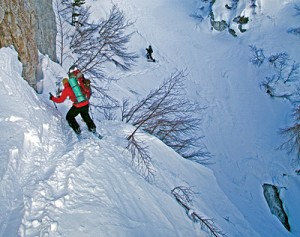
Day three dawned clear and bright so we decided to climb an improbable line right above camp before packing up to head out. The line held multiple rock bands requiring near vertical climbing on the way up and mandatory airs on the way down. Busting climbing moves using ice axes and crampons was nothing new to Jones (shown here), but it was a different story for Rahlves. He had never climbed anything even remotely as technical. Watching him hammer home his first ever ice axe placements was a trip highlight as you could tell he was in awe of the power of the axe, and the potential of the tool for accessing rowdy terrain.
Once again our climbing effort paid us back a hundred fold. The views of the Sierra crest added countless lines to our to-do list and the turns on the way down were tremendous. We ripped pow, wind buff and sun softened cream to within 200 yards of our tents. Packing up to head down to the cars, Rahlves was already fired up for the next backcountry mission. “We’ve climbed and skied way more gnarly stuff than I imagined,” said Rahlves. “The trip has definitely exceeded my expectations. Where are we going next?” Three long days of climbing, two cold nights in a tent, and Rahlves was ready for more. So much for sandbagging an Olympian. This rarefied rookie had led the charge, and opened his eyes to a whole new world of skiing in the backcountry.
Nov/090
Rocker 101

Photo by Clark Fyans

Photo by Clark Fyans
The Lowdown on Reverse Camber and Rockered Skis and Snowboards
By Seth Lightcap
Rocker. Camber. Zero Camber. Reverse Camber. Shovel Rocker. Banana Tech. C2 Power Banana. V-Rocker. S-Rocker. P-Rocker … Whoa!
As if the camber vs. reverse camber debate in the ski and snowboard world wasn’t confusing enough a few years ago, you’re likely to find your head spinning like an out of balance washing machine looking at the racks of new boards this season.
Every ski and snowboard company on the market has a reverse camber board model to offer this winter. While traditional cambered boards are definitely not dead, the rocker revolution (rocker = reverse camber) is undoubtedly here to stay, and rightfully so. There is a time and snowy place when a little rocker underfoot would probably do your riding abilities some good.
Are you a beginner or intermediate rider who still catches your edges now and again? Do you lust to ski powder, powder, and only powder? Do you spend a majority of your day in the terrain park jibbing and bonking?
If you answered yes to any of these questions the soft, catch-free feel of rocker flex could be a serious advantage for you. Actually, rocker can offer a noticeable advantage to just about anyone, aside from serious all-mountain bulldogs and racers. In aggressive situations like racing or technical hard pack the edge grip of camber will still be unmatched; reverse camber boards aren’t tensioned to grab the snow and hold a railing edge.
To help you decipher the techno babble and decide if a reverse camber ski or snowboard might be suited to your riding style, I’ve broken down the common rocker flex patterns for both skis and boards into a handful of general categories. This framework won’t cover every technological nuance of the dozens of rocker designs out there, but should hopefully keep your head on straight when you roll into a shop and the sales sharks start circling.

Moment Comi

Moment Comi
SNOWBOARDS
Rocker Between the Feet:
Snowboards with rocker between the feet are characterized by a reverse camber flex point between the bindings from which the tip and tail shoot out dead flat. By making the board softer as you flex the tip or tail it keeps the tips from hanging up, improving turn initiation and providing for catch-free jibbing. These boards are perfect for pow and park riding, but handle pretty darn good on hardpack too as the tips make contact with the snow when riding flat. Snowboard models with rocker between the feet include Lib Tech’s Skate Banana, Gnu’s Park Pickle, and Burton’s Joystick.
Rocker Outside the Feet:
Snowboards with rocker outside the bindings have a dead flat base between the feet and a tip and tail that kick up. The lifted tip and tail decrease the contact length of the edges giving the boards a free spirit. These boards ride shorter than they look. With little edge to release, these rocker designs are the favorite of jibbers looking for an advantage when buttering boxes and rails. The turned up tip can improve powder performance as well, but the dead flat base and short length won’t do you any favors racing down hardpack. Snowboard models with rocker outside the feet include Burton’s Dominant and Ride’s DH2.
Hybrid Rocker/Camber:
This is where it gets tricky. Hybrid rocker/camber boards have camber under each foot but rocker between the feet and at both tips. The theory is that the camber points underneath your bindings help bring back the snappy feel of a cambered board on hardpack while the lifted tips and rocker underfoot keep that easy flex alive when the snow gets deep or your launching onto a terrain park feature. If you’re not quite ready for the super soft feel of a totally rockered rig these hybrid designs offer a compromise between power and playfulness. Snowboard models with hybrid rocker/camber include Lib Tech’s TRice C2BTX, Burton’s Flying V, and Never Summer’s EVO-R.
SKIS
Rockered Tips:
Skis with rockered tips are the most common reverse camber ski designs on the market. Known as early rise or shovel rocker tips, the concept keeps your ski tips floating above the pow while the traditional camber underfoot and through the tail gives you the same snappy turn initiation you’ve come to expect. These designs excel as all-around skis as they can still handle the hard pack and crud but keep your tips from catching in deep snow. The differences in models will be how much the tip is lifted and how far in front of the binding the rocker begins. Ski models with rockered tips include Moment’s Comi and the K2 Coomback.
Full Rocker:
This design is where the rocker revolution originated (Thanks Shane!). Skis with full rocker have tips and tails that bow up from a flat spot under the binding. This design is perfect for the deep pow or the terrain park as the tips are always floating above the snow or the park features. Without much edge on the snow these skis may feel a bit squirrelly on hardpack and are not the best racers – unless maybe you’re racing your buddy down KT-22 on a knee-deep day. Ski models with full rocker include the K2 Pontoon and the Moment Rocker.
Camber Underfoot, Rockered Tips and Tails:
Here we go again with the hybrid designs. Skis with rockered tips and tails but camber underfoot are built to be the best of both worlds. The camber underfoot keeps you railing on the hardpack while the rocker tips keep you floating on those dream days. The amount of rocker in both the tip and tail will vary with most designs offering more lift in the tip than the tail. This concept seems to be winning over most professional freeskiers so look out for many, many more models with this hybrid design in the future. Ski models with camber underfoot and rockered tips include the K2 ObSETHed, the Rossignol S7, the Salomon Czar, and the 4FRNT CRJ.
Oct/092
Pumpin’: An Introduction to the World of Pump Tracks
By Seth Lightcap
“Pumptracks are the new horseshoes.” –Mark Weir, WTB pro mountain bike racer

Lory state park in Ft. Collins, CO features a massive pump track playground. www.leelikesbikes.com
Unless you’ve been hanging out by the bike shop water cooler, you might not have heard of the latest craze to hit the mountain bike world – the pump track.
A pump track is a small, looping trail system that you can ride continuously without pedaling. Your speed along the pump track is dependent on your ability to gain momentum by “pumping” the tight terrain transitions of the track.
Once you’ve got your “pump” mastered, the track becomes a freestyle bobsled course complete with steep-bermed corners, smooth rollers, and criss-crossing interconnected lines. Well-built pump tracks allow top riders to complete a lap in less than 30 seconds while hitting top speeds over 20 mph – without a single pedal stroke mind you.
The origins of the pump track are rooted in the hardpack BMX trails of the ‘70s and ‘80s, and recently, in the backyards of Australian downhill racers who created some of the first pump tracks around 2002. The first new era pump track on American soil was built in 2004 at The Fix Bike Shop in Boulder, CO, by pro downhiller Steve Wentz.
Rolling into 2008, pump tracks are popping up in backyards and empty lots all over the world. The word is out that pumping is not only ridiculously fun, but also extremely rewarding. Using as little as 10 x 30 feet of land, a pump track builds confidence, strength, and lightning fast bike handling skills – not to mention the social benefits. Pumpin’ can be a party!
Two of the bike industry’s leading pump track ambassadors are WTB pro racer Mark Weir and racer/journalist Lee McCormack of www.leelikesbikes.com. Both Weir and McCormack were introduced to pump tracks at The Fix, but have since constructed two of the world’s finest pump tracks in their respective backyards.
Weir and McCormack are thrilled by the efficient genius of their sculpted lawns, as their pump tracks provide not only endless cycling fun, but also an amazing workout. Talking with ASJ they couldn’t help but expound on the virtues of pump tracks.
“The pump track is the best skills riding I have done,” said Weir. “It is super physical and builds every muscle in your body. Pumping helps you learn to use the terrain better.”
McCormack, author of a guide to building pump tracks called “Welcome to Pump Track Nation,” describes pump tracks as “xeriscape with a purpose.”
“A pump track requires less maintenance, water, and chemistry than a grass lawn,” quips McCormack. “And it’s great technique training for cycling, skiing, snowboarding, or anything like that.”
The ground level features of a typical pump track keep the stakes relatively low as you learn how to pump. Though crashing on a pump track is not uncommon, proper pump technique, including good terrain anticipation, will usually keep you upright. McCormack discusses learning to pump in his book.
“Pumping is simple,” he says. “Just absorb any surface that faces the way you’re coming from, and push into any surface that faces the way you want to go. Part of this push gets translated into forward motion and, voila, you gain speed.”
The ideal bike for a pump track is a hardtail mountain bike with front suspension. Full-suspension bikes don’t allow you to gain and maintain speed as well because the suspension sucks up your pumping effort. Weir likes his pump track bikes “stiff, with really fast tires.”
Most pump tracks link a series of rollers to steeply bermed corners that bring you back around. Once you can maintain speed through all the features you can experiment with jumping or wheelie-ing rollers or choosing a new line. Creative pump opportunities are only limited by the design of the track and your imagination.

Riders pump the ‘S’ berms at Lory State Park in Ft. Collins, CO. www.leelikesbikes.com
Building a pump track is both as easy and as hard as it looks. It’s true that the tracks are merely collections of small dirt piles, but with all the planning and shoveling it is undoubtedly hard work to create a fast pump track.
A full-sized pump track requires about a 50 x 50 foot plot of flat ground. Sloped land can work too, but you’ll have to consider the slope in your design. As with any construction project, it helps to measure twice and dig once.
McCormack agrees. “I cannot overstress the importance of planning your track,” he says in his book. “If you just start digging you WILL dig yourself into a corner, and you’ll end up making compromises – or starting over. No fun!”
Deciding where to put a roller or berm doesn’t have to obey a blueprint, however. Certain distances between features are known to pump best, but ultimately, the quirks of the land and the vision of those building it will decide the ideal layout. Weir’s track started with no plans and has metamorphosed into a community masterpiece.
“The perfect pump track for me is my own,” Weir said. “It was something that my friends and I built with our own vision … The pump track represents way more than just a place to ride. It is a place that builds friendships and produces creativity.”
Dubbed the Peacock Pit, the pump track in Weir’s Novato backyard has become the Nor Cal poster image for the beauty of social pump track riding. After hosting several “pump” parties where friends, neighbors, and even strangers came to ride his track, Weir and other Novato residents, including project coordinator Sam Neff, sparked a movement to build a public pump track in a local park. Plans for the Novato track are rolling smoothly through the recreation committees, so hopefully this summer the track will be built. Neighboring Mill Valley also has a pump track project in the works, while Folsom has already opened a bike skills park that includes pump-track style features.
No matter whether you’re a North Shore huckster, a single-speed snob, or even a crazy cross racer, spending some quality time pumping on a pump track will surely improve your cycling skills. Biking without pedaling may sound strange, but according to McCormack, that’s the point. “A pump track is a laboratory, it’s non-threatening, and so different from normal riding that it allows you to ride your bike with an entirely new mindset.”
So if you haven’t heard of a pump track near you, keep asking around, or better yet, get digging. You are but a shovel blister away from a chronic case of pump track hysteria.
Check out www.leelikesbikes.com for further info on pump tracks and to order McCormack’s pump track builder’s guide, Welcome to Pump Track Nation.
Oct/090
Crucial Beta: The Climber’s Guidebook

By Seth Lightcap
Marty Lewis on Wounded Knee. Photo by Kevin Calder.
In the adventurous world of rock climbing sometimes knowledge is half the battle. Whether you’re an aspiring climber or a seasoned wall rat, having prior knowledge about the details and difficulties of a climbing route can be a vital first step to a successful ascent. Commonly known in climbing lingo as “beta,” such route information can have life and death consequences.
Most climbers are all ears for route beta. Getting lost on the wall or missing a critical protection point can be scary at best and dangerous at worst. Anyone who has ever been lost on a big climb knows the value of pitch-by-pitch information. Also, anyone who has ever gotten lost while trying to descend from a big climb knows the value of detailed information.
For example, the North Dome Gully descent from Washington’s Column in Yosemite Valley sees several rescues a year and has been the scene of a dozen or so tragic deaths. The reason for this is simple—the North Dome Gully descent route is circuitous and confusing and the consequences for getting lost are high. Climbers who turn south too early after initially traveling east can find themselves marooned in a “lost world” of loose, sandy ledges separated by 100 foot cliffs. From here trying to rappel to the valley floor can have fatal consequences as the cliffs get larger and the ledges get smaller and more slippery. Eventually hapless victims end up dangling in space, trying not to rappel off the end of their ropes. Typically this is when they start screaming for a rescue until a random tourist hears them while hiking at the base and relays the message to Search and Rescue.
The way to avoid such scenarios starts with having a good guidebook to the climbing area you are visiting. Guidebooks have improved greatly over the past 20 years, and have made multi-pitch climbing much safer for those who choose to take full advantage of the ascent and descent beta. For example, the 1987 Yosemite guidebook, Yosemite Climbs by George Meyers and Don Reid, offered this for climbers wanting to research the North Dome Gully descent: “Routes that end atop Washington Column necessitate a familiarity with North Dome Gully. The descent down North Dome Gully is the scene of frequent accidents. The trail from the top of the column traverses east all the way to the forested gully and completely above the death slabs. Don’t descend too early; if in doubt and contemplating rappels, keep traversing.”
This sort of brief description was fine for those seeking maximum adventure, but accident statistics show that too many climbers were unclear on just how to get down from Washington’s Column safely.
In contrast, the newest guidebook to the area is much more detailed. Yosemite Big Walls (2nd edition, 2005, SuperTopo) has a full page of point-to-point directions plus an aerial photograph, making the journey down the harrowing North Dome Gully much less ambiguous, and therefore much safer. For those wishing to return home safely after climbing, the current guidebook is as important as any piece of climbing equipment they carry, including their rope.
With all the world-class climbing areas in California, it is fitting that we are also blessed with some of the world’s best guidebooks. Popular areas like Yosemite and the Owens River Gorge demand stellar guidebooks – and the available masterpieces do not disappoint. Two men are largely responsible for the most current and definitive guidebooks to Yosemite and the Gorge: Chris McNamara (SuperTopo Publishing) and Marty Lewis (Maximus Press).
McNamara and Lewis are lifetime climbers who have turned a passion for climbing into businesses built on providing accurate beta to others. Purposefully written with truth, humor, and a climber’s eye, their guidebooks are invaluable references for the climbing community. Despite these common traits, Maximus Press and SuperTopo guidebooks have two very distinct personalities.
“I have lived in the Eastern Sierra for 29 years,” says Lewis. “I always loved climbing guides, so when I started climbing in the Owens River Gorge it felt natural to try to keep track of what climbers were doing, as there was no book.”
Lewis diligently chronicled all the new routes put up in the Owen’s River Gorge, founded Maximus Press and published a pamphlet style first edition guidebook in 1990. He has now gone on to author four books, including 10 editions of the Owen’s River Gorge guide. Emphasizing comprehensive regional information, Lewis’ guides are incredibly thorough resources. “Ninety percent of all routes in an area make the book. Only the most obscure, hard to find, or poor quality routes are omitted,” he says.
McNamara founded SuperTopo in 1999 while still in college at UC Berkeley. Already one of Yosemite’s finest aid climbers, he was frustrated with the lack of up-to-date and thorough information available for popular Sierra routes. In response, he pioneered a new guidebook style that focuses on the complete picture behind only the classic climbs. His first SuperTopo guidebook, “Yosemite Big Walls,” was a huge hit with the big-wall crowd because the guidebook took a more detailed approach to helping climbers ascend multi-day routes on El Capitan and Half Dome without getting into trouble. He has since authored five guidebooks and published other authors through SuperTopo, from Alaska to Nevada.
“The SuperTopo approach is select,” says McNamara. “We feature the best routes and get the information for those climbs by having locals climb every route that is in the book. We emphasize depth of route info and quality control.”
SuperTopo guides highlight the classic routes at epic destinations. Places where there is not enough daylight nor lifetimes to climb everything in sight. In an area as immense as Yosemite, the SuperTopo guide makes finding the best route for your abilities substantially easier.
Supertopo.com is also a thriving website whose online forum contributes to quality control. “The Supertopo web site really helps because climbers comment on the route info and make corrections,” McNamara says. “When we make second editions it is a great source of feedback.”
Respective to their chosen climbing areas, both Lewis’ comprehensive approach and McNamara’s select approach are very effective. Maximus Press covers regions of the Sierra that are littered with small crags and major formations. Listing every route allows visiting climbers and locals alike to make the most of a limited climbing spot. The common elements the two publishers share are a dedication to accuracy and an articulate grasp on the pulse of the local climbing community.
“The first step in producing a new guidebook is to find someone who loves the area, go climbing, and then find the best local pizza and beer,” says McNamara. On the other hand, he agrees that details like route length and the number of anchor bolts per pitch don’t just appear in the foam of a frosty mug.
Both authors frequently fact-check by climbing the route personally. “For most routes one lap is usually sufficient, but I have done some routes 30 times,” Lewis says. “I’m always thinking about these laps when I’m revising the books.”
The most important beta in a guidebook are the “topo” drawings (short for “topographical”). Topos are line drawings designed to reflect the exact nature of the route. They detail the division of optimal pitches, possible variations, and most importantly, describe subtle rock features that define the route. Climbers routinely bring topos with them on long climbs.
Translating pocketed rock faces and sweeping granite arches into these two-dimensional topo drawings is a major part of the technical work of creating a guidebook. “A topo starts as a hand drawn map,” McNamara explains. “The maps are then traced into Adobe Illustrator for cleanup and fine tuning.”
Once a rough draft of a topo is assembled both authors go back to step one – the locals. “I like to make PDF sample pages of tentative content and get as much local feedback as possible,” says Lewis.
Climbing all the routes in a guide book may sound like amazing hands-on work, but organizing and compiling the details about all those routes is the crux of the production process. “Producing a guidebook is so much work!” McNamara emphasizes. “There are literally thousands of little pieces of information to collect and format: photos, text, line drawings, topos…”
Maximus Press and Supertopo are both known for their clean design, impeccable formatting, and durable construction. Unlike a novel you might read twice, your favorite guidebook may be flipped open a hundred times a week. Binding construction is critical. “Because of the abuse climbing guides receive they just fall apart when the pages are glued together,” Lewis says. Maximus uses a sewn binding. “There are actually little sewn-in threads and glue holding the book together. This type of binding costs a lot more, but is indestructible.”
Aside from spot-on beta and bomber durability, a great guidebook must also inspire climbers to get out there and climb. Breathtaking photos are one of the prime motivators. Images grace all the guidebooks as pictures express difficulty and rock quality in a way that text and drawings simply cannot.
First ascent histories and stories of the climbing pioneers are also rewarding anecdotes included in most guidebooks. SuperTopo specializes in presenting such route history.
“The climbing experience is enhanced by hearing the rich history of first ascents,” says McNamara. “When you read about a first ascent done with minimal equipment in epic conditions by one of your heroes like John Muir or Yvon Chouinard, the climb takes on a whole new light. The climb becomes an experience of walking in the footsteps of a legend.”
No matter what style of rock climbing you enjoy, the benefit of a precise and polished guidebook cannot be overstated. Whether you are visiting a new area or pushing your limits at a favorite crag, being in tune with the best routes, the quickest approaches, and the safest descents will help you climb more and wander less. If you’re climbing with an outdated guidebook, check out the new edition. You’ll surely discover a new route or possibly even a whole new area.
For further information about guidebooks from Maximus Press and SuperTopo, visit them online at www.maximuspress.com and www.supertopo.com.
Oct/092
The Highs and Lows of Slacklining

Story by Seth Lightcap • Photos by Kevin Walker
Shawn Snyder, Indian Cave Corridor, Joshua tree
Slacklining, the art of walking along one-inch wide nylon webbing, is a new school variation of circus style tight-rope walking. Born along chain link fences in Yosemite Valley, the sport of slacklining has become a recreational phenomenon enjoyed worldwide, from the beaches to the highest alpine spires.
A slackline gets its name because although the line is tensioned very tightly between two anchor points, it is not rigidly taut due to the dynamic nature of the nylon webbing. As you walk out on the line the webbing stretches underfoot and hence it feels “slack” compared to a rigid tightrope cable that does not stretch. The squirrelly and seemingly unpredictable movement of the line is what makes slacklining the ultimate balance challenge. Your entire mind, body, and soul are needed just to stay blanaced, let alone walk
the line.
The average slackline is set up between trees or posts at a beach or park and ranges from 15 to 100 feet in length. The tension of the line varies based on your equipment and desire. A tight line is easier to walk, but the rubbery bounce of a slightly looser line can be rewarding. There is always a great deal of energy in the line so getting aggressively bucked off is not uncommon. To avoid injury, most slacklines are set up within a few feet of the ground.
While rope walking has been around for thousands of years, the familiar art of slacklining along a taut length of tubular nylon webbing was invented in the early 1980s by two Yosemite rock climbers, Adam Grosowsky and Jeff Ellington. The pair picked up on the idea after walking along loose chain fences on rainy days in the Valley. Hooked on the challenge, they strung up old climbing webbing between trees around their campsites at Camp 4, the traditional campground for Yosemite climbers for over 40 years. Voila! The slackline was born.
In the summer of 1983, Adam and Jeff’s slackline antics started to draw the attention of other Yosemite climbers. Their attempt at walking on a steel cable across the gap between the Valley rim and Lost Arrow Spire, a 2900-foot deep chasm that’s 55 feet across, was especially impressive. Several more climbers began slacklining that summer, but only a select few really developed a passion for it. One of the most inspired was a young climber named Scott Balcom.
Returning to Southern California that fall, Scott and a few friends started practicing religiously and experimented with different types of slacklines. Soon Scott’s skills were dialed and he began focusing on the goal inherited from Adam and Jeff – to walk across the Lost Arrow Spire gap. For practice, Scott’s crew set up a 22-foot slackline underneath a highway that spanned an 80-foot drop. Using doubled lines for added strength, and harnesses and a tether to escape from would-be fatal falls, this “highline” was a first of its kind.
In 1984, Scott returned to Yosemite set on conquering the Lost Arrow chasm. Skilled but unable to escape his fear, the exposure proved too daunting and Scott was unsuccessful. Throughout the next year Scott trained both harder and smarter, focusing on visualization and distance perception. The training paid off and that next summer, in July of 1985, Scott became the first person to walk the gap from Lost Arrow Spire to the Valley rim.
Scott’s achievement stands proud to this day. Still the most coveted accomplishment in the world of slacklining, the Lost Arrow highline was not walked again until 1993 when Darrin Carter successfully crossed the span. Darrin would later up the ante even further by not only crossing the span in both directions, but also by crossing without a safety tether!
Though Adam, Jeff, Scott and Darrin were the pioneers, it was not until well-known rock climber Dean Potter stepped on the Lost Arrow highline that slacklining was seen in the public eye. Pictures of Dean slacklining in Patagonia ads introduced the sport to the masses and inspired the next generation of slackliners such as Shawn Synder, Corbin Usinger, and Damian Cooksey.
In today’s world of slacklining, the discipline has evolved two distinct specialities – lowlining and highlining. Lowlining is the style that a majority of slackliners enjoy because it can be practiced anywhere you can find two anchors and requires a lot less equipment. With little consequence for falling, lowlines also afford the freedom to attempt tricks on the line. The progression of lowline stunts is much like that of a gymnast on a balance beam – beginners work on moving smoothly through direction changes while the very best in the world execute front and back flips (taking off and landing on the line). Freestyle slackline competitions are even popping up where competitors perform a routine for judges.
On a highline, overcoming your fear to just walk the span is the goal. Highlines are significantly more dangerous as swinging falls can careen you back into the rock and the rigging of the line must be incredibly strong to withstand a fall midline. The exposure on a highline is immense and only those who can focus beyond their trivial fears will be successful. Despite the danger, the world’s best slackliners and rock climbers continue to push the boundaries of balance by walking highlines as long as 200 feet.
Slacklining is a graceful form of moving meditation and many regard its benefits to be Zen like. “Walking the slackline makes you look within,” notes accomplished highliner Shawn Synder. “Everytime I walk a highline it’s almost like a beautiful enlightenment … an experience that opens your eyes, softens your heart, and quiets you a little bit.”
Though rock climbers have been the foremost proponents of slacklining, walking the line can be fantastic training for any sport requiring balance. Professional surfers, snowboarders, and cyclists have taken up slackline training as a means of improving core strength and mental resolve. Walking the quivering line mimics riding through uneven terrain and improves your ability to control your center of gravity and stick to your path no matter the obstacle.
Whether you’re an aspiring surfer, climber, or Cirque de Soleil performer, learning to walk on a slackline will undoubtedly improve your performance. Part sport, part meditation, slacklining requires focus and commitment. Look for a slackline in a neighborhood near you or learn how to make one. Better balance is just a couple of wobbly steps away!
Oct/091
Just Riding Along Crash Testing in the Cycling Industry
by Seth Lightcap

ODGee testing the flight controls.
Photo: www.olivierguincetre.com
Imagine this:
You’re blazing down a favorite trail on a new full-suspension mountain bike. Your brakes are buttery smooth, your suspension is dialed. The rocky trail melts under your wheels. Feathering the brakes you prepare to hit a small jump that drops off into a creek. The line for the jump is tattooed on your brain. You stand up on the pedals and pull up slightly as you hit the lip.
Whoa! The lip has more pop than expected. Someone manicured the takeoff. You’re floating balanced, but way over the front wheel. You aren’t worried yet. After all, your hard-earned dollars bought you a beefy suspension fork. You prepare for the blow of a nosedive landing.
The front wheel hits. Suspension fork bottoms out: Crack! Your virgin bike frame buckles directly behind the fork on the down tube. The front wheel folds left. You torpedo over the bars like a lawn dart. You’re headed for a rocky kiss. Your helmet is on, but is your chin-strap tight?
Is such a nightmare possible? Could a bike frame really just crumple landing a jump? Riding your average cruiser frame—absolutely. But if you were riding a frame built for such abuse? Not likely.
An airborne mountain biker amounts to a tremendous ball of energy. When a sudden impact redirects that energy into a rigid object like your frame or your helmet, there is a finite amount of force it will withstand before giving way. Cross that threshold and products will fail.
Whether it’s a bike or a baby crib, manufacturers are responsible for determining when a product will routinely fail. Once a product’s limitations are known, the company may label the product with explicit recommendations as to its intended use. If a product shows that it is prone to failing when used as intended it may be recalled. But if a failure occurs during improper operation, it is the responsibility of the user.

ODGee up the wall. www.olivierguincetre.com
In most cases, manufacturers must meet certain testing standards for products before they are deemed acceptable for sale. Depending on the product, standards may be voluntary or government mandated. Where public safety is a concern, standards are mandatory and governed by the Consumer Product Safety Commission. Voluntary standards are usually created by private organizations concerned about efficiency, compatibility, and safety.
The bicycle industry is regulated by both voluntary and mandatory standards. Basic frame strength standards are mandatory but most manufacturers surpass these. Bicycle helmet standards are mandatory, having been signed into law by Congress.
When developing new bike products designers must first assemble prototypes. As a design evolves, each successive version must be tested to meet the standards. Many cycling companies invest substantial resources into developing in-house testing facilities. Two California cycling companies known for their extensive test laboratories are Bell Sports and Santa Cruz Bicycles.
Bell is an industry leader in the manufacture of helmets. Starting with auto racing, Bell has gone on to produce helmets for just about every sport. With its purchase of Giro helmets in 1996, Bell Sports adopted a home in Santa Cruz and added the industry-leading designs of Giro to its own line of bike helmets. The merger also made possible a cutting-edge testing facility.
Santa Cruz Bicycles is an independent bike manufacturer that has helped pioneer the art of full suspension. Their frames are coveted worldwide for their superior ride and durability. Dedicated to producing only frames that meet strict self-imposed standards, Santa Cruz has created a custom test facility to assure that new frame designs meet their lofty standards.
Let’s take a peek behind the dead-bolted test lab doors of these two companies.

Tighten your chin strap!
Photo: Seth Lightcap
Bell Sports
A man of many helmets, I had a stack of questions when I arrived at Bell. Glimpsing the historical helmet display in the lobby, it seemed promising that I would leave with some answers. My docent was Bell’s Test Lab Manager, Brian Sidwell. Brian has run the test lab for several years and is an industry authority on testing methods and standards.
“What can I expect from my helmet?” I inquired before he even opened the test lab doors. “Will I walk away smiling from a massive head blow if my helmet hits first?”
“It’s not quite so simple,” he replied.
“The responsibility of a helmet is to provide an environment that will decrease the force of acceleration on the brain upon impact. The force of your brain slamming against your skull is what causes brain damage. Your safety will depend on how hard you hit.”
Certain variables not withstanding, a helmet that meets mandatory standards should protect you when the intensity of the collision is equal to or less than the test threshold.
“So what’s the test?” I asked as Brian led me into the lab.
Towering test machines were arranged to one side while helmets of every design were organized in surrounding racks. Brian loaded up for an impact test. A helmet weighted down with a head form was suspended two meters above a blunt steel anvil. With the flick of a switch, the helmet plummeted and struck the anvil, landing dead on its temple.
The blow barely fractured the hard plastic coating and left but a 1/8 inch depression in the helmet. Glancing at the monitor, Brian verified that the helmet had passed the standard.
I was impressed. You never know how hard your head will hit in a crash but the anvil blow looked rough. Witnessing the helmet survive with only minor damage, made one thing obvious Å0å2 a helmet can save your life.
But to be most effective, it’s imperative that the helmet fit properly, Brian stressed. A helmet should be comfortably snug. The ear adjustments should be just under your earlobes and your chin strap should be snug against your chin.
In the next test a helmet was strapped on a fake head. A weighted bar was then suspended from the back of the helmet. To meet the standard the helmet must stay on after the weight is dropped. As the bar fell, the helmet winced slightly but barely shifted.
I thought about how I flip my helmet back and scratch my head without undoing the chin strap. Would my helmet pass this test? Not how I’ve been wearing it. After countless bike rides, skate sessions and snowboard descents, I realized how foolish I had been parading around with a loose chin strap.
Blam! Another helmet hit the anvil.
“Every sport seems to have its own specific helmet,” I said to Brian. “Am I compromising my safety by mismatching a helmet with a sport it wasn’t intended for?”
“Not necessarily,” he replied. “The main difference between helmets is the amount of head coverage and the number and type of impacts they are rated for. A helmet can be worn in multiple activities, but if the accident is abnormal to the sport the helmet was designed for it may not perform adequately.”
I recalled how I had once lent a friend my rock climbing helmet for snowboarding. Obviously, my climbing helmet was not intended for the high-speed impacts of snowboarding. Nonetheless, it was still better than no helmet at all.
Finishing up the tour, I thanked Brian and the crew and headed out. Arriving home I remembered what I needed to do right away: Tighten the chin straps on all my helmets!

How would your body feel after 300,000 bad landings? Photo: Seth Lightcap
Santa Cruz Bicycles
Have you been mountain biking recently? If not, you may be surprised at the terrain even occasional riders attempt to negotiate. Singletrack trails aren’t just rocky hardpack anymore. On new trails you may ride off a four-foot log drop or launch a six-foot gap jump. It’s all part of the fun as confident riders trust that the bikes can handle such big hits.
The current crop of high-end trail bikes are the most forgiving and maneuverable ever produced. Engineers like those at Santa Cruz have spent more than a decade tweaking suspension and frame designs so that the bike doesn’t spit you off when you barrel into a garden of boulders. Your ability to keep control through massive bumps is due to the suspension absorbing the energy that’s created when your wheels spontaneously change position over an obstacle.
A bike frame with rear suspension is designed so that the metal tubes rigidly resist flexing while the shock absorbs all that it can handle. But like a boxer, metal will start to fatigue after repeated hits. When the metal components on a bike frame reach their fatigue limit they will crack or bend.
The test lab at Santa Cruz is dedicated to researching the fatigue limits of frame designs. Durability is incredibly important to Santa Cruz because they tune the ride quality to handle the roughest terrain around. Great handling means nothing if the frame cracks after a hundred bad landings. A hardcore rider expects a bike to suck up around half a million landings!
The first time I saw the test machines at Santa Cruz I was a little confused as to how a few clamps and hoses could simulate years of rider abuse in a single day. But the pile of broken frames in the corner had clearly been worked.
To better understand the torture tactics I talked with the designer of the machines, Eric Lindsley. He explained that the machines use hydraulic pistons to simulate the forces that an aggressive rider on tough terrain applies to a bike. One simulates standing and cranking hard on the pedals while another mimics landing a big jump. Programmed to apply the force of such landings in repeated succession, the bike absorbs the equivalent of a year’s worth of hard riding in a couple hours.
New designs also undergo tests designed to mimic catastrophic accidents. One of these is the JRA test, short for “just riding along.” The JRA test simulates running into a brick wall at faster and faster speeds. By compressing a hydraulic piston attached to the wheel mounts the frame comes under increasing stress. The test is over when a tube buckles or a weld cracks.
There are mandatory standards for frame strength but those standards are so low even toy-store bikes pass. The standards that Santa Cruz adheres to are purely self imposed. Rider owned and operated, they refuse to sell a bike they wouldn’t ride themselves.
Hanging throughout the test lab there are frames of every model with the number of test repetitions it took to crush them written on the tubes. Compiling all this information in a database, the engineers are able to compare frame strengths by model and judge new prototypes against proven successes. When a prototype fails prematurely they revisit the design and examine how to strengthen the area that failed.
The next time you are “just riding along” consider the forces pounding away on your frame. Don’t dwell on the image of your bike frame folding like origami, though. Frames rarely break catastrophically. But if you are still nervous about your old bike, buy a new one.
Oct/092
FYI: Help! Poison oak is everywhere. How do I avoid it?
Text & Photos by Seth Lightcap
Whoa Tiger! Watch where you step! Poison oak is rampant this year. But you can’t stop running, hiking or biking. How do you avoid it?
The first step in avoidance is proper identification. Poison oak can grow as a green plant, a dense thicket, or a crawling vine. Despite plant size the leaves are always clustered in a group of three. Usually the individual leaves resemble a small mitten with a wavy contour on one side that outlines a thumb.
In the spring and summer the leaves are green and waxy. As the summer dries up the leaves may turn a vibrant crimson. Poison oak thrives in shady damp locations but can survive in hot exposed areas. It is a hardy competitor and will quickly reestablish disturbed ground such as the sides of trails and campsites.
Poison oak’s toxic ingredient is the resinous oil called urushiol (“oo-roo-she-ol”). When urushiol contacts your skin it begins to bond with your skin cells. An allergic reaction occurs as your body recognizes the bound cells as toxins and sends out a cutthroat battalion of killer cells that destroy the urushiol and all the surrounding tissue. The rash and oozing blisters are the aftermath of your immune system’s overzealous warpath.
Allergic reactions happen when your body recognizes a substance it has previously deemed toxic. Ninety percent of people are allergic to urushiol with significant exposure. If you have been exposed but never got the itch, it’s likely that with the next exposure you will. That first exposure alerted your immune system and now it’s on the look out.
In most cases people who contact poison oak do not notice when it occurs. Maybe they casually stepped off trail to fix a bike. Maybe they petted a dog that had trampled through it.
Get in the habit of suspecting that every plant on trail could be poison oak. In time your knee-jerk reaction to avoid touching any plants will protect you from incidental contact. Direct contact is necessary to release the urushiol. However, beware when burning or trimming brush as the oil can be released into the air.
On overgrown trails exposure may be unavoidable. The only way to avoid a nasty reaction is to immediately clean all exposed skin, clothing and equipment. When quickly washed away the urushiol does not have time to bond with your skin. Urushiol can remain potent for up to five years. Letting those bike gloves sit for two weeks won’t help.
Luckily several cleansers are available that help wash away unbound urushiol. Tecnu is one popular brand. The petroleum-based product works like an organic paint stripper and binds to the urushiol before it bonds with your skin. Apply Tecnu while still dry and then rinse thoroughly with cold running water. Do not rinse with hot water as the heat opens your pores and lets in the urushiol.
When washing without a special cleanser imagine having to remove a sticky pine sap. Regular soap won’t cut it. Try acetone, alcohol, or a waterless hand degreaser like Goop. Clothing can be washed on a standard heavy rinse cycle as the agitation and abrasive soaps will remove the urushiol.
Most people develop a rash about 3 to 5 days after exposure. If the itchy rash appears keep the area clean and immediately consider where you were exposed. You may be continually infecting yourself using something still contaminated. The rash may blister and weep fluid. This fluid is not contagious.
It will take two to three weeks for the rash to heal. If the itch is unbearable try a new product called Zanfel. It works to remove bound urushiol and usually eliminates the itch. If symptoms are severe or spreading dramatically go see a doctor. Urushiol may be traveling within your blood stream. This is called a systemic reaction and you’ll need treatment with steroids.
Don’t be foolish. Stay away from poison oak even if you think you’re immune. Learn how to identify the plant and train your gaze to scan terrain before you step. Only then can you rest easy that your woodsy escapade won’t ooze back to haunt you in the days to come.
Oct/091
Technique Clinic: Winter Camping
by Michael Lanza

Photo: Seth Lightcap
The campsite is the focus of much of the joy of camping in the backcountry in winter. With a snow-covered ground, we have many morepotential campsites from which to choose and an opportunity for tremendous creativity in constructing our temporary living quarters. With a little skill and luck, we can enjoy an evening of rarely matched quiet and solitude and a soul-stirring view of wilderness cloaked in white. On winter’s long nights, the campsite is where we spend much of our waking time relaxing with companions, eating (and eating, and eating), and engaging in the age-old form of communication too often absent from our lives back in civilization: conversation.
Take the time to find a good campsite in winter. Given the long nights, you’ll spend many hours there, and a poorly sited camp can be uncomfortable, whereas a well-chosen site may produce the most lasting memories of the trip.
The Perfect Spot
In many respects, finding the “perfect campsite” is easier with the ground covered with snow than it is in summer: No searching for a flat spot—you can level sloping snow. No hidden rocks and roots under your pad—they’re buried. No worrying about locating near a water source—the snow all around is your water source.
That said, these are things to avoid in choosing your camp
- For starters, be aware of and respect all backcountry camping regulations, and know how to recognize and avoid avalanche hazard in the mountains.
- If you like the view from an exposed ridge or mountaintop, be sure
you’re confident of a calm night, because those spots tend to get buffeted by strong winds that can damage your tent or keep you awake all night. - Whenever possible, pitch your tent out of the wind, or with its lower end pointing into the wind and the door away from the wind. Sometimes it’s possible to camp on the lee side of a broad ridge without getting
onto a slope that could possibly avalanche and enjoy a nice view without getting hammered by wind. - Avoid the lowest ground in the area, such as a valley bottom—the coldest air will settle there overnight. Atop a knoll protected by trees is best.
- Consider your campsite in the context of a storm: Will you be able to leave safely if a lot of snow fell overnight and slopes at certain angles and aspects suddenly became prone to avalanche?If there’s any concern about animals raiding your food, identifying a proper spot for overnight food storage (such as a tree with a good branch for bear-bagging) should be a priority in selecting your campsite.

Illustration 10-1. The complete winter campsite features a firm platform stomped into the snow; a path stomped to the “bathroom”; a cooking area protected from the wind by a snow wall; and a tent secured by guy lines, stakes and deadmen.
Making Camp
Once you’ve selected a campsite, the real work—and creativity—begins. How you set up camp will affect the rest of your time there. Think about the type of camp you want and how to make it comfortable, given your environment.
Some ideas for camping with a tent follow:
- At the outset, unless the snow underfoot is firm enough to support your
weight without postholing in, you’ll have to stomp out a snow platform. Wearing your skis or snowshoes, walk back and forth across an area big enough for your tent plus surrounding area where you want to walk in boots or booties (that is, without putting on snowshoes or skis)—usually, an area about twice the foot-print of your tent. During this time, also stomp out a path to your designated “bathroom” (usually a tree or trees nearby) and your food-storage spot, if the latter will be separate from your campsite. - In dry powder it can take an hour or more of stomping and waiting for the snow to firm up before it holds your weight without skis or snowshoes. But the snow will eventually firm up and freeze into a solid platform, unless you’re in unbonded “sugar” snow, which resembles its nickname and resists packing into snowballs or a firm platform. If that’s the case, you might want to relocate. Although sugar snow can cover a large area, sometimes getting to a spot with a different aspect, snow depth, or exposure to sun and wind will yield better snow.
- Build a snow wall on the upwind side of your tent as a windbreak or all around your tent if the wind could shift (Illustrations 10-1 and 10-2). It has to be close to the tent to be effective. If winds are severe and you cannot find a spot protected from them, dig out a tent site a couple feet down into the snow before you begin stomping a platform; this will give you more of a snow wall on all sides as a shield against the wind.
- Excavate a living room/kitchen in the snow outside your tent door that’s big enough for everyone to sit inside (depending on circumstances, this may be immediately outside your door or a short distance
away in a spot that’s either more protected or has a better view). - Immediately outside your tent door or vestibule door cut down 12 to 18 inches into the snow to create a step where you can sit to put on boots or just sit partly protected by the tent.
- Mark off in the snow the area for the living room/kitchen. Measuring about a foot in from its edges, dig down a foot or two (how deep you go depends on how hard you want to work vs. how much protection from wind you’re seeking) to create a bench around the pit’s perimeter. Then dig out the pit’s interior floor, about a foot deeper than the bench.
- Build a snow windbreak on the upwind side of the pit.
- Customize other features such as a cooking surface on the bench or rim of the living room/kitchen, including a snow windbreak for your stove, and small “cabinets” dug into the walls of the pit for storing cooking gear and—-if there’s no concern about animals—food.
- This is an excerpt from the book Winter Hiking and Camping: Managing Cold For Comfort and Safety by Michael Lanza. The book is published by The Mountaineers Books.

Illustration 10-2. When camping in strong wind, encircle your tent with a snow wall and pitch your tent with its foot facing into the prevailing wind so you can cook in the lee of your tent while lying inside, out of the wind.
Oct/090
Endless Winter: A Passion Bordering on Addiction
Story by Seth Lightcap

Photo: Steve Borge
There is a fine line between passion and addiction. Passion connotes a ravenous love, often at the edge of control. Addiction suggests a habitual fixation, usually beyond control. So then, how does one define a love so wildly passionate that your soul abandons all control and drowns in pleasure regardless of sacrifice?
Twenty four months into an ongoing quest to backcountry snowboard every month of the year, my relationship with snowy peaks, scoured ridges and epic drives demands such a cross-examination.
Floating knee-deep turns… Taking flight off cornices… Bonking powder laden trees… Surely passion!
But driving 10 hours round trip from Santa Cruz for every outing… Hiking for hours in loose talus for a 100-yard patch of sun cupped, barely edgeable snow… Addiction?
It’s just something about snow. Powder, slush, wind buff, even breakable crust. I need it. Got to have it. When? Now! Pack the boards, grab the boots, and pick me up. We’re going snowboarding. But it’s August! Fine. Bring some flip-flops for the approach.
Thankfully, I am not alone in my fiendish pursuit. As the northern hemisphere barrels headlong into winter it marks the second complete year that my equally passionate partner, Allison Lipp, and I have fulfilled our craving for an endless winter in the high peaks of the Sierra and Cascades.

Beyond Bounds Training Photo: Brian Bozack
The concept of skiing or riding year round is not a new one. A Pacific Northwest forum called Turns-All-Year.com boasts over 500 members. One skier in Colorado just celebrated his 300th consecutive month of skiing. But we don’t live in Whistler, B.C. or Leadville, Colorado.
Living on the California coast, our quest to snowboard year round has been a daunting test of backcountry strategy. The snow pack evolves so quickly that sometimes we haven’t decided where to go and the car is already packed and running. Should we go to the eastside of Mt. Shasta or hunt for snowfields on Sonora Pass? Should we guarantee success and drive to Mt. Hood? Will it all be bullet proof ice when we get there? Maybe.
In concept, our monthly ritual seems simple… find the best snow conditions possible to hike and snowboard at least 1,000 vertical feet. In the leanest of snow months, we’ll settle for riding at least ten linked turns.

Approaching Sierra gridlock on the Mist Trail, Yosemite.
Photo: Seth Lightcap
Somehow we have managed to pull it off without strangling each other in a Milpitas traffic jam or a loose talus field, but we’ve been close a few months. The sight of snow and the satisfaction of knowing you’ve
completed yet another improbable outing always reunites us.
Our fixation might seem trivial or misguided to the uninitiated masses, but those who have felt the burn and bliss of earning your turns are better able to understand why we stretch our every resource to play this game. When every adventure involves keen exploration, rugged exercise, and the adrenaline rush of backcountry snowboarding, it’s easy to get addicted.
Here’s to a hearty winter and a bountiful harvest come next summer.
Twelve Months of Snow: The Cali Reality
January
“Ski Dreams”Matterhorn Peak • Bridgeport, CA
“Ski Dreams” is a broad but steep ramp cresting the ridge just east of the summit of Matterhorn Peak. Typically tackled in two or three days, the snowfield funnels slightly and then dumps into a massive bowl ringed on all sides by spectacular towers. When filled with milky powder, a descent of “Ski Dreams” is a true wet dream.
February
“Bear Scratch”• East Shore, Lake Tahoe
The “Bear Scratch” is the name for the steep logging flumes that plummet off of Marlett Peak high above Incline Village. East shore descents require a low snow line, so tackle this one after a heaping
helping of snow at lake level. Expect steep technical lines entering the namesake chutes and moderate tree glades along nearby ridges.
March
Sugar Bowl to Squaw Valley
Here’s a fabulous warmup for a big spring tour. The recommended route meanders along the Sierra Crest from the top of Mt. Lincoln at Sugar Bowl to Shirley Canyon at Squaw. Wicked descents of Anderson Peak and Tinkers Knob highlight a moderate tour that even has two Sierra Club huts perfectly positioned along the way. Reservations required.
April
Mammoth to Yosemite Valley
April usually marks the height of the winter snow pack in the Sierra. Go Big. Cross the Sierra Crest and don’t look back. Last year, we splitboarded the John Muir Trail from Mammoth Mountain to Yosemite Valley, nearly 60 miles, with summit descents of Mt. Lyell and Cloud’s Rest. In the fall I had placed a cache at the Tuolumne Meadows ski hut and so we enjoyed a night feasting on Trader Joe’s goodies and drinking alpine-aged “Two Buck Chuck.” Following our descent of Cloud’s Rest, we rode down to snowline above Half Dome. Hiking down the Mist Trail in our snowboard boots with boards on our backs we drew looks of shocked curiosity from day hikers.
May
Fourth of July Chutes • West Shore Lake Tahoe
Unless an El Nino winter finishes with a bang, May is usually the time to harvest California’s famous Sierra corn snow. Look for the steepest patches you can find. They don’t call it “hero snow” for
nothing. Last year we checked out the Fourth of July Chutes hidden back behind Homewood. We used mountain bikes for the approach, as the access road up Blackwood Canyon was still gated at the lake but dry for a few more miles. I had heard about these chutes in an old issue of Couloir magazine which hyped them up as a place you could ride in July. They look real steep and unmistakably intimidating, but we found three of them to be rideable and wild fun.
June
Red Banks Bowl/Avalanche Gulch • Mt. Shasta
Mt. Shasta could be the greatest ski mountaineering peak in the world. Where else can you bag 7,000-foot runs in a single day! June is prime climbing season on Shasta so avoid the crowds by blasting off light fast in from the Bunny Flat parking lot. Ride gnarly rime from the summit then roll off skier’s right to the entrance of the relatively moderate Red Banks Bowl. Some 6,000 feet of sweet corn lie ahead.
July
Wintun/Hotlum • Mt. Shasta
By July the north and east sides of Mt. Shasta usually have the best snow. The Wintun/Hotlum route follows a snowfield between two crevassed glaciers. Winding up crazy tongues of evolving snow, the ascent and descent are guaranteed to be breathtaking. Time it right and you might be able to ride directly off the summit. This year we found huge sun cups that looked like frozen white caps on a wind-whipped lake. But the sun had warmed them just enough for your board to plow through fluidly. We railed through the sometimes three-foot deep wave crests. By the time we hit the last tongues of snow around 9,000 feet, our quads could barely support a turn.
August
Mt. Adams, WA
August usually marks the beginning of the true hunting season. In years past we have ridden on Lassen and Shasta, but this year we bagged Mt. Adams. Situated two hours from Portland across the Washington border, Mt. Adams holds a huge summer snowfield and several technical snow gullies. The cherry of the peak was far and away the southwest chute. From a distance it looked like a pin stripe on a black tuxedo. Even in late August, we were able to ride off the summit and down the southwest chute, a 35-degree bowling lane of soft snow, for a total descent of over 2,500 feet. The next day we were back at it, this time riding the main southern snowfield and then a crazy steep 45-degree pitch on the Crescent Glacier headwall that hung above bone-crushing talus.
September
Mt. Shasta / Mt. Hood / Sonora Pass
By September, both the Cascade and Sierra snow packs are relatively thin. But don’t dismay, there are still places to ride. Set your sights on hidden north facing snow gullies that often last all year. Start early on a warm day and scour the talus slopes looking for a rideable patch. This year we committed to Sonora Pass after hearing rumors of a 100-yard snow snake alive in a high bowl. Sadly, we got beat back to a small patch at lower elevation by hail.
October
Fresh Snow / Mt. Shasta
October is prime time to pray for snow and set out your food caches. This year, the Sierra got creamed Oct. 17th, answering our prayers and allowing fresh but thin backcountry fun around Mammoth and Donner Summit. No fresh snow in sight? Start packing for a hunt-and-peck adventure amongst blue ice on the east side of Mt. Shasta.
November
Mt. Rose, NV
By late November a thin snowpack in the Sierra should be established. In the early season, snow depth lives and dies with wind direction so hunt for “deep” pockets on the leeward side of ridges and in protected gullies. With a higher elevation than the rest of the Tahoe area, the quick descents off Mt. Rose are perfect for powder lapping.
December
Mt. Tallac • South Lake Tahoe
Mt. Tallac is one of the finest ski peaks in the Tahoe Basin. The 3,000-foot descent is an easy bag and affords magnificent views of the Desolation Wilderness and Lake Tahoe. Early season it is best to steer clear of the technical rock lines that litter the northeast face and stay in the protected trees along the ascent ridge. An early start allows for two laps totaling more than 6,000 feet.
Brian Bozack just can’t get enough – Donner Summit. Photo: DSTT
Venturing into the solitude of the backcountry is a life-affirming experience. But without the proper knowledge and training, seemingly harmless mishaps or miscalculations can spiral into life threatening situations in rapid fashion. Don’t go unprepared. Reading books, such as “Allen & Mike’s Really Cool Backcountry Ski Book” (see review in this issue) or NASTC’s “All Mountain Tactics,” provides a good background on safe backcountry travel, equipment, avalanche awareness and rescue, snow camping and survival. But nothing can replace the practical experience and skill development you get from taking courses through one of these northern California guiding and instructional programs:
Alpine Skills
International
(530) 582-9170
Started 25 years ago by Bela and Mimi Vadasz, ASI helped create the template for backcountry education in California and beyond. Based in Truckee, ASI offers a complete and lengthy menu of courses for telemark, randonee and extreme skiing; plus ski mountaineering, avalanche skills, mid-winter mountaineering and ice climbing. They also offer guided trips from the Sierra High Route to the European Haute Route, plus steep skiing camps in the Eastern Sierra and on Mt. Shasta. ASI does it all.
Mountain Adventure Seminars
(209) 753-6556
Based in low-stress Bear Valley in the central Sierra, an easy drive from the Bay Area, Mountain Adventure Seminars provides a wealth of winter adventure training. Run by guides Aaron and Kimi Johnston, MAS specializes in telemark skiing and avalanche education, plus backcountry skiing, snowboarding and snowshoeing. This winter, MAS will also offer lift-access backcountry ski and snowboard courses at Bear Valley Mountain Resort. MAS will also host the 9th Annual Bear Valley Telemark Festival, February 11-13,
which has grown to become one of the premiere free-heel celebrations in the country. Register early, as it usually sells out.
North American Ski Training Center (NASTC)
(530) 582 -4772
Based in Tahoe, NASTC is a high-performance ski school for resort and out-of-bounds skiers that offers clinics and guided trips around the world… from Squaw to Jackson Hole, Chamonix to Portillo, Chile. All NASTC
trainers are members of the Professional Ski Instructors of America (PSIA) or American Mountain Guides Association (AMGA). NASTC offers backcountry and avalanche skills training in Tahoe and elsewhere in the Sierra. Courses/trips include: Introduction to Backcountry Skiing Skills (Tahoe), Overnight Ski Mountaineering Adventure (based out of Tioga Pass Resort, Eastern Sierra); and a spring climb of Mt. Shasta.
Sierra Wilderness Seminars
(888) SWS-MTNS
SWS is one of the only companies permitted to operate year-round on both Mt. Shasta and Mount Whitney. Boasting nearly a quarter century worth of instruction in backcountry, SWS offers everything from randonee and telemark lessons to “a selection of classic ski tours through some of the finest alpine wilderness terrain in the United States.” All guides are AMGA and Wilderness Instructors and Guides Association (WIGA) certified.
Outback Adventures
(408) 551-0588
A growing Bay Area retail, rental and guiding outfit, Outback Adventures offers courses in introductory snow camping (Lassen National Park), backcountry snowriding (skiing or boarding, Lassen), and single- and multi-day mountaineering courses (Shasta or Lassen).