Feb/111
Mammoth Extends Reach

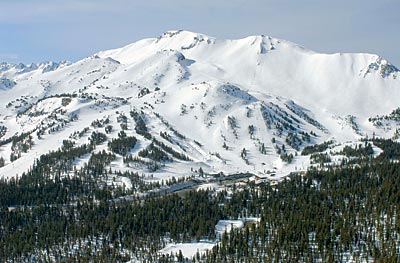
Mammoth Mountain is a massive sleeping volcano that last erupted some 50,000 years ago when it was even bigger, perhaps as high as 18,000 feet. The Main Lodge is bottom right.
With daily flight service from the Bay, Mammoth lures Nor Cal skiers to the High Sierra
By Pete Gauvin • Photos by MMSA/Peatross
It is only by virtue of geographic inconvenience that Mammoth Lakes is considered more a playground for Southern California than Northern California. If it were not for a wall of snow-caked mountains in the way — chiefly Yosemite National Park and the Ansel Adams Wilderness — Mammoth would likely be Nor Cal’s winter alternative to Tahoe.
Look at a map: Mammoth is directly east of the Bay Area, at virtually the same latitude as Hayward and San Mateo. By way of the bird, the Bay Area is closer to Mammoth than Los Angeles. If you had wings, you might care.
Without them, the drive to Mammoth in winter is more than most Nor Cal skiers want to undertake; some 6-8 hours from the Bay Area on clear roads. Plus you have to drive right by the temptations of Tahoe — and we hear there are some decent mountains to ski there, too.
Indeed, for Bay Area and other Nor Cal skiers, “Mammoth” … well, that might as well describe the drive. And so, heretofore, Mammoth has largely been left to Southern Californians, who have no significant mountain passes to cross, nothing approaching Tahoe in their path, just a few hundred miles of sagebrush-lined asphalt to channel them up the backside of the Sierra.
That’s not going to change. But with the advent of direct flights from San Francisco and San Jose this season, Bay Area skiers and boarders can now jump the topographical fence in little more than an hour and find themselves at one of the most unique, dramatic and naturally well-endowed ski mountains in North America.
Winging It
Through April 25, there is one flight daily out of SFO on United (departing 3:50 pm), and one flight out of San Jose on Horizon (12:30 pm weekdays; 3:10 weekends). (There are two daily flights from LA.)
And the cost of flying is on par with driving. Flights range from as low as $29 one way from San Jose, $59 one way from SFO. If you’re flexible, there are some tremendous weekday deals. Through February, Mammoth is offering a four-day/four-night midweek fly, ski and stay package for $99 a day from San Jose, $109 from SFO. (Check mammothmountain.com/flyskistay for details.) For comparison, a one-day adult lift ticket runs $92.
Once on the ground, it’s easy to get around without a car. It’s only an eight-mile shuttle ride from the airport to the closest lift. In town, the free Mammoth Trolley runs every 20 minutes until 2:30 in the morning.
You can grab a coffee in town at the Looney Bean and head for the mountain, enjoy a pint of Real McCoy Amber Ale from the Mammoth Brewing Company at the popular Whiskey Creek restaurant and bar, or head to the actual brewery tasting room (open daily 10-6) two blocks away for a full sampling. There’s the also the Euro-style pedestrian village at the base of the mountain with a selection of shops, bars and eateries.
Blessed by Geography
There’s the Sierra and then there’s the High Sierra. Though often used interchangeably, they are not one in the same. The true High Sierra, as noted author/guide John Moynier has pointed out, begins near the northern boundary of Yosemite and Matterhorn Peak, the northern most 12,000-foot peak in the Sierra, and extends southward 175 miles through the Whitney Zone.
Mammoth and sister resort June Mountain are the only developed ski areas in the true High Sierra, where the relief from sageland to summit is most dramatic.
Due to its geographic position and altitude, Mammoth often gets more snowfall than Tahoe resorts, an average of 32 feet annually. This season it nearly equaled that by January with an astounding 370 inches.
Sitting on the eastern flank of the range, one would guess the mountain might suffer from the rainshadow effect. But the San Joaquin River canyon funnels Pacific haymakers up to a low section in the Sierra Crest allowing moisture-laden air to cross to the east side, where it’s wrung out by the broad volcanic peak topping 11,000 feet.
The mountain, which has been snoozing since its last eruption some 50,000 years ago, is the remains of a humungous volcano that may have been as tall as 18,000 feet. Imagine, for a second, the vert we’d be talking about had it not blown its top!
Still, Mammoth more than justifies its name. The resort’s base of nearly 8,000 feet is as high as some Tahoe resorts, yet it still offers more than 3100 feet of vertical. It’s all sprawled over 3500 acres served by 28 lifts (including three gondolas) and three base areas: Canyon Lodge, Eagle Lodge and Main Lodge.
All this in a stunning Alps-like setting framed by the steepled summits of the High Sierra and long views of the Great Basin out east.
On the Mountain
Mammoth’s upper mountain is entirely above treeline and offers some of the steepest skiing in the West, including the famous Cornice Bowl. Beginner and intermediate skiing can be found all over the mountain.
The backside, close to a thousand acres and served by only two lifts, Chairs 13 and 14, is a good place to find both sunshine and powder. It features big bowls up top and well-spaced tree skiing below. Hemlock Ridge just beyond Santiago Bowl is a great place to hike for turns. After about a 400-foot vertical hike, a steep descent leads down to Chair 14.
Though not well publicized, Mammoth has an open-gate policy. The most popular expression of this is skiing off the top of the Mammoth Crest, a big palisades running right behind Mammoth Mountain toward the south, with multiple runs that all drain back to the Tamarack/Twin Lakes area, where the Tamarack Lodge and cross-country center are located. The most popular and unique out-of-bounds run is “Hole in the Wall,” a steep chute through a lava tube that forms a natural tunnel.
From Tamarack, you can catch a free shuttle bus that runs every hour on the hour back to the village and town.
If you work up an appetite but don’t want to leave the slopes, keep an eye out for Mammoth’s latest culinary creation, the Roving Mammoth, a snowcat that roams the mountain like an all-terrain taco truck, selling burritos for $5.50.
If you like your burritos with lots of corn, wait till spring. That’s when Mammoth’s ‘Great Corn Factory’ produces that buttery hero snow ripe for carving and serves it typically longer than any resort in the country. Last year, Mammoth was open until Independence Day.
June Mountain
For a change of pace, Mammoth tickets are also good at June Mountain, a hidden gem of a resort about 10 miles north on Hwy 395. There’s a shuttle roughly every hour, opening the possibility for a double day.
Overlooking the June Lake Loop, with jagged mountain peaks right behind it and views of austere Mono Lake out east, June is more of a purist’s mountain. No roaming burrito snowcats here.
Although it gets less snow than Mammoth, about 250 inches a year, June is known for its powder because it’s so uncrowded for its size. While a weekend at Mammoth can draw 20,000 people, a big day at June is 2000 people. And its acreage is still substantial, about two-thirds the size of Mammoth. It has seven lifts and 2,500 feet of vertical with a variety of terrain, including some great tree skiing.
Tamarack Cross-Country
Another great way to mix up a week of skiing at Mammoth is to stretch out the legs and lungs on the 19 miles of groomed trails at Tamarack Cross-Country in the scenic Lakes Basin. Adult day passes are $27. The ski school run by two-time Olympian Nancy Fiddler can help iron out your skating or diagonal stride imperfections. Snowshoe trails are also offered.
However you choose to wrap up a trip to Mammoth, with the new flight service there’ll be no worries about fatiguing yourself because you’re facing a long drive home. Enjoy your wings.
Oct/090
Flashback: Norman Clyde
The Sierra’s Unknown legend
By Seth Lightcap

Photo courtesy of Norman Clyde’s private collection
In the annals of wilderness exploration, being the first to succeed at a given challenge has always been one of the primary motivators of inspired adventurers. The rich buzz of knowing not a soul has passed there before you is, human history would suggest, highly addictive.
Amongst the legendary explorers of California’s High Sierra, few men can claim as many first ascents as the legendary but little known mountaineer Norman Clyde. Between 1914 and 1940, Clyde made nearly 120 first ascents while tagging close to a thousand or so Sierra summits. His bold accomplishments stem from a lifetime of physical dedication to the Sierra unmatched by any other explorer who roamed the range before or after his era.
Who was this hardy mountain cat?
Norman Clyde was born the son of an Irish clergyman in Philadelphia on April 8, 1885. Throughout his childhood, the family moved frequently as his father rarely spent more than a year serving at a church. As they traveled, Norman was schooled by his father.
When Norman was 12, the Clyde family moved outside Ottawa. Amidst the surrounding forests and streams, he got his first taste of wilderness and grew fond of hunting and fishing. Meanwhile, under his father’s tutelage, he devoured classical literature and began to read Latin and Greek.
He entered college at 18 and though he could read Ulysses in Latin, Norman’s home schooling left him behind in other subjects. Nevertheless, he completed a degree in Classical Literature.
Upon graduating, Norman began moving west in stages. He taught in North Dakota for a year, in Utah the next. After two years of teaching, he decided he needed further formal education himself, so he enrolled at the University of California in Berkeley. Little did he know that this would expose him to the mountain geography that would guide much of his life.
For the next two years, Norman continued his studies in classical literature, while spending his summers exploring wild lands and teaching at summer schools in California and Nevada. In 1913, with only a single class and a thesis left to complete before graduating, he dropped out. He balked at the need to write a literature thesis that he felt no one would read.
Such a stubborn move was characteristic of his demeanor, though not a sign of low ambition. He was still driven to educate and returned to teaching at schools in Northern California. With his free time, he explored whatever mountains were within striking distance.
With a fresh focus on peak bagging, Norman slowly began making Sierra history. In 1914, he joined the annual Sierra Club trip to Tuolumne Meadows. After the rest of the group headed back to Yosemite Valley, he continued south along the Sierra Crest with a pack train destined for Lone Pine. On this trip he made the first two of his Sierra first ascents, Electra and Parker peaks, and also summited Mt. Whitney.
For the next 10 years, Norman jumped from classroom to classroom. He taught in Mt. Shasta, near Stockton, and in San Francisco. His next recorded first ascents occurred in 1920 when he caught up with a Sierra Club expedition to the Evolution Valley. Leaving Camp Curry, several days behind the pack train, Norman lugged a 90-pound pack of supplies. Fellow hikers were in awe, for Clyde weighed only about 140 pounds himself.
Norman wasn’t concerned with his pack weight. As far as he was concerned, he carried only necessities: a shoe cobbler’s outfit, several classical books, fishing poles, iron pots, and enough canned food to survive on for weeks. He became known as, “The pack that walks like a man.”
In between teaching and his solo expeditions, Clyde married a woman from Pasadena. Tragically, only three years later she died from tuberculosis. His heart was deeply scarred.
In 1924, he landed a job that would change his life. He was appointed as principal of the high school in the Owens Valley town of Independence. Living at the doorstep of countless Eastern Sierra trailheads, Clyde’s enthusiasm for peak bagging hit a feverish pitch. When school let out on a Friday he would quickly lock up and race to the mountains. Quite possibly the Sierra’s first true “weekend warrior” climber, Clyde bagged 48 peaks his first year in Independence, half of them first ascents.
His second year as principal he was even more prolific, recording 60 peak ascents. However, not everyone in Independence thought highly of his alpine addictions. Talk circulated widely that Clyde was not an adequate role model for a school principal. He never attended weekend functions at school nor church and many people felt such responsibilities were inherent in such a prestigious position. Yet Norman fought off his critics. Although he was absent during the weekends, the youth of the Owens Valley had never been controlled so diligently during school hours.
An incident on Halloween night in 1927 changed everything. Clyde had been tipped off that some rowdy boys in town were going to vandalize the school. He waited nearby, armed with a pistol to scare them off. When the car of hoodlums burst onto school grounds, he demanded they leave. They blew him off, so he fired a warning shot in the air. When this didn’t stop them, he fired a second shot, which reportedly ricocheted and hit the car.
The kids screeched away and promptly spread the story around town that the principal had shot at them. Clyde’s local foes immediately called the sheriff demanding his arrest. The sheriff denied to press charges, but in the end Norman was forced to resign as principal.

Photo: Eastern California Museum
Between the ache of a lost love and the burn of getting deposed, Clyde was now fully disenchanted with humanity. He succumbed to his reclusive instincts and began studying the High Sierra full time.
In the summer, he would live out of high camps that he had stationed in prime locations. When he wasn’t in the backcountry by himself, he made money guiding Sierra Club climbing trips and writing magazine articles. His writings describing some of his first ascents and the natural wonders of the high country were printed in the magazine published by the Auto Club of Southern California, a precursor to AAA.
In the winter, he worked as a caretaker at mountain resorts. Finding warm residence at such famous lodges as Glacier Point in Yosemite, Glacier Lodge above Big Pine, and Giant Forest in Sequoia, allowed him to spend much time touring about on skis.
With his mountaineering skills and backcountry knowledge, Clyde was often called to join search and rescue efforts for lost hikers, wrecked airplanes, or stranded climbers. One of his most famous recovery efforts occurred in 1933 while searching for the body of a young climber, Walter Starr Jr. Days after the search had been called off, Clyde found his fallen friend high on an exposed rock ledge below Michael Minaret.
Age didn’t slow Clyde down too much. Well into his 70s, he would hike up to camps in the High Sierra. Some of his patience for humanity seemed to return with age. He would dazzle Sierra Club members with gripping tales of his early adventures.
During his last years, he retired to a ranch outside Big Pine. He continued to venture into his beloved Sierra for as long as he could muster the strength. He died in 1972 at the age of 87.
In a fitting tribute his ashes were scattered from the summit of a stunning 13,851-foot peak along the Sierra Crest in the Palisade region – a peak which he made the first ascent of in 1930. It’s now known as Norman Clyde Peak.
Oct/091
Ten Favorite High Sierra Climbs
By Doug Robinson

Short pants and sunny High Sierra granite on the East Buttress of El Capitan, with a sweeping view of the Cathedral Rocks from the belay; this is as good as it gets.
Photo: Karl Bralich
“Best Of” lists are bogus. Or at least suspect. In Jack Kerouac’s Sierra climbing novel The Dharma Bums, the Gary Snyder character puts it that “comparisons are odious.” Which is better anyway, Half Dome or El Cap? See what I mean?
Even so, as much as I revel in the uniqueness of every climb, I once found myself playing a “best of” game as I drove across the country: Find the best 5.6 climb anywhere. The Great Arch on Stone
Mountain in North Carolina had perfect rock and a tree for each belay. But pitch after pitch most of the moves were the same. Classic, but all liebacking. Last of the Good Guys on Quartz Mountain, Oklahoma, had tremendous position, snaking through a much harder headwall, with bomber bolted belays. But it was a taste harder at 5.7. Nearly home, I found it: The Tree Route on Dome Rock in the Needles of the southern Sierra. It flows from face climbing to jams to liebacking to friction. And everyone gets to make their own anchors.
Yes, the High Sierra. It’s hard not to be a chauvinist about our great weather and sparkling granite. If I’m not careful, I catch myself raving about “the finest mountain range in the world.”
It’s also hard to choose just ten climbs. Worse though, it feels downright scary to me to put out recommendations so anonymously. Sure, I know the terrain. I’ve been guiding in the Sierra for nearly 40 years. I’m constantly recommending climbs to clients and even to strangers I meet on approaches. My function as a guide, I like to say, is to make myself useless. Trouble is, those guys I can urge onward after checking their moves, watching them build anchors and test holds. Or at least ask about their relevant experience and look them in the eye.
But you there, dreaming through this list on the couch: it’s impossible to summarize the pitfalls – many of them deadly – of trad climbing in the wilderness. Just don’t forget, if you please, that humility is worth its weight in cams, and that gravity is very democratic. For a rule of thumb, if you back off two number grades from what you lead trad climbing outdoors (sport leading doesn’t count, and gym leads are totally irrelevant here), then you’re getting into the ballpark of what you might reasonably step up to on a thousand feet of unknown rock, at altitude and with occasional runouts, hidden looseness, the wind rising and clouds starting to build over your shoulder. Did I mention that your partner has turned silent and no longer feels like leading? It’s on you now. As they said in The Right Stuff: “Work the problem.”
So let’s just call this list some of my favorites. As a guide on the lookout for “teachable moments” I arranged these climbs to lead you gradually into the art of mountaineering on High Sierra peaks. I hope you enjoy the journey.
Enough. Get out. Go wild. Live your adventure.

Russell’s East Ridge.
Photo: Bob Burd
Mt. Russell East Ridge: Class 3
Let’s start on Third Class, and go right to the head of the class with Peter Croft’s favorite third class climb in the High Sierra. It is ultimately cool that this guy with the skill and huevos to make the first solo ascent of Astroman (5.11c), this guy who is simply overflowing with the sheer animal joy of moving over stone, would move on to the Sierra’s alpine zone for the next phase of an astonishing climbing career. But there he is, if we catch sight of him at all, romping over jagged peaks. Peter says this is the best third class in the Sierra, so go do it. And take a rope. Classic wit defines third class as “you can probably stroll up this with your hands in your pockets, but you’d better take a rope along just in case.” Any change in weather, darkness, or even
the attitude of your partner can make you mighty glad you did.
Matterhorn Peak, North Gully: Class 3
Still third class, but with snow. So add an ice axe to the rope. And a few runners and nuts to belay from the granite walls of the gully. And take a quick snow climbing lesson (Sierra Mountain Center in Bishop is very good). You’ll be glad you learned the hot tricks, and once you are snow-proofed the alpine zone really opens up. For a literary spin, get a copy of Jack Kerouac’s classic The Dharma Bums as your guidebook. It’s so faithful to the terrain that you can actually stumble over rocks in the terrain just where you trip onKerouac’s prose. And those “free
bhikku” alpine Buddhists of Kerouac’s “rucksack revolution” will point you to a revitalized vision of the West.

Bear Creek Spire.
Photo: Chris McNamara
Bear Creek Spire, NE
Ridge: II, 5.5
Norman Clyde soloed this first ascent back in 1932 and called it fourth class. Now it’s rated 5.5. Both are right. Classic mountaineers like Clyde were really that good. And belays on his era’s hemp ropes had their limitations. So classic fourth class has become one of those ratings with a built-in sandbag: bring a rope, a light rack (with lots of runners), your helmet and maybe even rock shoes. Clyde did. He and his buddies Jules Eichorn and Glen Dawson had special tennis shoes, fitted tight with the insoles ripped out for sensitivity. Sound familiar?
Mount Conness West Ridge: III, 5.6
Yes, I skipped Cathedral Peak. So crowded, and it was already on your list anyway. The west ridge of Conness is like two Cathedral Peaks stacked on top of each other with no traffic. Finding the rope-up is a bit confusing, so pay attention. DON’T approach it from Saddlebag Lakes: too long, too vague, and you end up climbing the peak twice for a pretty long day. DO backpack in from Tuolumne to Young Lakes (get a wilderness permit), and camp a mile beyond them toward the beautiful south face. DO linger a second night after your climb. That way you can truly savor the incredible fourth-class pitches that ride the edge of the south face, and enjoy the best views of the Cathedral Range on your hike out.

View of the Matthes Crest ridge.
Photo: Cathy Claesson
Matthes Crest Traverse
South to North: III, 5.7
As a teenager it took me three tries to finally pull off the traverse of Matthes Crest. I was proud of what a long route we had done. The climbing is not too bad on average, but at times it is wildly exposed, and there is plenty of rope handling to tangle you up. And there’s a surprising amount of route finding for a line you could summarize as, “It’s a ridge, stupid.” In particular, getting down off the fin at the very north end of the route seems to foul people up. So this is a good climb to work on staying found, hustling along, and ropehandling – in other words, all the stuff that will carry you onward to bigger alpine climbs.
Half Dome Snake Dike: III, 5.7
The best route on Half Dome is kind of scary. The crux 5.7 is fairly well protected – not wonderful, but OK. It’s the 5.4 you’ll be sweating. Several runouts go 75 feet, with no chance of extra pro. Nothing to do but suck it up and place each foot with care. The Dike shoots hundreds of feet up a smooth and crackless face that would be seriously harder but for this weathered protrusion, scooped and whorled with friction pockets that are solid enough without ever getting really positive. At times the dike is merely a foot wide. Read Steve Roper’s account on the Supertopo website of his second ascent (with extra bolts) for the entertaining story of how this climb came into existence.

Charlotte Dome
Photo: Bob Burd
Charlotte Dome South Face: III, 5.8
You will get lost on this climb, and it won’t matter. Everyone seems to have a favorite way to describe how to find your way up this massive wall with few prominent features. Don’t worry, there are many ways to go on the finely sculpted orange granite. You won’t know quite where you are, but you’ll get there. The only really sorry group I’ve heard about was climbing right at its limit, wandered way to the right, where they endured a gripping bivy. It is rumored that there is a loose rock on pitch #8, but this is unconfirmed. There is no choosing, either, between approaching it from the east or the west. You’ll want to come back anyway, maybe to climb Neutron Dance (III, 5.10d), and then you get to hike in the other way. I like to camp right at the base of the wall (good bear hangs on the wall – claws keep them from frictioning very well), which means going relatively early when melting snow patches save a long hike to the creek.
Temple Crag Venusian Blind Arete: IV, 5.7
This may be the shortest and easiest of Temple Crag’s Celestial Aretes, but it is not kindergarten. Think of its 14 pitches as a stepping stone to the world of longer, harder alpine ridges. Take your ice axe for the approach, climb efficiently, and watch for splitters. No, I don’t mean perfect cracks, though there are some. I’m thinking about fractured alpine granite poised to teeter off from the already-airy arete. Temple Crag is actually getting looser in recent years, and I wish I had space here to relate the story of the Atomic Broom, as unlikely as it is relevant. Since the millenium there have been several close calls and even two deaths, both on the Moon Goddess. STAY OFF of that ridge; I consider it too loose and no longer a rock climb. You will develop the fine art of testing every hold on the Venusian Blind, and probably like it enough to make plans to return for the 18-pitch Sun Ribbon (IV, 5.10a).
El Capitan East Buttress: IV, 5.10b
This is the way to climb El Cap: no hauling, no lines, no aid, no huge rack or extra water, no poop tube. The East Buttress comes equipped with fine climbing, great position, and has its ledges built-in. Don’t go too early in the season, though, when Horestail Falls is running just to the west. Every afternoon when the wind picks up it drenches the East Buttress. You don’t want to know how that would feel. You do want to sit up there in the sunshine, soaking up the inspiring view of classics from the Central Pillar to the Steck-Salathe.

Red Dihedral Incredible Hulk
Photo: Chris McNamara
Incredible Hulk The Red Dihedral: IV, 5.10b
Back in the seventies my friend Mike Farrell, who was on the first ascent of the Red Dihedral, dragged me up to the Incredible Hulk. We climbed a beautiful line on featured orange granite reminiscent of Charlotte Dome or the Salathe Wall that goes straight to the summit. It seemed like the shortest and easiest route on the face at III, 5.9, though we were climbing really well at the time. Neither of us wrote it down or drew a topo, and it was never reported anywhere. Now it has vanished. Of course it must be there, and every time I look at our photos I’m fired up to go back and find it again. But show me a photo of the right side of the Hulk, and I just draw a blank. So until I can retrace our sweet line from that long ago summer afternoon, I guess we’ll all have to make do with the Red Dihedral, on what Supertopo modestly calls “the best rock in
the High Sierra.” See you out there.