Jul/100
Tahoe Day Hike
Meeks Bay to Emerald Bay: 19 Miles of Forgivenes

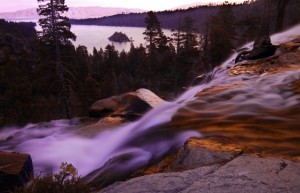
Photo © iStockphoto
By Robert Frohlich
There are times in every person’s life that demand a modest act of penance – like when you’ve been ill tempered to your sweetie, or been busted pretending to know the difference between trout flies or climbing copperheads. When you’ve behaved badly a good remedy is to hike Meeks Bay to Emerald Bay in a day.
If executed with rigor this 19-mile hike through Desolation Wilderness in summer offers an ennobling out-of-body experience that approximates a sadist session scolding for the true penitent.
Forget camping, backpacks and a scrumptious lunch. If you’re going to take on 19 miles of agony between dawn and dusk its best to feel as light on your feet as you possibly can. Never mind carting along a bunch of water and food. This is Purgatory after all. Instead, bring a water filter, windbreaker, hat and sturdy shoes. A single energy bar is permissible.
Starting early is crucial. Be sure to fill out your wilderness permit available in the self-regulating box next to the map at the Meeks Bay Trailhead.
The hike travels over just about every type of terrain that Desolation offers. The first part of the hike follows Meeks Creek up the Tahoe/Yosemite Trail, through sun-filtered dense forests, four and a half miles to Lake Genevieve. From there a succession of lakes appear: Crag, Hidden, Shadow, and Stoney Ridge. It’s just before Rubicon Lake that the elevation rises dramatically in a sequence of switchbacks.
By Phipps Pass you’ve covered 11 miles. From its 9234-foot elevation, panoramic views of the Velma Lakes Basin and the granite character of Desolation unfold under a sky as wide as the face of time. Once past the steep high alpine pass the trail runs into a part of the Pacific Crest Trail that winds its way to the granite carpet of Middle and Upper Velma Lakes and the Eagle Falls Trail which concludes at Emerald Bay.
Your eager smile and polite greeting may alarm other evening hikers and tourists at the end of the trail who don’t recognize an exile returned. Go home and shower. Phone those you’ve offended and apologize. You have already forgiven yourself.
Robert “Fro” Frohlich is a popular Tahoe journalist and book author.
Jul/102
Long May He Run

Andrews running past Cougar Rock in the 2007 Western States 100. Photo courtesy of Bill Andrews.
The Himalayan Quests of Dr. Bill Andrews
Reno geneticist/ultra-runner preps for 135-mile race in the Himalayas while he pursues lifetime goal to find a “cure for aging”
By Pete Gauvin
Audacious. Improbable. Mind boggling. Ludicrous.
These are words that come to mind when you first hear of Dr. Bill Andrews’ personal and professional goals. And certainly based on cursory impressions, they appear quite on target. In fact, without knowing more, you might well add insane, delusional and quack-headed to the list.
Tread below the surface of implausibility, however, and the certitude of these impressions quickly erodes like 20th century limits on technology. One’s take on Dr. Andrews shifts from: “Wow, this guy must be trying to sell some fountain-of-youth snake oil!” … to …“Holy smokes! Here’s a credible scientific visionary quite possibly holding the keys to a revolutionary extension of our lifespans!”
It didn’t take long for Andrews to wash my reflexive skepticism downstream in a flood of scientific awards, credentials and cogent, well-practiced explanations geared for a doubtful audience. And the outlandish first-time running event the 58-year-old is about to head to India to do, the reason he contacted us in the first place? That was made seemingly possible by his impressive ultra-running résumé.
My investigation began with a tour of the offices and labs at Andrews’ company, Sierra Sciences in Reno, where I saw sat down with Andrews for an interview. Andrews, who a PhD in molecular genetics, is founder, president and CEO of the 11-year-old biotech company, whose motto is no less than “Cure Aging or Die Trying.” The company employs about 25 people in a single-level building in an anonymous office park near the Reno airport.
My inquiry continued later that afternoon when I met Andrews for a short-but-tough six-mile run on a narrow goat track of a trail up Hunter Creek Canyon on Reno’s western edge.
But let’s get to those pies in the sky — before we bring them down to earth.
Running “High”
The first head-slapper, easier to wrap your brain around but astonishing in its own right, is that Andrews will be toeing the starting line July 24th of an inaugural footrace called The High (www.thehigh.in), a 135-mile ultra marathon in the Himalayas of India.
At 135 miles, The High is the same distance as the Badwater Ultramarathon (July 12-14 this year), which runs trhough Death Valley to the flanks of Mt. Whitney. Heretofore, Badwater has been recognized as “the world’s toughest foot race.” Andrews has run it twice.
“My goal is to run a 7-minute mile when I’m 130 years old. When I do that, or when somebody else does that, using treatments we’ve developed, that’s when we’re going to say that we’ve cured aging.”
— Dr. Bill Andrews
What separates The High is, of course, elevation. Sustained, ridiculous elevation! The course follows the Leh–Manali Highway through the “foothills” of the Himalaya. It starts at Rumptse (13,451 feet) and crosses four passes over 16,000 feet before finishing at Patseo (12,303 feet). The high point of the course is Tanglang La at 17,585 feet. Runners have 60 hours to complete the course.
For some perspective on its difficulty relative to other ultra-endurance events, I asked Gordon Wright, an ultra runner and president of Oustide PR, an endurance race promoter in San Francisco. “I’m convinced, after only a cursory glance at this event, that it represents the current limits of human endurance,” he said.
The High is designed to bring attention to the receding glaciers of the Himalayas, often called the “water tower of the world” because they contain the largest store of fresh water in the world after the north and south poles. The waters of 10 major river systems originate in the Himalayas, sustaining nearly one-fifth of the world’s population.
A couple hundred accomplished ultra-runners from around the globe were invited to compete in the race, according to Andrews. However, the field is limited to 40 runners max.
But organizers aren’t going to have to worry about that. Due to expense or distance or time, or maybe sanity, only a few signed up. In fact, other than Andrews, only three others committed to this year’s race, and one of those is Andrews’ girlfriend, Molly Sheridan, 52, of Las Vegas. And Andrews said there was some question whether the other two runners signed up — two Brits, Sharon Gayter and Mark Cockbain — were going to back out. (Gayter did cancel. But the race director himself, Rajat Chauhan, has decided to run, so the field is still at four.)
“Everybody else is saying they want to wait and see if it’s possible,” says Andrews. “Apparently, a whole bunch of people signed up for next year. But nobody wants to do it this year because they’re afraid of altitude sickness.”
“Right now it’s not a race,” he adds. “It’s an opportunity to see if somebody can do 135 miles at that altitude under 60 hours.”
Andrews is comfortable being one of the guinea pigs. You might even say he’s cut out for it given his scientific goals. And as an ultra-runner for 14 years, he’s got the chops: He’s competed in more than 100 ultramarathons 50 miles or longer. In 1998, he ran more 100 milers than anyone else in the world and completed the Grand Slam of Ultrarunning: the Western States 100, the Vermont 100, the Wasatch 100 in Utah, and the Leadville 100 in Colorado.
But in addition to the challenge, his reason for doing The High is much more pedestrian: He’d rather try new races because it’s “boring” to do the same races over and over again.
Relative to the race demands, Andrews’ preparation seems rather modest. He typically averages about 75 miles a week: 5 miles on Monday, 8 on Tuesday, 15 on Wednesday, five on Thursday, Friday he takes off, 25 on Saturday, 15 on Sunday.
“I’m also competing in 50 and 100-mile races as often as I can right now which is more than once a month,” he said when I talked to him in June.
How will he prepare for the altitude? Though he’s lucky he doesn’t live at sea level, Reno’s 4,400-foot elevation doesn’t begin to replicate the thin air of The High’s course. Even the peaks of the surrounding mountains where he often trains don’t come close. So Andrews has been experimenting with a portable altitude simulator from an Arizona company called AltoLab. In addition, he’ll arrive in India a couple weeks before the race to acclimatize.
Like most everyone else, Andrews acknowledges that it’s difficult to balance training with his work demands. And that brings us to the one thing about Andrews more fascinating and astonishing than running 135 miles at altitudes above the highest summits in the continental U.S.
“Cure Aging or Die Trying”
Dr. Andrews professional — and personal — goal is to find a cure for aging. He says his company, Sierra Sciences, is well on its way, probably closer than anyone else in the world, to accomplishing that. It’s conceivable, he says, if they get the funding they need, they could have an FDA-approved drug ready in 15 years that would undo or significantly slow down the process of aging at the cellular level, and prevent a host of age-related diseases as well.
We’re not talking immortality here, but a significant extension of life. Sierra Sciences is a company “devoted to finding ways to extend our healthspans and lifespans beyond the theoretical maximum of 125 years,” states its website, www.sierrasci.com.
“When I first started everyone thought this was an impossibility,” says Andrews. “It took us about eight years to show proof that this was possible and that was only about two and a half years ago.”
The extension of life could be on par or far greater than the lifespan jump that’s occurred in recent history. In just over a century, the average life expectancy in the U.S. has increased from 47.3 years in 1900 to 78 years in 2008.
Andrews thinks lifespans of 130, 150 years or more are possible. “With the technology we’re developing we have no idea what the limit is,” he says.
For reference, the longest living person confirmed to date was Jeanne Louise Calment of France, who died at age 122 in 1997.
The Benefits of Intense Exercise
Ultramarathons like The High are part of Dr. Andrews’ inspiration for seeking a cure for aging. At 58, he’s determined not to let his age stop him from pushing himself to the limits of what the human body can accomplish. And he believes ultra running will help him stick around long enough to see an actual cure for aging come around the corner.
Andrews keeps his cool modeling a ventilated Sun Precautions Solumbra running suit. Photo courtesy of Bill Andrews.
“Right now it’s not a race. It’s an opportunity to see if somebody can do 135 miles at that altitude under 60 hours.”
— Dr. Bill Andrews on The High ultrarun
“I’ve always believed that exercise is the number one thing that could extend our lifespans and healthspans as much as possible,” he says. “And I’ve always believed, because I’ve seen really elderly people competing really well in endurance races, the more exercise the better. I don’t care what the mouse experiments say. Humans: the more exercise the better.”
Only in the last year are scientific publications coming out proving that to be the case, he says. “Two papers have come out that show that you can have a biological age that is less than people your own age if you do intense exercise, and the more intense the better.”
Many papers, he adds, have also come out in the last few years demonstrating that joint pain actually is less if you run all the time.
“You’re less likely to have joint pain if you’re a really consistent, serious runner, than if you take breaks all the time,” he says. “People that run marathons feel fine right afterwards. The next day they’re sore. Whatever’s causing the soreness, the inflammation and the swelling, that’s actually causing the damage. So getting yourself to where you can run a marathon and not go through all this inflammation and stuff is the way to really keep from having joint pain.”
“People like me, I never get any joint pain anymore. Occasionally I twist something. Then I’ll go see a physical therapist. But I’m not suffering from the joint pain that other people do. I’ve got an identical twin brother who does not run and he’s got joint pain.”
“Short Telomeres are Bad News”
If Andrews has a maxim to live by it’s: “Short telomeres are bad news.”
What are “telomeres” and what are “telomerase genes?”
Telomeres are the clock that controls aging, says Andrews. They’re found at the tips of our chromosomes, acting like protective caps that protect them from deterioration. They’re often likened to the cap at the end of a shoelace (an “aglet”). Telomeres are longest before we’re born and they shorten throughout our lifetimes, each time our cells divide and our chromosomes replicate. Once they get to a certain point, our cells cannot divide any further (known as “cellular senescence”) and we die of old age.
The time remaining on our “telomere clocks” can be measured from our blood cells, and there are laboratories that will do this for you, Andrews says.
The curious thing is that not all of our cells experience this shortening. Our reproductive cells — our sperm and our egg cells — for all intensive purposes, don’t age. Otherwise, “they would contain telomeres the same length as the rest of our cells, which would yield embryos as old as we are,” Andrews explains on the Sierra Sciences website. “Because so much cell division takes place in the womb, our children would then be born much older than us. Humanity could not exist more than a generation or two if this were the case.”
Obviously, evolution is behind this. More specifically, it’s because reproductive cells contain an enzyme called telomerase that re-lengthens the telomeres as they shorten.
Sierra Sciences is searching for pharmaceuticals that will induce the production of telomerase in all our cells. That breakthrough in 2007 that Andrews mentions — that’s when they found the first drug that “turns on the telomerase gene.”
“Since then we’ve found 38 more,” Andrews says. The process has sped along because prior to finding the first drug they had no positive controls to test for detection of telomerase activity. Since then the company has redesigned all its protocols for screening. With the help of million-dollar robotic machines that never take a coffee break, they are able to screen 4,000 compounds per week. “We found something more potent just a few months ago,” he says.
Countering Skepticism
Despite being grounded in science, Andrews is acutely aware of the skepticism that initially arises when he talks about finding a cure for aging. “Ever since I was 10 years old I’d wanted to find a cure for aging and everywhere I looked all I found was quacks.”
In his presentations he strives to counter those perceptions. “No one comes by and says, ‘Oh, you’re a charlatan or a quack,’ after they see my presentation,” he says. (You can view one of his presentations on the home page of Sierra Sciences’ website.)
And it’s getting easier to talk about. “Aging research is actually coming to the forefront now,” he says. “Believe it or not, even when we started this company, we stayed in the closet … Investors and anybody we associated with were afraid to let anybody know they were associating with us because we were, ‘curing aging.’ And that doesn’t happen anymore.”
A number of media have recently done pieces on his research, including Discover magazine, the BBC’s Horizon TV series, and National Geographic TV, though the latter two have yet to air in the U.S.
Extending Healthspans
“When I talk to people,” says Andrews, “they say why would somebody want to live forever. I say, well, I love living. I don’t ever want to die. And I can’t imagine that a day is ever going to come where I’m going to say, ‘OK, I’ve had enough’ —unless I’m unhealthy. So that’s the chief priority here — not just to extend our lifespans but to extend our healthspans too. … We want to dance, play tennis and have the time of our lives when we’re 150 years old.
“There’s this theoretical maximum of a 125 years. My goal is to demonstrate that I can run a 7-minute mile when I’m 130 years old. When I do that, or when somebody else does that, using treatments that we’ve developed, that’s when we’re going to say that we’ve cured aging.”
There are a lot of things already on the market that actually do extend lifespan by extending healthspan, he says, by helping to keep people healthy. “Resveratrol does that. Resveratrol will probably add five to ten years to a person’s life,” he says, also mentioning antioxidants, omega-3 fatty acids and Vitamin D.
“I take like 25 supplement pills every day. I’m a big fan of a company called Life Extension Foundation. They have a magazine and sell products and I do what ever they say. The field of anti-aging is so broad, so big now, that nobody can stay on top of everything. So I’m really focusing on the telomeres and I’m relying on the people I consider experts to keep me apprised of everything else I should do.”
Ties to Cancer, AIDS, other diseases
Prior to founding Sierra Sciences, Andrews was director of molecular biology at Geron Corporation, based in Menlo Park. He led the research that discovered the components of telomerase and was awarded second place as “National Inventor of the Year” in 1997 for his work. He is a named inventor on 35 patents for telomerase.
While at Geron, much of Andrews research was focused on cancer. There are potentially major breakthroughs in preventing and curing cancer in the telomere research he’s doing now.
“A cure for cancer would definitely extend our lifespans,” Andrews says. “I think one of the most exciting new developments is the finding that a major cause of cancer is short telomeres. When telomeres get short that causes all the mutations that cause a cell to become cancerous. So keeping telomeres long is a way to actually decrease the risk of cancer.”
It appears that most of these mutations result from short telomeres. “This is why cancer is so much more prevalent in the elderly,” he says. “But short telomeres can exist in young people too if, say, their immune system is taxed a lot. The cells have to divide and when cells divide, the telomeres get shorter.
“A good example is the AIDS virus. When an AIDS virus infects a person, the immune system starts dividing like mad to kill off the AIDS virus. And it’s unsuccessful, so it just keeps dividing, dividing and dividing. And the division causes the telomeres to get shorter. In the early 1980s when doctors were first surprised to find that people infected with the AIDS virus had no T cells, or immune cells, that was why: Because their telomeres were shortened to the level of old people. Their immune system died of old age.
“One of our goals is that our drugs should make AIDS patients live a normal life. Being infected with AIDS, your immune system gets weak and you become vulnerable to all the different infections and cancers, like Kaposi’s saroma (a cancer that develops from cells that line lymph or blood vessels, often forming skin lesions.)
“Practically every disease we’ve ever heard of has some role in cell division and telomeres,” Andrews continues. Some of the diseases that could potentially be prevented or cured by lengthening telomeres include: cancer, heart disease, Alzheimer’s, osteoporosis, osteoarthritis, and macular degeneration, the number one cause of blindness in the elderly.
“There are at least 30 (diseases) I’ve identified,” Andrews says. “And that’s probably just a fraction of what they really are because anything that involves cell division is going to have telomere shortening.”
The Nobel Prize in medicine was just awarded last year to colleagues of Andrews that pioneered research showing that telomeres play a big role in not just aging but overall health. “And I was awarded second place for United States Inventor of the Year (in 1997) for figuring out how to stop telomere shortening, and that’s what this company is focused on.”
In regards to cancer, in the past researchers have suspected that telomerase promotes cancerous cells. But, Andrews says, “Everyday I’m reading a new scientific publication (that says) telomerase doesn’t cause cancer. Short telomeres cause cancer. And short telomeres can cause cancer cells to turn on the telomerase gene. But if you can put telomerase in before the telomeres get short, then the cells will never become cancerous to begin with.”
“The Manhattan Beach Project”
Andrews believes Sierra Sciences may be 10 years or more ahead in this research than any other company in the world, but it doesn’t mean they’re not sharing what they’ve learned in order to some day possibly make a ship-load of money. That would defeat the purpose and possibly delay the mission too long for it to benefit anyone currently involved.
“We’re all dying of aging. So the real top leaders in the aging field are all working together,” Andrews says.
Last year Andrews helped organize a three-day conference with the world leaders in anti-aging in Manhattan Beach near Los Angeles. They called it “The Manhattan Beach Project.” (Videos of Andrew’s presentation at that conference are available on YouTube.)
“We got together in one room, roundtable discussion, we met for three days and that was very, very exciting. The whole idea was that we all agree. Every single person in that room was in the field because they are trying to cure their own aging. And so they don’t want to compete; they want us all to work together.”
A more practical reason they need to work together is that there is little funding available for age research that is not tied to a specific disease. And venture capital is more focused on short-term profits than long-term cures.
Andrews estimates Sierra Sciences will require $30 million to get a drug to the FDA and another $100 million to get through the FDA. “We’ve already spent $30 million getting to where we are now,” he says. Finding new funding he hopes will be easier now that they have drugs that show promise.
Anti-Aging vs. Curing Aging
There’s very little competition in the field of curing aging, Andrews says.
“There’s more competition in the field of anti-aging — human growth hormone, testosterone, resveratrol, things like that. Those things are going to add a few years of life to you by improving your health. But they’re not going to cure aging. A cure for aging is actually something that’s going to stop or really slow down the aging process. And that’s a whole separate field. We are one of the few companies that are actually doing something to cure aging.”
There are a bunch of different things doctors can recommend to combat aging, he says. “Those are just going to make you healthier, which is a good thing. I strongly encourage them. But they’re not enough for me. I want more than five or 10 more years.”
How Can Earth Sustain Us?
And what if Andrews or others are successful in finding a cure for aging? What about its impacts on overpopulation and shrinking resources and pollution and Social Security and retirement pensions and all the rest of the societal and environmental issues? Won’t we exceed Earth’s capacity to accommodate us?
Andrews addresses this on Sierra Sciences’ website in greater detail. His core answer is that birthrates will decline just as they have before when our life expectancy significantly increased over the last century. In less than four decades, he notes, the average number of children per family was more than cut in half, from 6 to 2.9.
“Today, most researchers think we are headed quickly towards a stable population,” he writes. “Evidence is mounting that humans will simply not reach populations larger than our ability to sustain them: economics preclude us from doing that. As resources become scarce, prices rise, and as prices rise, family sizes shrink.
“Is it a bad thing that our medical advances have nearly doubled our life expectancy?” he asks. “Most would say it’s a decidedly good thing. So it’s probably a safe bet that if we can drastically increase that figure again, future generations will also look back on it as beneficial.”
Now that doesn’t sound so ludicrous after all. And Andrews will soon find out if running 135 miles in the Himalayas is a ludicrous undertaking. It’s all part of a rich life of discovery — one that he hopes will be exceedingly long.
Jul/101
The Big Ideas
11 Solutions That Could Actually Save the Planet
By Will Harlan and Graham Averill

11 Big Ideas
The editors of Blue Ridge Outdoors, our sister magazine in the Southeast, asked Pulitzer Prize-winning authors, CEOs, and leading environmental experts: What is the single most important change needed to protect the planet and its people? Here are their 11 insightful, innovative, and inspiring responses.
1. Educate Women Worldwide
The most effective contraceptive is education for girls. When women are educated, they tend to marry later in life, to have children later in life, and to have fewer children. In effect, you have a form of population control that’s peaceful, voluntary, and efficient. Plus, women do better in business, raising economic growth rates and lowering societal conflict.
Empowering women through education provides the highest return on investment in developing countries. It is the single most cost-effective way to empower and modernize communities.
Of course, it’s also important to educate boys, but there are a couple of reasons why girls’ education brings an even higher return. First, it reduces birth rates very considerably, which brings the country a demographic dividend. Second, women are more likely than men to use extra income to educate their own children and to start small businesses.
—Sheryl WuDunn, Pulitzer Prize winning co-author of “Half the Sky: Turning Oppression Into Opportunity for Women Worldwide”
2. Safe Drinking Water
Imagine if, instead of just going to a tap in your kitchen anytime you were thirsty, you had to hoist a heavy vessel onto your head and walk, up to two hours, to a well, where, after filling your vessel—now really heavy—you had to carry it up to two more hours back home. The water you carry would often be dirty and diseased. After your trek, how much more time and energy would you hope to have to farm, cook, take care of your family, especially the sick ones, or go to school? This is the dilemma facing over one billion women and children worldwide each day. A child dies every 15 seconds because of water-related diseases.
Fortunately, we already have the solutions to the world’s water crisis, and they are surprisingly simple: low-tech wells and small-scale water projects that are completely sustainable and maintainable by the communities they support. Hand-washing and basic hygiene education are also essential to prevent disease and contamination.
In the United States and other developed nations, water conservation is crucial. Improving water infrastructures and protecting watersheds are important governmental actions, but the Blue Revolution begins with each individual taking steps to reduce his or her own water footprint.
—Lisa Nash, CEO of the Blue Planet Network
3. No-Growth Economy
The rapid economic growth of the past two centuries has been felt very unevenly around the globe. Many have prospered while many others remain desperately poor. Economic growth has depended on a massive increase in the use of materials and energy, and on the spread of humans into virtually every corner of the planet, accelerating the extinction of other species. And yet the human population is forecast to grow by another 3 billion or so in the next 50 years.
It is most unlikely that the planet will be able to accommodate so many of us and raise the material living standards of those in greatest need, without changing the priority we give to economic growth. Having overshot the capacity of the planet to support us, starting in the rich countries we should reduce the demands we make on the planet to cater to our profligate way of life and forego the pursuit of endless economic growth.
An economy that doesn’t grow in material terms—a steady-state economy—can be healthy and even desirable, as economists as great as John Stuart Mill and John Maynard Keynes acknowledged. But it will require fundamental changes: we will work less so that more people stay employed with a reasonable salary, and consume less, scaling back to something like levels in the 1960s, so that citizens in developing countries can prosper. A world with fewer larger inequities between rich and poor would be more secure and would also help stabilize world population levels. And with more time to spend with family, friends and in our communities, we might well live truly richer and more fulfilling lives.
—Peter Victor, Professor of Economy at York University and author of Managing Without Growth: Slower By Design, Not Disaster
4. Think Globally, Eat Locally
We need a transparent and locally-based food system, where people understand exactly how food gets to their table and what the hidden costs of cheap food really are. In order to get that cheap tomato out of season, it takes a vulnerable labor force, big factory farms, and giant waste lagoons.
Cheap food is also responsible for our obesity epidemic. There’s also an environmental cost to shipping food around the world. From the perspectives of economy, ecology, health and taste, the actual value of a locally grown tomato far surpasses the actual cost of a tomato grown by a factory farm.
Once locally grown food becomes mainstream again, we’ll see a healthier population and a healthier environment. And the systems we have in place can handle this change. Grocery stores can be supplied by local farmers just as easily as corporate farms. Even large distributors are willing to accommodate local farms. They just need to see the desire in the marketplace.
—Charlie Jackson, executive director of the Appalachian Sustainable Agriculture Project
5. Corporate Revolution
Benefit Corporations—called B-Corporations (or B-Corp)—is a certification to distinguish truly sustainable businesses from the pretenders and greenwashers. Instead of simply measuring economic performance, B-Corporations have also committed to meeting social and environmental performance measurements. The IRS audits the economic portion, while the B Lab — a public charity nonprofit — audits and rates the added performance measurements of all B Corps.
Maryland and Vermont became the first two states to enact B-Corporation law earlier this year, and already there are over 125 B-Corps in 31 industries comprising $1 billion of the market. It is the best way to definitively evaluate and separate the pretenders from those businesses that really practice what they preach. Best of all, consumers can know with certainty that the businesses they support have met certain social and environmental standards.
How you measure a successful business is changing in the 21st century: from “me” to “we.”
—Andrew Kassoy, co-founder of B-Lab, the certification organization for B-Corporations
6. Cash for Pollution
You have to show Americans the true price of pollution. That is best accomplished by levying a tax on fuels when they’re taken out of the ground or imported into our country. The companies will pass most of that cost onto the consumer, which will make turning your lights on and driving your car cost more. So give the $500 billion in tax revenues back to the American people as a “green check” each year, divided up equally, exactly like they do in Alaska with oil revenues. This gives citizens a chance to recoup the extra costs that are passed down because of the carbon tax.
The cap and trade system has to die before the carbon tax will live. The problem with cap and trade—where companies buy and sell a finite amount of pollution credits—is that once you have trading, you have Goldman Sachs—the smartest people in the room figuring out ways to game the markets and make a profit. The clearest, fairest, most transparent way to address the issue is with a straightforward tax.
There’s a dirty little secret with energy. Occasionally, the Americans see the truth when an accident like this oil spill (in the Gulf) or the coal ash spill (in Tennessee last year), but mostly, it’s a matter of out of sight, out of mind. We don’t see the true cost of this energy to our health, our environment, and our everyday lives.
—Charles Komanoff, co-founder of the Carbon Tax Center
7. Free Condoms
Our planet is simply overwhelmed by too many people. We’re doing all this work to clean up the streams, protect a habitat here and there, or reduce our carbon footprint, but it’s not going to do any good if our population continues to grow out of control.
Here in the U.S., which has the fastest population growth of any developed nation in the world—the impact of our population growth is compounded because an American child’s carbon legacy is 168 times more than a child born in a developing country like Bangladesh.
The way to stabilize population—both in the U.S. and overseas—is to make birth control universally accessible. Here in the U.S., birth control is not covered by many women’s health care programs, and worldwide, millions of women don’t have access to any health care. So we’re distributing free condoms, with endangered species depicted on them to help people make the connection between population and the planet’s health. We’ve already distributed 350,000 free condoms in the first five months of 2010.
We must look at birth control not as a moral or religious issue, but as a simple biological question: How many people can this planet sustain?
—Randy Serraglio, overpopulation project coordinator for the Center for Biological Diversity
8. Drive Less
On average, Americans spend 18.5 hours per week in our car, and over $7,000 a year in gas, maintenance, and taxes. Americans essentially need a part time job to pay for their car.
The solutions are attainable: first, try to drive 1,000 miles less per year (Americans average 22,000 miles per year). Next, keep a car diary detailing the number of trips you take in your car and how much time you spend in your car. Also compute the household car costs in this diary. Write down every tank of gas you buy, every set of tires you buy.
Once you start writing these trips and costs down, you’ll begin to see that owning a car is a trade off. If you’re spending $7,000 or more on your car every year, that’s a lot of vacations, take-out meals, or college tuition payments you could be contributing to.
Having a positive impact on climate change is a good reason to drive less, but it goes beyond that. Car-related accidents are the main cause of death for people ages 3 to 44. It’s a public health issue as much as it is an environmental issue.
—Catherine Lutz, anthropologist, professor at Brown University, and co-author of “Carjacked: The Culture of the Automobile and its Effect on Our Lives”
9. Play Outside One Hour a Day
We’re seeing a generation-long disconnect between kids and nature. The implications of this disconnect range from obesity, to media addiction, to attention deficit disorder. And there are volumes of research showing that time outside is good for a kid’s mind, body, and spirit.
Set aside a green hour everyday where your kids—and you—can explore the outdoors. Even 10 or 15 minutes of outdoor play is worthwhile. The important thing is for you and your family to immerse yourselves in nature, to rebuild that connection that we’re losing.
The amount of time kids spend exploring the natural world today will inform how they will see the natural world as adults. Before we ask kids to save the world, let them first come to know it and love it.
—Todd Christopher, author of “The Green Hour: A Daily Dose of Nature for Happier, Healthier, Smarter Kids”
10. Put a Price on a Priceless Forest
Forests are the world’s main reservoirs for carbon. Old growth forest is optimum for the sequestration of carbon. The older the forest gets, the more carbon it banks. The Smokies (the Smoky Mountains) sequester a lot of carbon, and there’s a lot of forest left on public and private land that’s still in good shape. So how do you convince America to protect it?
We need to establish a system that actually details the monetary value of these intact forests from a carbon sequestering, watershed protection, and public health standpoint. Paying to protect forests is cheaper than shooting carbon into space, safer than shooting into the earth’s core, and it’s the solution that’s readily available.
If we can develop a carbon trading system that puts a price tag on the carbon sequestration, watershed protection, and public health values of a forest, we can then use a percentage of those trades fund the acquisition of more conservation easements and forest protections.
—Hugh Irwin, conservation planner for the Southern Appalachian Forest Coalition
11. Meatless Mondays
The United States is the world’s most obese country, and the world’s largest producer of greenhouse gases. How do you kill two birds with one stone? Eat better meat, and less of it.
Our entire food system needs to be overhauled, and it’s not going to happen overnight. But what is realistic, what everyone can do, is reduce the amount of meat they eat, which will substantially reduce the amount of livestock waste that ends up in our water sources, the amount of fresh water we use for those animals, the amount of grain we use to feed those animals, the amount of antibiotics injected into our food system, and the amount of greenhouse gases we produce.
Meat is a great resource for protein, and in moderation, it’s fine. We just eat too much of it. A realistic and attainable goal we’ve created is Healthy Mondays, where people eliminate—or reduce—meat consumption one day a week. The impacts it will have on your own health and the health of your environment are substantial.
—Ralph Loglisci, project director for the Johns Hopkins’ Center’s Healthy Mondays initiative, a push to get schools, hospitals, and institutions to make better choices one day a week.
Jul/100
Sierra Adventure Rides
Three All-Day MTB Epics from Bishop to Tahoe
Story and photos by Seth Lightcap

Sierra Adventure Rides
Though the dirt is decent and the rocks are wicked fun, one of the best things about mountain biking in the Sierra Nevada is the fact that there is a trail for any occasion. Whether you only have an hour to cruise or you have all day and are looking for an ass-whupping, there are countless ride options.
Finding a Sierra destination for your average three-hour ride window is easy. Chances are you’ve already spent an afternoon or two on a few great ones. But what about those dawn to dark days? Where would you pedal if you had 12 hours to burn and were allergic to riding laps?
Here’s your answer. Check the specs on the three all-day epic rides profiled here. These rides are adventure testpieces that will challenge your legs, lungs, and navigation skills with big mileage, high elevation, and tricky route finding. Don’t expect your average ‘cross the dam and head into the woods’ endeavours as all of these point-to-point routes cross rugged alpine terrain via some improbable pathways. Due to the distances, these rides also require car shuttles, so read on, feel the stoke, and inspire your friends to join you on the journey.
The Coyote Flat Traverse: Bishop to Big Pine
The Lowdown
The Coyote Flat Traverse is no doubt Type II fun. How else could you describe a 35-mile sufferfest that climbs 3,000 feet over an 11,000-foot plateau and includes more sandy doubletrack and hike-a-biking than singletrack? That said, this grand tour from Bishop to Big Pine is a spectacular adventure, well worth the pain if only for the glacial views and the chance to rip rarefied singletrack from the High Sierra to the Owens Valley.
This radical journey should only be attempted by strong riders with a keen sense of direction as route navigation is by far the crux of the trip. Your pedal payment won’t be the only sacrifice as the ride requires an hour car shuttle in both directions. Don’t be put off however. Just prepare well and roll with good company.
Trail/Shuttle Info
The car shuttle begins in Big Pine where you can leave a vehicle along Glacier Lodge Road. Cruise back to Bishop and make a left on W. Line Street (168), then a left on South Lake Road 13 miles later. Park at a turnout on South Lake Road just past Bishop Creek Lodge. The ride starts about a quarter mile up the paved road where you’ll make a left onto the first obvious dirt road and cross a creek on a gated bridge. The road looks like a private driveway but it’s a Forest Service easement.
Follow the road past a home then veer left and begin climbing as the road contours up the side of the valley. After grinding up 3,000 feet in six miles you’ll be greeted by stellar views as you reach the top of the plateau. At this point a map will be key as you’ll need to navigate the jeep roads across the massive Coyote Flat. When you pass a marked landing strip you’ll know you’re on the right route.
About a 1/4-mile past the airstrip you’ll reach a critical junction. If you head left you’ll climb up over a saddle and descend fast moto-banked jeep roads for about 15 miles back to Big Pine. This alternative route stays on dirt longer but misses out on the technical singletrack that awaits if you stay right and follow the original route.
If you hang right you’ll begin trending southwest following a road along a low-lying ridge until it dead ends at a hunting cabin. Riding out behind the cabin look for a faint horse trail that crosses a creek just after a barbed-wire fence. From here get ready to hike-a-bike a fair bit as the singletrack trail gets loose and steep as it climbs and meanders across a high meadow that overlooks the Palisade Glacier. After a couple miles of on/off climbing, the trail will drop sharply into rowdy technical switchbacks that cross another meadow or two before descending into the Big Pine Creek drainage and finally to trail’s end at Glacier Lodge. Zip down Glacier Lodge Road for nine miles back to your car.
Additional Info
Do not underestimate this 35-mile adventure. It is long, arduous, and extremely remote. Getting temporarily lost is probable, if not guaranteed. Prepare for a 12-14 hour day on the saddle. Following the route description in Mountain Biking Mammoth, a guidebook by David and Allison Diller, will vastly improve your odds of success as would bringing a GPS. The plateau is quite exposed so dress accordingly and abandon plans for the ride if you wake up to mixed weather. It’s also worth noting that there is a short cut variation to this ride that will take you back to Bishop after gaining the plateau. This route drops off to the north after 11 miles.
The Black Canyon of the White Mountains
The Lowdown
OK, so this one isn’t exactly in the Sierra but rather looks out upon them. The White Mountains are the massive and under-appreciated range that looms to the east of the Owens River Valley outside of Bishop. Though well-known as the home of the Bristlecone pines, the oldest living things on earth, few people recreate the sprawling escarpments of the White Mountains as they are hard to access and not quite as picturesque as their High Sierra counterparts to the west.
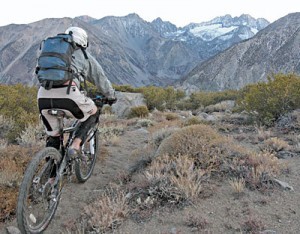
Riding the Black Canyon is a top-to-bottom thrill that drops from the brushy ridge crest to the streets of Bishop, a 4500-foot plummet over 10 miles. The route starts on singletrack as it traverses into the canyon but soon joins a rocky old road that winds down the mountain. You’ll want fresh brake pads, wide tires and a couple extra tubes for this one as the narrow road is undeniably loose and ridiculously fast.
Trail/Shuttle Info
A Black Canyon descent begins with a long shuttle up to the top. The best place to leave your car is at the end of Warm Springs Road, a road found a couple miles south of Bishop off Hwy 395. Follow Warm Springs Road for approximately seven miles and park at the first major intersection. Head back to 395 and drive south to Big Pine where you’ll make a left on SR-168 going toward Westgard Pass. After 13 miles on SR-168, make a left on White Mountain Road and continue until 1.1 miles past Grand View Campground where you’ll see an unmarked dirt pull-out on the left. Park here.
The trail starts as a northbound dirt road leaving the back of the pull-out. Pass the first faint road heading left but take the second left that quickly becomes a singletrack trail. The trail traverses across a few drainages before dropping into the Black Canyon after a couple miles. The bottom of the canyon is marked by a major intersection with a road, at which you’ll take a left and start ripping downhill. The route is obvious from here as you stay on the main road as it drops another seven miles through alternately lush then rocky, barren terrain. Hang on tight and don’t let the Sierra views distract you too much as the loose trail surface demands attention.
Additional Info
This ride is notorious for flat tires, especially if you have XC rubber on your bike. Throw on wider tires for better scree surfing and bring two tubes per person PLUS a patch kit. A mile-by-mile route description can also be found in the pocket-sized guidebook Mountain Biking Mammoth, a very worthy addition to your trail pack.
Spooner Summit to
Mr. Toad’s: Lake Tahoe
The Lowdown
The details don’t lie on this ultra-mega Tahoe Rim Trail link-up: 40 miles, 6300 feet of climbing and 7043 feet of descending. Whoa!
This ride requires some serious gusto but you get paid royally for the pain as you’ll travel through remote Tahoe high country before descending one of the most famous trails in the region, Mr. Toad’s Wild Ride. Other than a few intersecting portions of paved road, the entire ride is on perfect singletrack with several hyper-fast sections.
The route is locally known as the “Super Punisher” but it’s doable for mere mortals if you get an early start. The first 12 miles from Spooner Summit to Kingsbury Grade are a perfect warm-up as it climbs awhile then descends awhile leaving you well-balanced for the big push up to Mr. Toad’s. The climbing on the back half is also broken up fairly well providing opportunities to rest. A quick dip in Star Lake at the base of Freel Peak is also not to be missed.
Trail/Shuttle Info
The shuttle drop-off for this ride is at a OHV parking lot just outside of South Lake Tahoe. To reach the trailhead go south on Hwy 89/50, take a left on Pioneer Trail Road, then a right on Oneidas Road. Park at road’s end. Head back into South Lake Tahoe and drive east around the lake following US 50 to Spooner Summit. Park along the side of US 50 at the Tahoe Rim Trail parking lot.
Rolling onto the trail the route is straight forward as you follow the Tahoe Rim Trail for 12 miles as it climbs and descends about 1800 feet to the intersection of Hwy 207 (Kingsbury Grade). Once across 207 the route follows Tramway Drive up to Heavenly Ski Area where the Tahoe Rim Trail picks up again.
The next 15 miles of the route are the physical and mental crux as you climb over 3000 feet up to Freel Pass (9,700′). Dropping off Freel Pass, the pain eases for a bit as you descend awhile before climbing another couple miles to Armstrong Pass (8700′).
Five miles after Armstrong Pass you’ll reach the Mr. Toad’s Wild Ride turnoff, also known as the Saxon Creek Trail. Bust a right and muster some energy as you have another five miles of fast and technical singletrack to rally down to the car.
Additional Info
The sheer distance of this journey demands respect, let alone the fact that you climb 6000 feet over the 40 miles. That’s a lot of pedaling giving you ample opportunity to do stupid things like flail shifting gears and rip off a rear derailleur. Be patient climbing and don’t hesitate to put a foot down before you tie your drivetrain in a knot. The rocky sections of Mr. Toad’s are also quite challenging so keep your game tight in the last five miles. Finishing a 40-miler with a broken collarbone would put a serious damper on your day.
Jul/100
Tom Stienstra: Ambassador to the Outdoors
Iconic columnist and guidebook author has shared his adventures in California and the West for 30 years
By Pete Gauvin

Tom Stienstra: Ambassador to the Outdoors
In 1978, as a young sportswriter for the Peninsula Times Tribune, Tom Stienstra was covering an Oakland Raiders’ game against the Green Bay Packers at Lambeau Field, when a life-changing epiphany seemingly fell out of the Wisconsin sky.
“In the third quarter, I realized I was sitting with 60,000 people in need of exercise, watching 22 guys in need of a rest. And I asked myself, “What am I doing with my life?”
He realized that life as a spectator/sportswriter was no life for him. The thought of a career sitting on his bum, watching and writing about a few lucky men playing a game, struck him as ultimate boredom, the personal equivalent of caging a wild animal.
Little more than a year later, Stienstra was tipped that Ed Neal, the outdoors writer for the San Francisco Examiner, was retiring after 40 years in the biz. Stienstra went to the newspaper’s offices and managed to sneak past security into the newsroom just five minutes after Neal announced his retirement.
“I walked up to the sports editor, and said, ‘I’m your new outdoors writer.’”
“Word gets around fast,” quipped the editor.
He must have been impressed with Stienstra’s stealth and enthusiasm because he gave him the job.
His dream job in hand, Stienstra ran with it and never looked back. Thirty years later, Stienstra’s newspaper columns and best-selling guidebooks have made him the unofficial poster-ambassador for generations of California outdoor adventurers, particularly during this, the height of the summer outdoor season.
**************
With amiable blue eyes peeking out under a broad-brimmed black leather hat and a full beard crowning his usual outfit of hiking boots, jeans and a button-down work shirt, Stientstra is as likely to be identified as TV’ s Grizzly Adams as he is a San Francisco newspaper columnist, and that’s without noting the bear-claw necklace that often hangs from his collar.
But there’s nothing remotely Hollywood about this mountain man. In fact, one would be hard pressed to find a character truer to life. Stienstra’s appearance has been tailored by experience, by an ever-growing smorgasbord of adventures each year that have helped make him the most prolific outdoors writer in California, if not the country. He’s the nation’s top-selling guidebook author.
In fact, Tom spends close to 200 days each year in the West’s great unroofed — from hiking the alpine high country of the Sierra to fishing the briny Pacific … from scaling Mt. Shasta to exploring the myriad wildlands, lakes and pockets of open space that ring the Bay Area.
“He looks like Grizzly Adams, has the outdoor sense of Marlin Perkins, the spirit of Johnny Appleseed, and literally, the range of John Muir,” said Charles Cooper, the editor who hired Stienstra at the Examiner before becoming the managing editor of the Newark Star Ledger in New Jersey.
Indeed, county for county, trail for trail, Stienstra is arguably the most knowledgeable scribe about California’s wealth of natural beauty and recreational opportunities, roaming the state with the same sort of inquisitory awe that Muir displayed. From our most famous national parks to overlooked wild gems, including many just a short step from the clutter of urban life, you can bet that Stienstra has explored and written about it, and taught others to appreciate it.
“I’m really blessed that my editors let me roam around as much as they do,” says Stienstra, 55, who grew up in Palo Alto but now makes his home in the foothills below Mt. Eddy, west of Mount Shasta.
In addition to his ongoing role as outdoor writer for the San Francisco Chronicle and SFGate.com, Stienstra (pronounced “Steen-stra” — two syllables, not three) has written or contributed to nearly 20 books about exploring and recreating in California and the West — fishing its rivers, lakes and coastlines, hiking its most remote peaks and trails, discovering its best campsites — all the while marveling at and celebrating the awe-inspiring subtle natural splendors too often taken for granted.
Currently, he has some 10 titles in print, including four new guidebooks just out this spring focused on camping in Oregon and Washington. California Camping, now in its 16th edition, is the top-selling guidebook in the U.S. Twice it’s been ranked as the #1 outdoor book in the world by Amazon.com.
“The reason is not because I’m writing puffed out prose,” says Stienstra. “It’s because you can’t get this information anywhere else and rely on it. It’s because I’ve been there firsthand and done the adventure. It’s the whole reason I became an outdoors writer in the first place.”
His peers have noticed. He’s been inducted into the California Outdoor Hall of Fame and has twice been awarded National Outdoor Writer of the Year, newspaper division, by the Outdoor Writers Association of America.
Over the years, he’s also branched into radio and TV. In the Bay Area, he was a monthly guest on Evening Magazine and made numerous appearances on “Bay Area Backroads.” And for two years he hosted his own show, “The Great Outdoors with Tom Stienstra.” On the radio, he can be heard on Saturdays on KCBS-74.
Stienstra said he’s currently being considered for a national TV show on a new cable network. But even if he gets the show he would not leave his post at the Chronicle. Having written all his books while fulfilling his newspaper duties, he says it would be no problem to juggle both. “I learned that if you don’t watch TV and don’t have to commute, you’ve got time to write one book a year.”
As a TV persona, Stienstra’s mentor was Mike Rowe of the popular program “Dirty Jobs.” Rowe used to host Evening Magazine when Tom was a guest. “He completely transformed how I connected with the camera … Mike is every bit the great person that he appears to be on his show. He taught me more in a minute (about being on camera) than I’d learned in years.”
**************
It’s one of Stienstra’s more obscure book titles, Sunshine Jobs, Career Opportunities Working Outdoors, which provides the best clue to how he charted his career path.
Little did he know it, but he took his first step down the path when he was a lad of eight. As a class assignment, he wrote a story about his dog, Sport, which had run away and suddenly returned, titled “Searching for a Lost Friend.”
“You couldn’t read it without crying,” he recalls.
His second-grade teacher took the story to the local paper, the Palo Alto Times, where it was published. For young Tom, seeing his story in print was a thrill comparable to his first loves — hooking fish and playing baseball.
Stienstra continued to write through his youth and sold his first feature story at the age of 16. But writing still took a backseat to fishing, basketball and baseball, the latter at which he particularly excelled. In fact, on the pitcher’s mound he was skilled enough that the Oakland A’s give him a tryout in 1973. Fortunately, in retrospect, his fastball wasn’t big-league material. For the first time, he realized his fortunes were more likely to be determined by his ability to deliver a deft sentence than a strike on the outside corner.
Stienstra went to San Jose State University, graduated with a degree in journalism, then went to work as a sports reporter for the same hometown paper that published his first story, the Palo Alto Times. In 1979 the paper merged with the Redwood City Tribune to become the Peninsula Times Tribune and it wasn’t long after that Stienstra had his career-changing revelation in Green Bay.
**************
Years ago, Stienstra took me for a flight over the Peninsula and along the San Mateo coastline in his single-engine Mooney, a plane he had for 20 years before selling it when fuel prices spiked and it became too expensive to fly. He used it to commute to the Bay Area and for reconnaissance missions over the Sierra and other remote terrain.
“From the air you get such a tremendous perspective of the land. I’d see a place from the air and then go on the ground. I’ve discovered many of my favorite places that way.”
On this day in 2002, Stienstra invited me along as he checked out reports of off-road vehicle damage on Montara Mountain. From the Palo Alto airport, we flew across the Peninsula, over the redwood forest of Butano State Park, then north along the coast.
“It’s pretty incredible that we’re in an area with six million people and the odds of seeing another person in some nearby parks are about the same they are in Alaska,” Stienstra said flying up the coast. “The Bay Area has 1.2 million acres of greenbelt. There’s no place else in North America that has this much protected open space within its proximity.”
It was being in the pilot’s seat over California that convinced Stienstra to stay here, after thinking he might move to Alaska to become a guide and bush pilot. For only then did he realize how much wilderness was left to satisfy his adventurous spirit. “Once you have a perception of how much landscape there is left to explore,” he says, “there’s little need to go far.”
**************
As an outdoorsman, Stienstra is impossible to pigeonhole, except that he loves adventure in many forms. This gives him broad appeal among various camps of outdoor enthusiasts, including those with seemingly disparate interests. He can write about the thrills of hunting and fishing for rod-and-gun sportsmen and also appeal to take-nothing-but-pictures naturalists.
He might be fishing for striped bass in San Pablo Bay one day, hiking to a remote waterfall the next. “I don’t like to the same thing everyday. If I went fishing yesterday that’s the last thing I’ll do today,” he says.
Stienstra has paddled the length of the Sacramento River and backpacked the 211-mile John Muir Trail. He’s canoed the Owyhee River from Nevada to Idaho to Oregon and hiked 126 miles around the Bay Area in seven days. He’s hauled in 148-pound sturgeon (on 20-pound line) and an 11-pound Rainbow trout on a fly rod, among many other fish (see complete list on his website, tomstienstra.com).
In his columns he shows no particular allegiances for one type of adventure over another and palpable enthusiasm for whatever the adventure is at the moment. He often reminds users of all stripes what they have in common.
“I always try to network with enough people to get the complete scope of the story,” he says. “I get to see the goodness that most people have in them when they’re sharing a place that they love.”
“When you’ve done your reporting and done the adventure, I can hardly wait to sit down and write,” he adds. “It’s no problem for me to get up in the morning and write 2000 words.”
Despite his equal-opportunity approach, Stienstra is known to take strong stands on issues such as public access and conservation. He has long been an advocate of opening the Crystal Springs watershed, controlled by the San Francisco Water Department, to hikers and other low-impact users. He’s even received threats after he wrote columns pointing out that some of the water district’s employees lived in subsidized housing in these spectacular locations and treated them as their own private backyards, enjoying many of the activities off limits to the public, such as fishing and hiking.
Stienstra has also spoken firmly for people who want an unspoiled and serene experience in the outdoors, undisturbed by users whose fun intrudes on others or degrades the environment. For instance, he voiced strong support for banning noisy, fume-spewing two-stroke personal watercraft from sensitive coastal areas and alpine lakes.
**************
Despite troubled times in the newspaper industry, Stienstra doesn’t see his job with the Chronicle vaporizing in cyberspace.
“We have more readers than ever,” he says. “It’s like buying shoes. There are just as many customers as ever but instead of buying shoes at the local store, they’re going to a different store online to get them.”
Stienstra’s Sunday column is part of the Chronicle’s “exclusive to print” content; readers need to buy the paper or subscribe to the online edition to get it, or wait until Tuesday for it to appear in the free edition online.
“We have the most popular news site in the western United States. We’re hoping that enough readers think it’s worth paying a few pennies for content that’s independently verified and free of faction,” Stienstra says. “Almost everything you read on the Internet, there’s a public relations link behind the content. That’s why the newspaper business is going to survive in the long run — We’re the only ones that provide those two things. It may be delivered in a different form, but in the end you want to read information you can count on. It’s the same reason my books are so popular.”
It comes down to attribution and trust, he adds. “There’s a lot of people who think they’re journalists that aren’t willing to do the work of a journalist.”
By the sound of things, it looks like anyone hoping to sneak into the Chronicle to introduce him/herself as the next outdoors writer is going to have to wait a while. Tom’s got the job he always wanted and there’s never a lack of adventures to be had in California.
Jul/100
Growing Green on the Eastside
In the land of little rain and scrubby sagebrush, a climber morphs into gardener to find some roots
By Bruce Willey

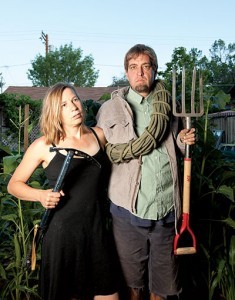
Dirt Farming Climber
June, the finest month of all, the earth in full tilt soak of the sun. Late afternoon light spills over the Sierra Crest and under the lenticular clouds. I’m sitting under an unknown grape, a vine with a trunk the girth of a large man’s thigh. It might have been planted when this house was built in 1918 … or not. Then again, there are always a lot of surprises with this old house that my wife and I bought this spring in downtown Bishop.
And this being a magazine with adventure in its title, perhaps it best to mention, there’s been a lot of that too, sometimes enough to rival any epic I’ve found on the rocks or in the water. Colonies of subterranean termites occupy my dreams at night; tearing down a wall to find a secret door leading to what might have been called a water closet at one time occupies my day. All the while, between framing up a wall or painting another coat of primer, I yearn up to the High Sierra, unable to decide whether I should be slinging an ice axe or a framing hammer.
But it’s the garden that has proved the biggest adventure of all and the reason we added “fixed rate lock,” “APR,” and “impound account” to our limited financial (in every sense of the word) vocabulary. When we saw the house we were sort of unimpressed. It was small, shoddily built, and smelled of 91 years of humanity. That is until we laid eyes on the big backyard sporting fruit trees and a long abandoned garden plot overrun by relentless Bermuda grass. We made an offer after mulling it over for three weeks only to discover another real estate idiom: 60-day escrow.
With the summer growing season fast approaching this meant only one thing. In order to get a garden growing we would be forced to become trespassers. The owner lived out of the area and we asked if we could simply water his property. He agreed. We watered in accordance to our agreement but we also hand weeded out a 40-by-25 foot plot, hauling four pick-up loads of the insidious grass to the dump. Meanwhile, a block away where we rented a small studio, we planted seedlings in plastic containers and peat pots.
Sierra climbing legend and skilled building craftsman, John Fischer, came over to look at the place we intended to buy. He shrugged at the visible dry rot, the leaning walls, the squeaky floor, the mounds of earth out back. He was silent for a while, not a good sign since we were planning on hiring his expertise on the work we would no doubt get in over our head. Finally he said (and I quote him loosely since there is no way to verify exactly what he said because John tragically died June 5 after hitting a deer on Hwy 395; Ed. Note: Look for a tribute to John Fischer in our September issue), “You probably know the story of French climbers Lionel Terray and Louis Lachenal, mountain guides in Chamonix who became itinerant farmers to make ends meet. Most days found them looking at their hoes then up to the high peaks then down at their hoes again. They looked at each other, dropped the hoes and grabbed their packs and headed up into the mountains.”
By the time escrow had closed beginning of May the garden was planted. Yet John Fischer’s underhanded but wise metaphor rang in my head. The only way to solve it I figured was to install an automatic-drip system with a timer. That way we could go into the backcountry for at least four days and still have a well-watered garden. Problem solved, we headed off to Vegas for the 17-pitch classic Epinephrine in Red Rocks. When we returned, scrubbed and scabbed by the notorious chimneys, the plants had grown twice as fast than if we would have been staring at them each day. Funny how that works.
So, a couple months since we have become Eastside farmers, reckon it’s time I take you on a garden tour from where I’m sitting. I moved from the unknown grape to under the cherry tree and feel rather like Bacchus with my wheat beer and a mouthful of fresh plucked cherries. Much like a climber who finds pleasure in doing a good route again just to show it to another climber, there’s not a gardener I know who doesn’t want to give a tour around the rows of vegetables and herbs so lovingly tended.
We’ll begin in what I’ve dubbed the Midwest ode to monoculture — corn, sunflowers, and soybeans. Monsanto isn’t welcome here, so they’re the only crops that hearken back to my paternal genetic roots in North Dakota. The only thing missing is wheat waving in the wind, which partly explains the hefeweizen in my hand. Next year. But I’m most excited about the corn seed I scored from an organic seed company. Propagated from a 4,000 year-old Anasazi Indian archeological site, I’m hoping this blue, yellow, and red kernel sweet corn will tap into North America’s rich agricultural past before white men like me arrived. Maybe I’ll even have some psychedelic visions after eating it and I’ll chip petroglyphs into the rocks I’ve pilfered from Bishop’s Tablelands (where many glyphs are found). But this is no doubt also the thinking of the white man in me. If all else fails at least I’ll deserve some federal farm subsidies for growing this much corn.
Next we move to what we call the salad bowl, another ode, but this time to the Salinas Valley, a hop down the 101 from Santa Cruz where I got my gardening chops started in the first place. Here we have lettuce, arugula, broccoli rabini, chives. Only thing missing is the artichoke and the Brussels sprout to round out the geographical metaphor. Again, next year. Given that Bishop has not a wisp of cooling sea fog, I’ve placed an arch of PVC pipe draped in shade cloth to make the leafy lettuce think they might not exactly be sweltering under the summer heat and bolt (or is it revolt?) into flower before wilting.
A row down, we arrive at a row of bean poles with of course beans climbing and writhing up the string and wire. That’s what they do best. Garlic covers the edges along with New Zealand spinach, Swiss chard, and watermelon radishes—green on the outside, deep red on the inside. I suppose it’s a good name but I hope they still taste deeply like radishes.
Then the ubiquitous tomato row next door crowned by a tarragon bush that I left from the previous owners gardening wisdom. Apparently these two plants are companions, the marjoram keeping pests away and providing a nice flavor to salads. At the end of the tomato row—mostly heirlooms and a cherry toms— is a small watermelon patch that has suffered then recovered twice now from late season frosts.
A row down and we arrive at the root crops—beets, carrots, sweet potatoes, and more garlic. Some of these seedlings were devastated by earwigs, especially the carrots. Which is why I hear the grating sound of my wife cutting plastic bottles with a dull knife to fit over the plants. She seems to think the earwigs will have a more difficult time climbing up the smooth plastic. With organic gardening if it works 20 percent of the time you might as well call it a triumph as long as you have another method—companion planting, attracting helpful insects to eat the not-so-helpful pests and the like—taking a another 20 percent swath. Most times, though, you just find a healthy resignation at nature’s persistence both in favor of your efforts and the one’s you can’t avoid.
Last we arrive at the hot feet row, the dancers of the garden, the squash, the sweet potatoes, the crook-necks and Kumi-Kumi squash (a native Maori squash). I thought of growing some zucchini but thought better of it after hearing my uncle’s yarn: “The only time we lock our doors in Maine is during zucchini season.”
I’ve had to ask myself what does this all mean? Well, it’s decidedly in line with the slow food movement. Though we haven’t bought a vegetable from Von’s supermarket in three weeks, living as we are on lettuce, broccoli rabini, radishes, beets, and chard, we would have starved while we watched our seedlings turn into proper, edible plants. Now each time we eat there’s an overwhelming hint of the good earth that we toiled in. Gardening, we’ve found is the slowest food movement out there and sometimes the slowest is the most satisfying.
Wendell Berry, one of the first great food and gardening writers, wrote that “the corporations will grow, deliver, and cook your food for you and (just like your mother) beg you to eat it. That they do not offer to insert it, pre-chewed, into your mouth is only because they have found no profitable way to do so.”
I’d like to think we are not growing our own for political reasons or we think it’s the end of the world. But maybe we are in some ways. There are definite tangibles that I can’t explain away with a gardening bias. We’re climbing harder, filled with more energy. The taste is different, too, drenched with flavor and I suppose if I were a meat eater it would be akin to eating something that roamed freely rather than slaughtered on a factory farm. The vegetables have a fibrous zest, almost a gamey aspect to them. And if I prevail to discuss what comes out the other side with the hopes you are not having lunch, my bowel movements have gone from G-flat sharp to G-major with Mahleresque proportions and even profundity helped along by a good book.
But we’ve all become bone-tired of another gardening article eschewing the virtues of growing your own while making a stab into the heart of big agriculture/petro-chemical industry. Yes, it’s the right thing to do probably, if you can find some land and some precious time. The good thing is the country is shifting slowly in the right direction. There’s an organic White House garden to replace the solar panels that Reagan ripped down. People are beginning to question what and if it’s food they are eating. We see more and more organic vegetables even in places like Wal-Mart. Farmer’s markets bring it all down to the local level with a garden of your own being as local as it gets. It’s mainstream and turning into a veritable movement.
But food politics and movements seem far removed from this garden. The plants could care less (or do they?). A little water (thanks LA Water and Power), good soil, a loving pat on a leaf now and then is all they require. Time to put down the hoe, then. The mountains are calling.
Thanks to their automatic-drip system, writer Bruce Willey and his wife Caroline Schaumann can sow seeds and multi-day climbing adventures all at once. You can read more of his fertile words at www.brucewilley.com and witness his camera work at www.plumephotoproductions.com.