Dec/110
A Royal Opportunity

Photo by Tim Hauserman
By Tim Hauserman
At Royal Gorge Cross-Country on Donner Summit, you can wind your way past the Snow Mountain hut to the jaw-dropping views from Point Mariah, ski along the edge of the ridge on Stage Coach, or catch the prevailing winds and fl y across the flats of Van Norden.
For 40 years, Royal Gorge has given Nordic aficionados something to smile about. But in August, after the owners of Royal Gorge defaulted on a $16.7 million dollar loan, a receiver was appointed to maintain Royal Gorge’s assets and prepare the 3000-acre property for sale.
What does this mean for the future of one of America’s largest cross-country ski areas?
David Achey, general manager of Royal Gorge, is optimistic. “We are definitely open this winter, six days a week, seven on holidays,” he says. “We haven’t withered away. The receivership has made it quite clear that the importance of keeping the ski area they will give Royal Gorge the resources necessary to make this a great season. It has been very positive. We’ve had guys painting, doing maintenance, summer trail work, looking into signage and maintaining the grooming fleet.”
Royal Gorge is also announcing that for the first time this year you will be allowed to take your dog out onto some of the trails. The Wells-Fargo-Emigrant trail loop near Summit Station will be available for dogs on Monday, Tuesday and Thursday. If the program is successful, Achey says they may expand the network of dog-friendly trails.
Tom Olson, managing director of brokerage services for the receiver of the property, Douglas Wilson, confirms Achey’s assessment. “(We’re) working to keep all the operations in place. We will try to do it in a way that maintains the value of the property. We want the community to be happy with the way it is run.”
But what is the long-term prognosis for Royal Gorge?
Olson says that the receiver’s task is to intercede while the lender and borrower are working things out. The receiver is a neutral party whose task is to maintain the asset and market it for sale.
“We are going ahead to market the properties with a price of $24 million, all cash at close of escrow,” Olson says. “In addition to Royal Gorge Ski Area, which includes some 3000 acres of land, the Summit Station and other buildings, the offer includes 300 residential acres above Donner Lake in Negro Canyon, and Rainbow Lodge, which includes 114 acres on the Yuba River.”
“The properties need to be sold as a group,” Olson adds. Ice Lakes Lodge, sitting on the edge of the Serene Lakes and adjacent to Royal Gorge trails, was also part of Royal Gorge until fairly recently, but it is not included in the sale.

Skating on more than 300 km of groomed track. Photo by Pete Gavin
“The judge wants to know that every rock has been turned over looking for a buyer that will pay the most for the property,” said Olson.
One group that has expressed interest in the property is the Truckee-based Truckee Donner Land Trust. “We have been interested in the property since our founding in 1990,” says Trust Executive Director Perry Norris. “The Royal Gorge property as a whole would be a perfect fi t for our organization — it has high natural resource values, recreational values, scenic and historic values.”
If the Trust acquired the land, Norris says, the plan would be to continue to operate it as a XC ski area through a operating partnership with the neighboring Sugar Bowl downhill ski resort.
“The ski area is an international destination for Nordic skiing and it needs to continue. Keeping the ski area thriving is an extremely high priority for us for both conservation and economic reasons. Sugar Bowl is interested in operating the ski area. We would really look at a partnership with them to run the area. They have the equipment and the expertise. They don’t do things for the short term. They have the right mindset that a conservation organization would want to work with.”
An additional potential public benefit is that the Donner Lake Rim Trail, built by the Truckee Donner Land Trust, goes through Negro Canyon, and the land trust owns 280 acres in Negro Canyon which border the 300 acres owned by Royal Gorge.
How did we get here?
In 1971, John Slouber started Royal Gorge Cross-Country Ski Area. Over the years he slowly expanded it to several thousand acres, built surface lifts and purchased Rainbow Lodge. His efforts turned a humble idea into North America’s largest cross-country ski area. He created a place with a tremendous variety of awesome cross-country ski terrain and ample snow within easy reach of the Bay Area and Sacramento metro areas.
While during Slouber’s reign Royal Gorge developed a reputation among Tahoe locals as being less friendly than the competing cross-country ski areas in Truckee and Tahoe City, no one could dismiss the great skiing at Royal Gorge.
In 2005, Slouber sold Royal Gorge to Kirk Syme and Todd and Mark Foster for a reported $35 million dollars.
Given the economics of cross-country skiing, $35 million is a lot to pay if you are just selling trail passes. The Fosters and Syme bought the property with the intention of creating a unique cross-country ski resort development, with approximately 900 homes and condos in several “camps,” as well as commercial development.
Before they could get the concept off the ground, the developers ran smack into a freight train full of problems:
First, there were difficult to solve questions about whether there was enough water or sewage capacity for all that development.
Secondly, since the Serene Lakes/Royal Gorge area is only accessible via one two-lane road, which happens to go over a busy railroad crossing, an expensive second road into the development would be required for emergency access.
Then, there was a hostile Donner Summit community that was fiercely against the project.
But probably the biggest kicker was the downturn in the economy. By 2008, real estate prices were declining and existing luxury resort developments in Truckee couldn’t unload their inventory, even at significantly reduced prices. There was no longer the market for almost 1000 new homes in an area as remote as Donner Summit.
Throughout, the developers understood the importance of keeping the ski area running to maintain the value of the property. Although there were some cutbacks in service and the number of kilometers groomed declined, it remains a wonderful place to skate away the day.
However, this past summer the developers couldn’t take the economic bleeding anymore and they defaulted on the loan.
This chapter of Royal Gorge is complete. The next one is yet to be written. By the time this hits print, Royal Gorge will be on the market and the receiver looking for a buyer. The Truckee Donner Land Trust hopes they will be that buyer, but certainly not at the current price of $24 million dollars.
Whoever buys Royal Gorge, hopefully they will see its value and continue to run it as a cross-country skiers’ haven. A place that in less than an hour’s ski you can stand and look to the south and east and see the Sierra Nevada crest unfolding before you, or look to the west and gaze into the 4000-foot deep gorge from which it gets its name.
Tim Hauserman is the author of “Cross-Coun-
try Skiing in the Sierra Nevada” and teaches
at Tahoe Cross-Country in Tahoe City.
Jun/110
Tahoe Road Rides

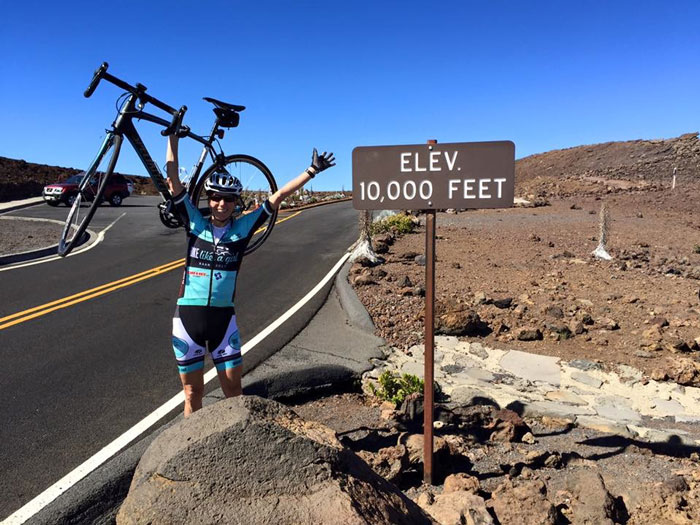
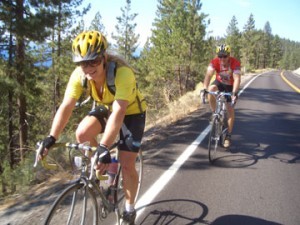
Sunshine and pines are commonplace on Tahoe rides. Just don’t ask the Amgen Tour of California. Photo by Pete Gauvin
May blizzards put a freeze on the Tour of California, but summer promises pleasant riding in Tahoe — honest!
By Tim Hauserman
Mother Nature has been far from hospitable to cyclists in Tahoe this year.
Most publicly, she had the audacity to drop snow and frigid temps on the opening two days of the biggest cycling race in North America, the Amgen Tour of California, nixing Tahoe’s debut performance on the world cycling stage with an icy middle finger.
But really that’s just egalitarian treatment for the pros. She’s been downright surly with nearly all Tahoe- region cyclists and visitors this spring. Mountain bikers are still waiting for the dirt to appear on many of their favorite trails. And roadies have had to endure an unsettled spring that’s been more of an extension of winter than a prelude to summer. Many just gave up and went skiing.
But now, finally, Ma Nature has put out the “Welcome to Summer” mat.
The peaks are still snow-capped but the snowplows are idle. The riding is beautiful. Come up and experience what the Amgen Tour peloton unfortunately missed out on.
Here are some good road routes to consider in the North Tahoe-Truckee area. Studded tires not required:
Blackwood Canyon
Barker Pass Road, which heads up Blackwood Canyon on Tahoe’s northwest shore, feels like a mountainous Tour de France stage without the screaming fans. Steep and narrow, it dishes out some kick- ass vistas across Blackwood Canyon to Twin Peaks.
The journey begins with an easy two-mile spin to a pastoral crossing of Blackwood Creek. Then the climbing begins, with a 1400-foot ascent in five miles to the end of pavement at the Ellis Peak trail (another half mile on dirt takes you to the PCT). It’s a steady low-gear grunt, followed by the long and winding ride back down.
The road isn’t plowed, so it takes until late spring or early summer to be snow free — count on the latter this year; it might even be July. But a few weeks before it is fully melted, you can ride the first few miles car free. Even once the road is open to cars, it is not exceptionally busy. Primary users are hikers heading to trailheads, so expect traffic early morning going up, and late afternoon going down.
To begin: Kilner Park, a good starting point, is three miles south of Tahoe City on Highway 89. You will find restrooms and water. From here, ride the bike trail two miles to Barker Pass Road and head up the canyon. To shave four miles, you can begin at the junction of Barker Pass Road and Highway 89.
Tahoe City to Truckee
This is a popular ride in both directions, often to access other rides, such as Donner Lake and Lake Tahoe.
From Tahoe City, proceed along the Truckee River bike trail to Squaw Valley. Early in the morning, late in the afternoon, or during the off-season this is a quiet, lovely ride along the Truckee River. Mid- summer, mid-day it is an obstacle course of oblivious, rafters and walkers, rarely paying attention, and small children just learning how to ride.
Past River Ranch things clear out and the riding is very pleasant to Squaw Valley. At Squaw, you can take a two-mile side trip into the valley or continue toward Truckee on Highway 89. The highway is busy, but the bike lane along the side is generous, and at least on the way to Truckee, you have the river clearly in view much of the way.
Eight miles from Squaw, you reach the outskirts of Truckee and a turn around spot just before the stop-light. Many riders swear that the section between Squaw Valley and Truckee is uphill in both directions, due to the barely detectable grades and swirling winds.
To begin: From Tahoe City, go south 1/4 mile on Highway 89, turn right into the “64 acres” parking lot, the Truckee River Recreation Trail and Public Access lot, and begin riding. From Truckee, ride down Highway 89 from wherever you are. Parking is available just 100 yards south of the light at West River Street. Restrooms and water are available at the Squaw Valley Park.
Donner Lake to Cisco Grove
It’s 40 miles and a deceptively difficult classic that should be on every Tahoe road rider’s tick list. From the east end of Donner Lake, start out riding west on Donner Pass Road. After a two-mile pleasant warm-up along the lakeshore, you are ready for the three-mile climb up Donner Pass. It’s generally not that steep, but if you need to catch your breath there are plenty of awesome Donner Lake views along the way.
At Donner Pass, you begin a long gradual descent to Cisco Grove. In a big snow year like this, you’ll enjoy the frothy waters of the South Yuba River tumbling later than usual, especially just above Rainbow Lodge, where the river frantically cascades down granite boulders.
Your turn around is at the Cisco Grove private campground where the road ends. As you start heading back you discover the deceptively difficult part of this ride. Was the hill this long and sustained on the way down?
When you finally crest the summit and fly down the winding road back to Donner Lake, take a sharp right turn at the bottom of the hill onto South Shore Drive and follow it around the lake to road end at Donner Memorial State Park. Here a bike trail continues into the park, quickly dumping you at a lovely beach calling your sweaty name for a dip. Cleanse and revive. It’s only a short coast to the park entrance and your car.
To begin: From Truckee, take Donner Pass Road west to parking on the road side near the entrance to Donner Memorial State Park. Water and restrooms can be found at a boat launch near the western end of the lake.
Boca to Stampede
For a fun 20-mile ride, start at Boca Reservoir and pedal along the Little Truckee River on a moderate uphill to Stampede Reservoir. After the steepest section, you reach a left turn, which takes you on a several mile jaunt over the dam and along the shore of Stampede to the boat launch.
To add a few miles, before you turn to go over the dam, continue ahead for several miles until the road junctions and pavement ends, then turn around and come back to the dam crossing road.
The ride provides wildflower dotted meadows, access to two reservoirs, and relatively easy riding on a lightly traveled road. Just like Jackson Meadows, the traffic you do see, however, is likely to be big and pulling a boat.
To begin: Drive seven miles east of Truckee on Interstate 80. Take the Boca-Hirschdale Road exit. Head over the railroad tracks to a small parking lot above Boca Reservoir. No bathroom or water facilities available at the start, but campgrounds along the route provide both.
Jackson Meadows Reservoir
This 36-mile out and back is a little known biking prize that is well worth a look. Long gentle descents and ascents bring you past quiet forests, wildflowers, and expansive views of Perazzo Meadows.
Your turn around point is Jackson Meadows Reservoir, a pleasant surprise that feels like Donner Lake without the houses crowding the shoreline. The road shoulder is narrow, but traffic is light, especially mid-week. What traffic you do see, however, will probably be a monster pickup hauling a power boat and coolers of beer in a hurry to get to the lake, so keep your ears peeled.
Got an extra day? Camp at Jackson Meadows, then jump on the little used, but beautiful section of the Pacific Crest
Trail which goes right through camp. Foot- traffic only.
To begin: Drive 14 miles north of Truckee on Highway 89. Turn left onto Forest Service Road 07, where you immediately find your starting point at a parking area with pit toilets (no water).
Sierra Valley
The Sierra Valley provides some of the best riding around. Start out by riding much of the route of the Tour de Manure metric century. From Sierraville head west about five miles on Highway 89 to Sattley, then turn right onto
A-23. Spin through lovely level countryside 16 miles to Highway 70, where you turn right.
In just a few miles, turn right again onto A-24 and travel through the center of the valley some 16 miles to Loyalton. From here, take a right and in 13 miles you will have looped back to Sierraville.
To begin: Drive 25 miles north of Truckee on Highway 89. Where 89 and Highway 49 meet in Sierraville begin your ride. Find water and restrooms in Sierraville and Loyalton.
Tour de Manure, June 11: Looking for a summer warm-up century? This is a great one. You only have to ride the more civilized 62 miles of a metric century, and there is excellent food and camaraderie at the end. Benefits Sierraville Fire & Resue. $45 until June 8; $55 after. Register at active.com.
_________________________________________________________________
Tim Hauserman lives in Tahoe City and wrote the guidebook to the Tahoe Rim Trail.
Jul/090
Step by Step Around Big Blue

Hiking the Tahoe Rim Trail is the thru-hike for everyone
Story and photos by Tim Hauserman
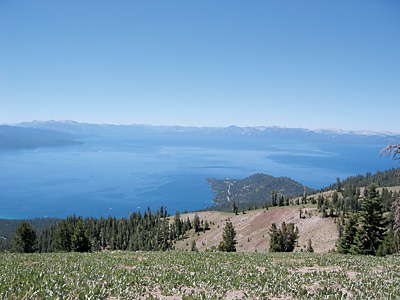
Looking south from the TRT near Wild Rose Peak, between Mt. Rose and Brockway Summit.
The Tahoe Rim Trail: It’s 165 miles of primo single-track circling Lake Tahoe via two mountain ranges, three wilderness areas and two states. Mile after mile of jaw dropping vistas of Lake Tahoe, quiet strolls through deep forest, and glacier carved lakes at the base of high granite peaks. In July, you’ll find spectacular wildflower gardens at Meiss Meadows; August is time for a refreshing swim in Dick’s Lake; and in the fall, yellow aspen leaves light up Snow Valley.
If Lake Tahoe is part of your outdoor lifestyle you’ve probably already spent time on the Tahoe Rim Trail. You’ve bombed down that sweet section of bike heaven above Tahoe City, or hiked to Star Lake before pushing to the top of Freel Peak. Perhaps you have hiked past the blaze of wildflower color along the streams north of Barker Pass, or spent a day with one foot in Lake Aloha and two eyes marveling at Pyramid Peak.
Don’t you think it’s about time to quit messing around with doing bits and pieces, and conquer the whole enchilada? Isn’t it time to thru-hike the Tahoe Rim Trail?
Why the TRT?
For the truly adventurous only the 2600-mile Pacific Crest Trail or 2100-mile Appalachian Trail will do, but most of us don’t have the time, inclination, or mental and physical strength to make that sort of commitment. The TRT is the thru-hike for ordinary humans. It provides a healthy challenge and a tremendous range of views and experiences, all in a nicely manageable size that can be handily completed in a two-week summer vacation.
Not only is the distance just right, but the TRT is user friendly in a variety of other ways as well. First, the trail is broken into eight segments providing plenty of road crossings and access to amenities that make trip planning easier. Second, it’s at Lake Tahoe, which dishes out nearly perfect summer weather. Other than the occasional thunderstorm you can count on sunny days, blue skies and temperatures that would make Goldilocks happy: Not too hot, not too cold, but just right.
And finally, the real selling point is that the TRT is a circle. You start walking and 165 miles later end up right where you began. This means you don’t have to mess around with shuttles; you just park your car and start hiking. But what the loop really means is that almost every day you can look across the gorgeous body of water that is Lake Tahoe and see where you have been and where you are going. It makes thru-hiking the TRT an awesome experience.
The Experience
When I solo thru-hiked the TRT in 2007, I started in Ward Canyon. I walked out the door of my house, caught a use trail from my driveway and in a mile I was on the TRT. In fact, many Tahoe area neighborhoods lie within a few miles of the TRT, so many locals can literally begin a trip at their door. Before departing I took a glance at Twin Peaks, towering above Ward and Blackwood Canyon. In the next few days I hiked past Tahoe City, Watson Lake and over Brockway Summit, and Twin Peaks kept getting smaller as the miles accumulated.
By day seven I sat on the bench of South Camp Peak, with almost all of Lake Tahoe unfolded before me, and there was Twin Peaks, just a little blip along the Pacific Crest, barely visible some 80 trail miles away (although only about 20 air miles). It was a moment of pride in my accomplishment, tinged with a sober assessment: I had covered a lot of ground, but I had a long way to go before Twin Peaks once again dominated the view.
At the south end of the trail as I headed into Desolation Wilderness, Twin Peaks disappeared for a few days and then like a light at the end of the tunnel it reappeared again, looking impressively close … a sign that my trip was nearing its end. On the last day, I walked just a few hundred feet below Twin Peaks’ summit before crossing from Blackwood into Ward Canyon, and on to home.
Solitude at Night
For those of you who have spent a crowded summer weekend day hiking or riding the Tahoe Rim Trail, backpacking provides a new discovery: The TRT is primarily a day-use trail. Hike from Tahoe Meadows to Hobart Road on a weekend day and it is not unusual to see over 100 mountain bikes on the trail, but when you get to Marlette Campground, it is likely you will have the campground to yourself. The next morning, since your day begins in the middle of a long segment, you are many miles from the trailheads on each end, which will translate into many hours of solitude before encountering your first day user.
Except for Desolation Wilderness, there are not a lot of backpackers on the TRT. On my thru-hike, except for busy Tamarack Lake just within the borders of Desolation Wilderness, I camped alone every night. In fact, on one midweek day I set up camp early in the afternoon at Star Lake, and didn’t see another person until late in the afternoon of the following day.
On my 14 days on the trail, I only ran into three other TRT thru-hikers. Where you will see other backpackers, especially if you are hiking in July, is on the 50-mile stretch where the TRT and the Pacific Crest Trail are combined. As a TRT thru-hiker, when you start talking to the hearty breed of folks that are 1000 miles into hiking the whole PCT, you start to feel like you are a three-mile walker in a local charity event talking to an Ironman competitor.
Challenges
Sure, thru-hiking the TRT is almost as easy as parking your car and starting to hike, but not quite. First, you need to arrange for food pick up. You can send packages to the Tramway Market on Kingsbury Grade, or to the Echo Chalet on Echo Lake. Another alternative is to make Tahoe City a stop, where a supermarket and Alpenglow, an excellent outdoor gear shop, are less than a half mile from the trail.
Your biggest challenge with thru-hiking the TRT is finding adequate water. There are long stretches along the north and east shore where water is not available. In several places you will want to cache water ahead of time, in other locations you will need to carry extra water to make it through a dry spot.
Perhaps the best way to hike the TRT is to let someone else do the planning and take care of all those water and food issues for you. Become a participant in the Tahoe Rim Trail Association’s annual thru-hike.
Tim Hauserman is the author of, “Tahoe Rim Trail: The official guide for hikers, mountain bikers and equestrians,” published by Wilderness Press, as well as “Monsters in the Woods: Backpacking with Children” and “Cross-Country Skiing in the Sierra Nevada.” He is a professional hiking guide and teaches skiing at Tahoe Cross-Country ski area. He is scheduled to lead the TRT thru-hike leaving July 25th.