1
Jul/08
0

The Last American Road Trip

Essay by Bruce Willey

It begins when you can leave town, when you leave your common sense, your guilt and a large chunk of yourself behind. It could be four years of pent-up academic frustrations. It could be the many years at a job that fleeces your ability to connect to the sweet simmering world. It could be simply that you want to let the road show you the pace. To hell with schedules, unwanted phone calls, the incessant hassles of life. To be immersed in the vicissitudes of flux at just a tad above the speed limit is nothing short of being loyal to the human spirit.

So your car or your pick-up truck is a little low in back with the tent, the sleeping bags, a Coleman stove and lantern, food, cooler, foam mattress, the beer and firewood. You will press on the accelerator and feel the precious gas pull you forward down the road. Nothing better than to see the gas gauge on full. So much promise and portent. And it begins with a full tank of gas. It always does.

But you’re guilty, as well you should be. Disbelief that you just paid well over $4 a gallon, enough to make you feel almost European. Disbelief that the oil in the earth will run dry just as sure as the mighty and seemingly endless Colorado River does not anymore empty into the Gulf of Mexico. You’ve got to do it now, now before it hits 10-15 dollars a gallon—because it will. Sooner than you think.

Common sense declares you would be doing your part to save the world by taking a long bicycle trip instead. You would. But a bicycle won’t make it to Utah in two days. So you promise yourself just one more road trip, one more time to see the ancient layers of red and tan rock carved by inches of time and water.

So you head due east, running up the flanks of the Sierra by noon. It would have taken John Muir a week to walk the same distance. Muir thought horse travel was too fast. But he knew the pleasures of wildflowers not asphalt. And besides, his former path to the Sierra is now blocked by Wal-Marts, Starbucks, and corporate farms, the air as polluted as the Los Angeles Basin. He’d be lost now, another visionary homeless man in a thumped and thrashed landscape.

You reach Yosemite’s Tioga Pass and drop down the eastern scarp of the Sierra, down into Owens Valley. At Big Pine you hang a left, and start ascending again to a narrow pass that will take you over the White Mountains, home to some trees that were already old when the Egyptians began building the pyramids. Then on into Nevada where you’ll turn right at a roadside brothel that has since gone out of business because most long-haul truckers have turned to their wives for love when it takes $1,000 to fill up on diesel.

Making Las Vegas by nightfall, you’ll camp at the Red Rocks campground. A cactus-covered hill will hide the swift creeping suburbs below, but the strip’s neon glow will still penetrate the night sky. In the morning you’ll take a long walk into the canyons of Red Rock and you will feel finally that you have reached the Southwest. The wildflowers will be blooming against the black desert patina and you’ll realize that life on earth is tenaciously bold.

Still, the alarming proximity of the city will begin to fray your nerves. So you will travel northeast through Arizona for an hour where you’ll indulge yourself with some Meat Puppets, a lazily stoned punk rock band that has musically articulated the desert better than any other band in the history of rock & roll. Once you cross the Utah border, you’ll turn off the music and let the tires and the wind take over the soundtrack. Two hundred or so miles the road weaves in and out of canyon lands, a rippling landscape so stunning and strange it seems to have the capacity to kidnap your soul.By afternoon you’ll head south into Moab where the economy, once dominated by the search for uranium to blow the world to smithereens, is now the mountain biking and motorized off-roading capital of the world. Mud splattered jeeps roar in and out of fast food joints. Motorhomes bung the highway with gas tanks that take a month’s pay to fill. Moab, a Mecca in the desert where people religiously worship the dirt road or file into guided raft trips down the Colorado River. All fueled by oil from another desert half a world and a white robe away.

So you head south, past the Hole-in-the-Rock tourist trap where you can pat a wallaby if you’re so inclined. Dipping down into Indian Creek you’ll camp for a few days amongst the junipers, the remnants of splitter cracks scabbed on your hands. You’ll build a bedroom with your tent and rocks for chairs in your open-air living room. You may even assemble a kitchen on a flat rock while the red sand slowly works its way into every cranny and hair of your body. And it will feel good; better still when you sit in the cold, mountain-fed creek.

At night you’ll make a campfire, noticing someone left their unpaid student loan bill ($38,984 due) and an outstanding medical bill ($567.34) near the fire pit. You use the bills for fodder and soon have a lively fire while you wonder about the guy who camped here before.

Next day the rain will come, bathing the sky with rainbows. The creek will come up to the floorboards as you cross it, and you will seek higher ground. So you head north to a place where desert towers stand like old, gossipy men. It will be impossible not to wonder what you will find on the tops of these summits, so you will tie into a rope and climb the ancient mud to a wild summit that ravens have vital knowledge of.

Nearing the top with 700 feet of air below your feet you think you could very easily die, especially when you are forced to belly flop onto a snout of mud-hardened rock. But you must put this thought out of your mind. If you had any sense you would remember that the world’s food supply is in trouble. The strung-out economy is a Wall Street minute from collapse. The earth’s climate is showing the strains of one too many road trips. It would do the planet a lot of good if you jumped. One less Toyota truck on the road. One less mouth to feed. One less carbon footprint. But you’re already gripped with your possible and immediate demise as it is.

As you look around, the Fisher Towers appearing as though they were made by a giant hand dripping mud from the sky, you want nothing more than to get down and drive home. To feel the road under your seat just one more time before the road trip simply becomes a thing of the past. So you rappel into what’s left of the late afternoon, knowing that this place may one day soon be too far, too expensive for your gas-driven reach.

1
Jan/04
0

Trans-Sierra Winter Trek

by Matt Johanson


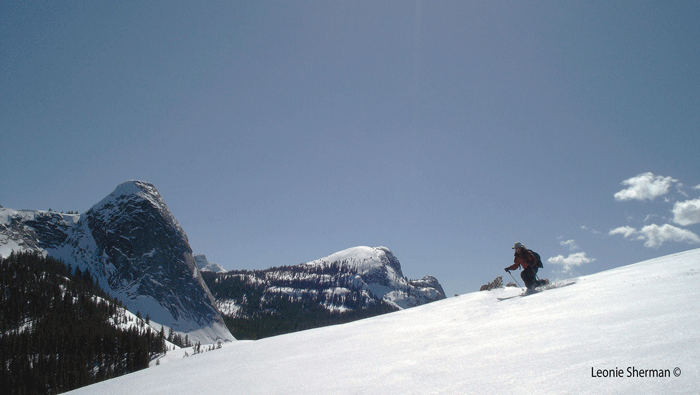
As we gazed over Tuolumne Meadows and countless snow-covered pinnacles on the horizon, we saw not a soul and scarcely a sign that people had ever been there. It was hard to believe we were in one of the world’s most famous and popular parks, visited by more than 4 million people every year. To reach the 9,450-foot summit of Lembert Dome in summer involves an easy hike, but to earn that same view in winter we had to ski for two days to even get close, and then trudge upwards through several hundred feet of deep powder. We had carefully hiked the final steps over rock and ice to reach a patch of bare granite atop the mountain of snow . The amazing view from the peak was our reward. The whole point of visiting Tuolumne Meadows in winter is to be one of the few to enjoy the perfect tranquility and spectacular snow covered landscape. The amenities that summer visitors enjoy are scarce.

Crossing the mountains on cross country skis from east to west was our goal, starting in Lee Vining and finishing in Yosemite Valley. We spent five days in early April to cover 35 miles plus side trips. Our three-man team consisted of me, my friend Cliff DeYoung (both in our early thirties), and Cliff’s father Richard DeYoung, the fittest and toughest 61-year-old I know. We are all experienced if not expert skiers. We took many preparation trips, both in Yosemite and the Lake Tahoe area. On one trip, after a surprise storm buried our tent at night near Lassen Peak, I figured we were ready for anything.

Tioga Pass was our destination the first night—eight uphill miles from the winter gate east of Lee Vining on Highway 120. To our surprise, a crowd of people waited at the road closure for a ride from one of the few motorists with winter access: a driver for Tioga Pass Resort. Tioga Pass Resort, a privately-owned cluster of cabins just two miles west of Yosemite’s Tioga entrance is a convenient first stop for skiers crossing the mountains. Dinner, breakfast and a pick-up ride to the snow line are all included with TPR’s package, and we watched the truck’s driver take a pack of tourists up the mountain. We chose to forego commercial assistance and trek in alpine style, so we set off on foot under heavy packs, scoffing at the “softness” of the resort guests. Privately, though, I found little satisfaction in plodding up a paved highway in ski boots. Within two miles, Cliff felt blisters forming. An hour later, the pick-up approached on its final run.

“You guys wanna ride?” asked TPR’s driver Stacy Lewis. “You talked us into it,” I said. Stacy took us about two miles, from 7,800 feet to the snow line at 8,800 feet, and even offered to haul our packs in the snowcat the next two miles to the resort. That was going too far, we decided, and politely declined. We had four miles and about 1,100 feet of elevation gain between us and Tioga Pass. “We should make it to the pass tonight, shouldn’t we?” Richard asked. “If you don’t, you’ve got no business doing the trans-Sierra,” Stacy replied.

How Did You Get That Up Here? Skiing on good snow, we reached Tioga Pass Resort in an hour. A friendly crowd, warm fire, and the promise of a hot dinner tested our resolve, but we pushed on towards the pass, reaching
it in an hour. Normally, camping at the 9,943-foot pass would be inadvisable due to high winds, but the warm and calm conditions were inviting. For better or worse, this meant we would have access to a nearby pay phone,
half buried but operational. We spent a peaceful evening in our four-season tent, dining on soup, rice and leftover steak which we ate with bare hands right out of tin foil. Big, bright and countless stars filled the clear
sky, until a moon rose so bright it seemed to turn night into day.

It was only eight downhill miles from Tioga Pass to the next common destination, Tuolumne Ski Hut, a public cabin that serves as a campground office in summer. Near a host of exciting winter attractions such as Cathedral and Unicorn peaks, the hut provides shelter and modest comfort to up to ten skiers on a first-come, first-serve basis, at no cost . We arrived at 1 p.m. on our second day, claiming three of the four open beds. That evening, our fellow cabin guests put our meal of rice and noodles to shame with their dinner menu: beer, wine, salad, a hearty stew, and cheesecake. How had they carried such a backbreaking load? They took advantage of a large food locker provided by the park service. Many winter visitors cache non-perishable food during the fall, and we earnestly wished we had done so, though one friendly skier offered us his surplus pickles, olives, cheese
and salami.

Together the nine of us passed a pleasant evening. I called my wife on the pay phone and checked on the Giants, who had just swept three games from the Dodgers behind a barrage of Barry Bonds’ home runs. Women teased the men about snoring, and men stoked the fire hot enough to make a sauna of the cabin, trying to entice the women to disrobe. Sweating like a pig, I stripped down to my shorts. The women held tough.

“I can’t believe you can come here for free,” laughed Dave, chief fire-tender and an accomplished skier. Only a handful of people visited the hut in December, January and February, according to the guest book. On most nights, it was vacant. Many more came in March and April, and the cabin actually overflowed on our second night. Ten skiers slept inside and a family of four camped nearby. They did not seem pleased to spend a long night in their tent away from our warm stove.

Shall We Tell Them How Easy It Was? We relished the waterfalls and snowy granite domes of the trek’s fourth and longest day. We had grunted up many long hills by this point, but here I found the first technically
challenging skiing comprised of runs down long, shady ice slopes. We skied about two hours from the hut to an amazingly turquoise, frozen Tenaya Lake, where we paused to eat and refill our water bottles. We considered it important to rest and hydrate before Olmstead Point, a notorious avalanche hazard and the most serious obstacle of the trip.

The avalanche danger of Olmstead Point became clear as we approached. Facing into the sun, its steep slope seemed to be 40 to 45 degrees—a perfect combination to encourage snow slides. Sure enough, the trail of a previous avalanche crossed our route directly. A cause for concern, it had motivated me to attend a basic avalanche safety seminar prior to our trip. On the bright side, fresh snow had not fallen for more than ten days. Still, we took basic precautions. Before entering the hazard area, each of us tied on an avalanche “tail,” a thin, 50-foot length of rope. Should an unexpected snow slide bury one of us, the others could quickly find him as long as they could find any part of the tail. Resolving to move quickly, I led at double time, followed by Richard and Cliff. As we crossed the hazard, I wondered what I would do if the slope were to suddenly slide. Turn downhill and try to escape the avalanche? I doubted the plan would work, but the alternative of being buried alive was even less appealing. Five breathless minutes later, we reached more level terrain, where we relaxed and admired the view of Tenaya Peak, Tenaya Lake and Polly Dome. Olmstead Point also boasts an awesome view down Tenaya Canyon and a unique perspective of Half Dome. From a short distance past Olmstead Point, skiers must leave Tioga Road for the first time and either follow Snow Creek Trail or devise another route to Yosemite Valley. After camping near Mount Watkins, we started this descent in earnest on the fifth and final day. Though mostly downhill, this leg of the trip can be the most difficult because of inconsistent snow and the challenge of route finding. We took our
first falls on snow that was sometimes icy and fast, and other times slushy and slow. After a few aggravating hours of trudging over downed logs, boulders and snow patches on a steep grade while trying to reacquire the trail, we reached bare earth again and hiked down the switchbacks near North Dome. Despite fatigue, our spirits rose as we completed the last leg of the journey back to civilization.

“Are we going to tell everyone how easy it was?” Richard asked. The Trans Sierra is not always easy, though. Conditions for us in early spring had been nearly perfect, but good weather and snow are never guaranteed. A foot of fresh powder would have made our work twice as hard, and every one of our warm-up trips had been far more difficult. Only strong and experienced skiers should even consider a trip like this. Help in an emergency will be unlikely. If you’re ready for it, though, there’s no finer backcountry skiing in California. “My only regret,” Cliff said, “is that we didn’t do this a long time ago.” Catching the bus at Mirror Lake, we enjoyed our trip across the valley like a victory lap.