7
Sep/11
0

Kokatat Celebrates 40 Years of Sewing in California

Kokatat, a premiere manufacturer of technical apparel and accessories for water sports based in Arcata, is celebrating 40 years of handcrafted innovation this year.

“When other technical brands were moving their manufacturing offshore, we made the decision to continue to invest in our own infrastructure in the US,” said Steve O’Meara, Kokatat founder and CEO. “By keeping manufacturing in Humboldt County we’ve been more flexible and provided better service to our dealers.”

Kokatat’s hands-on approach to manufacturing has allowed the company to quickly respond to market demands and keep a close watch on product quality.

More than 90% of Kokatat’s global sales are generated from apparel and accessories that are manufactured in Kokatat’s factory in Arcata. With a just-in-time manufacturing strategy, Kokatat is able to control its inventory and react to market demands much faster than competitors who manufacture offshore. This strategy ensures product availability the entire season without having to stock unnecessary excess inventory of finished goods.

The strategy has paid off. Kokatat has annually been named as one of the top customer service and dealer service brands in the paddlesports and outdoor industry.

“When we started out, the decision to keep manufacturing local was a business decision,” added O’Meara. “We’ve since found that sewing “Made in USA” into our garments, was also a socially and environmentally responsible decision as well.”

Thanks to domestic manufacturing, Kokatat has been able to maintain a low carbon footprint relative to many other outdoor apparel brands that source goods offshore. Kokatat further reduced its impact this year when it activated one of the region’s largest private solar photovoltaic systems, enough to run much of the company’s manufacturing equipment.

1
Jul/10
1

The Big Ideas

11 Solutions That Could Actually Save the Planet

By Will Harlan and Graham Averill

11 Big Ideas

11 Big Ideas

The editors of Blue Ridge Outdoors, our sister magazine in the Southeast, asked Pulitzer Prize-winning authors, CEOs, and leading environmental experts: What is the single most important change needed to protect the planet and its people? Here are their 11 insightful, innovative, and inspiring responses.

1. Educate Women Worldwide

The most effective contraceptive is education for girls. When women are educated, they tend to marry later in life, to have children later in life, and to have fewer children. In effect, you have a form of population control that’s peaceful, voluntary, and efficient. Plus, women do better in business, raising economic growth rates and lowering societal conflict.

Empowering women through education provides the highest return on investment in developing countries. It is the single most cost-effective way to empower and modernize communities.

Of course, it’s also important to educate boys, but there are a couple of reasons why girls’ education brings an even higher return. First, it reduces birth rates very considerably, which brings the country a demographic dividend. Second, women are more likely than men to use extra income to educate their own children and to start small businesses.

—Sheryl WuDunn, Pulitzer Prize winning co-author of “Half the Sky: Turning Oppression Into Opportunity for Women Worldwide”

2. Safe Drinking Water

Imagine if, instead of just going to a tap in your kitchen anytime you were thirsty, you had to hoist a heavy vessel onto your head and walk, up to two hours, to a well, where, after filling your vessel—now really heavy—you had to carry it up to two more hours back home. The water you carry would often be dirty and diseased. After your trek, how much more time and energy would you hope to have to farm, cook, take care of your family, especially the sick ones, or go to school? This is the dilemma facing over one billion women and children worldwide each day. A child dies every 15 seconds because of water-related diseases.

Fortunately, we already have the solutions to the world’s water crisis, and they are surprisingly simple: low-tech wells and small-scale water projects that are completely sustainable and maintainable by the communities they support. Hand-washing and basic hygiene education are also essential to prevent disease and contamination.

In the United States and other developed nations, water conservation is crucial. Improving water infrastructures and protecting watersheds are important governmental actions, but the Blue Revolution begins with each individual taking steps to reduce his or her own water footprint.

—Lisa Nash, CEO of the Blue Planet Network

3. No-Growth Economy

The rapid economic growth of the past two centuries has been felt very unevenly around the globe. Many have prospered while many others remain desperately poor. Economic growth has depended on a massive increase in the use of materials and energy, and on the spread of humans into virtually every corner of the planet, accelerating the extinction of other species. And yet the human population is forecast to grow by another 3 billion or so in the next 50 years.

It is most unlikely that the planet will be able to accommodate so many of us and raise the material living standards of those in greatest need, without changing the priority we give to economic growth. Having overshot the capacity of the planet to support us, starting in the rich countries we should reduce the demands we make on the planet to cater to our profligate way of life and forego the pursuit of endless economic growth.

An economy that doesn’t grow in material terms—a steady-state economy—can be healthy and even desirable, as economists as great as John Stuart Mill and John Maynard Keynes acknowledged. But it will require fundamental changes: we will work less so that more people stay employed with a reasonable salary, and consume less, scaling back to something like levels in the 1960s, so that citizens in developing countries can prosper. A world with fewer larger inequities between rich and poor would be more secure and would also help stabilize world population levels. And with more time to spend with family, friends and in our communities, we might well live truly richer and more fulfilling lives.

—Peter Victor, Professor of Economy at York University and author of Managing Without Growth: Slower By Design, Not Disaster

4. Think Globally, Eat Locally

We need a transparent and locally-based food system, where people understand exactly how food gets to their table and what the hidden costs of cheap food really are. In order to get that cheap tomato out of season, it takes a vulnerable labor force, big factory farms, and giant waste lagoons.

Cheap food is also responsible for our obesity epidemic. There’s also an environmental cost to shipping food around the world. From the perspectives of economy, ecology, health and taste, the actual value of a locally grown tomato far surpasses the actual cost of a tomato grown by a factory farm.

Once locally grown food becomes mainstream again, we’ll see a healthier population and a healthier environment. And the systems we have in place can handle this change. Grocery stores can be supplied by local farmers just as easily as corporate farms. Even large distributors are willing to accommodate local farms. They just need to see the desire in the marketplace.

—Charlie Jackson, executive director of the Appalachian Sustainable Agriculture Project

5. Corporate Revolution

Benefit Corporations—called B-Corporations (or B-Corp)—is a certification to distinguish truly sustainable businesses from the pretenders and greenwashers. Instead of simply measuring economic performance, B-Corporations have also committed to meeting social and environmental performance measurements. The IRS audits the economic portion, while the B Lab — a public charity nonprofit — audits and rates the added performance measurements of all B Corps.

Maryland and Vermont became the first two states to enact B-Corporation law earlier this year, and already there are over 125 B-Corps in 31 industries comprising $1 billion of the market. It is the best way to definitively evaluate and separate the pretenders from those businesses that really practice what they preach. Best of all, consumers can know with certainty that the businesses they support have met certain social and environmental standards.

How you measure a successful business is changing in the 21st century: from “me” to “we.”

—Andrew Kassoy, co-founder of B-Lab, the certification organization for B-Corporations

6. Cash for Pollution

You have to show Americans the true price of pollution. That is best accomplished by levying a tax on fuels when they’re taken out of the ground or imported into our country. The companies will pass most of that cost onto the consumer, which will make turning your lights on and driving your car cost more. So give the $500 billion in tax revenues back to the American people as a “green check” each year, divided up equally, exactly like they do in Alaska with oil revenues. This gives citizens a chance to recoup the extra costs that are passed down because of the carbon tax.

The cap and trade system has to die before the carbon tax will live. The problem with cap and trade—where companies buy and sell a finite amount of pollution credits—is that once you have trading, you have Goldman Sachs—the smartest people in the room figuring out ways to game the markets and make a profit. The clearest, fairest, most transparent way to address the issue is with a straightforward tax.

There’s a dirty little secret with energy. Occasionally, the Americans see the truth when an accident like this oil spill (in the Gulf) or the coal ash spill (in Tennessee last year), but mostly, it’s a matter of out of sight, out of mind. We don’t see the true cost of this energy to our health, our environment, and our everyday lives.

—Charles Komanoff, co-founder of the Carbon Tax Center

7. Free Condoms

Our planet is simply overwhelmed by too many people. We’re doing all this work to clean up the streams, protect a habitat here and there, or reduce our carbon footprint, but it’s not going to do any good if our population continues to grow out of control.

Here in the U.S., which has the fastest population growth of any developed nation in the world—the impact of our population growth is compounded because an American child’s carbon legacy is 168 times more than a child born in a developing country like Bangladesh.

The way to stabilize population—both in the U.S. and overseas—is to make birth control universally accessible. Here in the U.S., birth control is not covered by many women’s health care programs, and worldwide, millions of women don’t have access to any health care. So we’re distributing free condoms, with endangered species depicted on them to help people make the connection between population and the planet’s health. We’ve already distributed 350,000 free condoms in the first five months of 2010.

We must look at birth control not as a moral or religious issue, but as a simple biological question: How many people can this planet sustain?

—Randy Serraglio, overpopulation project coordinator for the Center for Biological Diversity

8. Drive Less

On average, Americans spend 18.5 hours per week in our car, and over $7,000 a year in gas, maintenance, and taxes. Americans essentially need a part time job to pay for their car.

The solutions are attainable: first, try to drive 1,000 miles less per year (Americans average 22,000 miles per year). Next, keep a car diary detailing the number of trips you take in your car and how much time you spend in your car. Also compute the household car costs in this diary. Write down every tank of gas you buy, every set of tires you buy.

Once you start writing these trips and costs down, you’ll begin to see that owning a car is a trade off. If you’re spending $7,000 or more on your car every year, that’s a lot of vacations, take-out meals, or college tuition payments you could be contributing to.

Having a positive impact on climate change is a good reason to drive less, but it goes beyond that. Car-related accidents are the main cause of death for people ages 3 to 44. It’s a public health issue as much as it is an environmental issue.

—Catherine Lutz, anthropologist, professor at Brown University, and co-author of “Carjacked: The Culture of the Automobile and its Effect on Our Lives”

9. Play Outside One Hour a Day

We’re seeing a generation-long disconnect between kids and nature. The implications of this disconnect range from obesity, to media addiction, to attention deficit disorder. And there are volumes of research showing that time outside is good for a kid’s mind, body, and spirit.

Set aside a green hour everyday where your kids—and you—can explore the outdoors. Even 10 or 15 minutes of outdoor play is worthwhile. The important thing is for you and your family to immerse yourselves in nature, to rebuild that connection that we’re losing.

The amount of time kids spend exploring the natural world today will inform how they will see the natural world as adults. Before we ask kids to save the world, let them first come to know it and love it.

—Todd Christopher, author of “The Green Hour: A Daily Dose of Nature for Happier, Healthier, Smarter Kids”

10. Put a Price on a Priceless Forest

Forests are the world’s main reservoirs for carbon. Old growth forest is optimum for the sequestration of carbon. The older the forest gets, the more carbon it banks. The Smokies (the Smoky Mountains) sequester a lot of carbon, and there’s a lot of forest left on public and private land that’s still in good shape. So how do you convince America to protect it?

We need to establish a system that actually details the monetary value of these intact forests from a carbon sequestering, watershed protection, and public health standpoint. Paying to protect forests is cheaper than shooting carbon into space, safer than shooting into the earth’s core, and it’s the solution that’s readily available.

If we can develop a carbon trading system that puts a price tag on the carbon sequestration, watershed protection, and public health values of a forest, we can then use a percentage of those trades fund the acquisition of more conservation easements and forest protections.

—Hugh Irwin, conservation planner for the Southern Appalachian Forest Coalition

11. Meatless Mondays

The United States is the world’s most obese country, and the world’s largest producer of greenhouse gases. How do you kill two birds with one stone? Eat better meat, and less of it.

Our entire food system needs to be overhauled, and it’s not going to happen overnight. But what is realistic, what everyone can do, is reduce the amount of meat they eat, which will substantially reduce the amount of livestock waste that ends up in our water sources, the amount of fresh water we use for those animals, the amount of grain we use to feed those animals, the amount of antibiotics injected into our food system, and the amount of greenhouse gases we produce.

Meat is a great resource for protein, and in moderation, it’s fine. We just eat too much of it. A realistic and attainable goal we’ve created is Healthy Mondays, where people eliminate—or reduce—meat consumption one day a week. The impacts it will have on your own health and the health of your environment are substantial.

—Ralph Loglisci, project director for the Johns Hopkins’ Center’s Healthy Mondays initiative, a push to get schools, hospitals, and institutions to make better choices one day a week.

1
Jul/09
0

Fact or Fiction?

Green Myths photo

Busting the 10 Most Common Eco Myths

By Will Harlan and Graham Averill

You’ve heard these myths before. Your uncle likes to repeat them at the dinner table, corporations tout them on TV ads, and politicians spew them during stump speeches. They’ve been used over and over to justify poor environmental policy, and they’re just plain wrong. Here are the top ten most dangerous eco myths.

1. Clean coal technology will solve our energy problems.

The coal industry has spent millions marketing their new “clean coal” technologies to the public. In 2008, the American Coalition for Clean Coal Technology spent $40 million on TV and radio ads, and $1.7 million went to street teams who handed out clean coal schwag at the Democratic and Republican conventions. More troublesome, every politician from Obama to John Boehner tout clean coal as a viable workhorse for our energy needs.

Yet the truth is this: clean coal does not exist. According to MIT, the leader in clean coal technology research, the first coal plant able to capture its carbon emissions won’t come online until 2030 at the earliest, which makes carbon capture and sequestration a theoretical possibility at best.

But here’s the real kicker: clean coal isn’t even clean. Even if coal plants were able to capture its carbon emissions, turn them into liquid form, and inject them into the ground or ocean (which presents its own environmental pitfalls), we still would end up with even more polluted skies and waters. That’s because carbon is just one of over 100 toxic pollutants emitted from burning coal, including mercury, smog-forming nitrous-oxides, and particulate matter, which are responsible for higher rates of birth defects, asthma-related illnesses, and heart and lung diseases. Carbon capture does nothing to mitigate these other pollutants. But it does increase the amount of mountaintop-removal mining, sludge ponds, buried streams, coal ash dams, and other toxic legacies—hardly deserving of the word clean.

2. The U.S. shouldn’t cap carbon emissions until China addresses the issue.

There is no doubt that China’s carbon footprint is huge. In the last four decades, China’s carbon footprint has quadrupled, and recently, China became the world’s greatest emitter of carbon dioxide, just surpassing the U.S. But when you consider the population difference, the massive Asian country doesn’t even come close to our level of emissions. There are one billion people in China, emitting essentially the same amount of carbon dioxide as the 300 million people in the U.S., and we’ve been leading the CO2 emissions for over 100 years.

A new study by the National Center for Atmospheric Research indicates there is no way to avoid warming during the 21st century, but reductions of greenhouse gas emissions by 70% could stabilize the most drastic negative affects of that warming.

It is no longer an option to wait for China to address global warming if the world as a whole is going to hit the estimated global CO2 stabilization targets and avoid the worst impacts. As the largest piece of the emissions pie, and as the wealthiest and most technologically advanced country in the world, the U.S. has to lead the way in reducing emissions. We already have the technology to do so: a study by the international auditing agency McKinsey and Company found that if the U.S. just adopted stricter energy efficiency codes in its buildings and appliances, we could reach one third of our greenhouse gas reductions target.

3. Alternative energy is too expensive and coal is cheap.

Even if you set aside the environmental and public health costs of coal-fired power (how much are healthy lungs worth, anyway?), solar and wind are cheaper than coal when all of the government subsidies for coal are removed. Coal power claims to deliver power at $2 per kilowatt, but that price includes billions of federal funding. The only so-called clean coal power plant in the works—an experimental station called FutureGen in Illinois—is already pricing out at $6 per kilowatt, and that does not even include the cost of extracting and transporting the coal. A coal plant lasts only 20 years before it must be upgraded, and the coal must constantly be mined and transported.

Meanwhile, right now most solar can deliver solar power to the company for roughly $3 per kilowatt. And that energy continues indefinitely into the future, with no cost of mining or transport.

And renewable energy becomes cheaper with every new solar panel or wind turbine installed, while coal prices—because it’s a finite source—will only continue to climb higher. And this coal is actually going to cost you, the taxpayer and rate payer, a fortune: The Department of Energy just spent $2.4 billion for clean coal projects in its 2009 budget request, the largest increase in public funding for coal research in 25 years. While the government is subsidizing the research of clean coal, a new study by the University of Massachusetts shows that investing in clean energy creates three to four times more jobs than investing the same amount of money in the coal industry.

4. The population boom in third world countries threatens our resource supply. Someone make those poor people stop having babies!

Global population is a serious concern. There are an estimated 6.7 billion people in the world right now and U.N. projections put global population at 9.2 billion by 2050. Whether earth can sustain 9 billion people is at best debatable, and the rapid growth in developing countries is troubling.

But the scariest statistics hit closer to home. The United States is growing at a faster rate than almost every other developed country in the world. Our population has doubled in the last 60 years, and we’re expected to grow to add another 100 million Americans by 2050.

A hundred million more people doesn’t seem like a lot when India is expected to grow by 500 million, but we’re talking about 100 million more Americans, who already consume a quarter of the world’s natural resources. The average American uses four trees worth of paper products per year, twice as much as the average European. We’re worried about India’s population boom, too, but Americans consume 35 times more resources than the average Indian.

Our resource consumption is already taking a toll on our planet right below our feet. Half of our population currently relies on ground water for drinking water. Ground water tables have dropped hundreds of feet in western states, and Florida’s freshwater table has been so drastically depleted that saltwater intrusion is becoming a serious concern. In California and elsewhere in the West, the diminishing groundwater reserves are compounded by shriveled reservoirs and reduced average snowpacks in the Sierra and other ranges.

5. Green power can’t meet U.S. energy needs.

Eight hundred gigawatts. That’s how much power America uses. And to suggest that alternative energy sources like wind and solar can’t provide that amount of energy is simply wrong. Jon Wellinghoff, the head of the Federal Energy Regulatory Commission, recently told Congress that the U.S. may never need to build a new nuclear or coal-fired power plant again because renewable energy and improved efficiency can meet America’s future energy needs. He cited the 500-700 gigawatts of wind in the Midwest and ample solar potential in the Southwest.

Interior Secretary Ken Salazar recently said wind energy replacing coal is “a very real possibility.” The world’s largest wind farm, Titan Wind Project in South Dakota, will have 2,000 turbines producing 5,050 megawatts, enough to power every home in South Dakota and North Dakota. In 2008 alone, there was a 50% increase in the installed wind capacity in this country, with more projects scheduled to come online in 2009 and 2010.

As for solar, it alone could supply 90% of our energy needs, according to the Department of Energy’s own data. Every state in the union is an ideal candidate for solar power. The 800 gigawatts that America needs translates to 17 square miles of photovoltaic panels per state. It sounds like a sizeable amount of real estate, but there’s a movement afoot to build these solar centers in industrial brownfields. There are five million acres of abandoned industrial sites throughout the country. Many of them are situated near large population zones, which would eliminate the need to build extensive electric grids.

6. The Prius has a bigger carbon footprint than a Hummer.

This popular myth is based on a study that claimed the Hummer was actually greener than the Prius and other hybrids because it had less of a carbon footprint over the entire lifecycle. The study was cited by a number of journalists, bloggers, and hybrid-haters. It even made it onto an episode of Boston Legal.

The trouble with this scientific study was that it wasn’t scientific at all. An independent group, the Pacific Institute, did a thorough analysis of the study in 2007 and discovered several troubling factors: The study was produced by a marketing firm for the auto industry and funded by that same auto industry, and data was manipulated in order to create the desired outcome.

No peer review was conducted on the survey either, which enabled the authors to make numerous false assertions and assumptions. For example, the Hummer was given a life cycle of 35 years and 379,000 miles, whereas the Prius was given a lifecycle of only 12 years and 109,000 miles.

7. CFL’s contain too much mercury to be green.

Yes, there is a small amount of mercury in a CFL, so if you break one, don’t lick up the mess. But no, you don’t have to call an EPA cleanup crew to dispose of a broken CFL.

The mercury content in a CFL is about 5 milligrams. The mercury content in traditional thermometers is 500 milligrams. Since your home is likely powered by a coal-fired power plant, which emits an average of 50 tons of mercury every year and is the largest source of mercury poisoning in your community, switching your light bulbs to CFLs will significantly reduce the amount of mercury that’s in your ecosystem.

How? Because CFLs use 10 times less energy than a traditional light bulb, and less energy used means less mercury emitted from that coal-fired power plant down the road.

8. Temperatures were hotter in the Middle Ages than now.

Flat out false. Temperatures have indeed fluctuated over the centuries, but the 20th Century was the hottest on record. According to the National Oceanic Atmospheric Administration, there was a “warm period” between the 9th and 13th centuries when temperatures were warmer than the following 15th to 19th centuries. However, the temperatures during this Middle Age “warm period” weren’t as high as the temperatures we’re experiencing now in the late 20th and early 21st centuries.

In fact, we’re now living in the warmest period the earth has seen in at least the last 1,200 years. And based on all projection models, it’s only going to get hotter. According to the Intergovernmental Panel on Climate Change, depending on how well we curb greenhouse gas emissions, the average global temperature will rise anywhere from 3.6 degrees Fahrenheit to 6 degrees Fahrenheit.

9. Cows pollute more than cars.

Cows do emit a good bit of greenhouse gases in the form of methane. Agriculture is responsible for 14 percent of the world’s greenhouse gas emissions, and a sizable portion of those emissions come from the 1.5 billion cows currently grazing across the globe. The average cow emits anywhere from 26 to 130 gallons of methane gas a day through flatulence and belching. That’s roughly the same amount of pollution the average car emits in a day.

However, the assumption that this methane production from cows is perfectly natural is false. Back in the day, cows munched on native grasses and flowers, which were high in nutrients and easy to digest. When agribusiness agriculture took over, they switched the feedstock from natural grasses to cheap ryegrass, which has almost no nutrient value and inhibits digestion in cows, resulting in much greater methane emissions than normal.

So, much of the methane emissions from cows actually is manmade. The solution? Smaller, organic cattle farms have returned to the native grass feed, and some industrious farmers in New Zealand are capturing the methane from cow poop and using it to power their farms.

10. Going green is too expensive.

Going green is actually the smartest way you can save money right now. The golden rules of the “green lifestyle” are reuse and reduce, a message that often gets lost in the eco-chic hysteria of our consumer culture.

You really want to reduce your carbon footprint and live green? Buy a smaller house, a smaller car (or no car), and less plastic crap. Organic vegetables are tasty, so why not grow your own? Watch less TV and only turn on one light in your house at a time and you’ll save a fortune on your energy bill. Ride the bus—it’s cheaper than a tank of gas. Buy used gear. Get your clothes from a consignment store. Yes, that soy-based paint is more expensive than latex, but the cheapest and greenest paint, is the paint you don’t buy.

There’s a difference in living green and buying green, so you have to ask: Are you going green to make a difference, or are you going green so you can get the newest, shiniest stuff?

This story originally appeared in Blue Ridge Outdoors magazine, part of the Outdoor Adventure Media network of regional outdoor publications that includes Adventure Sports Journal.

1
Jul/08
0

The Transportation Dilemma

By Jeremiah Knupp

Hybrid versus standard. Incandescent versus compact florescent. Disposable versus cloth diapers…green choices can be daunting these days.

Probably your single most important eco-decision of all is transportation. Driving ranks right up there with electricity as one of the top two causes of pollution that the average American contributes to the environment. But are buses or railways any better than automobiles?

The true environmental impact of anything can only be understood through what is known as a “lifecycle assessment.” When applied to transportation, a lifecycle assessment takes into consideration factors like the pollution caused by manufacturing, maintenance and disposal of a vehicle, along with the pollution from refining, manufacturing, and consuming fuel. It also considers the impact of the infrastructure a particular form of transportation requires, like road, track or runway construction and maintenance and refueling stations.

Luckily, there are professionals like Mikhail Chester who compute these things on a daily basis. Chester, a doctoral student at the University of California-Berkley, has spent the past three years assessing the lifecycle impacts of various forms of passenger transportation. When analyzing the impact of roadways, he takes in consideration everything from the diesel equipment used to grade the roadbed, to the toxins released during the paving process, and the chemicals used to keep the road clear during the winter.

Chester says that our current focus on fuel economy and tailpipe emissions is a good start, because 70 percent of an automobile’s environmental impact comes from its operation (60 percent for buses and 50 percent for rail). Overall, Chester’s findings rank light rail systems first, followed by buses, and lastly, automobiles.

Chester also notes that you can differentiate the environmental impact of various forms of transportation by the type of pollution they cause. For example, operating cars creates large amounts of carbon dioxide that degrade air quality, while operating a light rail infrastructure uses copious amounts of electricity, which causes sulfur dioxide, a component of acid rain.

Chester notes that his results are preliminary and must undergo a peer review for validation. But his results are some of the first from a lifecycle assessment that takes a broad look at passenger transportation.

“We’re quick to say ‘mass transit is the best,’” Chester says, “But a lot of times mass transit is put in place without study how it will be utilized. Buses or trains that are not being ridden are causing more pollution than a passenger car. But the more people that use mass transit, the more you divide that impact.”

But a light rail system isn’t going to drop us off at our favorite camping spot anytime soon. Chester feels our greatest hope for the near future is to improve the automobile infrastructure. If you live in a rural or suburban area, you can’t take the bus, but you can car-pool to work in a fuel-efficient vehicle.

“We can make automobiles less massive, sacrifice acceleration for fuel economy, and there’s no reason that every vehicle can’t be a hybrid,” he notes. “We have the technology to make automobiles better, but we’re just not willing to pay for it.”

When it comes to automobiles, Detroit has only given us what we asked for. In the United States, bigger is better: bigger cars, bigger wheels, heavier vehicles, larger engines, more horsepower. Tiny wheels and hatchbacks scream “broke college student.” Doctors and lawyers drive Cadillacs not CRXs.

Outdoor enthusiasts are not exempt from such car fetishes. Trailheads are typically crammed with rugged all-wheel-drive SUVs, prepared to tackle anything that Mother Nature can throw our way.

As a result, the average fuel efficiency for today’s auto fleet is actually less Henry Ford’s Model T, which got 28.5 miles-to-the-gallon nearly a century ago.

What about electric cars? They’re hardly zero emissions. Just because smoke isn’t belching out of the tail pipe of an electric car doesn’t mean that smoke isn’t spewing from the stacks of the coal-fired power plant that produces its electricity. A 2001 study in Japan showed that an electric vehicle whose power comes from a coal-fired plant will cause nearly as much CO2 pollution as a standard gasoline-powered car.

A lifecycle assessment also offers a harsh reality when it comes to bio-fuels like ethanol. The production and transportation of corn ethanol requires more energy than it actually provides.

We want a transportation “magic bullet,” but ultimately, reducing our environmental impact requires a lifestyle change. If you live in the city, use public transit. If not, buy a smaller vehicle. Combine trips. Car pool. Drive less. A 1955 Cadillac that gets 10 miles-to-the-gallon and is driven 50 miles per week has less environmental impact than a Toyota Prius that is driven 100 miles a day.

And it’s time to start investing in solar, wind, and renewable energy sources—for both our home and transportation needs. An electric car or bus that gets its juice from a wind farm or solar power site instead of a coal-fired power plant reduces its lifecycle emissions by over 75%. The answers, my friend, may indeed be blowin’ in the wind.

—Article courtesy of Blue Ridge Outdoors

1
Jul/08
0

Still White as a Winter Moon?

Despite a couple lean snow years, Shasta’s glaciers bucking global warming trends – so far

Story and photo by Renee Casterline

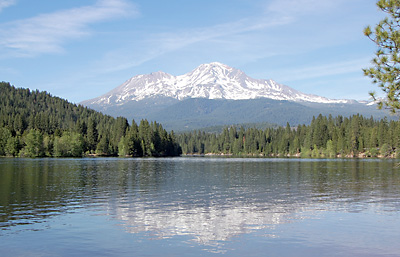
With its summit soaring 14,162 feet, Mount Shasta stands imposingly over the surrounding landscape, alone in its claim as the dominant peak of northern California. Unlike the highest peaks in the Sierra, Shasta has no peers on its flanks. It’s an absolute brooding, uncontested loner – a mountain “as lonely as God, and white as a winter moon,” as the poet Joaquin Miller memorably put it.

It is this solitude, this unrivaled claim on your attention, that brings into sharp relief just how barren the usually white-cloaked mountain has looked this spring and summer.

In mid-May, considered one of the prime climbing and skiing months, guides and rangers were bemoaning the summer-like conditions as the snow pack rapidly receded under the blowtorch of a week of 90-plus degree days. Looking up from the town of Mt. Shasta, narrow bands of snow were all that remained amid

thousands of feet of scree.

The scene was especially disheartening for climbers and skiers. It was easy to think global warming might be to be blame for the sorry conditions.

But you can’t draw conclusions from one season, of course, or even two; remember, last season’s snowpack was even worse. Indeed, things may not be as bad as they seem on California’s most prominent volcanic peak, where each year thousands of folks are introduced to the world of alpine mountaineering or come to earn their last turns of the season – sometimes six to seven grand of them in one epic run – on what many consider the best ski mountain in North America.

Glacial Enhancement?

According to a recent study by Ian Howat, a doctoral student in earth sciences at UC Santa Cruz, the Whitney Glacier on Shasta’s north slope, California’s largest, is, in fact, growing – not shrinking like most of the rest of the world’s glaciers.

By comparing photos and reviewing historical data, Howat and a team of four others arrived at the conclusion that the Whitney Glacier, the largest of seven on Shasta, has seen a 30 percent increase in size in the last 50 years.

But, as noted, you certainly wouldn’t guess that from looking at the mountain this year or last. And direct on-the-mountain observations indicate that, in last couple of years, annual glacial melt may be headed for the red.

As lead climbing ranger for the U.S. Forest Service in Mt. Shasta, Eric White spends more days on the mountain than not. He says last season the rangers saw creeks running later than normal despite the well below average snowpack, indicating increased glacial runoff. Perhaps just an anomally amid the overall growth of Shasta’s glaciers? Or perhaps a turning point followed by more lean years, rising temperatures and accelerated glacial receding? Impossible to say for sure.

But Howat’s team theorizes that the mountain’s glacial growth is likely a short-term phenomenon, the result of increased precipitation in the past half-century overcoming an increase in temperatures. With global warming, higher temps will eventually outpace precipitation, decreasing snowfall. This could result in near complete loss of Shasta’s glaciers by the end of the century, the researchers conclude.

Another Dry Year

Regardless of the bigger picture, a dry mountain makes climbing more hazardous, not too mention unpleasant. “This is the kind of mountain that you want to climb on the snow, because it’s all loose rock underneath,” says White, who’s also an avalanche specialist for the Forest Service.

This year’s snow stats have been far from encouraging: In May, after the driest spring on record, the snowpack at treeline was a paltry 51 percent of normal. And the upper slopes of the mountain were in even more dismal shape, according to Leif Voeltz, owner of The Fifth Season outdoor store in Mt. Shasta, which maintains a daily-updated mountain report (530-926-5555) for climbers and skiers, covering most routes and trailheads.

The big storms that hit early last winter were unusually cold, he noted. While they dropped lots of dry snow, the low-moisture content and high winds combined to leave the top portion of the mountain scoured. That has meant strikingly less snow on steep upper slopes for climber’s crampons to bite into and for holding loose rock in place.

Altered Routes

The fast waning conditions, estimated at least a month ahead of usual, were forcing guide outfits to alter their typical spring and summer climbing routes, veering away from some altogether.

Shasta’s most popular route by far is Avalanche Gulch. Sitting at the top of the Everitt Memorial Highway, the only paved road to treeline, Avy Gulch is easily accessible and technically easy.

“There is a reason that Avy Gulch is the number one route,” says Styles Larson, owner of Shasta BaseCamp and former guide for Shasta Mountain Guides (SMG). “It’s a gulch – you go in the gut and you come out the gut. It’s pretty hard to get lost.” Shasta’s total number of climbers has fallen back from the boom of the late 1990s when 10,000-12,000 attempted the mountain annually. The number of summit permits issued now averages 7,000-8,000. But the bulk of the

climbers, upwards of 80 percent, still head up the Gulch. If conditions like this year’s and last year’s persist, that may have to change to some degree. In mid June, the Gulch was in poor shape. Most climbers were taking an alternate route up through the Red Banks cliff band and even earlier than usual summit-and-descent times were recommended. By July, Voeltz said it would likely be completely cooked and off the list of wise options, leaving fewer routes for beginning climbers. (For more experienced climbers and those with a guide, Voeltz predicted the north side routes would be “fabulous with good, hard snow” through summer.)

Increased Rockfall Danger

Despite being less technical, Avy Gulch is highly prone to rockfall, as a group of 35 climbers with the Breast Cancer Fund’s Climb Against the Odds found out last July when they had to dodge a VW-sized boulder careening down, sending climbers scrambling and diving out of the way. Luckily, a smashed ice ax was the only casualty.

This year, Shasta Mountain Guides chose to stop taking trips up the Gulch by the end of May. “The Gulch is the most direct route, not the easiest, but it sees 90 percent of the traffic,” says Chris Carr, co-owner of SMG. “It’s a huge irony: it’s the most popular route on the mountain, but also one of the most hazardous.”

Shifting the Mess

In choosing to move their trips to other, less accessible routes on the mountain, the guide companies initiate a pattern of use that draws private climbers to those other routes like the West Face, Clear Creek on the east side, and glacier routes like Hotlum-Bolam. The climbing shops in town start telling independent climbers about those routes, shifting that traffic away from Avy Gulch. The Forest Service climbing rangers follow the climbers to routes on the east, west and north sides of the mountain.

David Cressman, a guide for Sierra Wilderness Seminars, worries about the stresses this dispersal of climbers to other routes puts on the mountain. “We’re going to see more impact as climbers spread out to those other trailheads,” he says. Maybe so. But as Mount Shasta’s veteran ranger, White says that cleanup on the mountain has greatly improved. With the instigation of the human waste pack out system in 1994 and efforts to educate climbers about Leave No Trace ethics, climbers are doing a much better job of leaving only footprints.

Some 2.5 tons of human waste are now hauled out to trailhead collection disposals annually. “Back in the mid ‘80s you could literally smell Lake Helen (a popular base camp in Avy Gulch) long before you got there,” recalls Voeltz of The Fifth Season, a former guide. There’s Always Next Year Crap is one thing we can control. Crappy snow is another we can not. And as any veteran mountain climber knows, weather and snow conditions are a bit of … well, a crapshoot.

SMG’s Carr isn’t convinced that the past two years of low snow indicate a new trend. He’s seen heavy snow years followed by dry seasons, followed by heavy snow years again. “If you look at Mount Shasta historically, we go through micro cycles of drought and then glacial growth,” he notes.

White also isn’t ready to start reformulating his approach to Shasta’s season yet. Under the increasing glare of global warming, Mount Shasta is fairing better than the Sierra, he believes, because the peak’s higher elevations and more northerly latitude offer cooler temperatures. But for how long? He speaks with the optimism of the avid backcountry skier that he is – an optimism no doubt shared by many other skiers and climbers. “I don’t think anyone has a great idea what’s going to happen next year. So I have no reason to believe that we won’t have a great season.”

1
Jul/08
0

High-Tech Hopes

Three Eco-Innovations that Could Save the World

By Graham Averill

In the midst of all false hype—and hope—surrounding corn ethanol and fuel cells, these three lesser-known innovations are gaining attention and research funding. Together, they represent some of the brightest opportunities for a green infrastructure, from the food we eat to the energy that powers our homes.

Nanosolar Panels

The trouble with solar right now is that it’s still too expensive. But not for long. The San Jose-based solar company Nanosolar has developed a low-cost, printable solar cell manufacturing process. Instead of the traditional solar panel, the Nanosolar product is a thin layer of photovoltaic film that converts light into energy. Powersheet solar cells cost one-tenth of conventional solar panels, can be produced at a much faster rate, and have proven to be just as efficient.

Traditional solar panels require silicon, which is increasingly rare, expensive to ship, build, and install. The silicon also has to be applied to glass, which exacerbates the shipping and installation woes. The cheapest conventional solar panels cost $3 a watt to produce. Nanosolar’s Powersheets cost only 30 cents a watt to produce, and are being marketed to the consumer at 90 cents a watt.

The company’s new production facility will churn out 430 megawatts of panels a year, more than all other U.S. solar plants combined. The first 100,000 panels are going to Europe for a 1.4-megawatt power plant. The company couldn’t have picked a better time to produce its technology: 2007 was the first full year for California’s Million Solar Roofs Initiative, which offers tax rebates for 100,000 solar roofs per year, every year, for ten years.

Test Tube Meat

In-vitro meat, (also known a laboratory-grown meat or cultured meat) is flesh that has never been part of a living animal. Scientists mix stem cells from a living or dead animal into a nutrient-heavy mixture. When the mixture is placed in a bioreactor, eventually those stem cells turn into muscle fibers. NASA has been working on in-vitro meat since 2000, but a growing number of scientists are pursuing a commercially viable form of test tube meat to help supply the world’s growing appetite for all things fleshy. People for the Ethical Treatment of Animals (PETA) has even offered a $1 million award for anyone who can develop commercially viable (and tasty) in-vitro meat by 2012.

Global demand for meat has doubled in the last 40 years and is expected to double again in the next 40 years. Meanwhile, Americans eat twice as much meat as the average earthling. All this beef consumption is an environmental nightmare. Thirty percent of the planet’s land is devoted to livestock production, a process that is responsible for a fifth of the world’s greenhouse gases—more than all of the world’s transportation infrastructure.

But greenhouse gas emissions are just the tip of the melting iceberg. 800 million people suffer from malnutrition on this planet, but 70% of all corn and soy we grow is fed to farm animals. The agriculture responsible for that corn and soy consumes half of all freshwater and contributes to three quarters of all our water pollution.

But don’t get too excited about in-vitro meat just yet. Right now, it would cost $1 million to produce a 250g piece of beef. It will likely be 20 years before we see a commercially viable in-vitro steak. The real question is: Will 20 years be enough time for Americans to get used to the idea of eating ribeye grown in a lab?

Feces Energy

Human excrement could hold the key to energy independence—at least for developing nations.

Sintex, an India-based plastics company, is investing in at-home biogas digesters to help solve India’s two greatest problems: a growing need for energy, and a desperate need to dispose of human waste. The small plastic domes turn human excrement and cow dung into fuel. Inside the plastic domes, bacteria breaks down the waste into sludge. Methane gas is captured and then used to provide gas for cooking and electricity. Household digesters in India will run about $425 and would provide enough gas for a family of four to cook all its meals while providing a byproduct that can be used as fertilizer.

It’s not likely that biodigesters will catch on in the U.S., where sanitation is paramount. However, larger models have been successfully employed to accommodate entire villages in India. And in Rwanda, overcrowded prisons are powered by feces digesters.

Several Western firms are developing similar technology that would turn hog excrement into biofuels. Untreated livestock manure poses a serious environmental threat to ground and surface water, and contributes to global warming through the release of methane gas. Belgium has installed a large methane digester on a major hog farm and six other systems are on order for farms across Europe. The U.S. could be next.

—Article courtesy of Blue Ridge Outdoors

1
Jul/08
0

Deeper Shade of Green

Top Five Ways to Take Green Living to the Next Level

By Graham Averill

Okay, you’ve changed all your light bulbs to CFL’s. Excellent. Now you’re curious about what you can do to color your eco-conscious lifestyle with an even deeper shade of green. Here are five tips guaranteed to make the most dramatic reduction on your carbon footprint. They require more drastic lifestyle changes than replacing your shampoo with organic botanicals, but given the alarming state of our environment, perhaps it’s time for something more drastic.

1) Eat Vegetarian: One of the most significant drains on our natural resources and contributors to global warming? Meat. The United Nations recently listed raising animals for food as “one of the top two or three most significant contributions to the most serious environmental problems at every scale, from local to global.” Growing animals for food is one of the most resource-intensive practices on the planet. Half of the fresh water consumed in America is used for livestock. Eighty percent of the agricultural land in the U.S. is used to raise animals and 70% of the grains and cereals we grow goes directly to feed farm raised animals, a process that is energy intensive. In fact, a third of all fossil fuels produced in the U.S. are used to raise livestock–which produce 130 times as much excrement as the entire U.S. population, excrement that ends up polluting our ground and surface water because a lack of regulations. The negative impact from the livestock industry is colossal, from the water we drink to the energy we consume to the 840 million starving people on this planet.

2) Eat Local: You’ve heard it before, but we’re going to say it again. On average, each ingredient on your plate traveled 1,500 miles from the farm to your belly. Eat a salad with the typical produce sold in most grocery stores, and that meal is responsible for possibly tens of thousands of petroleum sucking food miles. The solution? Cut back on products that are shipped from far corners of the world and concentrate on eating local fare grown within 100 miles of your home. Of course, the best and most local option of all is your own backyard. Plant a garden and enjoy the freshest, healthiest, and most eco-friendly fruits and veggies in town.

3) Recycle and Compost: Shockingly, only 33% of Americans recycle, which means those Earth Day specials starring Alan Alda during the ‘90s didn’t have a lasting affect on the population as a whole. We know in our gut that BRO readers already recycle their PBR empties, but what about composting? The average American produces 4.4-pounds of garbage a day–half of which is made up of organic material like food scraps, paper, and yard waste. Those same organic materials can be composted in inexpensive plastic bins, turning them into carbon-rich fertilizer for your garden. Between recycling and composting, you could feasibly cut your landfill production by 75%.

4) Walk: It’s the most simple thing you can do to reduce your carbon footprint, and yet it’s the last resort for most of us. Americans drive 12,000 miles a year on average, but 15% of all trips in the U.S. are less than a mile long. If we all substituted one short car trip a day with a walking trip, we’d save 8.4 billion gallons of gas and 8.2 billion tons of carbon emissions every year. If you can manage to drive ten fewer miles each week, you’d cut your personal carbon emissions by 500 pounds a year. Inventory the trips you make in your car and decide which ones could feasibly be substituted with a walk or bike ride. Develop a walking schedule and stick to it.

5) Consume Less: This could be the toughest habit to break. We are a species and a society that is obsessed with stuff. By the time we buy the iPod, we’re already saving for the newer, better version. “Reduce” is the first item in the old environmentalist’s mantra “reduce, reuse, recycle.” Yet America has more shopping malls than high schools. When the terrorists attacked, our president asked us to show solidarity by shopping. The average American consumes twice as much as we did 50 years ago and we spend 3-4 times as many hours shopping as Europeans. If everyone in the world consumed at U.S. rates, we would need five planets to house our goods and trash. Consuming less would have an overwhelming affect on the amount of goods produced, the amount of energy and petroleum used to produce those goods, and the amount of goods that end up in our landfills. www.storyofstuff.com.

Five More

These eco-suggestions may not have as big of an impact on global warming than the five solutions listed above, but you have to admire the innovation and level of commitment involved in each.

1) Eat Trash: A growing number of people have taken to rummaging through the garbage for food and other products in an attempt to minimize their impact on the environment. Dumpsters behind grocery stores are a hotbed of Freegan activity, as the stores are forced to throw away bread, canned goods, eggs, cereal, fruit…well before the food has expired. www.freegan.info.

2) Hitchhike: Are we really recommending you get into a car with a stranger? Not exactly. We’re suggesting you get into a car with strangers who share similar interests with you. Goloco.com is a social networking site for people looking to cut their gas consumption down by carpooling. Create a personal profile and find other commuters in your town who are religious fanatics, Obama supporters, or metal heads. www.goloco.com.

3) Vote for the Environment: The environment has gotten cursory lip service in previous elections, only to have the thunder stolen by topics like the economy and international affairs. This year, more than ever, remember that the environment directly affects big ticket items like the economy and the international relations. Log on to the League of Conservation Voters to see what environmental legislation is currently being debated in Congress as well as how Green your representatives have voted in the past. www.lcv.org.

4) Ditch the Catalogs: Twenty billion catalogs are distributed world wide every year, most of which are unsolicited. You probably get two or three random catalogs a week, which you either recycle or throw in the trash. Very few of those catalogs contain recycled paper. In fact, eight million tons of trees are cut down specifically to produce those unwanted catalogs. Check out Catalogcutdown.org for a service that will take you off the catalog mailing list (think: No Call Registry for junk mail). www.catalogcutdown.org.

5) Save the Bees, Save the World: One third of the fruits and vegetables we eat depend on honeybee pollination to thrive. It’s a disturbing figure when you consider 70% of the managed bee population in the U.S. has disappeared over the last decade. It’s called Bee Colony Collapse Disorder, and scientists aren’t exactly sure what’s causing it. A virus? Pesticides? Global warming? It’s anyone’s guess. You can help fight it by supporting honeybee research, buying pesticide free organic produce, and planting a native plant and wildflower garden. www.nappc.org.

—Article courtesy of Blue Ridge Outdoors