Mar/090
Building Better Bike Balance:

Mountain Bike Skill Tips with Ryan Leech
By Seth Lightcap
Photo by Ian Hylands
Ryan Leech takes on an arcing skinny line filming for Kranked 5.
Whether threading the needle between cars and a curb or lining up for a log ride on your favorite single-track, confident balance in tight situations is a crucial skill for cyclists who challenge the terrain.
But learning to let your mind and body relax and roll evenly along a narrow route, elevated or on the ground, is often easier imagined than done. You’re eyes may comprehend that your two-inch tires have plenty of room to negotiate a 10-inch wide path, but convincing your brain and body to confidently follow is another story.
To jumpstart a successful season of skill progression, I caught up with legendary mountain bike trials rider Ryan Leech and picked his brain on the basics of improving your skinny skills. Based out of the freeride epicenter of the North Shore in Vancouver, B.C., Leech is well known as one of the foremost technical riders in the world. He’s appeared in epic freeride flicks such as Roam, Kranked 6, and Crux, and even performed for the Cirque Du Soleil. He also self-produced the bike skills DVD, “Mastering the Art of Trials with Ryan Leech.”
While he’s gained notoriety for riding along half-inch thick sections of wobbly chain link, Leech remembers his years as a young teenager honing his balance on a six-inch wide curb next to his driveway. Now chain-link riding may not be something you aspire to in this lifetime. But to help you make a similar progression, Leech has some hard-won words of advice from his life on the edge.
On proper approach posture … Approaching a balance feature or negotiating a tight trail section, I get in a comfortable riding posture and stand up on my pedals. I keep the pedals level with each other and keep my weight balanced fore and aft on the bike. The importance of saddle height … Saddle height is a big thing for me. I always make sure I lower my saddle before I try anything technical. It’s much safer with a lower saddle. An easy first balance obstacle worth a session …
Raised curbs are fantastic. Try to balance as long as you can on them. Great thing to practice when you’re waiting for a ride to start in a trailhead parking lot. On watching and learning … If you have a more experienced riding partner have them ride a tricky trail section and watch what they do. Observing someone else’s technique is a great way to learn. Soaking in what it’s supposed to look like is always better than going in blind.
On the importance of brake control … Knowing when to brake and when to let the wheels roll is a very important skill but it’s something you just have to experiment with. Most of your momentum is controlled with the front brake so modulating the front is crucial for speed control. I’m always monitoring both brakes though and balancing between the two based on how traction is going.
On balance recovery … It’s amazing how far off you can go when balancing on a skinny without actually falling off the side. I surprise myself all the time. My body has learned to stick with it by knowing how to lean or poke a foot out to one side. I’ll think I’m about to fall and my body and wheels just hang on …
Your muscles make a million little adjustments every second as you work to stay balanced. Don’t be afraid to use a little body English for those adjustments. Stick out your knee, foot, or shoulders when necessary. All of these recovery techniques will come automatically in the heat of the moment as long as you know they’re an option.
A good confidence-boosting drill … Riding a technical trail as slow as possible without skidding is a great challenge and amazing practice. It makes you very aware of your brake control and body positioning. Pick a trail that has a fair amount of variation and just crawl down it as slow as possible.
The best elevated obstacles to practice on … There are a million things to practice on like logs and cement planters, but the main thing I would recommend is just getting out on the trail feature you want to conquer and riding it as much as you can. If a trail section gives you problems don’t hesitate to stop and ride it again.
Scoping your escape route … If a line has a higher consequence for error take a look around before you ride it and scope out areas you might crash. Know what’s there and what’s around. Inspecting a line before riding it should give you added confidence.
Practicing for the inevitable … Good crashing technique is something you have to learn experientially. It’s not impossible to practice though. Find a balance stunt that’s not too high and practice dismounting in both directions. Try leaping off the bike and sticking with it. When an unexpected fall does occur your body will naturally go for the best option if it’s had practice in a controlled situation.
Overcoming your fear of falling … Like any sort of fear, you have to listen to it. You have to acknowledge it, and figure out what it is telling you. Perhaps it’s saying slow down or take it easy, lets try this easier line, or walk that harder line. Or maybe it’s saying lets watch this person do it first before giving it a try. You have to balance the excitement of pushing your limits with the fear messages your body is sending. So listen to your fear, understand it, acknowledge it … Your riding will improve at just the right pace and with the maximum amount of enjoyment. See Ryan Leech in action at this year’s Sea Otter Classic, April 16 – 19. He’ll be performing trials demos throughout the festival. www.seaotterclassic.com. For further info on Leech’s two-wheeled high jinx, check out www.RyanLeech.com.
Mar/090
High Adventure with a Higher Purpose
.jpg)
The First All Women’s Trek Through Humla. Nor Cal nurse’s non-profit promotes maternal health in remote region of Nepal
By Sarah Ferris, Founder of the Bodhi Tree Foundation
Photos by Donna Reid, A Day in Your Life: Photography
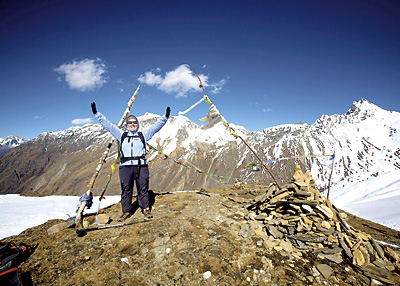
Dr. Else Uglum, Pediatrician, on top of Sankha La(14,700 feet), highest point on our trek.
Arriving in Kathmandu, amongst the hordes of tourists, climbers, and locals, you start to wonder how many of these people are going to be on the trail with you. If you are headed to the Khumbu or Annapurna regions you would probably see many of them again. But in Humla, the most remote and northerly region of Nepal, this is not the case. In fact, you may not see another tourist at all.
The stimulus overload of Kathmandu is quickly forgotten as you board a plane to Nepalgunj, the first leg of an indirect journey to the Humla. Once you land you realize you are now next to the Indian border. The heat and humidity bear down on you as you make your way through the Nepalgunj airport (or Nepalgrunge, as we have named it). There are few cars and most people travel by bike or horse and cart. We are fortunate enough to get a jeep with a trailer. The 12 of us, all women from the U.S. and Canada, most of us from the Lake Tahoe area, pile in and make our way to the only star-rated hotel in town, the Sneha.
We are scheduled to depart first thing the next morning, but of course this is Nepal and it is the middle of Dasain (the 15-day national festival of Nepal), so after a day hanging out at the airport we go nowhere but back to the Sneha.
After a second day of flight cancellations, catching up on movies and hanging out on the street people watching (and being watched as well) we decide to organize a two-hour car ride out to Bardia National Park for a jungle hike the next morning.
Bardia is located on the sprawling Gangetic Plains and is the perfect habitat to catch a glimpse of wild tigers, rhinos and elephants. Unfortunately, all we see are the many leeches that attach themselves to our various body parts.
With great excitement, day four finds us boarding our flight to Simikot, the district headquarters of the Humla region. Humla is one of the most remote districts in Nepal, located in the northwest corner adjacent to the Tibetan border. It is extremely isolated due to rugged mountains, deep river gorges and lack of infrastructure. There are no roads here so travel is limited to a 2-day (or more, in our case!) flight from Kathamndu or a 10-day walk from the nearest road.
Humla is a poverty-stricken area with food deficits up to six months of the year, female literacy rates of less than 5 percent and extremely high infant mortality rates (81/1000 births compared to 7/1000 in the U.S.). But it is also has an abundance of scenic mountain vistas and wonderful cultural opportunities, including exposure to Hindu villages and ancient Buddhist monasteries. It is because of all of these reasons we have chosen to come here.
Roots of the Tree
I was introduced to Humla eight years ago when my husband, Mark, and I volunteered with another non-profit organization in this region, the Nepal Trust. During those seven months, we learned as much as we could about the area, the people, their different castes and religions, and we made life-long friendships.
In 2006, after a 16-day trek around the Annapurna Circuit with our then 2- and 4-year-old daughters, we decided it was time to go back to Humla.
In 2007, Mark and I established the Bodhi Tree Foundation from our home in Truckee to raise funds that would support and promote maternal-child health programs primarily in Humla. Our focus on maternal-child healthcare stems from my passion and experience as a registered nurse working with labor and delivery, postpartum and newborns at a small local hospital in the Sierra Nevada.
Yak Butter Blessings
The one-hour flight from Nepalgunj to Simikot is uneventful, but full of endless scenic views that range from the flat humid plains of the Terai zone to the top of snow-covered 7000-meter peaks into Tibet. We land on the bumpy dirt runway and skid to a stop, dust and rocks flying about.
As we leave the aircraft and head up the trail into town, we are greeted by a line of Humli women. Since we are the first all-women’s trek in Humla they have come to meet us with the customary Nepalese greeting “Namaste” and give us a traditional ‘safe journey’ blessing by smearing yak butter on our heads.
These women are traditional birth attendants and community health volunteers that have come to Simikot for a five-day Safe Motherhood Training that is funded by the money from this trek. The money raised from this trek also paid for 300 clean-birthing kits as well as a small supply of essential children’s medicines.
The next morning we are awoken with a tap on the tent and the pleasant words of, “Tea please?” This is a delightful way to start each day on the trek and one can easily get used to it.
An Up and Down Existence
Humla has very little flat ground, pretty much just the airstrip, so each day is a lot of up and a lot of down, with the average being about 2000 vertical feet of gain and loss.
Our journey leads us from the mixed religious area of Simikot into Buddhist populated villages the first few days, before following the Karnali River south into the Hindu villages. The first four days take us to a height of 10,100 feet and a low of 5590 feet. We cross fields of barley, corn, hot peppers and marijuana (which the locals do not smoke), and over huge suspension bridges as well as wobbly little stick bridges. We meet women who tell us of birthing with only the help of their mother-in-law and no access to appropriate medical services, children who arrive in camp with no clothes at all, and one pregnant woman already burdened with caring for two blind sons.
The morning of day five leads us straight up 3500 feet, up and away from the Karnali River. We cross the Dhera La the next day at 11,430 feet and proceeded to go straight down again. The trail here is very primitive, steep and full of landslides. We make it down the other side of the pass and wait to see if the pack horses will also make it. The last time I led this trek we took porters since, we were told, the trail was too steep and difficult for pack animals. Apparently, our horsemen disagree.
Breathtaking and Unspoiled
After two more days of trekking along the Kuwadi Khola we arrive in a huge open valley that leads up to the base of Saipal (7619 meters, nearly 25,000 feet). This remote summer herding ground at 11,000 feet is one of the most beautiful places you could ever camp. The views are breathtaking from your tent and again the entire next day as you trek up and over the Sankha La (14,700 feet) and look over the border into Tibet.
The trail slowly winds back towards the Karnali River and the village of Yalbang. In Yalbang there is a peaceful little monastery that we visit early in the morning and listen to the monks chant and pray. Later we visit the local boarding school and participate in a small medical clinic for the children. The children here are well behaved and enthusiastic to learn and since there is very little tourism they have not become accustomed to begging for candy, pencils and money as they do on other well-trodden trails.
Trekking in Humla is like going back in time. There are virtually no modern conveniences except for a single light bulb in many homes that is powered by a micro-hydro project and only comes on for a few hours each evening. The Humli people live a simplistic life, day to day, barely getting by and yet are full of smiles and always happy to meet you. This was an incredible adventure for everyone and I look forward to going back again this year.
Mar/090
Catch That Shot!

Sports Photography Tips from Sierra sharp shooter Christian Pondella
By Seth Lightcap • Photos by Christian Pondella
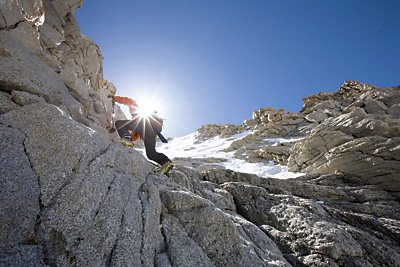
Skier Chris Davenport climbs and skis the Mountaineer’s Route on Mt. Whitney, spring 2008.
Do you ever wish your camera had an auto setting labeled ‘Amazing Action Shot’?
You’re not alone.
Despite how easy it is to flip your camera to the ‘sports’ setting and hit the shutter button as your buddy blows past you skiing, biking, or paddling, it’s surprisingly hard to come away from the moment with a stellar image of the action. Whether the shot is well–framed but blurry or focused but missing half a head, there are a lot of ways a one-chance shot can be flubbed.
Sure you can blame a little bit of your inability on a slow point and shoot camera, but the reality is, catching a striking action shot takes a lot more skill than just aiming and firing from the hip.
Mammoth local and Red Bull USA photographer Christian Pondella knows a little something about what it takes to fill a memory card with sick pics. Having published work in just about every major ski publication, as well as, Outside, Men’s Journal, Sports Illustrated and GQ, Pondella has built a career around producing intimate images of adventure sports’ best athletes basking in their glory.
As an exclusive treat for all of you aspiring action photographers, Adventure Sports Journal caught up with Pondella to pick his brain on the forethought and technique he applies to every jaw-dropping frame he shoots. If you’ve ever wondered how shots like Pondella’s look so good in the magazines, read on for a few tips and tricks to help bring your shutter skills up to speed with the pros.
What are the basic ingredients of a great action shot?
The best action sports photos express the dynamics of an experience or event using great light and a cool subject.
What kind of light do you look for?
My favorite photos combine light and shadows. I avoid shooting in direct sunlight if possible. Generally you’re looking for the sun off to one side, but still illuminating your subject. Don’t be afraid to break the rules though. I’ll often include the sun in my photos.
How do you capture dynamic movement?
The best way to make your photos dynamic is to catch your subject in a good position. If you’re serious about the shot, talk to your subject and see where they are going to go. Set it up so that you are framed and focused on the spot you think they are going to look best along their route.
What if the action is not overly impressive?
Change the focus of your intended image. Many times I will frame a beautiful landscape shot and try to place the subdued action perfectly within it.
What is your favorite size lens?
I like to get close to the subject so I use wide angle lenses a lot. Getting close gives you a more intimate feeling of the subject and what’s going on.
What are your sunny day camera settings for action shots?
If your shooting sports it’s best to learn how to configure your camera manually. Choose the manual or shutter speed priority setting; set the ISO at 100 or 200, shutter speed between 640-1000, and aperture at F5.6 or F8.
What angles do you recommend for ski/snowboard photos?
For snow sports shots I like to be on the slope with the skier right next to me or up slope looking down at the skier. From those two angles you can show the steepness of the slope. A lot of amateurs shoot straight up slope from below and it makes everything look flat.
Where do you keep your camera while you’re skiing on a photo shoot?
I usually keep my camera in my backpack and pull it out to set up a shot. If the line is really steep and I don’t want to take my pack off I’ll just slip it over my neck and into my jacket.
How do you dry snowy equipment in the field?
The best thing I’ve found to safely dry wet cameras and lenses is a leather chamois from the auto parts store. They are better than a goggle cloth because there so absorbent. I cut them up into small squares to take with me.
Any thoughts on winter camping with camera equipment?
Be cautious with your equipment going through drastic temperature differences. When you go warm to cold or cold to warm that’s when your equipment will fog up. If I’m winter camping I’ll leave my camera in the vestibule and just take the batteries inside the tent.
Any last advice for successful sports shooting?
Whenever you can, try to gain a vantage point or perspective where you can shoot the action from the same level it’s happening.
To see more of Pondella’s photo prowess visit www.christianpondella.com.
Mar/090
Cruisers, Clunkers and the Origins of the Off-Road Bike

Sitting Down with Mountain Bike Pioneer Charlie Kelly
By Colleen Corcoran • Photos by Wende Cragg
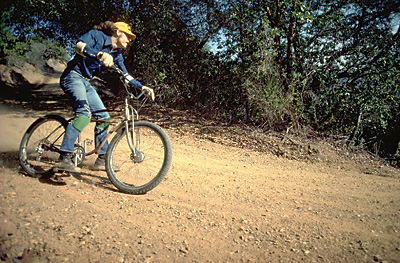
Charlie Kelly hauling denim down Repack’s Camera Corner, late 1976, on
his 50-pound modified Schwinn Excelsior. Notice the safety gear –
knee pads, elbow pads, leather gloves and boots – sans helmet.
A pickup truck parade that includes a pink 1953 Chevy leaves the last outpost of civilization – the leafy, hippie oasis that is Fairfax – heading up into the hills, with 50-pound bicycles and two chronometers … To Repack. The Repack trail drops 1,300 feet in 2.1 miles down the east side of Pine Mountain. At the top is an open ridge with views of Mt. Tamalpais, Marin, the San Francisco Bay, and the blue sky beyond. Fred Wolf and Charlie Kelly started the race down Repack, on Oct. 21, 1976, to be precise.
It was here that the words “mountain bike” and the subsequent craze began. Junkers, clunkers, bombers, ballooners, cruisers – paper boy bikes is what they were – $5 Schwinn Excelsior frames rigged with motorcycle levers, thumb shifters co-opted from five-speed touring bicycles, rear-wheel coaster drum brakes, and, eventually, a ten-speed derailleur.
“Hardly anyone ever asks me,” says Charlie Kelly, “but if I had to pick the day mountain biking started, it was the day in September 1977 that Joe (Breeze) rolled out his first Breezer inspired by Repack.”
Kelly’s ragged Schwinn beater had broken. Fellow dirt cycling revolutionary Joe Breeze built him a new steed – the 18-speed, 38-pound bicycle that would soon open other influential eyes to the possibilities of geared, fat-tire off-road bikes.
In 1979, the revolution shifted gears when Breeze and Otis Guy brought a primitive Breezer to Tom Ritchey on his Peninsula mountaintop. Until then, the mustachioed and wild-eyed Ritchey had been riding wire bead road tires across Santa Cruz Mountain hiking trails. He decided, upon seeing the Breezer, to build his own fat-tire frame.
This is how it would come to pass that Ritchey, the fastest frame builder in the West, strung together nine beautifully anonymous frames with no thought as to who would buy them or why. From his prolific garage workshop he wandered into the wet fog, thrashed around in the Bermuda Triangle of open space, and returned to fillet braze bicycles by the light of a woodstove.
“Want to help me assemble these and sell them?” Gary Fisher asked Kelly one day.
“Why not?” Kelly shot back.
They collected a few hundred dollars to open a bank account called “MountainBikes” and started assembling their bikes in living rooms and on kitchen tables. Ritchey made the frames, everyone pitched in to assemble them, and Fisher promoted. “It was such a big turn on,” Fisher recalls – to transform this gear-head freak show into a somewhat organized eccentricity of common purpose.
On the slopes of Repack, the bikes were tested and re-tested, disappearing in a rooster tail of dust past the Inside Line, the Knoll, Camera Corner, the Knob, the Sandbox – an alias to every twist or pile of rubble – followed by straightaway, out-of-control flashy 50-foot sideways skids to stops in front of a lone three-foot rock called simply the Rock. By the end of the blitzkrieg, the coaster brake grease would all but vaporize in an exhaust of smoke. It needed to be repacked. Hence, “Repack.”
Over the course of nine years, 24 races were held. By the end of it, MountainBikes had become “Fisher MountainBikes.” Tom Ritchey became “Ritchey Design Inc.” Charlie Kelly became Kelly Piano Moving Company. Pianos on strings floated high above the bay. And as the trio divided, an industry emerged – one that could be sometimes greedy, sometimes wonderfully slick, and generally a little bit wild and ridiculous behind the scenes.
In 1996 and again in 1997, with mountain biking in full, ubiquitous bloom, the usual suspects returned to Repack wearing Levis, lumberjack flannel, high boots and leather gloves to relive the first 2.1-mile descent.
The grooves had been rearranged, rocks had rolled to other resting places, trees had grown, but the art of it was exactly as it had been – to control your out-of-controlness on banked and rippled surfaces, feathering brakes just so, opening up and crouching low, accelerating fast, and yet living it all in slow motion. The spirit of Repack – the unofficial R&D lab for the first mass-produced mountain bike – remained.
Last year, I sat down with Kelly to interview him in a Mill Valley coffee shop. A swarm of caffeine-loading mountain and road bikers, many on the latest high-cost steeds, provided a time-warp contrast of the evolution of bicycling that Kelly’s witnessed over the last 40 years. Casual and earthy like the old school Marin native that he is, Kelly still rides frequently and remains in contact with many of the original Repack riders.
On Adapting Town Bikes to the Wild:
CK: Because we were all such dedicated hardcore cyclists, the limitations of the money-is-no-object bike are apparent right away. You can’t ride this thing to the grocery store, you know, and you can’t exactly haul freight with it. So if you’re gonna be a committed full-time hippie cyclist living without a car, well, you need something besides your money-is-no-object bike.
And so we kind of went to the other extreme and got town bikes. And it’s not like we were the first people who ever thought of that, because town bikes were already happening at every beach in Southern California. Everybody had a town bike ‘cause it’s level, you walk four blocks, and who cares. You want something that nobody would steal anyway.
So Gary (Fisher) and I got town bikes, and it was like an old one-speed with a coaster brake, you know, bare bones – for 15 or 20 bucks you could have one of these things. And we started riding ‘em around. And we weren’t even the first people in Marin to take our bikes on the dirt, but we did eventually …
You gotta understand, this house that Gary and I lived in – bachelor pad was probably not enough of a description. We’re talking about a place where you ate standing up. What we considered a dining room – work bench, vise, grease on the wall, bikes hanging from the ceiling.
And Gary had brought home one day – he’d bought a tandem. He’d gone to the flea market and somebody had dismantled their tandem, and the thing was just like in a box and would require lots of money and lots of time to make this thing work, but it was like 15 bucks, you know, and what it had that was interesting was this enormous drum brake, 5-speed rear hub which Gary immediately put onto his ballooner bike.
We weren’t even the first to do that, because some other guys had beat us to that. But we were the first in our area to do it. And now the first ride with Gary, who’s got this bike that now weighs 10 pounds more than even my already heavy bike, but at the same time he just totally trucks right away from us on the hills. It was like, ok, drum brakes, five speeds, we’re there. It’s a tandem part. You could get it if you special ordered it, and so we did.
On The Repack Races:
CK: We started putting on a race which was really the thing that made Marin County maybe more of a hub for this sort of thing than other places. Because we weren’t doing anything different than a lot of other people in a lot of other places. It wasn’t rocket science. You get an old bike and try to make it a little more useful in the dirt, and other people had done that.
But when we started racing, then people started going, “Well, what if money was no object?” The whole idea was, well, you know, I’ve got a 50-dollar bike. And that kind of flipped it when we were racing. You go, well, what if I spend a thousand bucks? What would I have? And then… So eventually a few of us did and thought that we had all the bikes of that sort that the world would need. But apparently we hadn’t.
On Joe Breeze and the Origin of Off-Road:
CK: If anybody invented the mountain bike, it’d be Joe Breeze because he sat around and basically decided every element of it. And up until Joe did that, everything had basically been patched together from what was around. And so, I mean, if I’ve gotta give credit to anyone, I’ll give it to Joe, but he won’t accept it. So we’ll leave that hanging.
I believe that (the mountain bike) was a product of critical mass ‘cause nothing we did hadn’t been done before. What happened was we did it in a crowd big enough to accelerate the process. ‘Cause my friend, John Scott, 1953, 20 years plus before we did anything – he built a bike pretty much identical to what we did in the ‘70s. But boy, if that market was not ready for it in the early ‘70s, it was way not ready for it in the early ‘50s. And so … he was the one bike geek in the whole wide world that he knew of … like this lone voice in the wilderness, and nothing ever came of it. But, in fact, he had all the same ideas.
So I think that critical mass, plus I think the world was ready for it a little more, you know. By the time we were hitting the streets with mountain bikes, the ‘70s was a bike boom, so there were a lot of people on bikes. There was a lot of bike awareness. I got lucky, and plus I was lucky enough to know Joe Breeze.
On MountainBikes Inc. Attending its First Trade Show:
CK: We walked in with our entire exhibit in one trip which is, well, it was two bicycles, a card table, and maybe a couple of boxes of cheaply-printed literature. So we’ve got a pretty funky display there, and right across the road you’ve got Shimano – spent eight million bucks on their display. It’s got sound and lights. It’s got dancing girls. It’s got models and it’s got bicycles. They’re paid. They’re taking shifts on the bikes because they’ve gotta ride bikes all day, you know. And they’ve got this disco theme. … It’s like money is no object.
So we’re pretty much getting ignored by all the adults, but the guy from Omaha – the guy who sells lawnmowers and bicycles, he’s there. Not at all a bike fanatic like us, but he’s walking by and he’s smoking a cigar. He’s got his 12-year-old kid with him … (and he) sees the bike – and you don’t have to explain a thing to him. The 12-year-old kid makes all the connections. It’s like, duh – heavy duty, cool, gears, brakes, big tires.
What’s to say? … The adults didn’t see it, you know, and so, I mean, that was quite a reaction because the kid would do, “Wait a minute, dad, dad, dad! Dad, I’ve gotta stop and check this thing out.” And a couple of those kids getting so insistent on their dads actually put a crowd in front of our place a couple of times …
This guy comes up to us and says, “You know guys, I just love your passion. You’re what’s great about the bike market. But I gotta tell ya, this stuff is going nowhere. The future of bicycles in America is aerodynamic components.”
We were so bummed to find that out because we were staking our futures somewhere else. But it’s a great story because the guy was absolutely dead wrong. And he was one of those industry insiders that presumably someone paid to know about that stuff.
On Early Bike Design and R&D:
CK: Specialized – those guys bought four bikes from us in 1980, and in about eight or nine months they had their bike on the market and it was basically identical to what they bought from us.
When the bikes were first starting to crack the market, around 1980, there were a number of different designs. I have a roundup of about 15 different bikes that were on the market, and the Ritchey – the bike that Gary and I were selling and Tom was making – is the one that looks like all the mountain bikes that were built for the next five or six years. Because, basically, rather than any R&D, people just knocked off what we were doing, and not a lot is patentable on the bike.
So basically we did the R&D for the industry, and only after all these other companies had a few years of building bikes and had their own stable of fanatic bike engineers and riders and so forth to do their R&D, well then it started branching out. But really, the first four or five years of the mountain bike industry … we had done R&D for everybody … All they did was copy what we did.
It really jumps out at you when you see this picture of all these bikes collected together from 1980, and there’s one that all the bikes two years later looked like … So Specialized was one of the first to jump on that. And at this point
I don’t really care. I cared then. I don’t care now.
Colleen Corcoran is a writer based in San Francisco. She is currently working on a book about adventure sports in California and beyond.
Mar/090
BEER THIRTY!

Readers’ (and Editors’) Memorable Adventures Made Better by Beer
After sea kayaking on Tomales Bay, a cold beer goes right to the sole. Photo Ralf Weber
The link between sports and beer is well established. But in the adventure sports community, we’re not talking about sitting on one’s kiester, sipping over-priced beer from a plastic cup while watching overpaid professionals have all the fun.
For the most part, our beers are earned. For us, beer is the reward at the end of a long backcountry journey, a relaxing capper at the end of a high-intensity effort, the liquid gold at the end of a sweat fest. Not only does it help replace lost calories and soothe from the bloodstream out, it provides a prism of perspective to share and relive our adventures with friends.
ASJ invited readers to send in their favorite outdoor epics that culminated with a tall cold one or two. And since it was our idea, ASJ staff and contributors chipped in as well. A couple stories deviated from the beer as reward theme, but then adventure is nothing if not unpredictable.
Flip-Flop Pop Top
As a pilot for a German airline, my favorite city to fly into is San Francisco. After we arrive, we have a 48-hour layover before departing. I often use this free day to visit the coast, go skiing in Tahoe, or paddling on the bay. Last spring I took one of my copilots up to Tomales Bay and we rented sea kayaks from Blue Waters Kayaking. After a day of wind and salt water, practicing rolls near the beach, paddling up to Hog Island and back, we were dreaming about the bottles of Gordon Biersch Pilsner back in the parking lot. I had to snap a photo of my buddy opening a beer with the sandals he bought the day before at the Sports Basement. They had a bottle opener in the sole. Very California, very convenient. Just watch where you step first.
—Ralf Weber, Sulzbach-Rosenberg, Germany
Truth in Advertising?
High altitude in the Andes is both dry and can be quite warm during the day. I have seen even lizards sunning themselves at 5,000 meters. Sometimes finding water can be a problem too. Feeling sorry for one particular lizard, I sprinkled some of the beer I was imbibing after coming off the mountain (7,000 meters) on the tundra next to the little guy. He proceeded to lap it up voraciously with his tongue. It was, I thought, the living embodiment a good Bud ad.
—John Thee, Camarillo, CA and La Paz, Bolivia
Spontaneous Gal Power
Some of the best ideas hatch around 11 o’clock on a hot summer’s night. Cynthia and I were sitting outside Marco’s Cafe in Coloma (on the South Fork American), where we worked as raft guides, when I suddenly had the impulse to kayak Burnt Ranch Gorge on the Trinity River way up north. Exactly 8.5 hours later we laid down with our sleeping bags in the dirt at put-in, until the day got too hot. Then, we had one of the most memorable kayaking days of our lives. No boys. No directions. And no doubt. Cynthia’s blond hair and buxom physique stopped a local driving a pickup truck dead in his tracks. He ended up running our shuttle and just happened to have a sixer of icy cold bevs with him, and well, it seemed like Beer Thirty to us.
—Wendy Lautner, Truckee
Days of Peak Bagging
When I was a young fellow living in Mammoth Lakes in the eastern Sierra in the 1970s, I used to love to bag peaks every weekend with my Springer Spaniel, Inyo. I just couldn’t get enough of it! I worked all week long for the Forest Service building trails in the wilderness and would climb a different peak on Saturday and Sunday. My favorite thing to do was to hit it early in the morning, climb a peak, enjoy the heck out of it and return home by 2 pm to watch Days of Our Lives with a cold Bud in my hand.
—David McNeill, Bishop
Huts, Brats and Bier
Can you say spoiled rotten? Well, that is how I felt each afternoon rolling into the hut on the 8-day long Alps Haute Route ski tour. Sure I had worked hard for my “turns” and my treat at the end but there is nothing like getting warm and cozy in a hut, ordering up a hot meal and accompanying it with cold refreshing beer. Feels a bit decadent. The “highlight beer” was at the end of the trip when I finally got my favorite meal of bratwurst and sauerkraut. Beer never tasted so divine. When it comes to integrating adventure and beer, the Euros do it right.
—Anna Siebelink, San Francisco
Post-Ride Reward on Hold
The plan was to ease into Moab’s bounty of biking. On our first day, we would ride a bit, soak in the hot tub, and end up at the local microbrewery. Little did we plan on darkness and over-enthusiasm separating our group, stranding two of us on the cold mesa. The beer would wait 24 hours, after a poacher-turned-deputy led us on an all-night search for two cold bikers huddled atop a mesa with parched lips, listening for cougars, rationing one Powerbar. After their rescue, worry and marital strife quickly shifted to thoughts of ice cream, pizza, and beer.
—David Lo
Tuolumne Trials
The Tuolumne is a great summer kayaking run because the river runs all summer with dam releases. But, oh my, it does get hot in them thar hills! We typically run it two days in a row, all 18 miles, which makes for long days. Just setting shuttle can be a bear. One particular weekend a couple years ago it was 105 degrees at the put in. At least! By the time we got down to the reservoir it seemed even hotter. The light breeze blowing up river would dry out your eyeballs as if we were paddling into an oven. The last mile of flat water on Lake Don Pedro was a sufferfest and dreams of cold beer danced in our heads. Stiff, hot, and exhausted … Nothing could have been better than cold pale ale!
—Adam Webb, Santa Cruz
Anchors Away
Although I’m not big on carrying 12-ounce anchors along on adventures, there was one trip last summer that I cherished every sip of the couple brews I packed. After a joyous afternoon of swimming, rappelling, and cliff jumping high above Yosemite Valley, the sweet taste of a PBR was absolutely exquisite as we contemplated our last two double-rope length raps to the valley floor. The view from the barstool might have had something to do with it though. We had a very sexy “Sentinel” sitting on the adjacent stool and her wide cracks were winking at us.
—Seth Lightcap, Truckee
Flippin’ Focused
Dressed for submersion in dry tops and stuffed into playboats, my kayaking buddy Ed and I floated a flat but swift section of the Truckee River. It was a high runoff year, but the day was hot and the kayak gear a bit stifling during the long flat sections.
With still miles to go before takeout, we passed a crowd of bathing-suit clad sunbathers on the far bank, eliciting a few shouts. Waving back, one of the guys – must have been a mind reader – motioned me a can of beer from the cooler in the river!
Although I was already a good ways downstream, he launched it. His toss came up a bit short and I flipped over reaching back to catch the incoming silver missile. Upside down, I tracked the can bouncing along the bottom in the current, tantalizingly close but still out of reach, straining as far as I could without popping my skirt.
I must have held my breath for a Phelpsian 20-plus seconds (and I mean in the pool not behind a bong!) before the object of my ridiculous desire bounced into my grasp and I stuffed it into the front of my PFD. On the verge of hypoxia, I grabbed my paddle and rolled up. As I did, I held the can up like an Olympic medal. From the riverbank came the loudest cheer I’ve ever received for any kayaking maneuver I’ve ever performed, or am likely to perform.
Not only was it one of the highlights of my boating career, but the prize (whatever it was, Miller Lite, I think) was like cold, wet nectar of the Gods, even to my beer-snobbish tastebuds. I shared some with Ed and we paddled on, revived, to our destination – our own cooler of microbrews waiting patiently.
—Pete Gauvin, Truckee
24 Hours of Ale
At the Coolest 24 hour MTB event near Auburn, I was fully prepared to test my theory that beer is a performance enhancing secret weapon for long-distance mountain biking. I hadn’t been able to train and was NOT relishing the severe beating I was about to endure, and I figured the beer might help dull the pain of riding a mountain bike for 24 hours straight. I arrived in beautiful Cool, CA, about two hours before the starting gun and began to drink beer as rapidly as possible. By the time I walked my bike to the start area I was six beers deep and in a super-friendly mood.
“Are you in the solo single-speed division?” a chatty competitor inquired as we prepared to start the race. This guy was built like a greyhound and I could tell he was a real pro. I nodded my head as his friendly curiosity turned to bewilderment while watching me fill a hydration bladder with beer after beer, Sierra Nevada Pale Ale to be specific. His facial expression changed to awkward concern as he realized that I was using beer for hydration. “Uh, good luck, dude,” he said with pity in his voice. In response I shot him a look of pity as well, but more exaggerated and sarcastic. Suddenly the gun went off and the race was on.
At first I was very wobbly, but two laps and three hours into the race I hit my stride. I passed a bunch of other solo riders and was only lapped by one other soloist: the greyhound guy. My confidence was increasing and I began to believe that energy gel and beer really were a secret weapon for long distance riding.
My original plan was to drink two beers per lap for the full 24 hours, or one-half a hydration bladder per lap. Things started to fall apart when I absolutely lost the ability to drink beer and had to switch to water around 10 p.m. For the rest of the race I ate and drank very little. The pain became unbearable around 4 a.m. and I surrendered my pride and collapsed into my tent. The idea was to sleep until five and resume riding, but I couldn’t wake up at five and slept until seven. During the final five hours I only completed two laps for a total of 10. This was good enough for seventh place in the solo division. But the top racers completed more than 20 laps, which put my efforts into beer-goggled perspective.
Still, I achieved double digits in my lap count for a grand total of 120 rugged miles. It was one of the hardest things I had ever done, and I was feeling proud of myself. To celebrate I staggered over to my cooler and opened a beer. The smell made me gag but I forced it down. After a short episode of dry heaving I opened another beer and chugged it as well. A pleasant feeling crept over me. Grabbing another brewski, I wobbled over to the lunch tent for some free chili.
– Matt Niswonger, Santa Cruz
The Pinnacles in August
In the late ‘80s and ‘90s, Jack Holmgren and I developed a taste for climbing at Pinnacles during July and August. I know, I know, it was 105 in the shade. How could we think about climbing? Well, hectic jobs (Jack’s an attorney and I was a school teacher) and the responsibilities of fatherhood dictated when we could climb far more than the thermometer. We both had to climb, so we braved the heat.
Because of our lives’ shared responsibilities and rhythms, we found that even when the climate was most inhospitable, certain times and places yielded comfort and adventure.
Our emerging climbing pattern mitigated the impact upon our families. We would meet at 3 a.m. at the McDonald’s parking lot in Soledad, leave a car and drive to Pinnacles, hike in by headlamp and climb at first light. We often made it home by noon, with time to transport kids to music lessons, dance recitals and baseball games. Fortuitously, this schedule also allowed us to escape the worst of the summer heat.
Occasionally, however, we blew it.
I remember one late August day when we lingered too long at Piedras Bonitas. To approach Piedras, we usually parked just outside the West entrance cattle guard (yes, that no parking sign is specifically directed at us) and hiked along the fence until we hit a ridge connecting with the High Peaks; a bit more than two miles.
The new route climbing was fascinating and it was well past noon when we started to unlace our shoes. It was still fairly mellow in the shade where we’d stashed our packs, but by the time I hit the ridge I was sweating buckets. I looked back at Jack. He was sweating and gasping, too.
I went into my ‘don’t-quit-until-it’s-over’ trudge and tried to tune out my discomfort. I took frequent swigs from my water bottle and could hear Jack crunching sticks about 10 yards behind me. Usually I enjoyed the walk out, the scents of heated sage and chemise, the smell of hot dust, sweet and aromatic. Not this time. I felt my brain starting to cook beneath my tractor cap.
Finally reaching the car, I popped the trunk, got out extra water and poured half of it over my head. Ahhh! I took a long drink and turned to make a sarcastic comment to Jack. No Jack.
My hearing’s not the best, but surely I would have heard Jack crash unconscious into the brush. Still, he wasn’t there.
I dropped several bottles of water and a tarp into my pack, turned and headed back up the hill. Waves of heat shimmered above the chemise. I stared at my toes and trudged on.
Soon after, I heard the crunch of a footstep and looked up. Weaving like a punch-drunk boxer, Jack staggered down the slope. I greeted him with a water bottle. He snatched it, poured half over the back of his neck and drank the rest. He took several deep breaths, then gasped that he’d almost passed out. The heat drove him to his knees and he had crawled under a bush for a few moments of rest in the shade, before staggering on.
We were too knackered to talk much when we got to the car. I’m a lifelong believer in the magical restorative properties of beer. It is the elixir of life. I reached in the cooler, grabbed a Tecate, popped it and inhaled the cold brew. Jack, abstemious as usual, stuck with water. We tacitly agreed to give ourselves a few days off from August climbing.
—Robert Walton, King City